

 Portable Tire Inflators
 Electric Air Pumps
 Electric Car Tyre Pumps
 Electric Ball Pumps
 Electric Bike Pump
 SUP Air Pump

Portable Air Pump Guide: How to Choose, Evaluate, and Safely Use a Cordless Inflator
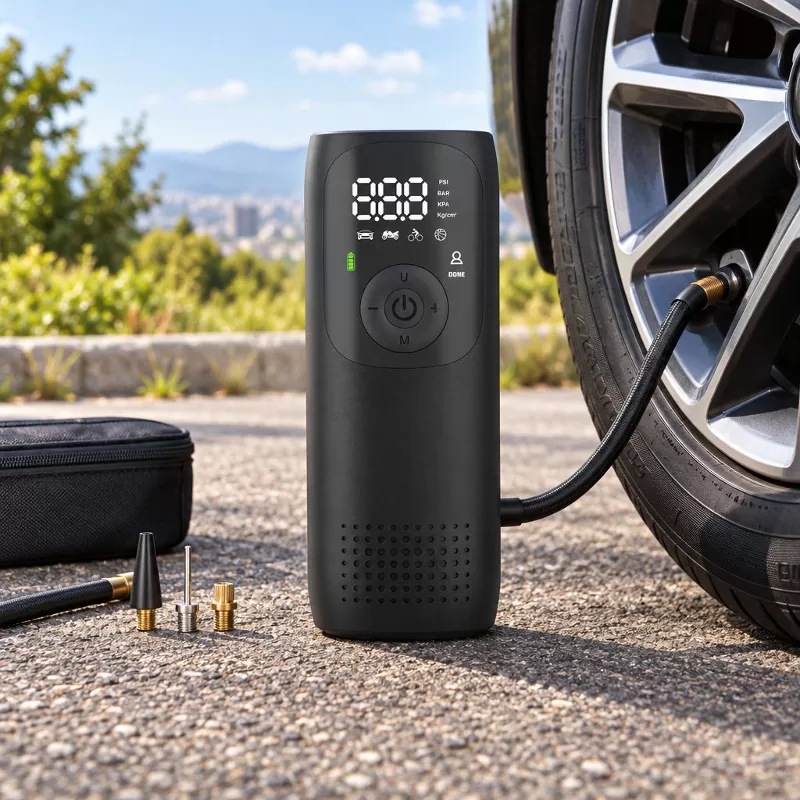
A portable air pump is a practical tool for drivers, bike commuters, and travelers who would rather not depend on a gas station compressor. Tire pressure drops on cold mornings, slow leaks show up at awkward times, and the nearest working air machine may be miles away. A cordless tire inflator puts a small electric compressor, a pressure gauge, and an automatic stop into one handheld unit, so you can check and correct pressure wherever the vehicle is parked.
Choosing the right portable tire inflator means looking past the biggest number on the box. Peak pressure, airflow, battery design, and heat management all affect how a pump behaves on a real tire. A pump that suits road bike tires may struggle with a pickup truck, and a pump built for car tires is the wrong tool for a paddleboard. This guide explains how these pumps work, what to compare, and how to use one safely.
1. Understanding the Portable Air Pump and Its Core Mechanics
1.1 High-Pressure Inflators Versus High-Volume Blowers
Small electric pumps fall into two groups that buyers often confuse. High-pressure, low-volume inflators use a small reciprocating piston inside a cylinder to push air against strong resistance. Each stroke moves only a little air, but the design can reach the pressures that car tires, bicycle tubes, and sports balls need. Many tire inflators are rated for well over 100 PSI.
High-volume, low-pressure blowers work differently. They use a spinning fan or impeller, much like a small vacuum cleaner in reverse. High-volume, low-pressure blowers move much more air but generally operate at substantially lower pressures than tire inflators, so their pressure limit must be checked for the specific model. That is why a mattress blower cannot fill a bicycle tire. In the other direction, filling a large inflatable kayak with a tire pump means hours of running and a hot motor. Knowing which group a pump belongs to prevents most mismatches.
1.2 The Anatomy of a Compact Piston Pump
Inside a compact portable air pump, a DC motor turns a crank mechanism, usually through gears. The crank converts rotation into the back-and-forth motion of a piston sealed against the cylinder wall. On each stroke, air enters through an intake valve and is pushed through an outlet valve into the hose. The seal materials and exact layout vary between manufacturers.
Many compact inflators use a pressure sensor in the air path or pump assembly. A small controller reads that sensor and shows the result on the display. In designs that use piston pumping, the controller may smooth pressure fluctuations so the number on the screen stays stable enough to read while the pump runs.
1.3 Target Users and Roadside Demands
Different users need a portable air pump for different reasons. Commuters use one to correct pressure lost in cold weather, since underinflated tires wear faster and handle worse. Tubeless bicycle riders top up before rides because these tires slowly lose air through the casing. Motorcycle riders check pressure often because the bike’s handling depends on running the correct front and rear pressures.
Emergency use is the other main reason to carry one. A slow puncture from a nail or a leaking valve core can leave a tire too soft to drive on. A cordless inflator can often restore enough pressure to reach a repair shop. It does not fix the leak, though. Driving on a tire that keeps losing air can damage the tire, and running the pump again and again to keep up with a leak puts heavy strain on a small motor.
2. Critical Evaluation Criteria for Portable Air Pumps
2.1 Decoupling Pressure Ratings from True Airflow
Packaging usually puts the maximum pressure, such as 120 PSI or 150 PSI, in large print. That figure tells you the highest pressure the pump can reach. It says little about how quickly the pump fills a tire. A pump with a very small cylinder can reach a high pressure while moving only a trickle of air.
Airflow, measured in liters per minute, is what decides inflation speed. Manufacturers often quote airflow with little or no back pressure, so the real flow falls as tire pressure rises. A compact pump rated at 15–18 L/min may be suitable for routine passenger-car top-ups, but actual inflation time depends on tire volume, starting pressure, and the pump’s flow under load. Larger 12V compressors deliver much more air. Compare airflow against the tires you actually need to fill.
2.2 Battery Architecture and Power Delivery
Battery design decides how long a cordless pump runs and how well it holds speed under load. Some small inflators run on a single 3.7V lithium cell. Others use two cells in series for a nominal 7.4V. For the same motor power, a higher voltage means lower current, which reduces heat losses in wiring and cells. In practice, two-cell packs tend to hold motor speed better against high tire pressure.
Many current inflators charge through USB Type-C, often at 5V/2A, so they work with common phone and laptop chargers instead of a dedicated adapter. Some also have a USB output that lets the pump work as a power bank. That feature is useful when a phone is low during a roadside stop, though every charge drawn for a phone leaves less energy for inflation.
2.3 Pressure Presets and Automatic Shut-Off Accuracy
Analog gauges and manual switches require you to watch the needle and stop the pump at the right moment. Digital inflators replace this with a preset. You enter the target pressure, start the pump, and the controller cuts power to the motor once the measured pressure reaches the target.
Pressure readings can change slightly after the motor stops because the air and tire settle. After inflation, verify the final reading and periodically compare it with a separate, trusted gauge.
2.4 Thermal Dissipation and Duty Cycle Constraints
Compressing air generates heat, which can accumulate in the cylinder head, outlet, hose, motor, and housing during extended operation. A handheld body has little surface area to shed heat, so continuous running time is limited.
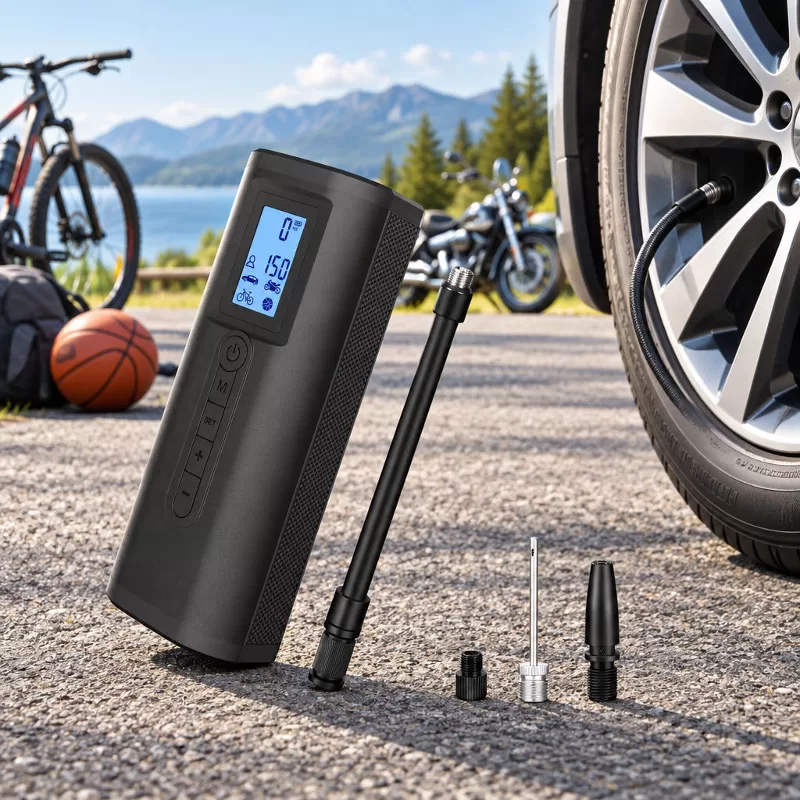
Manufacturers manage this with internal fans, vented housings, and heat-tolerant hoses. Each model lists its own continuous working time, and you should respect it. Running a compact pump past that limit can wear seals faster and stress the motor and battery. When a job is long, stop, let the pump cool, and then continue.
2.5 A Quick Selection Checklist
The criteria above are easier to apply when you start from the jobs you expect the pump to do. Working through them in order keeps the decision tied to your own tires rather than to the largest figure on the packaging:
- List the items you inflate most often, such as car tires, bicycle tires, motorcycle tires, or sports balls.
- Check which valve types they use, and confirm the pump ships with the adapters you need.
- Compare rated airflow, keeping in mind that real flow drops as pressure rises.
- Compare the continuous working time with the largest regular job on your list.
- Look at battery capacity, the charging port, and the listed charging time.
- Confirm the display offers the pressure units used on your vehicle placard or tire sidewall.
- Read the warranty terms and the manufacturer’s usage and storage guidance.
If the largest job on your list is a full-size paddleboard or a commercial truck tire, the checklist points away from handheld inflators altogether. In that case, a dedicated SUP pump or a larger compressor is the better buy.
3. Matching Portable Inflators to Real-World Inflation Tasks
3.1 Passenger Vehicles and Light Trucks
Topping up car tires is the most common job for a portable air pump, and it is also where a common mistake happens. Many drivers inflate to the pressure molded into the tire sidewall. That number is the tire’s maximum rated pressure. It is not the pressure the vehicle maker recommends for normal driving.
The correct figure is on the tire information placard, usually on the driver’s door jamb, and in the owner’s manual. Many sedans and crossovers specify roughly 30 to 36 PSI cold, but your vehicle’s placard is the only number that counts. The 15–18 L/min rating indicates suitability for routine top-ups, but actual time depends on tire size, starting pressure, temperature, and connection losses. Filling several fully flat light truck tires in a row can exceed a handheld unit’s working time.
3.2 Commuter Bicycles, Road Bikes, and E-Bikes
Bicycle pressures cover a wide range. Wide mountain bike tires hold a lot of air at low pressure, while narrow road tires hold little air at much higher pressure. The tire sidewall usually prints a recommended range. Heavier e-bikes deserve regular checks, because a soft tire under a heavy bike is more likely to pinch-flat on a pothole.
Valve type matters next. Cars, motorcycles, and many city bikes use Schrader valves, while many road bikes use slimmer Presta valves. Inflator kits usually include a Presta adapter. If the adapter does not seal fully, air escapes at the connection, the displayed pressure becomes unreliable, and the pump wastes battery.
3.3 Motorcycles and Powersports
Motorcycles react more to pressure changes than cars do. A front tire a few PSI low can make steering feel heavier and less precise, which matters most in corners and on wet roads. A car driver might not notice the same loss for weeks.
A compact electric inflator fits under many motorcycle seats or in a pannier, which is useful on multi-day trips. Motorcycle tires hold less air than car tires, so top-ups are usually quick. A small pump also has an advantage over CO2 cartridges, which are single-use and give limited control over the final pressure.
3.4 Sports Equipment and Recreation Inflatables
Sports balls are the opposite of vehicle tires. They hold little air and need low, fairly precise pressure. Recommended pressures vary by ball type, and most balls print their range near the valve. Pumping by hand by feel makes it easy to overshoot, which strains the bladder and seams.
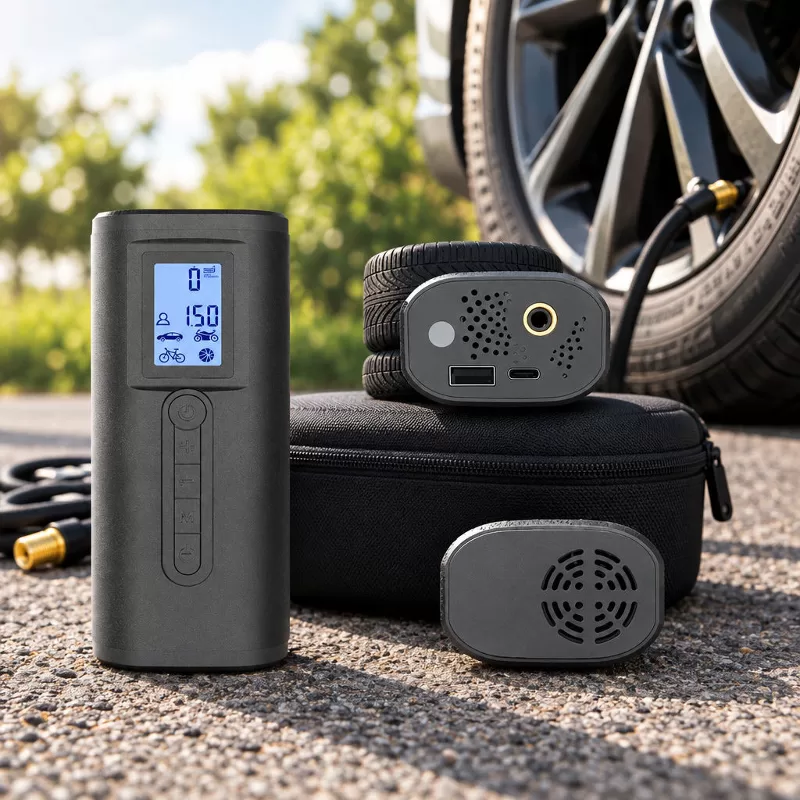
A digital portable air pump with a ball mode makes this easier. You wet and insert the needle adapter, set the pressure printed on the ball, and start the pump. The motor stops at the preset, so you get the same firmness every time without guessing.
3.5 High-Volume Limitations: The SUP and Inflatable Raft Boundary
Inflatable paddleboards, kayaks, and rafts often specify around 12 to 18 PSI. That sounds easy for a 150 PSI pump, but these boards hold hundreds of liters of air. At high pressure, a small piston pump moves well below its rated flow, so filling a board can take longer than the pump’s continuous working time.
Dedicated SUP pumps solve this with a high-volume stage for the initial fill and a piston stage for the final pressure. Using a pocket tire inflator on a full-size paddleboard means repeated stops for cooling and a drained battery, often before the board is firm. Keep small inflators for tires, balls, and small inflatables.
3.6 Wheelchairs, Balance Vehicles, and Other Small Tires
Pneumatic wheelchair tires and the tires on some self-balancing vehicles are small, so a handheld pump can top them up without approaching its working-time limit. The correct pressure is usually printed on the tire sidewall or listed in the user manual. A soft wheelchair tire makes the chair harder to push, which matters for anyone who propels the chair daily.
For these smaller tires, a custom pressure mode is the most useful feature, because it lets you enter the exact figure the manufacturer specifies. Check the valve type first, since some small tires use Presta or other valves that need an adapter. The AP2-P product data lists wheelchairs and balance vehicles among its intended uses.
4. Operating Instructions: A Structured Protocol for Safe Inflation
4.1 Step 1: Locating Cold Inflation Pressure Specifications
Start with cold tires. A cold tire is generally one that has been parked for at least three hours or driven less than one mile at moderate speed after that parking period. Driving warms the air inside a tire and raises pressure by several PSI. If you set pressure on warm tires, they will be underinflated once they cool.
Next, read the target from the door jamb placard, not the sidewall. Note the unit, whether PSI, bar, or kPa. Switch on the pump and change the display unit until it matches the placard, so you are not converting numbers in your head at the roadside.
4.2 Step 2: Valve Stem Preparation and Chuck Connection
Check the valve before you connect anything. Remove the dust cap, wipe off dirt and moisture, and look at the valve core. Grit on the valve can enter the pump hose and work its way into the pump’s valves.
Thread the hose connector onto the valve stem straight and snug, without forcing it. Once connected, the display should show the tire’s current pressure. If it shows zero or jumps around, the connector is probably not pressing the valve core properly. Remove it and reconnect.
4.3 Step 3: Setting Targets and Managing Duty Cycles
Choose the right mode or set the target pressure manually. For car tires, confirm that the preset matches the cold pressure on the placard. Press start, and the pump will run with a steady rhythmic sound as the piston works.
Set the pump on a dry, flat surface or hold it so the vents stay clear of sand, dirt, and grass. Stay with the pump while it runs. Watch the reading climb and listen for a hiss or a struggling motor, which can mean a loose connector or a leak.
4.4 Step 4: Disconnecting and Verifying Final Pressure
When the reading reaches the preset, the motor stops on its own. Switch the pump off so it cannot restart by accident. The metal connector can get hot during longer runs, so hold it by its grip.
Unscrew the connector quickly and cleanly. A brief hiss may occur when disconnecting; its source depends on the connector. If air continues to escape or the tire loses noticeable pressure, reconnect and check the valve and fitting. Refit the valve cap to keep out water and dirt, then pack the hose away.
5. Engineering Benchmarks: Comparing Compact Inflator Profiles
5.1 Comparative Specifications Across Pump Classes
The pumps on the market fall roughly into three classes. The table below compares them in general terms, with the AP2-P’s published figures shown as one example of an all-around handheld unit. Individual models vary, so check the specifications of any pump you consider.
| Feature Category | Pocket Micro Pump | All-Around Handheld Inflator (AP2-P example) | 12V Corded Compressor |
|---|---|---|---|
| Maximum Pressure | Varies; often lower | 150 PSI | Varies by model |
| Airflow | Lowest of the three | 15–18 L/min | Usually highest |
| Power Source | Small internal battery | Two-cell 7.4V battery | Vehicle 12V socket or battery clamps |
| Continuous Working Time | Usually shortest | Up to 30 minutes | Depends on model |
| Weight | Lightest | 386 g | Heaviest |
| Best Suited To | Bikes and balls | Cars, motorcycles, bikes, balls | Larger tires and frequent use |
5.2 Heat Dissipation and Continuous Runtime Factors
The comparison shows a basic trade-off. Smaller pumps have less material to absorb heat and less room for cooling. A pocket pump is easy to carry in a saddle bag, but it heats up fast when asked to fill car tires.
All-around handheld inflators sit in the middle. A larger cylinder and a built-in fan let them run longer between rests. In the AP2-P’s case, the listed continuous working time is up to 30 minutes. The manufacturer does not publish a specific car-tire fill-time test for this model, so the time needed to service multiple tires depends on their size, starting pressure, and the number of top-ups required.
6. Spotlight on Modern Portable Pumps: The AP2-P Cordless Inflator
6.1 Design Concept and Integrated Safety Capabilities
The AP2-P is a cordless inflator from Newo, a manufacturer of smart electric air pumps and portable inflation products. It measures 42 by 62 by 154 millimeters and weighs 386 grams. According to the product data, it uses a 35W brushed motor and reaches up to 150 PSI, in a body small enough for a glove box or a backpack.
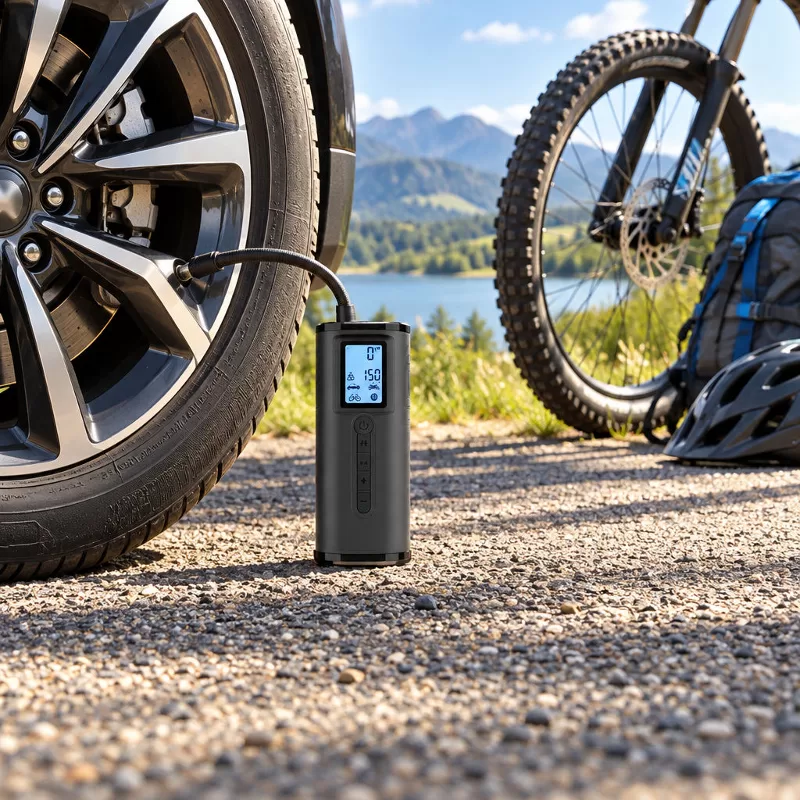
We designed the AP2-P around tasks that come up during a roadside stop. It offers five modes: car, motorcycle, bicycle, ball, and custom. The backlit LCD shows measured pressure, preset pressure, battery level, unit, and mode, so it stays readable at night. A built-in LED light helps you find the valve in the dark.
6.2 Manufacturer Specifications
The figures below come from the manufacturer’s product data for the AP2-P.
| Technical Parameter | Manufacturer Specification |
|---|---|
| Model | AP2-P Portable Electric Air Pump |
| Maximum Pressure | 150 PSI (adjustable 0–150 PSI) |
| Airflow | 15–18 L/min |
| Battery | 2000mAh, 7.4V, 14.8Wh (product features describe 2×2000mAh cells) |
| Charging | Type-C, 5V/2A input; 2–3 hours |
| Power-Bank Output | 5V/2A |
| Runtime | 20–30 minutes |
| Continuous Working Time | Up to 30 minutes (built-in fan) |
| Battery Cycle Life | 300 cycles at 80% or more of original capacity |
| Noise Level | 85 dB or less at 1 meter |
| Working Temperature | -10°C to 45°C (14°F to 113°F) |
| Weight and Size | 386 g; 42 × 62 × 154 mm |
| Pressure Units | PSI, BAR, KPA, Kg/cm² |
| Included Adapters | Three adapters |
| Warranty | 1 year |
6.3 Field Versatility and Battery Performance
The AP2-P has a memory function that keeps the last pressure value you set. If you top up the same tires regularly, you do not need to re-enter the target each time. The product data lists about 10 to 15 bicycle tires per full charge. Car tires hold far more air, so expect fewer car top-ups per charge.
The pump also works as a power bank through its 5V/2A output, which can charge a phone during a roadside stop. Charging uses Type-C at 5V/2A. A wall adapter that supplies 2A will charge it within the listed 2 to 3 hours, while a weaker car USB port may take longer.
7. Storage, Maintenance, and Field Limitations
7.1 Lithium Battery Storage and Temperature Extremes
Lithium batteries age faster in heat. The product data lists an operating range of -10°C to 45°C. Avoid prolonged exposure to direct sun, extreme heat, freezing conditions, or other environments outside the manufacturer’s storage guidance.
Where possible, keep the pump out of direct sun, for example in a glove box, under a seat, or in a bag you bring indoors in extreme weather. Check the battery periodically and recharge it before long trips or when the indicator shows a low charge. Follow the manufacturer’s storage and charging guidance.
7.2 Air Hose and Thread Maintenance
The air hose flexes, carries high pressure, and gets hot, so it wears over time. Check it now and then for cracks, kinks, or bulges. If any part of the hose swells during inflation, stop using it and replace it.
Keep the threads on the hose connector and the pump clean and undamaged. Check the small rubber O-rings inside the connector and adapters. A torn or missing O-ring causes leaks and unreliable readings. Store the needle, Presta, and cone adapters together in a pouch so they stay clean and straight.
7.3 Recognizing Mechanical Failures Versus Normal Air Loss
Tires gradually lose some pressure over time, even without a puncture. Temperature also plays a part: as a rule of thumb, tire pressure changes by about 1 PSI for every 10°F change in temperature, though the exact change varies. Making up this gradual loss is exactly what a portable inflator is for. Check your tires regularly and investigate pressure loss that seems unusually rapid.
Faster loss points to a problem. If a tire drops 10 PSI in two days, look for a puncture, a leaking bead, or a faulty valve. Do not inflate a tire with a bulge, visible cords, or deep sidewall cracks, because the damaged structure can fail under pressure. If a tire will not hold air, fit the spare or call for help.
8. Frequently Asked Questions
8.1 Does a 150 PSI rating mean a portable pump can handle heavy commercial trucks?
No. Pressure rating and air volume are separate things. Commercial truck tires hold a very large volume of air, and a handheld pump moving 15 to 18 liters per minute would need far longer than its continuous working time to fill one. Heavy vehicles call for shop compressors or dedicated truck equipment.
8.2 Can an automatic shut-off feature eliminate the need for supervision?
No. Automatic shut-off stops the pump at the preset, which helps prevent overinflation. If an adapter slips or a leak develops, though, the pressure may never reach the target and the pump keeps running. Stay nearby, watch the display, and switch the pump off if it sounds strained or the reading stops rising.
8.3 How long does a cordless inflator take to top off a car tire?
The 15–18 L/min rating indicates suitability for routine top-ups, but actual time depends on tire size, starting pressure, temperature, and connection losses. The manufacturer does not publish a specific car-tire fill-time test for this model. A fully flat tire takes much longer, and a tire that went flat on its own should be checked for damage before you rely on it.
8.4 Why do the chuck and air hose become hot after five minutes?
Compressing air turns part of the motor’s work into heat, which warms the cylinder, the outlet, and the hose. This is normal behavior for any piston pump. Hold the connector by its grip after a long run, and let the pump cool if it gets very hot.
8.5 Can a handheld tire inflator inflate a stand-up paddleboard or air mattress?
It is the wrong tool for both. Air mattresses need a large volume of air at very low pressure, which suits a fan-type blower. Paddleboards need a large volume at moderate pressure, which suits a dedicated SUP pump. A handheld tire inflator moves small amounts of air per stroke and will run hot and drain its battery long before either is full.
8.6 How often should a standby emergency pump be recharged?
Check the battery periodically and recharge it before long trips or when the indicator shows a low charge. Follow the manufacturer’s storage and charging guidance. Batteries lose charge slowly in storage, and heat and cold speed this up. A regular charging habit makes it much more likely the pump is ready when you need it.
8.7 Which adapters should a portable inflator kit include?
The right set depends on what you inflate. Car and motorcycle tires use the Schrader connector on the hose itself. Road bikes often need a Presta adapter, sports balls need a needle, and many small inflatables take a cone-shaped nozzle. The AP2-P product data lists three included adapters, so compare that set with the valves on your own equipment before you rely on the pump away from home.
9. Conclusion
9.1 Summary of Practical Recommendations
When comparing pumps, give airflow, battery design, continuous working time, and preset accuracy as much weight as maximum PSI. Inflate to the cold pressure on your vehicle’s placard, not the sidewall number. Respect the pump’s working time, and choose a different tool for large inflatables and truck tires.
9.2 Final Thoughts on Preparedness
A portable air pump is most useful when it is charged, stored sensibly, and used within its limits. Keep the adapters clean, check the hose occasionally, and know the signs of a damaged tire. With those habits, a cordless portable air pump or rechargeable tire inflator handles seasonal pressure checks, bike commutes, and slow leaks without a trip to the gas station.
-

Meet NEWO at the 140th Canton Fair: Visit Booth 10.3 M03–04
Meet NEWO at the 140th Canton Fair in Guangzhou, October 15–19, 2026. Visit Booth 10.3 M03–04 to explore portable air pumps and discuss OEM, ODM and distribution opportunities.... -

As Shenzhen Welcomes the World for APEC 2026, NEWO Welcomes You to Our Factory
As Shenzhen prepares for APEC 2026, NEWO welcomes international buyers and partners to visit our factory, meet our team and explore future cooperation.... -

Leading the Way in Product Innovation and Excellence
Smartnewo exemplifies professionalism in product innovation and manufacturing. Their collaboration with Xiaomi Youpin on the G01 crowdfunding project highlights their expertise in creating compact, powerful inflatable pumps. Rigorous engineering, meticulous production processes, and advanced quality assurance underscore their commitment to excellence. The success of the G01 project, with significant market... -

Essential Qualities of an Excellent Supplier
In today's competitive market, finding a reliable supplier is crucial for business success. Based on insights from Smartnewo and broader internet research, here are key qualities an excellent supplier must possess:... -

NW06 Tire Inflator: Compact Power for Quick Inflation
Summary The NW06 Tire Inflator delivers quick and efficient tire inflation with a powerful 35L/min airflow. It features a user-friendly LCD screen for real-time pressure monitoring, dual power options with a built-in 6000mAh battery, and multiple nozzle attachments for versatile use. Its compact design and integrated LED light ensure convenience and... -

Unleash the Power of Portability: The SmartNewo Jump Starter with Air Compressor KF03
This guide will walk you through the steps to effectively use a portable tire inflator, helping you stay prepared and safe on the road.... -

Newo Attends The 2024 Consumer Electronics Show (CES)
Smartnewo booth is located at 53672, Halls A-D, Level 2, Venetian Expo, Las Vegas Convention Center (LVCC). ... -

Smartnewo’s Dual-Cylinder Air Pump Rocks the Hong Kong Autumn Electronics Fair!
Smartnewo’s Dual-Cylinder Air Pump Rocks the Hong Kong Autumn Electronics Fair!... -

Meet at the Canton Fair! Smartnewo brings dual-cylinder air pumps, making your inflation experience faster and more stable!
NEWO has went deep communication and negotiation with customers from all over the world on booth.... -

“Hong Kong Autumn Electronics Fair – 1CA18 (October 13th to 16th): Smartnewo invites you to visit our booth!
Hong Kong Autumn Electronics Fair...
-

What to Check Before Ordering Custom Electric Bike Pumps
Plan custom electric bike pumps with a clear requirements freeze for valves, TPU tubes, portability, repeated top-ups, charging, and model-specific documents.... -

OEM vs ODM Air Pumps: Which Manufacturing Model Fits Your Brand?
Compare OEM and ODM air pump projects by design responsibility, change approval, development scope, and written ownership terms before choosing your route.... -

How to Choose a Reliable Tire Inflator Manufacturer in China
Choose a tire inflator manufacturer in China with a focused RFQ, supplier evidence, configuration checks, and clear sample-to-pilot decisions for your brand.... -

Rechargeable Electric SUP Pump for Paddle Boards: Faster Inflation for SUPs, Kayaks and Inflatable Tents
The BL10-C Portable Electric Bike Tire Inflator is a compact and lightweight mini electric bike pump designed for modern cyclists. With up to 120 PSI pressure, a digital LED display, preset pressure control, automatic shut-off, USB-C charging, and multiple valve adapters, BL10-C offers a convenient inflation solution for road bikes,... -

Are Electric Bike Pumps Worth It in 2026? Electric Pump vs CO₂ vs Mini Hand Pump
Discover whether electric bike pumps are worth it in 2026. This guide compares electric bike pumps, CO₂ inflators, and mini hand pumps for road cycling, gravel riding, commuting, and long-distance rides. Learn the pros, limitations, best use cases, and key features to look for before choosing the right portable tire... -
BL10-C Portable Electric Bike Tire Inflator: Small Size, Reliable Power for Every Ride
The BL10-C Portable Electric Bike Tire Inflator is a compact and lightweight mini electric bike pump designed for modern cyclists. With up to 120 PSI pressure, a digital LED display, preset pressure control, automatic shut-off, USB-C charging, and multiple valve adapters, BL10-C offers a convenient inflation solution for road bikes,... -

Why Mini Electric Bike Pumps Are Becoming Essential for Modern Cycling
Discover why mini electric bike pumps are becoming essential for modern cyclists. Learn how portable electric bike pumps improve tire pressure management, riding safety, and convenience.... -

The Ultimate Smart Solution for Easy Outdoor Adventures in 2026
Discover how a spring travel air pump simplifies outdoor trips with fast inflation, smart features, and powerful performance—perfect for every adventure.... -

Powerful 5-in-1 Portable Car Tire Inflator and Jump Starter: The Ultimate Emergency Tool for Every Driver
Why Every Driver Needs a Portable Car Tire Inflator and Jump Starter Modern drivers face many unexpected situations on the road. A flat tire, low tire pressure, or a dead car battery can happen at the worst possible time. That’s why having a portable car tire inflator and jump starter is... -

7 Real Cycling Scenarios That Show Why Every Rider Should Carry a Mini Bike Pump
Cycling is one of the most freeing activities you can enjoy. Whether you’re commuting to work, riding through city streets, or exploring quiet countryside roads, a bike ride can instantly improve your day. But there’s one small problem that almost every cyclist eventually faces: Low tire pressure. It might happen...
-

How Is a Football Properly Inflated?
The correct inflation of a football - with not too much and not too little air - is a hotly debated topic among footballers.... -

Application Scenarios of Car Inflator Pump
Often long-distance business trips or play car owners because the road may be more remote areas, in this case if you encounter a tire leak....