

 Portable Tire Inflators
 Electric Air Pumps
 Electric Car Tyre Pumps
 Electric Ball Pumps
 Electric Bike Pump
 SUP Air Pump

Portable Auto Tire Inflator: How to Select and Use Compact Air Compressors
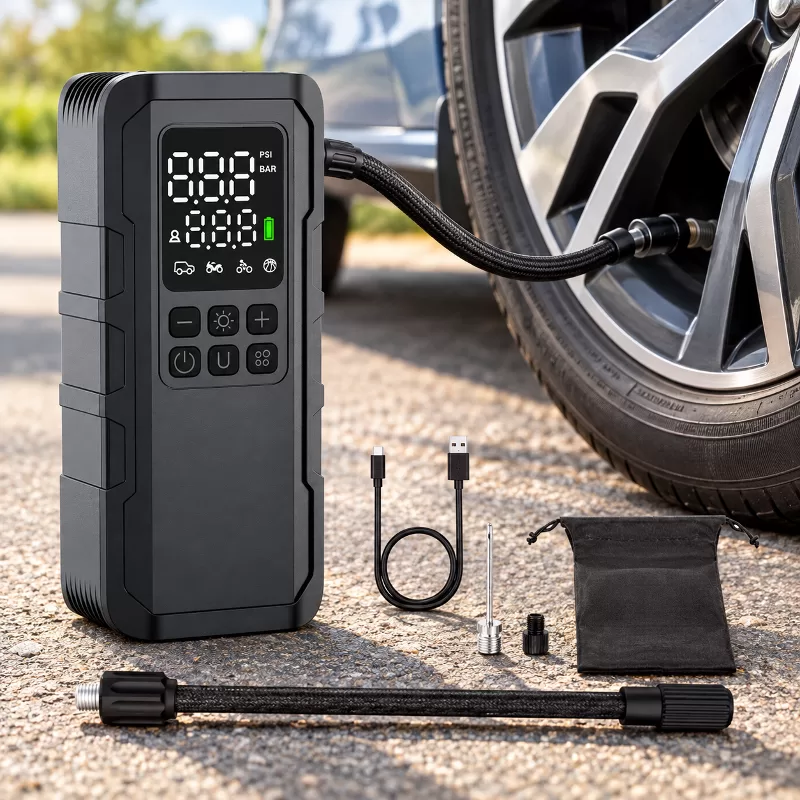
A dependable portable auto tire inflator has transformed from an optional roadside novelty into a necessary piece of automotive safety gear. Modern vehicle engineering increasingly omits full-size spare wheels to reduce chassis weight and maximize interior room, leaving drivers reliant on tire sealant kits or temporary emergency spares. Maintaining proper inflation protects internal tire construction, optimizes tread contact patches, and avoids accelerated tire wear during regular commuting. Having a dedicated inflation tool inside the vehicle provides prompt mechanical support whenever tires drop below their baseline operating thresholds.
Whether confronting sudden tire pressure monitoring alerts on an early morning commute or servicing passenger vehicles in a residential driveway, compact air compressors resolve air loss without inconvenient detours to commercial service facilities. Selecting the right equipment requires understanding pneumatic displacement, battery architecture, thermal management, and practical field safety. This technical guide outlines the critical operational factors drivers need to evaluate when choosing a compact inflation tool, ensuring that roadside adjustments remain safe, efficient, and aligned with manufacturer standards across diverse driving conditions.
Understanding Driver Needs and Tire Pressure Dynamics
The Problem of Natural Pressure Loss and Cold Weather Drops
Pneumatic tires are not completely sealed chambers over extended operational lifespans. Tires commonly lose about 1 PSI per month through natural leakage and permeation through the butyl rubber liner, although the actual rate varies depending on tire age, wheel assembly condition, and ambient environmental shifts. Faster pressure loss than this typical baseline often indicates a slow puncture, a leaking valve core, or wheel rim corrosion, all of which require thorough visual inspection rather than repeated unmonitored inflation.
Ambient temperature drops noticeably accelerate these pressure reductions through basic thermodynamic gas behavior. A recognized operational rule of thumb indicates that contained tire pressure drops by approximately 1 PSI for every 10 to 12 degrees Fahrenheit of ambient temperature reduction. Consequently, a large temperature drop can reduce the pressure by several PSI overnight, where the actual change depends on the temperature difference and starting conditions. Driving on underinflated tires causes structural sidewall flexing, increases rolling friction, elevates internal carcass temperatures, and lengthens emergency stopping distances on wet or dry pavement.
A personal inflator gives drivers an alternative when a service-station pump is unavailable or inconvenient to access. Commercial air stations often require driving out of one’s planned route, waiting in lines during peak morning hours, or navigating payment terminals. Having an immediate on-board compressor ensures that motorists can address seasonal pressure deficits in their own driveways before tires accumulate friction and heat on the open road.
Why On-Board TPMS Is Not a Substitute for an Inflator
Many vehicle owners mistakenly assume that an illuminated dashboard warning lamp provides adequate preventative notice for routine tire maintenance. Under Federal Motor Vehicle Safety Standard 138, a vehicle tire pressure monitoring system is required to illuminate an alert when tire pressure drops to 25 percent or more below the vehicle manufacturer’s recommended cold inflation pressure, or a minimum activation pressure specified by the standard, typically detecting this condition within 20 minutes under regulatory test conditions.
A 25 percent deficit represents a significant shortfall below optimal cold inflation pressure rather than an early routine service prompt. Waiting for an electronic dashboard alert can permit subtle, unmonitored pressure loss to compromise vehicle handling and fuel efficiency during regular commuting. Passive sensor systems merely alert drivers to an existing problem; they cannot add compressed air or restore structural tire volume.
A portable auto tire inflator bridges the operational gap between passive alert sensors and active pressure management. Keeping a compact compressor inside the vehicle allows owners to verify cold inflation baselines monthly and eliminate slow pressure deficits immediately, preserving handling characteristics and preventing premature shoulder wear on passenger tires. Regular manual checks ensure that tire pressures remain aligned with vehicle placard recommendations between scheduled dealer maintenance intervals.
Core Engineering Factors for Evaluating Tire Inflators
Displacement, Compressor Geometry, and Airflow Performance
Pneumatic compressors operate via reciprocating mechanical piston designs where cylinder bore and stroke volume dictate volumetric delivery. Compact inflator performance varies according to airflow delivery, working pressure ranges, duty cycles, and target tire dimensions. In portable equipment, achieving practical volumetric output requires balancing piston surface area, motor power, and electrical current draw from the internal power supply so the compressor can deliver sustained flow without excessive thermal accumulation.
The LP8 combines a 19-cylinder compressor, 60W working power, and a stated airflow of 26 to 28 L/min, providing a practical balance between compact dimensions and functional inflation capability for everyday vehicles. While a high maximum-pressure rating may be useful for some high-pressure bicycle tires, the correct target remains the tire or equipment manufacturer’s recommendation. Passenger vehicles operate within moderate pressure ranges where steady volumetric air delivery is essential for timely roadside maintenance.
| Compressor Category | Primary Power Source | Flow and Delivery Profile | Pressure Scope | Typical Intended Application |
|---|---|---|---|---|
| Manual Floor Pump | Human Mechanical Stroke | Low volume per stroke; manual effort required | High pressure capability | Bicycles, sports equipment, minor emergency top-offs |
| 12V DC Corded Pump | Cigarette Lighter Socket | Continuous electrical flow limited by 12V vehicle fuses | Moderate pressure range | Standard passenger car emergency tire inflation |
| Cordless Lithium Pump | Rechargeable Internal Cells | Portable high-current delivery without trailing wires | Broad pressure range | Multi-vehicle maintenance, emergency tire inflation |
| Heavy-Duty Shop Pump | AC Mains or Battery Clamps | High volumetric output with larger piston assemblies | Industrial pressure range | Large commercial trucks, off-road vehicle flotation tires |
Lithium Battery Architecture and Working Power
Cordless inflators rely on high-drain lithium-ion chemistry capable of delivering steady current without excessive voltage sag during motor operation. Driving a reciprocating mechanical compressor against tire backpressure requires consistent electrical output from the internal cell assembly. For portable equipment, battery design determines both output stability and the tool’s practical shelf life in vehicle storage, ensuring the motor turns reliably even under elevated manifold pressures.
The LP8 is specified with three 18650 cells, 2000mAh capacity, 11.1V, and 22.2Wh, paired with 60W working power. Regarding service longevity, Newo specifies 300 charge cycles while retaining 80% or more of the original capacity, providing predictable performance across multiple seasons. Routine battery maintenance preserves this storage life and ensures electrical readiness whenever emergency top-offs become necessary on distant travel routes.
Modern cordless inflators incorporate Type-C charging ports supporting 5V/2A and 9V/1.5A input and output parameters. This broad input and output compatibility allows drivers to recharge the device from standard vehicle ports or household adapters while providing electrical output when emergency power is needed. A versatile charging interface eliminates the need for proprietary wall chargers during road travel and simplifies routine power maintenance.
Digital Pressure Control, Displays, and Auto-Stop Safety
Manual tire inflation carries risks of tire carcass overpressurization, which can alter vehicle handling and increase wear along the center of the tread. The LP8 provides a dual LED pressure display, selectable PSI and BAR units, preset modes, custom pressure control, and automatic shut-off. These digital features remove the ambiguity often associated with mechanical spring-and-dial gauges, allowing drivers to inspect and adjust line pressure with clear visual confirmation.
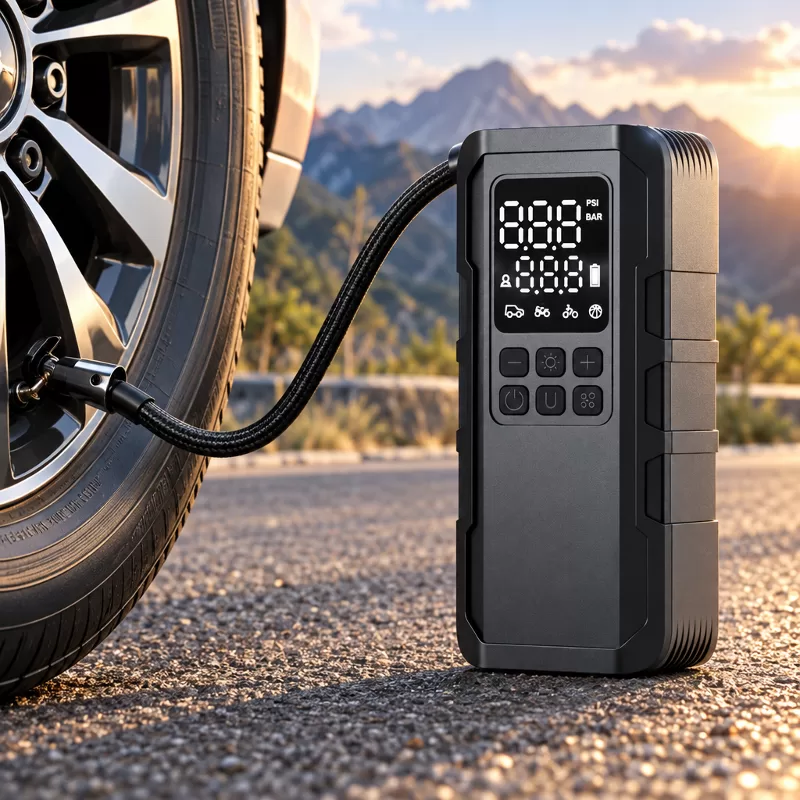
Dual digital displays enhance usability by presenting real-time measured pressure alongside the target pressure setting. Once connected to a tire valve stem, the internal sensor samples current line pressure and displays the reading clearly across the chosen measurement unit. This dual-readout format allows operators to monitor immediate pressure gains while keeping the intended cutoff target in clear view, helping users set each tire to the same target value.
The automatic shut-off stops the compressor when the selected pressure target is reached. This automated control prevents accidental overinflation, eliminates continuous manual gauge checking, and supports consistent target adjustment across all four wheels. Drivers can enter their vehicle placard specification, initiate inflation, and allow the integrated controls to terminate air delivery once the target threshold is reached.
Heat Dissipation and Air Hose Thermal Management
Gas compression generates significant heat governed by thermodynamic laws. When ambient air is compressed into high-pressure streams, mechanical work converts into thermal energy concentrated around the compressor cylinder and discharge connector. Managing this heat load is vital for preserving internal valve components and motor windings, which is why compact housings incorporate ventilation slots and internal air pathways to dissipate excess heat.
The compressor and fittings may become warm during operation, so users should follow the manufacturer’s duty-cycle instructions and allow hot components to cool before handling them. Operating guidelines for compact equipment specify continuous runtime between 20 and 25 minutes, after which the unit should be allowed to cool before initiating subsequent inflation cycles to protect electrical and pneumatic assemblies.
Inflation hoses feature flexible braided construction and threaded connectors to endure pressurized airflow under real-world roadside conditions. Users should exercise reasonable caution when handling metal connectors after continuous pumping, as thermal conduction from the compressor manifold warms the fittings during use. Allowing fittings to cool briefly after inflation prevents handling discomfort and avoids stressing rubber valve stems.
Operational Performance: The Newo LP8 Inflator
Manufacturer Technical Specifications
Engineering compact pneumatic equipment requires strict manufacturing tolerances and consistent component quality across every assembly stage. For us at Newo, development centers on balancing motor performance, portable power management, and pneumatic reliability across smart inflation solutions. The LP8 model demonstrates how specialized engineering provides dependable consumer performance for automotive and recreational maintenance, combining balanced airflow delivery with straightforward digital controls.
Equipped with a 19-cylinder compressor, 60W working power, and an airflow delivery of 26 to 28 L/min, the unit handles regular passenger vehicle maintenance while remaining compact. Its 70.5 × 50 × 165 mm size and 522 g net weight support portable, vehicle-kit, and travel use. The lightweight profile allows drivers to store the compressor easily inside vehicle utility compartments without taking up valuable luggage space.
| Technical Specification | Manufacturer Parameter |
|---|---|
| Model Identifier | LP8 |
| Product Classification | Portable Tire Inflator |
| Compressor Architecture | 19-cylinder compressor |
| Motor Working Power | 60W |
| Maximum Working Pressure | 150 PSI (Operational range: 2 to 150 PSI) |
| Volumetric Airflow Delivery | 26 to 28 L/min |
| Battery Configuration | 3 × 18650 cells, 2000mAh, 11.1V, 22.2Wh |
| Charge Interface Protocols | Type-C (Input and Output: 5V/2A, 9V/1.5A) |
| Estimated Charge Duration | 2 to 3 hours |
| Continuous Operation Runtime | 20 to 25 minutes |
| Operational Temperature Span | -10°C to 45°C |
| Acoustic Sound Rating | ≤ 85 dB at 1 meter distance |
| Physical Enclosure Dimensions | 70.5 × 50 × 165 mm |
| Net Hardware Weight | 522 g |
Single-Charge Capacity and Application Envelopes
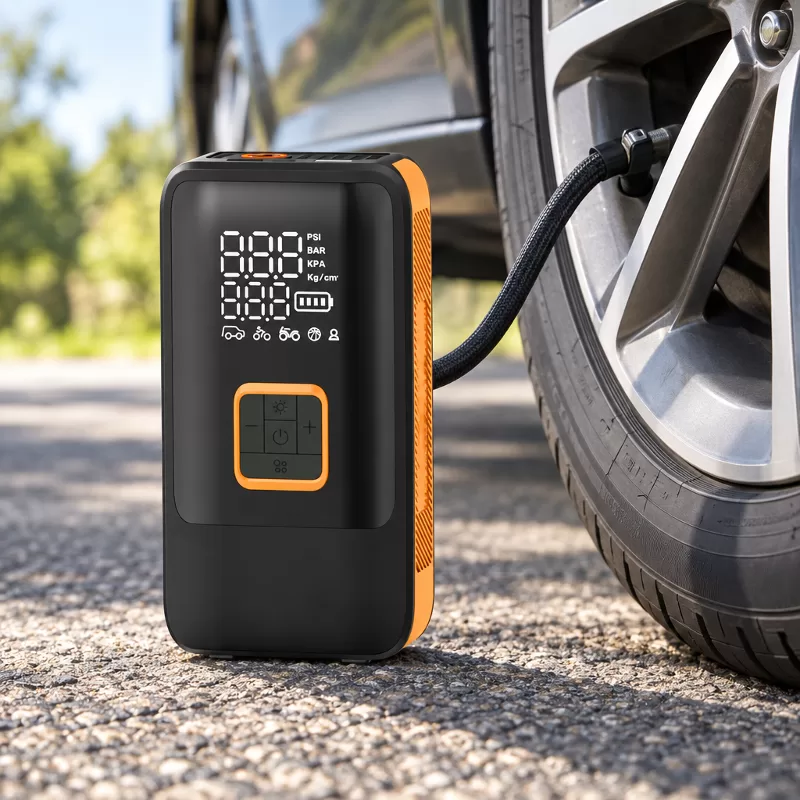
A practical concern for drivers is the total inflation volume delivered by a cordless unit on a complete battery charge. Newo lists a capacity of about 3.5 205/55 R16 tires per full charge, though actual results vary with starting pressure, target pressure, ambient temperature, and overall tire condition. This metric highlights that compact lithium-powered compressors can service multiple tires before requiring a recharge.
Routine monthly tire maintenance generally requires smaller top-offs to offset seasonal temperature fluctuations and natural molecular diffusion rather than filling fully depleted casings. This volumetric capacity enables drivers to complete preventative tire maintenance on a single battery charge cycle without needing intermediate access to electrical power outlets, making routine checks convenient to conduct at home or during road travel.
The listed applications focus on passenger vehicles, two-wheeled vehicles, mobility equipment, and sports balls; confirm suitability before using it for larger or high-volume inflatables. The stated working-temperature range is -10°C to 45°C, and users should follow the manufacturer’s operating instructions in extreme conditions. Storing the unit away from prolonged exposure to extreme heat or cold helps maintain equipment condition over time.
Step-by-Step Field Operation and Safety Protocols
Determining Recommended Cold Pressure
Accurate inflation begins with locating the vehicle Tire and Loading Information placard on the driver-side B-pillar door jamb. This placard provides the vehicle manufacturer’s recommended cold inflation pressure ratings for front and rear axles based on vehicle weight distribution, braking performance, and original equipment suspension tuning. Reviewing this placard prevents guesswork and ensures the vehicle operates within its certified engineering parameters.
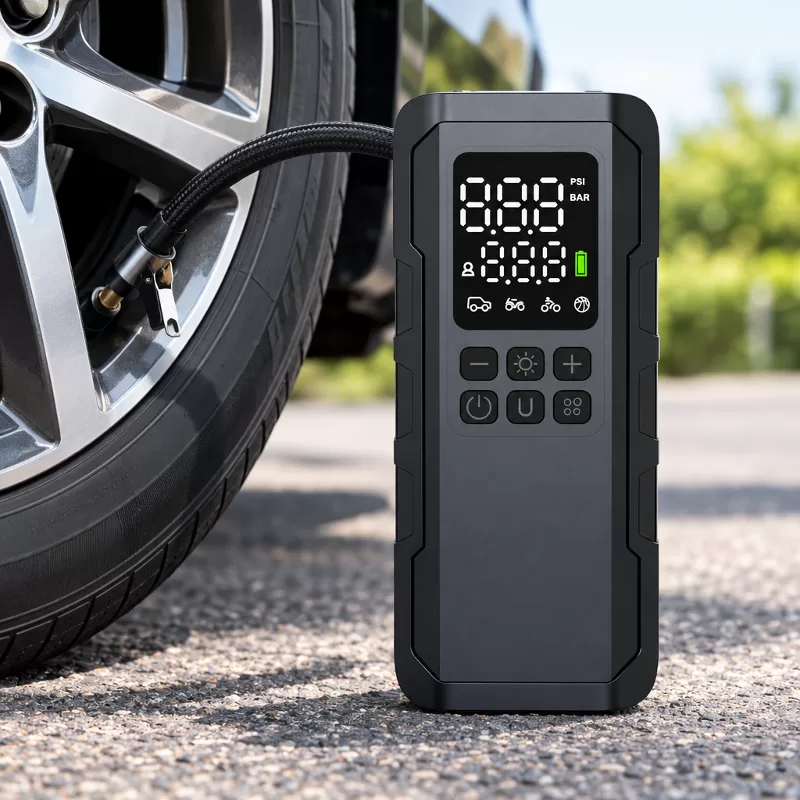
Drivers must avoid using the maximum pressure rating molded onto the tire sidewall. The sidewall rating defines the maximum mechanical pressure threshold the tire structure can support, whereas the door placard specifies the engineered pressure for vehicle load distribution, handling, and ride stability. Using the sidewall maximum instead of the vehicle placard value may alter ride, handling, and tread wear, so use the vehicle manufacturer’s recommended cold pressure.
According to highway safety guidance, cold tire pressure should be measured after a vehicle has remained stationary for at least three hours, or driven less than one mile at moderate speeds. Driving heats the internal air volume, producing elevated pressure readings that subside once the tire cools back to ambient ground temperature. Taking measurements under cold conditions guarantees true baseline readings.
Step-by-Step Car Tire Inflation Workflow
Following a systematic procedure prevents valve stem damage, eliminates unintended pressure leakage, and protects electronic inflator components during maintenance operations. Adhering to these structured steps ensures clean, reliable connections and accurate pressure management across all four vehicle wheels:
- Park the vehicle on a level surface, engage the parking brake, and confirm tires are cold before taking initial measurements.
- Unscrew the protective dust cap from the tire valve stem and check the valve threads for grit or road debris.
- Secure the threaded chuck of the braided air hose firmly onto the Schrader valve stem without cross-threading the brass collar.
- Power on the inflator to read the current baseline pressure on the dual digital screen.
- Select the car preset mode or adjust the target pressure using the manual buttons to match the vehicle door placard recommendation.
- Press the power button to start the compressor, letting the unit run until the automatic shut-off engages at the preset value.
- Switch off the device, disconnect the hose chuck, confirm the valve core is securely seated, and replace the dust cap firmly.
Maintaining this orderly sequence prevents unnecessary air loss while attaching the hose and ensures the brass connector forms an airtight seal against the Schrader valve. Once inflation concludes, storing the hose without sharp bends prevents internal crimping and extends the working life of the flexible rubber assembly.
Roadside Hazard Assessment and Mechanical Limits
Portable compressors are designed for pressure maintenance and controlled air delivery rather than repairing structural punctures. Attempting to inflate a severely compromised tire creates immediate roadside safety risks that no portable compressor can safely mitigate. Inspecting the tire’s physical surface prior to attaching the air hose is an essential diagnostic step for personal safety.
Inflation must never be attempted if a tire shows visible sidewall cracks, exposed cord belts, localized bulges, or bead separation from the wheel rim. These conditions indicate structural tire carcass degradation, and applying air to a structurally damaged tire can increase the risk of tire failure; do not drive on it and seek professional assistance immediately to prevent hazardous highway situations.
Tires exhibiting rapid continuous air loss or severe damage cannot be made roadworthy by an air pump alone. In these scenarios, drivers should install a spare wheel or contact roadside assistance rather than running the inflator continuously. Pumping air into a severely punctured tire merely wastes battery reserves without stabilizing the vehicle or restoring mechanical safety.
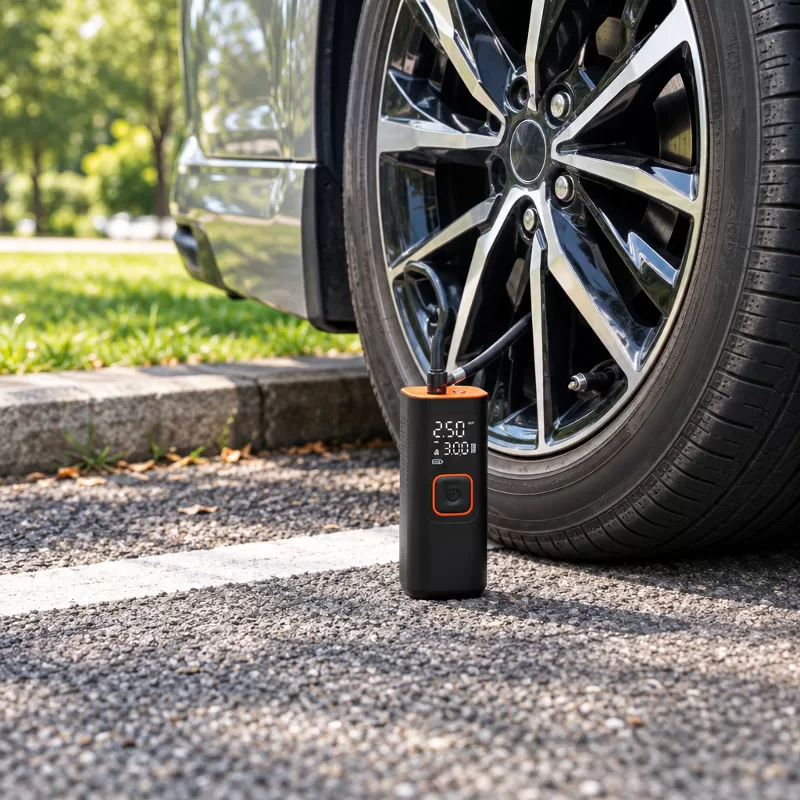
When roadside inflation is necessary, park well clear of active traffic lanes on a stable shoulder. Integrated multi-mode LED lights with constant on, flashing, and SOS modes provide critical visibility during dark roadside maintenance, alerting approaching motorists to the vehicle’s presence while illuminating the wheel workspace for safer operation.
Multi-Vehicle Versatility and Maintenance Practices
Servicing Commuter Bikes, E-Bikes, and Equipment
Modern cordless inflators adapt across numerous household and recreation inflation tasks beyond passenger cars. Different pneumatic systems require specific adapters and pressure limits to prevent component damage and maintain safe operation, making a multi-mode digital tool particularly valuable for active households with diverse vehicle fleets.
- Bicycles and E-Bikes: Bicycle tires feature smaller internal air volumes and require varying pressures depending on the tire casing and rim specifications. Using appropriate valve adapters allows clean connections without physical floor pumping or unmonitored garage air hoses.
- Motorcycles and Scooters: Two-wheeled vehicles rely on precise pressure maintenance specified by the vehicle manufacturer, where small pressure deficits directly influence steering response, chassis feedback, and lean-angle stability.
- Mobility Equipment: Regular pressure checks can help maintain the tire pressure specified by the equipment manufacturer and support normal rolling performance across wheelchairs and personal balance vehicles.
- Sports and Recreational Balls: Use a compatible ball adapter and follow the pressure specified by the ball manufacturer or printed on the ball or its packaging to prevent bladder distortion.
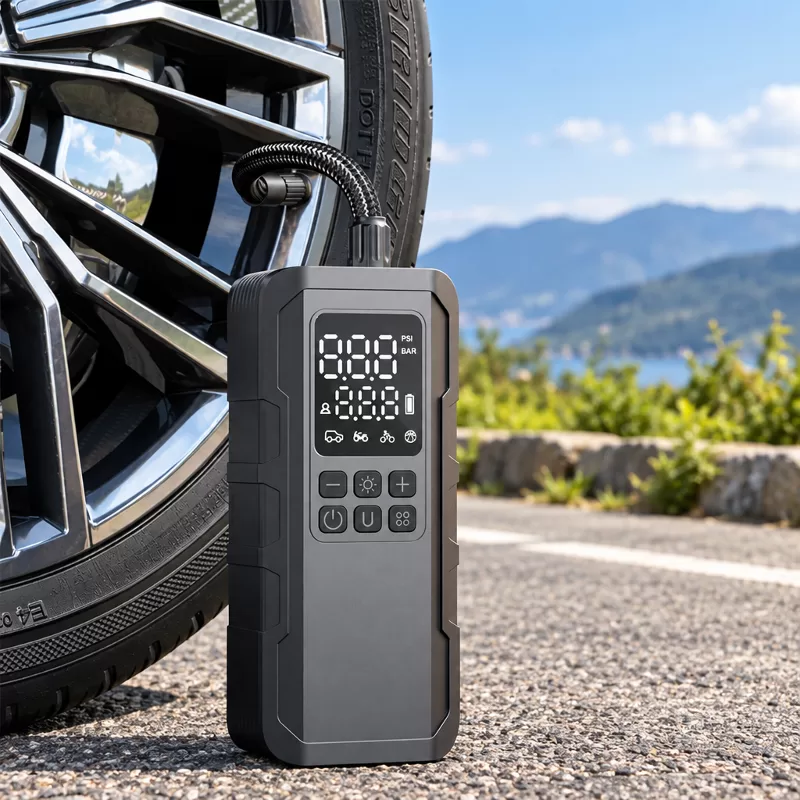
Preset modes can simplify selection for supported applications, while custom pressure control allows users to set another target when needed. Operators can quickly transition from servicing an automobile tire to inflating an e-bike tube without manual unit conversions or recalibrating target parameters, enhancing overall maintenance efficiency across varied household equipment.
Battery Preservation and Long-Term Storage
Lithium cells experience gradual self-discharge when stored for long periods without use. Leaving a portable inflator inside a vehicle trunk indefinitely without checking its charge state can deplete the battery and compromise readiness during unexpected roadside emergencies. Establishing a routine inspection schedule prevents surprise power outages when roadside conditions require prompt inflation.
Drivers should inspect the battery level periodically in accordance with the manufacturer’s charging instructions. Ensuring adequate charge before long road trips keeps the inflator ready for immediate roadside use when commercial air access is unavailable. Following regular charging cycles maintains cell stability and extends the usable lifespan of the internal battery pack.
Store the unit inside its supplied storage pouch away from direct sun exposure. The durable molded housing provides everyday drop protection, but avoiding prolonged exposure to extreme cabin heat preserves display clarity and sensor reliability over multiple driving seasons. Clean storage also prevents dust from entering the air intake perforations.
Inspect the air hose and connector fittings periodically for dirt, thread wear, or cracked external braiding. If any connection or component exhibits physical damage, avoid using the tool and seek professional service or authorized manufacturer support to ensure reliable pneumatic operation and leak-free valve connections.
Frequently Asked Questions (FAQs)
Is a 150 PSI maximum rating intended for everyday car tires?
Passenger-car tire pressure varies by vehicle, and drivers should always use the cold pressure specified on the vehicle placard or in the owner’s manual. The 150 PSI rating reflects the maximum structural pressure ceiling supported by the internal compressor mechanism, which is beneficial when inflating specialized high-pressure bicycle tires rather than standard passenger car casings.
Can I use a portable inflator immediately after highway driving?
Tire friction and ambient pavement heat warm the contained air during highway driving, causing elevated pressure readings. It is recommended to check and adjust tire pressures when the tires are cold. If air must be added to a warm tire during travel, follow vehicle manufacturer guidance and verify final baseline pressure once the tires cool completely.
How often should I check the battery of an inflator stored in a vehicle?
Check the battery indicator periodically every few months and before embarking on long road trips. Because ambient vehicle temperature variations influence charge retention, routine inspections ensure the compressor remains ready when needed, preventing unexpected battery depletion during an urgent roadside inflation scenario.
Can a compact tire inflator reseat a bead that popped off the rim?
A compact inflator is generally not intended to reseat a dislodged bead. Because bead seating requires equipment and procedures suited to the tire and rim, seek professional service rather than relying on this device. Dislodged tire beads demand specialized high-volume air delivery systems found in automotive tire repair shops.
Why does the air hose connector feel warm during operation?
Rapid pneumatic compression converts mechanical work into heat, which naturally warms the compressor cylinder and transfers into the connected hose fitting. This is a standard physical characteristic of compression; allow the connector to cool slightly before unscrewing it to avoid minor handling discomfort.
Selecting the Best Roadside Emergency Companion
Maintaining correct tire pressure remains one of the simplest and most effective ways to preserve vehicle safety, improve fuel economy, and maximize tire service life. Compact, rechargeable tools have eliminated the need to rely on coin-operated service station pumps or awkward manual floor pumps that demand significant physical exertion. Having a self-contained compressor empowers drivers to manage inflation independently wherever travel takes them.
A quality portable auto tire inflator provides drivers with a digital pressure display with selectable PSI and BAR units, automatic shut-off safety, and versatile emergency power in a compact package. Incorporating routine cold-pressure checks into your regular maintenance routine can support proper tire-pressure maintenance and reduce reliance on service-station air pumps, but it is not a substitute for regular professional inspection or roadside assistance.
-

Meet NEWO at the 140th Canton Fair: Visit Booth 10.3 M03–04
Meet NEWO at the 140th Canton Fair in Guangzhou, October 15–19, 2026. Visit Booth 10.3 M03–04 to explore portable air pumps and discuss OEM, ODM and distribution opportunities.... -

As Shenzhen Welcomes the World for APEC 2026, NEWO Welcomes You to Our Factory
As Shenzhen prepares for APEC 2026, NEWO welcomes international buyers and partners to visit our factory, meet our team and explore future cooperation.... -

Leading the Way in Product Innovation and Excellence
Smartnewo exemplifies professionalism in product innovation and manufacturing. Their collaboration with Xiaomi Youpin on the G01 crowdfunding project highlights their expertise in creating compact, powerful inflatable pumps. Rigorous engineering, meticulous production processes, and advanced quality assurance underscore their commitment to excellence. The success of the G01 project, with significant market... -

Essential Qualities of an Excellent Supplier
In today's competitive market, finding a reliable supplier is crucial for business success. Based on insights from Smartnewo and broader internet research, here are key qualities an excellent supplier must possess:... -

NW06 Tire Inflator: Compact Power for Quick Inflation
Summary The NW06 Tire Inflator delivers quick and efficient tire inflation with a powerful 35L/min airflow. It features a user-friendly LCD screen for real-time pressure monitoring, dual power options with a built-in 6000mAh battery, and multiple nozzle attachments for versatile use. Its compact design and integrated LED light ensure convenience and... -

Unleash the Power of Portability: The SmartNewo Jump Starter with Air Compressor KF03
This guide will walk you through the steps to effectively use a portable tire inflator, helping you stay prepared and safe on the road.... -

Newo Attends The 2024 Consumer Electronics Show (CES)
Smartnewo booth is located at 53672, Halls A-D, Level 2, Venetian Expo, Las Vegas Convention Center (LVCC). ... -

Smartnewo’s Dual-Cylinder Air Pump Rocks the Hong Kong Autumn Electronics Fair!
Smartnewo’s Dual-Cylinder Air Pump Rocks the Hong Kong Autumn Electronics Fair!... -

Meet at the Canton Fair! Smartnewo brings dual-cylinder air pumps, making your inflation experience faster and more stable!
NEWO has went deep communication and negotiation with customers from all over the world on booth.... -

“Hong Kong Autumn Electronics Fair – 1CA18 (October 13th to 16th): Smartnewo invites you to visit our booth!
Hong Kong Autumn Electronics Fair...
-
What to Check Before Ordering Custom Electric Bike Pumps
Plan custom electric bike pumps with a clear requirements freeze for valves, TPU tubes, portability, repeated top-ups, charging, and model-specific documents.... -

OEM vs ODM Air Pumps: Which Manufacturing Model Fits Your Brand?
Compare OEM and ODM air pump projects by design responsibility, change approval, development scope, and written ownership terms before choosing your route.... -

How to Choose a Reliable Tire Inflator Manufacturer in China
Choose a tire inflator manufacturer in China with a focused RFQ, supplier evidence, configuration checks, and clear sample-to-pilot decisions for your brand.... -

Rechargeable Electric SUP Pump for Paddle Boards: Faster Inflation for SUPs, Kayaks and Inflatable Tents
The BL10-C Portable Electric Bike Tire Inflator is a compact and lightweight mini electric bike pump designed for modern cyclists. With up to 120 PSI pressure, a digital LED display, preset pressure control, automatic shut-off, USB-C charging, and multiple valve adapters, BL10-C offers a convenient inflation solution for road bikes,... -

Are Electric Bike Pumps Worth It in 2026? Electric Pump vs CO₂ vs Mini Hand Pump
Discover whether electric bike pumps are worth it in 2026. This guide compares electric bike pumps, CO₂ inflators, and mini hand pumps for road cycling, gravel riding, commuting, and long-distance rides. Learn the pros, limitations, best use cases, and key features to look for before choosing the right portable tire... -
BL10-C Portable Electric Bike Tire Inflator: Small Size, Reliable Power for Every Ride
The BL10-C Portable Electric Bike Tire Inflator is a compact and lightweight mini electric bike pump designed for modern cyclists. With up to 120 PSI pressure, a digital LED display, preset pressure control, automatic shut-off, USB-C charging, and multiple valve adapters, BL10-C offers a convenient inflation solution for road bikes,... -

Why Mini Electric Bike Pumps Are Becoming Essential for Modern Cycling
Discover why mini electric bike pumps are becoming essential for modern cyclists. Learn how portable electric bike pumps improve tire pressure management, riding safety, and convenience.... -

The Ultimate Smart Solution for Easy Outdoor Adventures in 2026
Discover how a spring travel air pump simplifies outdoor trips with fast inflation, smart features, and powerful performance—perfect for every adventure.... -

Powerful 5-in-1 Portable Car Tire Inflator and Jump Starter: The Ultimate Emergency Tool for Every Driver
Why Every Driver Needs a Portable Car Tire Inflator and Jump Starter Modern drivers face many unexpected situations on the road. A flat tire, low tire pressure, or a dead car battery can happen at the worst possible time. That’s why having a portable car tire inflator and jump starter is... -

7 Real Cycling Scenarios That Show Why Every Rider Should Carry a Mini Bike Pump
Cycling is one of the most freeing activities you can enjoy. Whether you’re commuting to work, riding through city streets, or exploring quiet countryside roads, a bike ride can instantly improve your day. But there’s one small problem that almost every cyclist eventually faces: Low tire pressure. It might happen...
-

How Is a Football Properly Inflated?
The correct inflation of a football - with not too much and not too little air - is a hotly debated topic among footballers.... -

Application Scenarios of Car Inflator Pump
Often long-distance business trips or play car owners because the road may be more remote areas, in this case if you encounter a tire leak....