

 Portable Tire Inflators
 Electric Air Pumps
 Electric Car Tyre Pumps
 Electric Ball Pumps
 Electric Bike Pump
 SUP Air Pump

Portable Inflator Pump: How to Choose and Use One
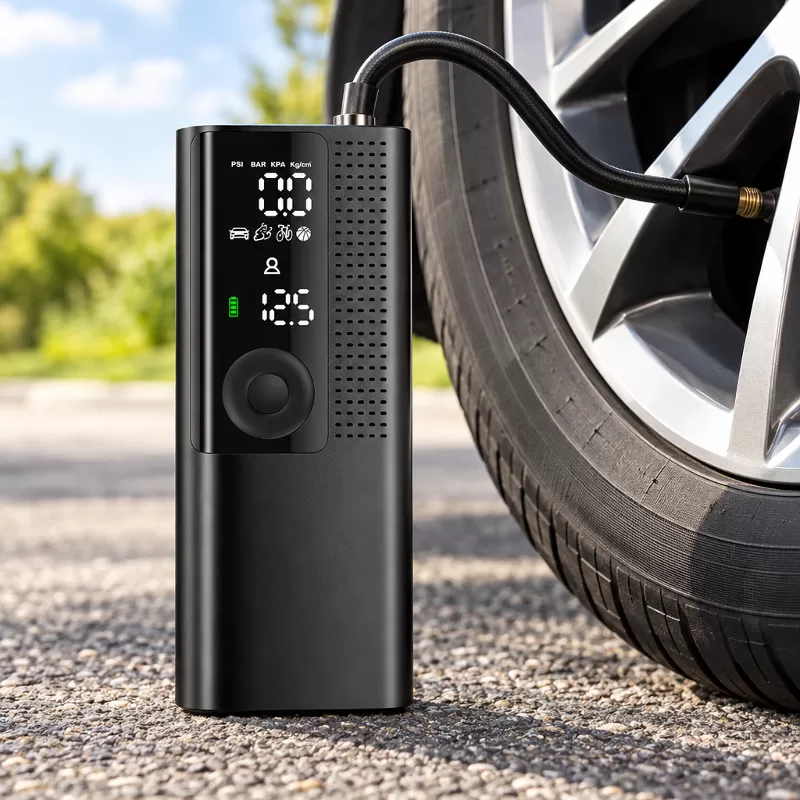
When a low tire pressure warning illuminates on your dashboard during a morning commute, finding a functioning service station air hose becomes an immediate chore. A reliable portable inflator pump eliminates that dependency entirely, turning an inconvenient delay into a straightforward pressure correction right in your driveway. Compact electric air inflators have transformed how drivers, cyclists, and outdoor enthusiasts maintain pneumatic equipment without wrestling with bulky workshop compressors or fragile hand pumps.
Selecting the right device requires understanding how pressure requirements, airflow velocity, and power configurations interact under real-world conditions. Whether you need a dependable car tire air pump for routine pressure maintenance, an electric bike pump for high-pressure bicycle tires, or an all-around inflator for sports gear, this guide covers the engineering fundamentals, selection criteria, and proper operational techniques.
What Is a Portable Inflator Pump?
How Portable Electric Inflators Work
Many portable inflators use an electric compressor mechanism paired with digital pressure controls. Ambient air enters through intake ventilation openings, passes into the compression chamber, and is driven through an internal pathway into the connected air line during operation.
Unlike traditional manual pumps that rely entirely on physical muscle, an electric unit utilizes electronic monitoring to track pressure inside the line. The control board interprets the pressure reading and presents it on an electronic screen. This setup allows the tool to run until it reaches a programmed target value, at which point the automatic shut-off feature stops the unit to help prevent unintended overinflation.
Common Uses Across Vehicles and Gear
Modern inflators serve a broad spectrum of equipment beyond passenger cars. Their flexible pressure range and varied nozzle adapters accommodate many pneumatic items used in daily transportation and recreation.
- Automotive Maintenance: Adjusting tire pressure on sedans, crossovers, light trailers, and minivans during seasonal weather shifts or routine monthly safety checks.
- Two-Wheel Commuting: Delivering pressurized air for road bicycles, gravel rigs, commuter e-bikes, and scooters that experience pressure loss over time.
- Powersports and Motorcycles: Supporting sportbikes, cruisers, and all-terrain vehicles that require consistent tire pressures for predictable handling and braking stability.
- Mobility and Recreation: Maintaining pneumatic tires on manual wheelchairs, electric balance boards, and inflating athletic sports balls using dedicated pin adapters.
Portable Tire Inflators vs. High-Volume Blowers
A common misunderstanding among buyers is conflating high-pressure tire inflators with high-volume transfer pumps. Pneumatic tasks split into distinct mechanical categories: high pressure with lower airflow volume, versus high airflow volume at lower operating pressure.
A portable tire inflator pump is designed to deliver focused airflow against significant resistance, reaching pressure ratings up to 150 PSI. Conversely, specialized mattress or raft blowers move large volumes of air designed for quick expansion of thin-walled chambers at low pressure.
Attempting to inflate a large raft or air mattress with a compact tire inflator can take an impractical amount of time because the pump provides a focused, lower-volume airflow. Conversely, an air-mattress blower cannot inflate a car or bicycle tire because it does not generate the mechanical pressure required to push air past a closed vehicle or bicycle valve stem.
Key Technical Specifications to Look For
Pressure Range and Real-World Requirements
Inflation tools list maximum pressure ratings such as 120 PSI or 150 PSI on their product specification sheets. However, your actual operational pressure is almost always lower than these structural maximums.
Passenger vehicles typically specify cold tire pressures between 30 and 36 PSI under standard vehicle loading, though exact values depend on the automaker. Performance road bicycles often require between 60 and 90 PSI depending on tire width and rider weight, while commuter e-bikes frequently operate around 45 to 60 PSI. Devices such as the LP17A-P feature an adjustable pressure range from 2 to 150 PSI to accommodate these varied equipment requirements.
Airflow Rate, Piston Sizing, and Usable Runtime
Air delivery volume is measured in liters per minute (L/min). Compact handheld devices generally produce between 15 and 25 L/min under zero backpressure, tapering slightly as internal resistance rises inside the tire.
Compressing air generates thermal energy inside any mechanical compression chamber. Because handheld enclosures have limited physical surface area for heat dissipation, manufacturers specify runtime recommendations to prevent component strain. For instance, an inflator listed with an airflow rate of 17 to 18 L/min and an operating power up to 50W typically lists approximately 20 minutes of runtime per charge. Users should always consult their product manual for operating guidelines and allow the unit to rest if the housing becomes excessively warm.
Power Options: Cordless Battery vs. Vehicle 12V DC
Power delivery determines where and when your pump can assist you. Cordless battery-powered units afford physical mobility, allowing you to walk freely around all four vehicle tires, inflate bicycle tires along a trail, or carry the tool onto a sports court.
| Power Source | Primary Advantages | Practical Limitations | Best Application Scenario |
|---|---|---|---|
| Internal Lithium-Ion Battery | Cordless operation; lightweight; usable anywhere without vehicle proximity | Runtime limited by battery charge state; capacity varies in extreme ambient temperatures | Urban bike commuting, residential top-offs, sports equipment |
| 12V–14V Auxiliary Car Cord | Continuous power tied to vehicle electrical system; independent of internal cell charge | Constrained by cord length; requires vehicle auxiliary socket connection | Road trips, extended highway travel, vehicle emergency kits |
| Dual-Power Design | Flexible operation; runs on internal battery or plugs into car auxiliary power | Slightly more components to house in the casing | General car travel, multi-purpose household and roadside use |
A dual-power design offers valuable flexibility for travel kits. If the tool has been stored in a vehicle trunk through cold weather where battery performance can drop, having the option to connect to a 12V to 14V vehicle socket provides immediate operational power.
Digital Controls, Pressure Presets, and Auto Shut-Off
Mechanical dial gauges can vibrate while an inflator runs, which makes tracking exact numbers challenging. Modern digital inflators address this issue by incorporating digital displays and electronic controls.
Many units provide dedicated operational modes for cars, motorcycles, bicycles, and balls, along with manual pressure adjustment controls. You select or program the target pressure, start the pump, and let the automatic shut-off feature stop the motor once the system registers that the setpoint has been reached. This eliminates the need to constantly monitor a needle and helps protect against over-pressurization.
Ergonomics, Weight, and Secondary Utility
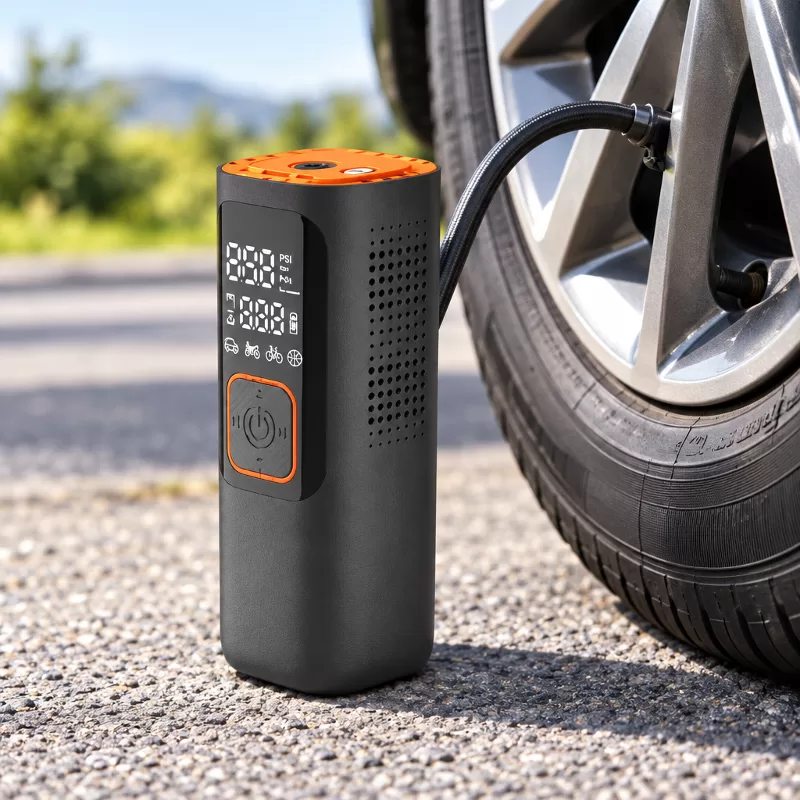
Emergency vehicle equipment must balance operational capability with practical storage size. An inflator weighing under 500 grams with a slim profile fits easily into a glove compartment, door storage pocket, trunk organizer, or cycling bag.
Secondary electrical functions add everyday convenience. Modern inflators frequently feature Type-C charging ports for replenishment using standard adapters, while some models also include an LED light or a 5V/2A power output port capable of supplying auxiliary power to compatible electronic devices during travel. Buyers should confirm specific accessory and illumination features for each individual model.
How to Choose the Right Inflator for Your Daily Needs
For Daily Commuters and Vehicle Preparedness
Drivers commuting daily need straightforward equipment that delivers reliable pressure adjustments without unnecessary complexity. A portable inflator is valuable for correcting minor pressure drops caused by weather changes or slow valve leaks before they trigger vehicle handling issues.
When choosing an automotive inflator, check the recommended pressure specifications on your vehicle placard and select a unit tested for passenger tire inflation. Models offering dual-power capability ensure that you can power the unit from your vehicle auxiliary port even if the internal battery has not been recently charged. An inflator is intended to restore proper operating pressure, but it cannot repair physical tire damage or punctures; any damaged tire requires professional inspection or roadside service.
For Bicycles, E-Bikes, and Two-Wheel Commuting
Bicycle tires contain relatively small air volumes and operate across a wide range of pressures. Road bikes, gravel bikes, and commuter e-bikes experience natural pressure loss over time and require regular checks to maintain proper rolling resistance and rim protection.
Two-wheel commuters should confirm valve compatibility before purchasing. Automotive tires and many standard bicycle tubes use Schrader valves, whereas high-performance bicycle tires frequently use narrower Presta valves. Look for inflators that include a secure Presta adapter and provide fine digital pressure control across the 40 to 90 PSI spectrum.
For Family Recreation, Wheelchairs, and Sports Equipment
Inflatable equipment around the home requires varied pressure settings. Sports balls such as basketballs, soccer balls, and volleyballs operate at relatively low pressures that are clearly marked on the casing by each equipment manufacturer.
A versatile inflator should include specialized adapters, such as a narrow pin for athletic balls and tapered nozzles for small recreational inflatables. Precise digital settings at low pressure ranges prevent sudden overexpansion, ensuring that recreational balls and mobility chair tires remain within their manufacturer-specified operating limits.
Practical Inflator Selection Matrix
To help identify the right tool profile for your requirements, evaluate how different feature combinations align with typical use cases:
- Automotive Preparedness: Prioritizes vehicle 12V auxiliary power support or dual-power options, compatibility with vehicle placard pressure ranges, and clear digital pressure readouts.
- Cycling and Commuting: Prioritizes lightweight handheld construction, cordless battery power, Presta adapter inclusion, and higher pressure ratings up to 90 PSI or above.
- Family Sports and Mobility: Prioritizes dedicated low-pressure presets, included ball pin adapters, quiet operation below 85 dB, and an easy-to-read screen.
Product Spotlight: LP17A-P Portable Tire Inflator
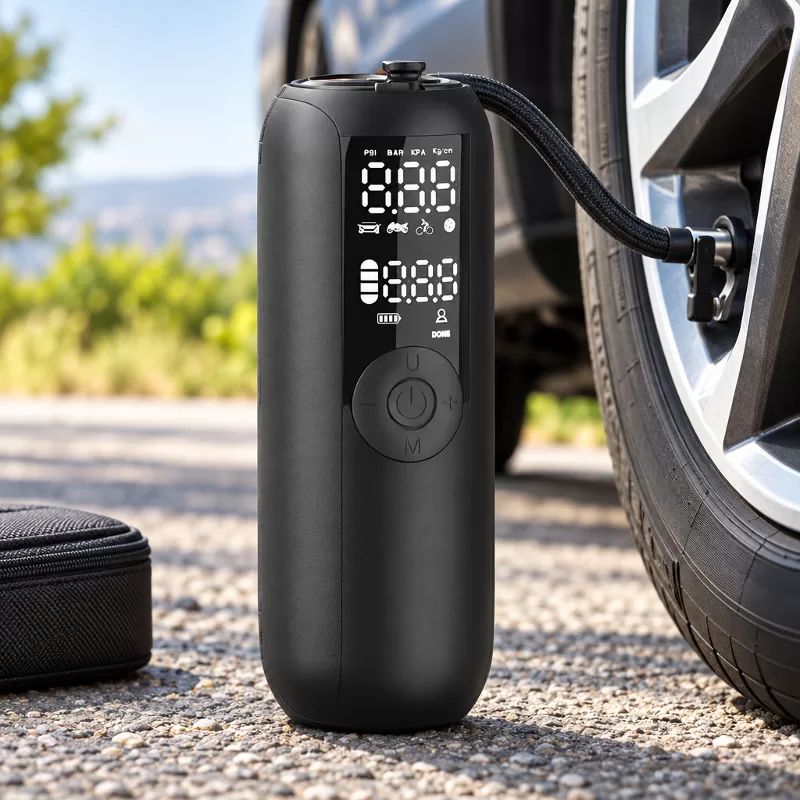
As a professional manufacturer specializing in the research, development, and production of smart electric air pumps and portable inflation solutions, Newo provides pneumatic equipment designed to deliver convenience, efficiency, and reliability for customers worldwide. For us, designing practical roadside solutions involves combining compact dimensions with versatile power options, as reflected in the LP17A-P model.
Engineering Specifications at a Glance
The LP17A-P is built with a 17-cylinder structure and delivers a stated airflow rate of 17 to 18 L/min, operating at a maximum working power of 50W. The unit provides an adjustable pressure range from 2 to 150 PSI, accommodating both low-pressure sports balls and higher-pressure vehicle tires.
Model: LP17A-P
Product Type: Portable Tire Inflator
Pressure Range: 2 to 150 PSI (Maximum 150 PSI)
Airflow Rate: 17 to 18 L/min
Cylinder Configuration: 17 cylinder
Internal Battery: 2 × 18650 cells, 2000mAh, 7.4V, 14.8Wh
Charging Input: Type-C (5V / 2A)
Power Bank Output: 5V / 2A
Vehicle Power Support: 12V to 14V car power
Maximum Working Power: 50W
Runtime: Approximately 20 minutes
Operating Sound Level: 85dB or below at 1 meter
Operating Temperature Range: -10°C to 45°C
Dimensions: 68 × 46 × 160 mm
Net Weight: Approximately 453.1 g
Dual-Power Flexibility for Roadside Readiness
The LP17A-P features dual-power operation, allowing it to run from its internal rechargeable battery or directly from 12V to 14V vehicle power. The internal battery system uses two 2000mAh 18650 cells (7.4V, 14.8Wh). Newo lists about 20 minutes of runtime and an inflation capacity of about two 205-width tires per full charge; actual results depend on tire size, starting pressure, target pressure, temperature, and battery condition.
For extended travel or emergency car kits, the 12V to 14V vehicle power input provides operational flexibility. Users can connect the inflator to their vehicle’s auxiliary power port, ensuring the device remains usable on the road even when the internal battery has not been pre-charged.
User Interface and Pressure Management
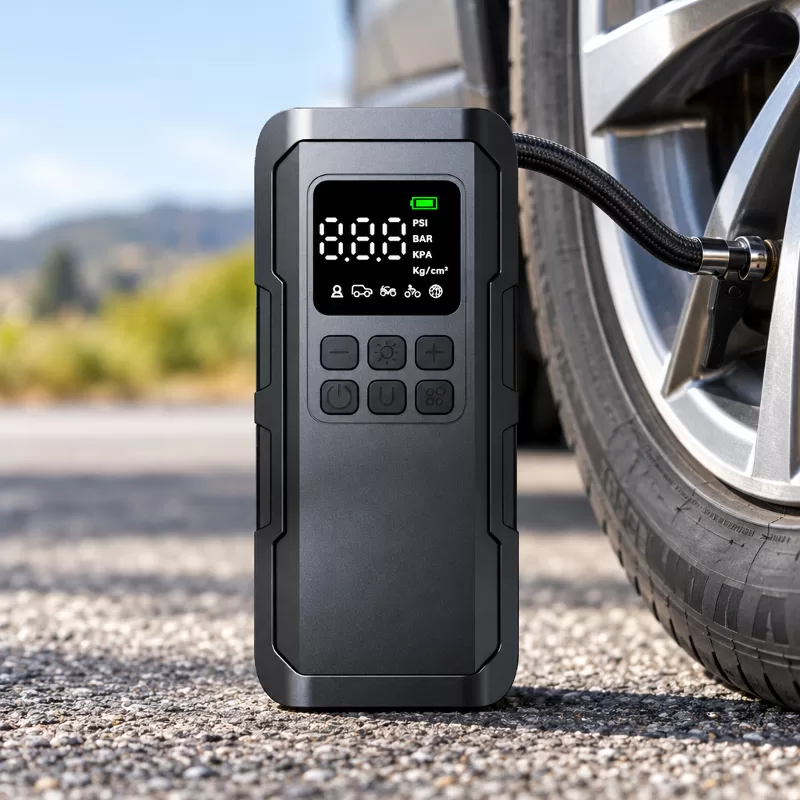
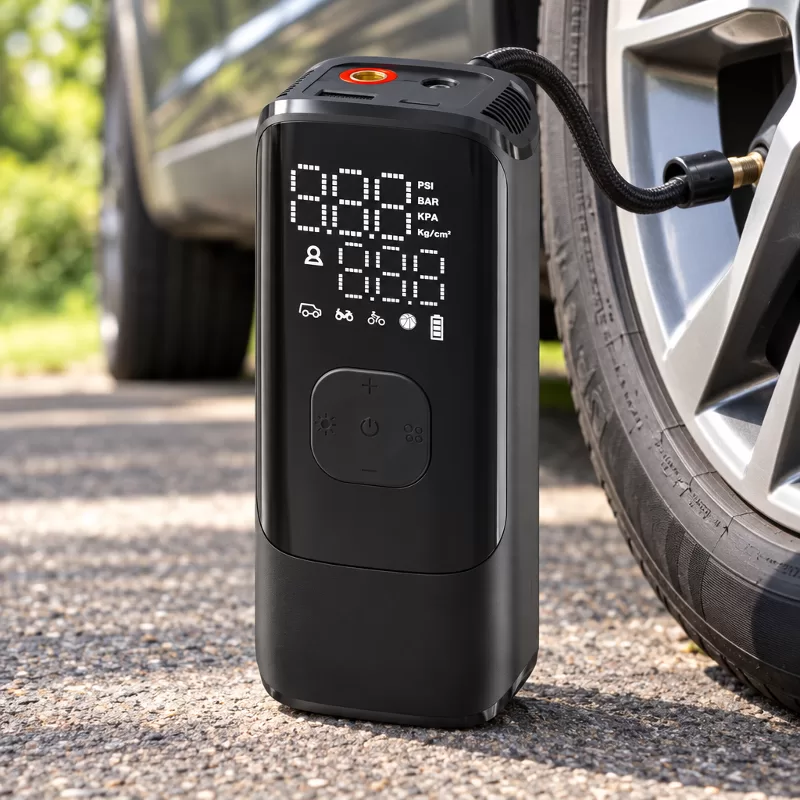
The LP17A-P incorporates a dual LED screen that displays both preset target values and measured real-time pressure on the same panel. This arrangement helps users track inflation progress without switching between different menu screens.
The system includes five preset modes alongside custom pressure adjustment settings. The user selects the appropriate mode or sets a custom pressure anywhere within the 2 to 150 PSI range, and the automatic shut-off feature stops the unit once the target pressure is achieved.
Form Factor and Emergency Capabilities
With physical dimensions of 68 × 46 × 160 mm and a net weight of approximately 453.1 grams, the LP17A-P is sized for convenient storage in automotive glove boxes, center consoles, or travel backpacks. The unit is rated for operation across a temperature range of -10°C to 45°C.
In addition to tire inflation, the device provides auxiliary utility through a 5V/2A power output port. This output can supply power to compatible electronic accessories and mobile devices when an auxiliary power source is needed during travel.
Step-by-Step Guide: How to Properly Inflate a Tire
1. Locate the Recommended Tire Placard Pressure
Always check your vehicle’s designated tire information placard rather than the number stamped on the tire sidewall. The sidewall marking indicates the maximum cold pressure the tire construction can hold, not the operational target selected for your vehicle.
Open the driver-side door and locate the vehicle placard affixed to the door jamb or B-pillar. This label provides the exact front and rear cold tire inflation pressures specified by the automobile manufacturer to deliver balanced handling, braking efficiency, and even tread wear.
2. Verify Cold Tire Conditions
Tires heat up during driving due to internal friction and road contact, which causes internal air pressure to rise temporarily above static levels. Setting pressures on warm tires can result in underinflation once the tires cool down.
Measure and adjust tire pressure when the vehicle has been parked for at least three hours or driven less than one mile at moderate speed. If you must add air to a warm tire during an unavoidable roadside stop, consult your vehicle manual for recommended warm-tire procedures, and always verify the cold baseline pressure later once the tires have fully cooled.
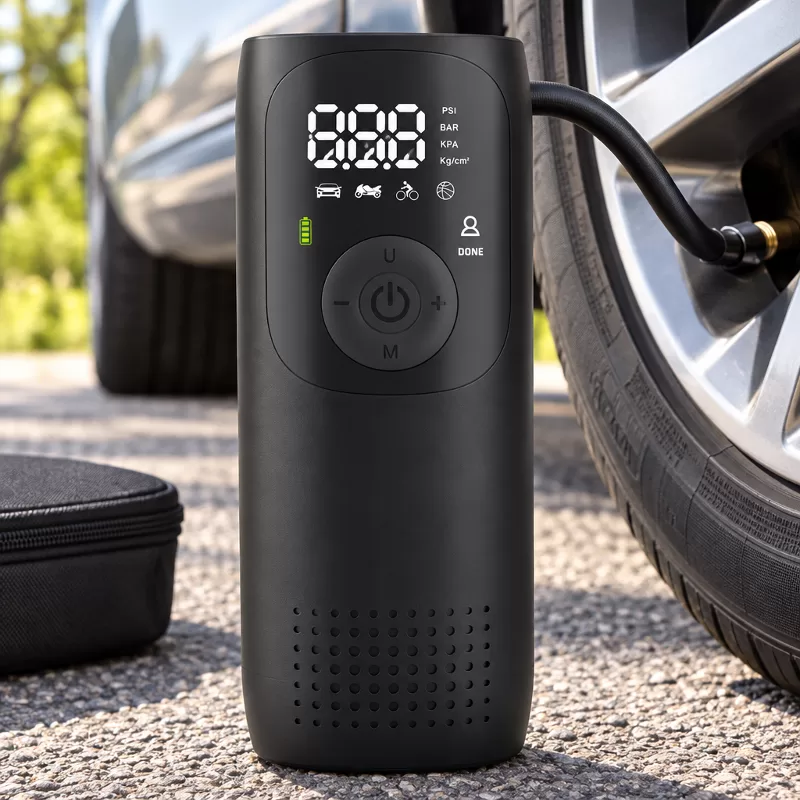
3. Connect the Hose and Calibrate
Unscrew the dust cap from the tire valve stem and check the stem opening to ensure it is free of dirt, road grit, or moisture. Align the inflator chuck carefully and thread or clamp it securely onto the valve stem.
Once attached, inspect the pressure reading shown on the digital display. Keep in mind that this reading reflects the tire’s current internal pressure under present temperature conditions, which may differ from the true cold pressure if the vehicle was recently driven.
4. Set Target Pressure and Initiate Inflation
Select the vehicle mode or use the adjustment controls to set your vehicle’s specified placard pressure. Confirm that the air hose is positioned without severe bends or tension, then activate the power switch to start the motor.
Observe the unit during inflation to ensure the hose remains securely seated on the valve stem. The inflator will run until the system registers that the preset pressure target has been reached, at which point the automatic shut-off feature will stop the motor.
5. Disconnect, Inspect, and Cap
Unhitch or unthread the nozzle connector from the valve stem in a smooth motion to minimize air loss. A brief hiss of venting air from the hose line is normal as the connection disengages.
Screw the valve dust cap back onto the stem to protect the internal valve core from moisture and road contaminants. Allow the inflator hose fitting to cool before stowing the tool in its protective case or vehicle compartment.
Safe Operation and Equipment Maintenance
Mitigating Heat Buildup During Extended Inflation
Compressing air inevitably generates heat in the cylinder head and hose fittings of any portable air compressor. Because compact housings have limited cooling area, managing operating cycles helps ensure product longevity.
Always refer to the manufacturer’s manual regarding recommended runtimes, and never treat listed battery endurance as a continuous-duty rating. If the inflator housing or air hose connector becomes hot during operation, pause inflation and allow the device to cool down before resuming work.
Proper Hose, Adapter, and Thread Care
The air hose experiences vibration and repeated mechanical movement during regular use. Check the hose body periodically for signs of surface wear, cracks, or loose fittings near the base connector.
Ensure that the rubber sealing gasket inside the chuck remains clean and free of debris. When installing sports needles or Presta adapters, align the threads carefully by hand to avoid cross-threading the connector fittings.
Battery Longevity and Storage Best Practices
Rechargeable lithium batteries require basic care to maintain capacity over repeated storage cycles. Extreme cabin temperatures during summer or winter can accelerate battery aging if tools are left unattended for long durations.
- Storage Environment: Store the device within its rated operating temperature window of -10°C to 45°C whenever practical.
- Storage Maintenance: Follow the product manual’s recommendations for periodic recharging and partial-charge storage during off-seasons.
- Connection Care: Keep the Type-C port and auxiliary cords free of moisture, dust, and vehicle debris.
Frequently Asked Questions (FAQs)
Can a portable inflator pump inflate a completely flat car tire?
A portable inflator may be able to inflate a flat tire if the tire remains undamaged and its bead is still securely seated on the wheel rim. However, filling a tire completely from zero pressure requires significant air volume, which will consume considerable battery runtime and generate heat. If a tire has suffered a puncture, sidewall tear, or bead separation, do not attempt to drive on it; inspect the wheel and call for professional roadside assistance.
Why does the tire sidewall say 44 or 50 PSI when the car manual says 32 PSI?
The pressure rating molded onto your tire sidewall represents the maximum permissible inflation pressure certified for that tire structure at its maximum load rating. The lower number on your driver door-jamb placard represents the operating pressure engineered specifically for your vehicle’s weight distribution, suspension tuning, and handling characteristics. Drivers should always inflate to the vehicle placard specification rather than the tire sidewall maximum.
Can one portable inflator handle both Presta and Schrader valves?
Yes, provided the inflator package includes an appropriate Presta adapter. Portable inflators feature native Schrader connectors that fit automotive valves, motorcycles, and most standard bicycles. Threading a brass Presta adapter onto a bicycle stem allows the standard Schrader chuck to lock securely into place for airtight inflation.
How does ambient temperature affect tire pressure throughout the year?
Tire pressure fluctuates with seasonal temperature changes because air contracts as it cools and expands as it warms. Industry guidelines from tire manufacturers indicate that tire pressure generally changes by roughly 1 to 2 PSI for every 10°F change in ambient temperature. Because of this natural fluctuation, drivers should regularly check their cold tire pressure against the vehicle placard during seasonal weather transitions.
Can a compact inflator also blow up stand-up paddleboards or air beds?
Portable tire inflators are engineered for high-pressure, lower-volume applications, making them unsuitable for large inflatable items like air mattresses or stand-up paddleboards. Stand-up paddleboards require substantial air volumes, which would require a small piston inflator to run far too long, causing excessive component heat. Air beds and rafts are best inflated using high-volume centrifugal pumps designed for low-pressure airflow.
Conclusion: Matching Inflation Tools to Your Mobility Needs
Maintaining correct tire pressure is one of the most effective ways to preserve vehicle safety, extend tire tread life, and optimize fuel economy. A portable inflator pump eliminates the inconvenience of locating operational service station air compressors, giving you reliable pressure management at home or on the road.
By evaluating pressure capabilities, airflow ratings, power flexibility, and digital auto-shutoff features, you can select an inflation solution tailored to your transportation needs. A versatile device like the LP17A-P provides practical readiness across automobiles, bicycles, and sports gear, ensuring dependable tire maintenance wherever your journeys take you.
-

Meet NEWO at the 140th Canton Fair: Visit Booth 10.3 M03–04
Meet NEWO at the 140th Canton Fair in Guangzhou, October 15–19, 2026. Visit Booth 10.3 M03–04 to explore portable air pumps and discuss OEM, ODM and distribution opportunities.... -

As Shenzhen Welcomes the World for APEC 2026, NEWO Welcomes You to Our Factory
As Shenzhen prepares for APEC 2026, NEWO welcomes international buyers and partners to visit our factory, meet our team and explore future cooperation.... -

Leading the Way in Product Innovation and Excellence
Smartnewo exemplifies professionalism in product innovation and manufacturing. Their collaboration with Xiaomi Youpin on the G01 crowdfunding project highlights their expertise in creating compact, powerful inflatable pumps. Rigorous engineering, meticulous production processes, and advanced quality assurance underscore their commitment to excellence. The success of the G01 project, with significant market... -

Essential Qualities of an Excellent Supplier
In today's competitive market, finding a reliable supplier is crucial for business success. Based on insights from Smartnewo and broader internet research, here are key qualities an excellent supplier must possess:... -

NW06 Tire Inflator: Compact Power for Quick Inflation
Summary The NW06 Tire Inflator delivers quick and efficient tire inflation with a powerful 35L/min airflow. It features a user-friendly LCD screen for real-time pressure monitoring, dual power options with a built-in 6000mAh battery, and multiple nozzle attachments for versatile use. Its compact design and integrated LED light ensure convenience and... -

Unleash the Power of Portability: The SmartNewo Jump Starter with Air Compressor KF03
This guide will walk you through the steps to effectively use a portable tire inflator, helping you stay prepared and safe on the road.... -

Newo Attends The 2024 Consumer Electronics Show (CES)
Smartnewo booth is located at 53672, Halls A-D, Level 2, Venetian Expo, Las Vegas Convention Center (LVCC). ... -

Smartnewo’s Dual-Cylinder Air Pump Rocks the Hong Kong Autumn Electronics Fair!
Smartnewo’s Dual-Cylinder Air Pump Rocks the Hong Kong Autumn Electronics Fair!... -

Meet at the Canton Fair! Smartnewo brings dual-cylinder air pumps, making your inflation experience faster and more stable!
NEWO has went deep communication and negotiation with customers from all over the world on booth.... -

“Hong Kong Autumn Electronics Fair – 1CA18 (October 13th to 16th): Smartnewo invites you to visit our booth!
Hong Kong Autumn Electronics Fair...










-

What to Check Before Ordering Custom Electric Bike Pumps
Plan custom electric bike pumps with a clear requirements freeze for valves, TPU tubes, portability, repeated top-ups, charging, and model-specific documents.... -

OEM vs ODM Air Pumps: Which Manufacturing Model Fits Your Brand?
Compare OEM and ODM air pump projects by design responsibility, change approval, development scope, and written ownership terms before choosing your route.... -
How to Choose a Reliable Tire Inflator Manufacturer in China
Choose a tire inflator manufacturer in China with a focused RFQ, supplier evidence, configuration checks, and clear sample-to-pilot decisions for your brand.... -

Rechargeable Electric SUP Pump for Paddle Boards: Faster Inflation for SUPs, Kayaks and Inflatable Tents
The BL10-C Portable Electric Bike Tire Inflator is a compact and lightweight mini electric bike pump designed for modern cyclists. With up to 120 PSI pressure, a digital LED display, preset pressure control, automatic shut-off, USB-C charging, and multiple valve adapters, BL10-C offers a convenient inflation solution for road bikes,... -

Are Electric Bike Pumps Worth It in 2026? Electric Pump vs CO₂ vs Mini Hand Pump
Discover whether electric bike pumps are worth it in 2026. This guide compares electric bike pumps, CO₂ inflators, and mini hand pumps for road cycling, gravel riding, commuting, and long-distance rides. Learn the pros, limitations, best use cases, and key features to look for before choosing the right portable tire... -
BL10-C Portable Electric Bike Tire Inflator: Small Size, Reliable Power for Every Ride
The BL10-C Portable Electric Bike Tire Inflator is a compact and lightweight mini electric bike pump designed for modern cyclists. With up to 120 PSI pressure, a digital LED display, preset pressure control, automatic shut-off, USB-C charging, and multiple valve adapters, BL10-C offers a convenient inflation solution for road bikes,... -

Why Mini Electric Bike Pumps Are Becoming Essential for Modern Cycling
Discover why mini electric bike pumps are becoming essential for modern cyclists. Learn how portable electric bike pumps improve tire pressure management, riding safety, and convenience.... -

The Ultimate Smart Solution for Easy Outdoor Adventures in 2026
Discover how a spring travel air pump simplifies outdoor trips with fast inflation, smart features, and powerful performance—perfect for every adventure.... -

Powerful 5-in-1 Portable Car Tire Inflator and Jump Starter: The Ultimate Emergency Tool for Every Driver
Why Every Driver Needs a Portable Car Tire Inflator and Jump Starter Modern drivers face many unexpected situations on the road. A flat tire, low tire pressure, or a dead car battery can happen at the worst possible time. That’s why having a portable car tire inflator and jump starter is... -

7 Real Cycling Scenarios That Show Why Every Rider Should Carry a Mini Bike Pump
Cycling is one of the most freeing activities you can enjoy. Whether you’re commuting to work, riding through city streets, or exploring quiet countryside roads, a bike ride can instantly improve your day. But there’s one small problem that almost every cyclist eventually faces: Low tire pressure. It might happen...








-
How Is a Football Properly Inflated?
The correct inflation of a football - with not too much and not too little air - is a hotly debated topic among footballers.... -
Application Scenarios of Car Inflator Pump
Often long-distance business trips or play car owners because the road may be more remote areas, in this case if you encounter a tire leak....

