

 Portable Tire Inflators
 Electric Air Pumps
 Electric Car Tyre Pumps
 Electric Ball Pumps
 Electric Bike Pump
 SUP Air Pump

Portable Smart Tire Inflator: How to Choose, Safely Use, and Maintain a Compact Cordless Air Pump
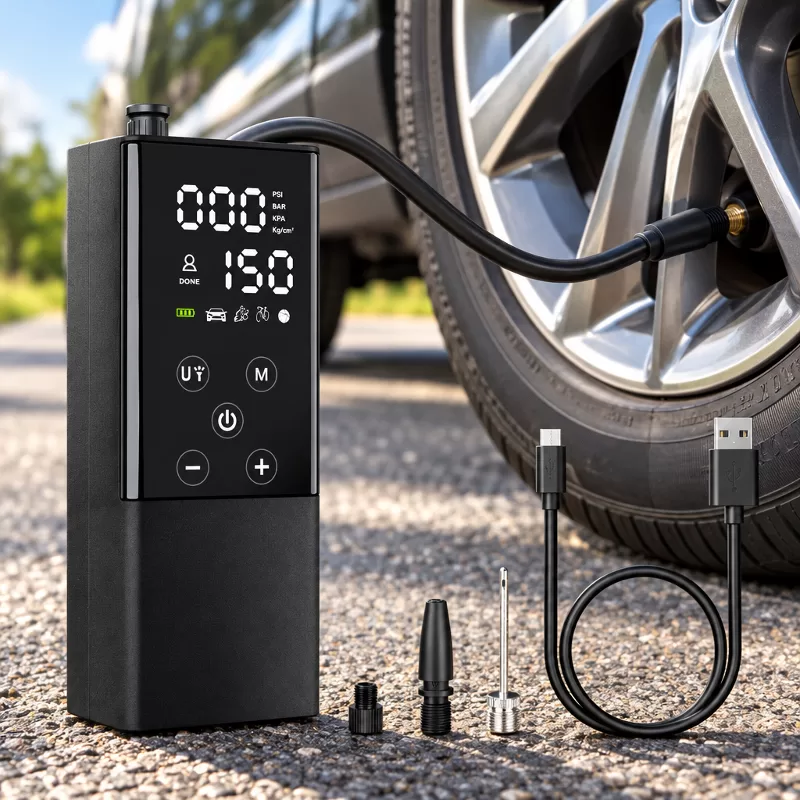
Finding a tire soft before a morning commute or out on a quiet secondary road can turn a predictable schedule into an inconvenient disruption. A portable smart tire inflator addresses this situation by pairing an integrated pressure control interface with a rechargeable internal battery, helping drivers and riders adjust tire pressure without relying on a stationary mains connection or a roadside facility. Rather than driving on under-inflated rubber to find an operational service bay, you can check and top off pressure directly from a compact handheld housing.
Maintaining appropriate inflation pressure is a foundational maintenance habit that directly influences vehicle handling, braking stability, and rolling resistance. Modern portable inflation devices have moved away from basic analog dial needles toward digital displays that monitor pressure as air enters the chamber, stopping inflation once a designated target value is reached. This guide explores the mechanical principles behind compact electric pumps, reviews objective criteria for choosing an appropriate model, and details practical operating techniques across automotive, cycling, and recreational applications.
Understanding the Portable Smart Tire Inflator
What Defines a "Smart" Electric Air Pump?
Traditional portable inflation gear has historically relied on two conventional formats: manual hand or floor pumps, and 12V corded compressors powered through a vehicle auxiliary outlet. Manual pumps require continuous physical exertion and are slow when working against large tire volumes, while corded 12V units require unraveling wiring through car doors and often feature vibrating mechanical gauges where identifying exact pressure readings can involve guesswork. Without careful monitoring, an unassisted pump can easily run past an intended pressure level.
Many smart inflators incorporate electronic pressure sensing, automated control circuits, and internal lithium battery packs within a self-contained chassis. As a category, these units measure pressure when attached to a tire valve stem, allowing users to enter a target pressure value. The system powers an internal electric motor until the detected reading matches that programmed value, triggering an automatic shut-off. In the case of specific consumer models like the GP2, the unit is specified with a dual LCD pressure display, preset modes, and automatic shut-off to manage this sequence cleanly without continuous manual timing.
The Real-World Problems Portable Inflators Solve
Seasonal temperature shifts represent one of the most common causes of low tire pressure warnings. In typical automotive conditions, tire pressure drops by approximately 1 PSI for every 10 degrees Fahrenheit reduction in ambient temperature. Drivers confronting an unexpected warning light on a cold morning often encounter out-of-order service station compressors or inconvenient detours, making an onboard cordless pump a practical alternative for routine adjustments.
For cyclists and outdoor enthusiasts, pressure adjustments frequently occur far from garages or bike shops. While a portable electric pump cannot repair structural tire damage, torn casings, or unsealed punctures, it provides a controlled air source to re-inflate repaired tubes or top up slow pressure losses until a permanent workshop service is possible. Storing an independent pneumatic tool in a travel kit provides accessible inflation support whenever pressure needs to be checked or adjusted.
Key Buying Criteria: How to Evaluate a Compact Electric Pump
Stated Maximum Pressure vs. Actual Tire Requirements
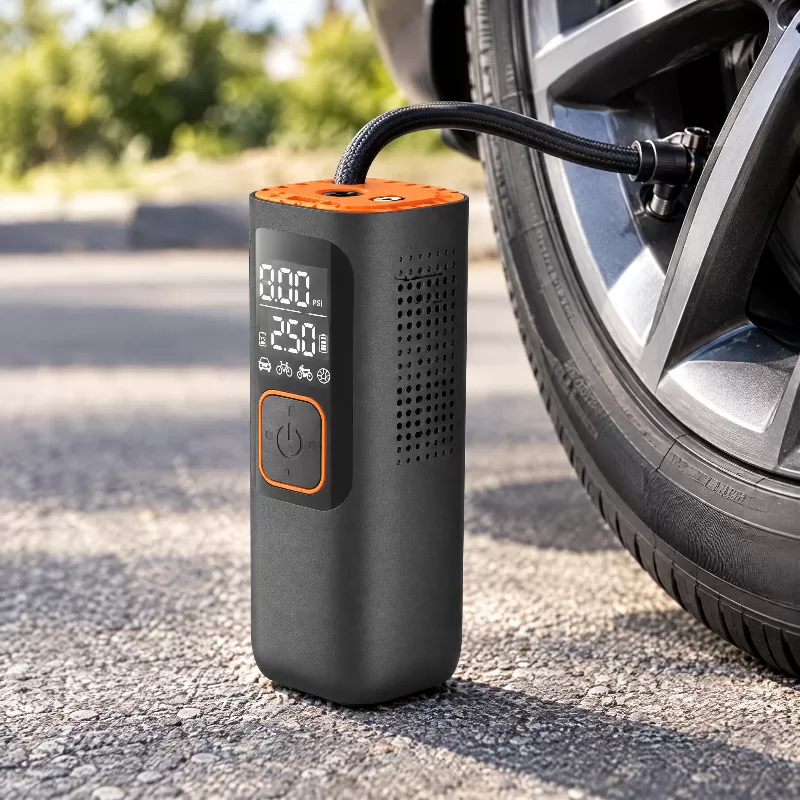
Compact inflators frequently list a 150 PSI maximum pressure specification on their technical data sheets, which can sometimes be misunderstood by car owners. The 150 PSI figure is the manufacturer-listed maximum pressure capability of the inflator; it is not the recommended pressure for most tires and is not a burst-rating certification. Many passenger vehicles use recommended cold pressures in the low-to-mid 30 PSI range, though exact numbers depend entirely on vehicle specifications.
The listed pressure range may accommodate some higher-pressure bicycle tires, but users should confirm the required pressure, connector compatibility, and manufacturer performance data for the specific tire. Conversely, sports balls frequently require low operating pressures, often below 10 PSI, where small variations alter bounce and feel. A versatile electric inflator must deliver stable motor operation and controlled air delivery across both low-pressure sporting gear and higher-pressure tires.
Airflow Rate, Cylinder Architecture, and Inflation Speed
While maximum pressure indicates mechanical tolerance against backpressure, airflow delivery indicates volume throughput over time. In compact electric inflators, airflow is commonly measured in liters per minute (L/min) under nominal test conditions. For example, the GP2 is listed with a 14-cylinder specification and an airflow delivery rate of 15 to 18 L/min, providing a compact configuration suited for portable consumer inflation tasks.
Actual inflation times depend heavily on tire volume, initial starting pressure, ambient temperature, and battery charge status. A smaller internal pneumatic cylinder configuration requires longer runtimes to transfer a given volume of atmospheric air, whereas an enlarged cylinder demands higher motor wattage and heavier battery cells. Evaluating airflow ratings alongside battery capacity helps ensure the selected unit aligns with your intended inflation tasks without carrying unnecessary physical weight.
Battery Capacity, Power Management, and Duty Cycles
Compressing atmospheric air requires notable electrical power, as mechanical friction and air compression generate heat during extended operation. High-drain applications benefit from multi-cell lithium battery packs. The GP2 is specified with a 2000mAh, 7.4V, 14.8Wh battery and a 35W motor, providing a dedicated power source within a portable footprint.
Battery management systems incorporate protection thresholds to safeguard the power cell. For the GP2, the manufacturer specification lists battery protection voltages of 8.4V and 6V. Portable electric inflators typically offer a continuous runtime of 15 to 20 minutes under load before a rest period is recommended to manage internal heat. Recharging via a standard 5V/2A Type-C input (drawing approximately 10W input power) generally requires 2 to 3 hours from a discharged state.
Pressure Measurement Accuracy and Display Interfaces
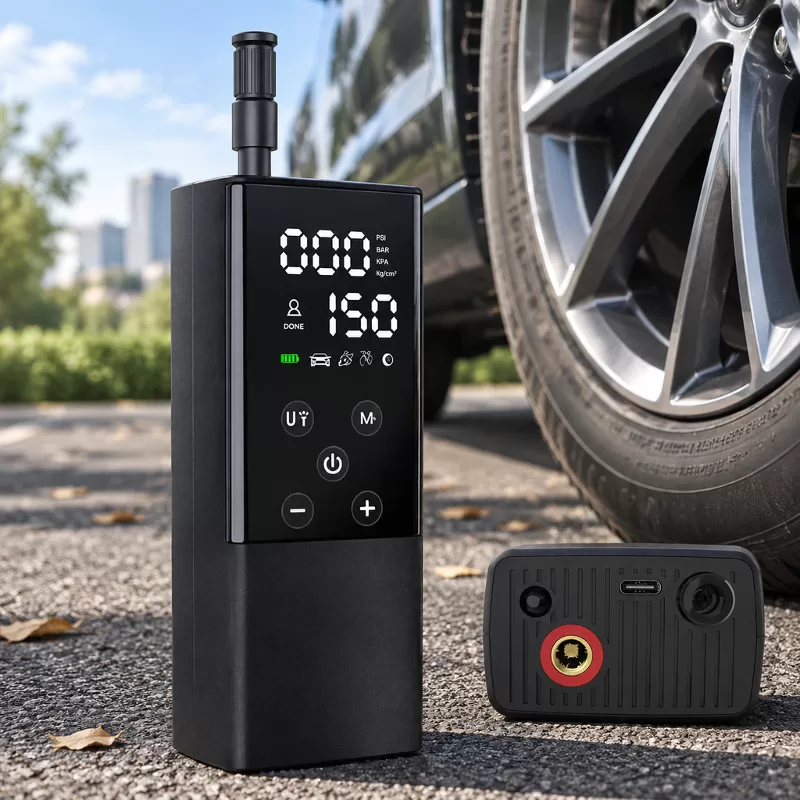
A dependable inflation tool requires an unambiguous interface to communicate working conditions to the user. Many modern smart air pumps feature dual digital display layouts that show both the real-time measured tire pressure and the user-selected target pressure simultaneously. This side-by-side presentation allows users to monitor inflation progress directly without needing to toggle through intermediate screens.
Analog mechanical gauges can experience needle sticking or calibration drift if subjected to vehicle vibrations or drops on pavement. In contrast, digital LCD screens operated via touch-button controls provide clear numerical readouts of measured values. While visibility depends on the display construction and prevailing ambient light, digital interfaces eliminate the viewing angle errors common to mechanical needle gauges.
Product Spotlight: GP2 Smart Tire Inflator 150PSI
Engineering Specifications and Form Factor
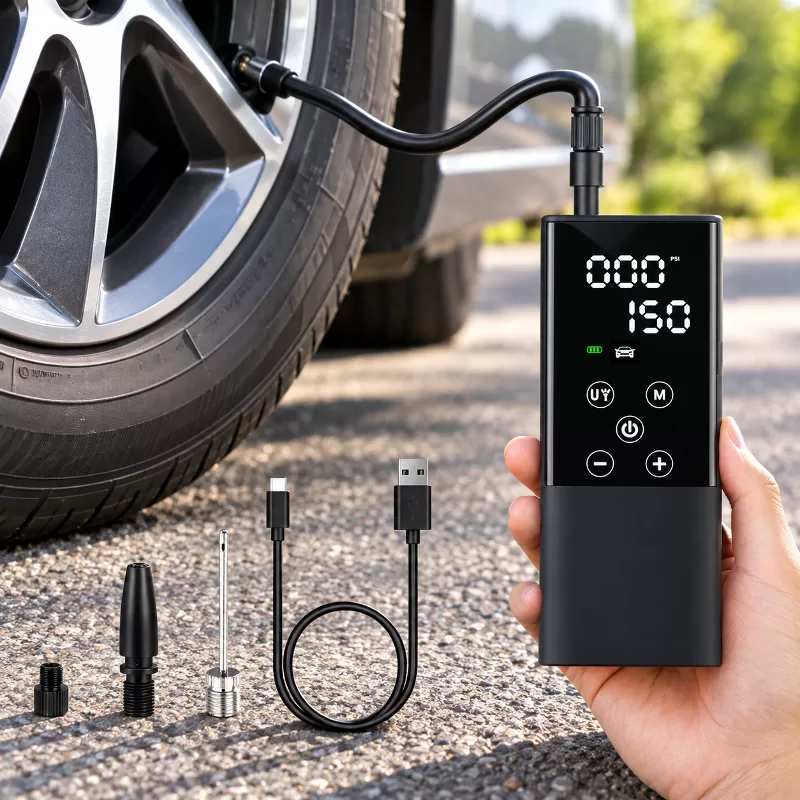
For drivers, riders, and travelers seeking an integrated cordless option, the Smart Tire Inflator 150PSI GP2 illustrates how functional pneumatic components can fit into a compact profile. With listed product dimensions of 155 × 62 × 39 mm and an official net weight of 428 grams, the device is easy to carry in a travel kit or keep inside a vehicle compartment. The exterior pairs a smooth satin-matte body with an LCD touch-button control interface.
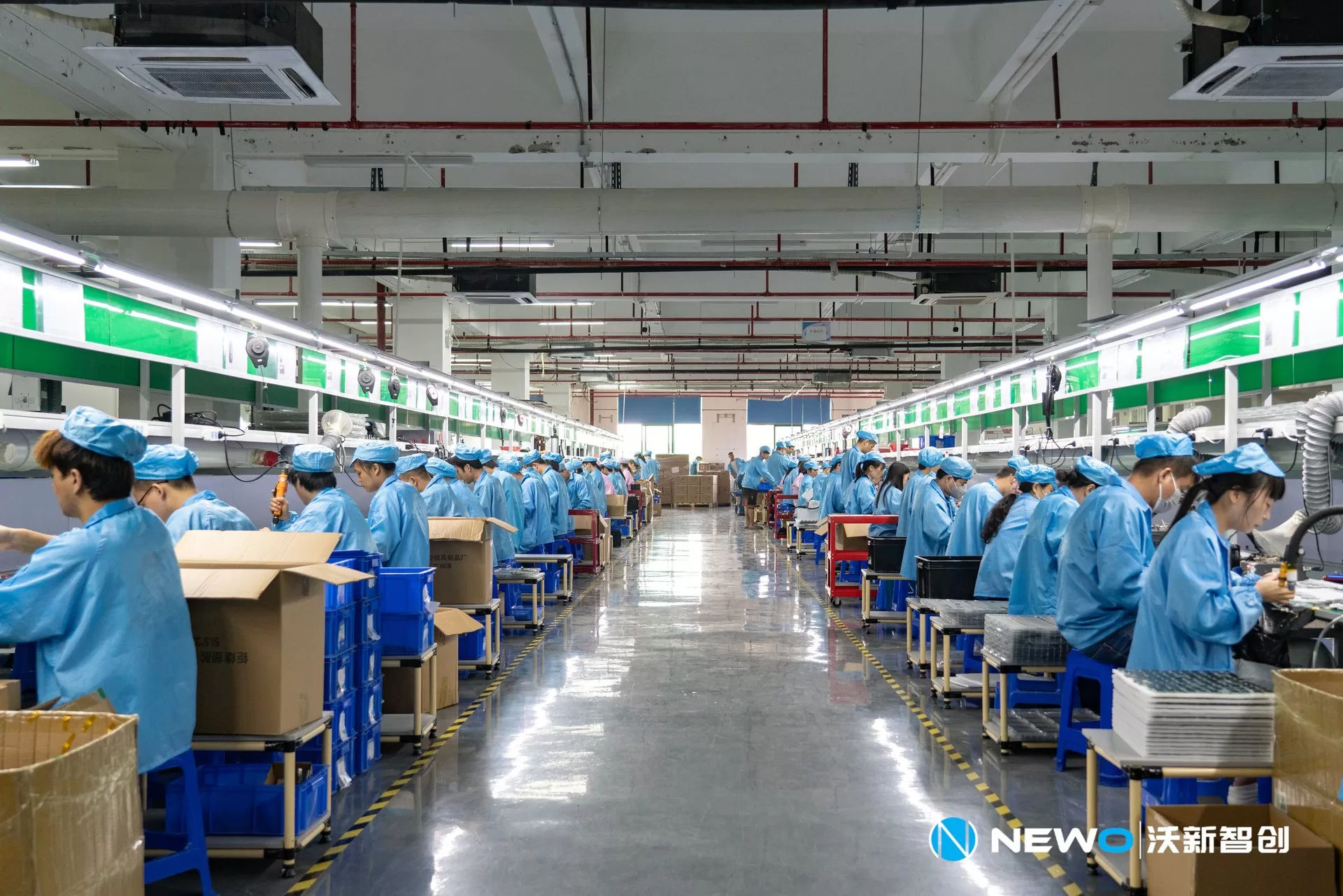
As a professional manufacturer, Newo specializes in smart electric air pumps and portable inflation equipment, focusing on pneumatic technology and portable designs for consumer applications. The GP2 model incorporates a 35W brushed motor rated for a service life of 200 to 400 hours, paired with an internal cooling fan to assist thermal regulation. Operating noise is rated at or below 85 dB at a one-meter distance, and the housing includes an internal storage slot designed to stow the flexible air hose when not in use.
| Technical Parameter | GP2 Product Specification |
|---|---|
| Model Designation | GP2 Portable Electric Air Pump |
| Stated Pressure Range | 0 to 150 PSI (Manufacturer Rated Maximum) |
| Air Delivery Rate | 15 to 18 L/min |
| Battery Specification | 2000mAh, 7.4V, 14.8Wh Lithium-Ion |
| Charging Interface & Time | Type-C (5V/2A, 10W input); 2 to 3 hours |
| Motor Configuration | 35W Brushed Motor (200–400 hours rated life) |
| Cylinder Specification | 14 cylinder |
| Rated Runtime | 15 to 20 minutes continuous |
| Dimensions & Net Weight | 155 × 62 × 39 mm; 428g (Gross: 528g) |
| Operational Noise Level | ≤ 85 dB measured at 1 meter |
| Rated Operating Temperature | Minus 10°C to 45°C |
Integrated Protection Systems and Thermal Management
Air compression naturally concentrates thermal energy inside an inflator pump head during continuous use. The GP2 includes an internal cooling fan along with dedicated lateral casing vents designed to assist heat dissipation during active pumping. While these features facilitate air circulation around the motor, operational temperatures still rise during extended cycles, making it advisable to allow periodic cooling when running multiple cycles.
On the electrical side, the GP2 integrates motor overcurrent protection to shut down operation if the mechanism encounters excessive resistance, along with short-circuit controls and low-voltage protection thresholds. The unit is rated by the manufacturer to operate within an ambient temperature span of minus 10°C to 45°C. Actual runtime and battery output can vary depending on external ambient temperatures and the backpressure encountered during inflation.
Multi-Scenario Presets and Adapter Versatility
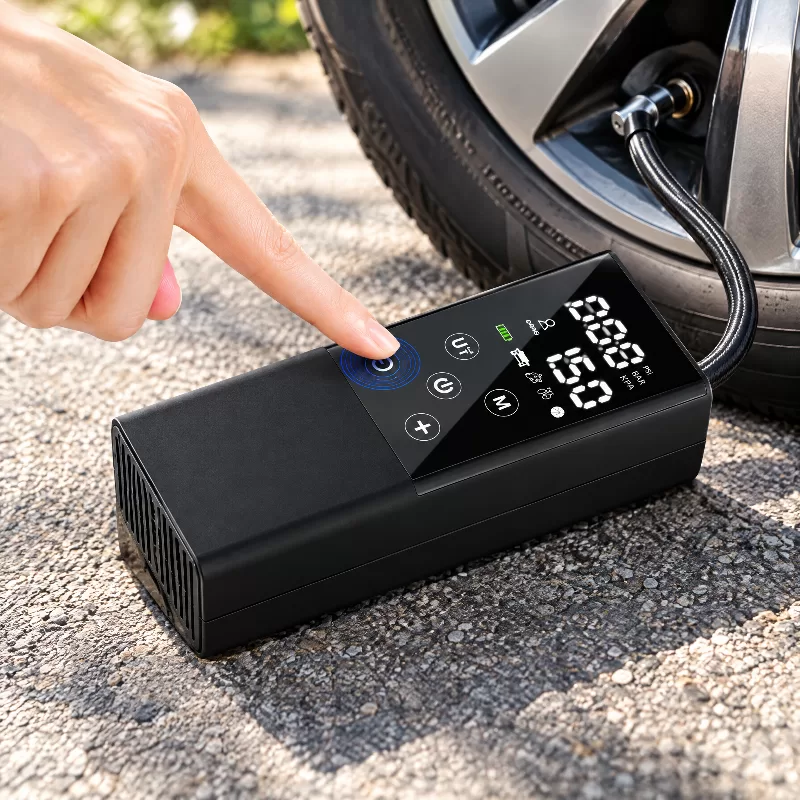
To simplify operation across various inflatables, the GP2 features five preset application modes that provide standard starting target pressures. Users can adjust these baseline values using the touch-button controls on the front panel to match specific manufacturer recommendations. Once set, the digital display tracks the live pressure rise until the programmed target is met.
Different inflation tasks require specific mechanical connections. The GP2 comes with a flexible air hose alongside accessory adapters designed for vehicle tires, bicycles, sports balls, and recreational items. An integrated LED light provides illumination when working in dim environments, and the internal 14.8Wh battery pack can supply auxiliary power-bank charging if a compatible connection is used during travel disruptions.
Step-by-Step Safe Operation Guide
[1. Check Placard Target] -> [2. Thread Hose to Valve] -> [3. Confirm Units & Preset] -> [4. Inflate with Auto-Stop] -> [5. Disconnect & Cap]
1. Determining Cold Tire Pressure Targets
Always check the vehicle placard rather than the sidewall marking when establishing the correct cold tire inflation pressure for your car. The vehicle placard, typically located on the driver-side door pillar or noted in the owner’s manual, specifies the manufacturer’s recommended cold pressure based on vehicle chassis weight and load distribution. In contrast, the tire sidewall indicates only the maximum permissible cold inflation limit for that particular tire casing.
A tire is considered cold after the vehicle has been parked for at least three hours, or after it has been driven less than one mile following that period of rest. Driving generates friction that heats the air inside the tire, temporarily raising internal pressure readings. Adjusting pressure when the tire is warm can lead to under-inflation once the assembly cools back to ambient conditions.
2. Hose Connection and Static Pressure Verification
Remove the dust cap from the tire valve stem and check that the valve threads are clear of grit or moisture. Retrieve the inflator hose from its storage housing and connect the supplied hose fitting squarely to the valve stem. Threading the connector evenly creates a solid mechanical fit and prevents air leaks during operation.
When the hose chuck engages the valve core pin, the inflator display activates to indicate the current static tire pressure. Compare this detected value against the target pressure specified on your vehicle placard to determine the adjustment needed. If an audible hiss persists after connecting the hose, unthread and reseat the connector to ensure the internal rubber gasket is seated properly against the stem.
3. Setting Unit of Measurement and Target Pressure
Power on the device interface and cycle to the appropriate preset mode or manual setting for your application. Select the pressure unit supported by the device that matches the units specified in your vehicle or equipment documentation. Automotive specifications commonly use PSI, while international references may specify values in BAR or KPA.
Use the touch-button controls on the front panel to adjust the target pressure display to your exact requirement. For example, if your vehicle specification calls for 33 PSI and the detected static reading shows 29 PSI, set the target display to 33 PSI. The dual display layout allows you to view your active baseline reading alongside your desired target before starting the motor.
4. Activating Inflation and Auto-Stop Monitoring
Once the target pressure is set, press the primary power button to activate the internal 35W motor. The pump will begin delivering air through the 14-cylinder mechanism, accompanied by a steady mechanical hum. Place the inflator on flat ground adjacent to the wheel so the unit remains stable during the cycle.
As the pump runs, the digital display reflects the rising pressure measured inside the valve line. The automatic shut-off function is designed to stop inflation when the selected target is reached, helping prevent over-inflation; however, it remains good safety practice to verify the final pressure with a suitable independent gauge when working with safety-critical tires. Remain nearby during operation to monitor the connection and observe progress.
5. Disconnection, Hose Storage, and Inspection
When the motor stops at the target value, unthread the hose connector from the valve stem in a smooth, continuous counterclockwise motion. A brief hiss of escaping air is normal as the chuck clears the valve pin, and prompt removal keeps air loss to a minimum. Once disconnected, inspect the valve stem briefly and screw the protective dust cap back on firmly.
Remove any specialized adapters used during bicycle or sports ball inflation and return the air hose into its designated storage slot within the GP2 housing. Power off the display panel, check that the battery level remains sufficient for upcoming needs, and store the device in a dry, protected location inside the vehicle or equipment bag.
Practical Applications and Realistic Capabilities
Passenger Cars and Light Commuter Vehicles
For sedans, hatchbacks, and compact crossovers, the GP2 is intended for routine pressure adjustments on compatible vehicle tires, although actual performance depends on tire size, starting pressure, battery charge, and ambient temperature. Routine top-offs—such as bringing a passenger tire up by 3 to 5 PSI—represent the standard use case for a compact battery inflator. It serves as an accessible tool when dashboard warning lights illuminate during seasonal temperature shifts.
Expectations must remain realistic, however, when dealing with completely flat, large-volume tires. Filling an empty light-truck or large SUV tire from zero PSI requires compressing a substantial air volume, which will place heavy demands on a compact battery pack and may require pausing for motor cooling. For severe bead seating or fully depleted high-volume tires, high-capacity workshop compressors remain the standard choice, while compact inflators excel at periodic top-offs and routine maintenance.
Motorcycles, Scooters, and E-Bikes
Two-wheeled vehicles operate with smaller air volumes, making them sensitive to minor pressure variations. Under-inflated motorcycle or scooter tires can compromise cornering stability, wet-weather grip, and electric drive range. At the same time, tight wheel hubs and dual brake disc assemblies can make rigid service station air chucks awkward to attach.
Its flexible hose may make connection easier where valve access is limited, but users should confirm clearance on the specific wheel and valve configuration. The 15 to 18 L/min air delivery can adjust pressure across two-wheeler tires efficiently, though exact inflation times depend on tire volume and initial pressure. Its compact form factor allows riders to stow the device in a tail bag or pannier for road trips.
Road Bicycles, Gravel, and Mountain Bikes
Bicycle tires span a wide spectrum of inflation pressures depending on riding discipline and setup. High-volume mountain bike and gravel tires often run at lower pressures for trail traction, whereas narrow road tires require significantly higher pressures to protect rims and maintain rolling efficiency. In every case, the rider or tire manufacturer remains responsible for choosing the target pressure appropriate for the tire, rim, and rider weight.
The GP2 features a manufacturer-rated pressure range of 0 to 150 PSI, allowing users to select appropriate targets for various bicycle setups. The internal 2000mAh battery pack is rated to inflate approximately 8 to 12 bicycle tires on a full charge, depending on tire volume and target pressure. This capability makes it a practical addition to home workshops or vehicle-supported cycling outings.
Sports Balls, Wheelchairs, and Inflatables
Athletic equipment requires adherence to specific manufacturer inflation guidelines. Over-inflating a basketball or soccer ball can strain its internal bladder and alter its bounce characteristics. By attaching the supplied ball needle and setting the pressure specified for the particular ball, users can inflate equipment to recommended specs without the guesswork of a basic hand pump.
Mobility gear also benefits from reliable air maintenance. For supported wheelchair and balance-vehicle applications, the inflator can help maintain the pressure specified for the equipment. The automated shut-off and clear digital display may be easier to operate than a manual pump for some users, providing an accessible way to keep everyday equipment properly inflated.
Portable Battery Pumps vs. 12V Corded Compressors vs. Floor Pumps
Feature Comparison Table
Selecting an appropriate inflation tool involves balancing portability, power access, physical effort, and overall size. The table below outlines general operational distinctions between portable battery-powered inflators, 12V corded compressors, and manual floor pumps.
| Feature Category | Portable Smart Inflator (GP2) | Selected 12V Corded Compressors | Selected Manual Floor Pumps |
|---|---|---|---|
| Primary Power Source | Integrated 7.4V Rechargeable Battery | Vehicle 12V DC Auxiliary Socket | Manual Physical Operation |
| Operator Effort | Motor Driven (Push-Button Start) | Motor Driven (Switch Activated) | Continuous Manual Pumping |
| Power Cable Needs | None (Cordless Mobility) | Dependent on 12V Socket Lead | None (Completely Cordless) |
| Pressure Monitoring | Digital Display with Target Auto-Stop | Typically Gauge-Monitored | Integrated Base or Barrel Gauge |
| Stated Pressure Range | 0 to 150 PSI Maximum Rating | Varies by Model Specification | Varies by Barrel Design |
| Relative Housing Size | Compact Handheld (155 × 62 × 39 mm) | Varies; Often Box-Style Trunk Unit | Tall Upright Workshop Tool |
| Application Scope | Vehicles, Bicycles, Sports Equipment | Primarily Vehicle-Adjacent Tasks | Bicycles and Inflatable Sports Gear |
Decision Guide: Which Inflation Tool Fits Your Needs?
A portable smart tire inflator is well suited for drivers, daily commuters, and multi-sport households looking for a self-contained tool that operates without vehicle cables. Its cordless design allows you to move freely around all four wheels or carry it to a trail staging area without needing a nearby power source. Its compact dimensions make it practical to keep inside a vehicle console or gear bag.
On the other hand, heavy commercial vehicles or large off-road fleets with high-volume tires may be better served by heavy-duty 12V compressors designed for high continuous airflow. Similarly, dedicated bicycle mechanics often rely on manual floor pumps in home workshops where immediate mechanical action is preferred without needing battery charging. Assessing your primary inflation tasks will help clarify which tool format fits your routine.
Battery Care, Storage, and Maintenance Best Practices
Preserving Lithium-Ion Battery Lifespan
Proper storage and charging habits help maintain the service life of an internal lithium-ion battery pack. The GP2 battery is rated for 300 cycles while retaining at least 85% of its original capacity under standard testing conditions. To help maintain cell health over time, avoid leaving the device in a completely discharged state for prolonged periods, and follow the manufacturer’s storage and charging guidelines.
Storage temperatures also influence long-term battery performance. The GP2 has a specified operating temperature range of minus 10°C to 45°C. Avoid prolonged storage in direct sunlight or very hot locations, and follow the manufacturer’s storage instructions. Storing the inflator in a shaded vehicle compartment or inside an equipment bag helps keep the unit protected from direct thermal exposure.
Operating Thermal Hygiene and Duty Cycles
Because air compression generates friction and heat, users should follow the manufacturer’s duty-cycle recommendations during operation. The GP2 lists a rated continuous runtime of 15 to 20 minutes under load. When topping off multiple tires in succession, pause operation if the housing feels excessively warm to the touch, giving the internal fan and ventilation openings time to assist cooling.
Keeping the exterior casing and cooling vents free of dust, dirt, and road debris ensures proper airflow through the housing. Never cover the ventilation holes while the motor is active, and avoid exposing the pump to standing water or heavy rain. Following these basic maintenance practices supports consistent mechanical operation across routine top-offs and roadside emergencies.
Frequently Asked Questions (FAQs)
Why does my car tire require 32–35 PSI if the inflator is rated for 150 PSI?
The 150 PSI figure is the manufacturer-listed maximum pressure capability of the inflator, indicating the upper pressure limit the internal pump can deliver. It does not represent a recommended pressure for automotive tires. Recommended cold tire pressure for passenger vehicles is established by the vehicle manufacturer and listed on the door pillar placard to optimize braking performance, traction, and tire wear. Inflating a passenger car tire to 150 PSI would dangerously over-pressurize the casing.
Can a portable smart tire inflator seat a tubeless bicycle tire bead?
Seating a tubeless bicycle tire bead often requires an immediate burst of high-volume air to push the tire bead firmly onto the rim shelf. The GP2 delivers a metered airflow of 15 to 18 L/min, which is designed for steady, controlled inflation rather than high-volume bursts. It may seat some loose-fitting setups, but difficult bead seating may require a workshop compressor or dedicated tire booster; do not rely on the GP2 for bead seating without testing the specific rim and tire combination.
How does ambient temperature affect digital pressure readings?
Ambient temperature affects tire pressure through natural gas laws: air contracts in cold temperatures and expands when heated, resulting in a change of roughly 1 PSI for every 10°F shift in temperature. While the GP2 is specified to operate between minus 10°C and 45°C, users should measure tire pressure when tires are cold and at outdoor ambient temperature. Checking pressure in a heated garage before heading into winter weather can result in under-inflated tires on the road.
Can the GP2 smart tire inflator be used as an emergency power bank?
The GP2 includes power-bank functionality powered by its internal 2000mAh, 7.4V (14.8Wh) battery pack, which can provide backup power in an emergency. You can use it as a power bank if the supplied model configuration provides the required output connection for your mobile device. While secondary to its primary role as an air pump, this feature provides practical utility when traveling.
How often should tire pressure be checked using an electric pump?
Tires can lose roughly 1 PSI per month under normal conditions, and temperature shifts or minor valve leaks can cause additional pressure loss. Inspecting tire pressure once every month and before embarking on extended highway trips helps maintain proper inflation levels. Having a portable smart tire inflator on hand makes these routine checks straightforward without needing a trip to a service station.
Can an electric inflator run continuously until all four car tires are filled from empty?
The GP2 is rated for a continuous runtime of 15 to 20 minutes under load. While it easily handles routine top-offs across four passenger tires (such as adding 3 to 5 PSI per wheel), filling four completely flat tires from zero involves sustained operation that may exceed the continuous duty cycle. When performing heavy inflation work, it is best practice to let the pump rest periodically to allow the internal fan and vents to dissipate heat.
Practical Readiness on the Road
Consistent tire pressure management directly supports driving safety, fuel economy, and tire tread life. Incorporating a portable smart tire inflator into your travel equipment provides a straightforward way to maintain appropriate pressures across cars, motorcycles, bicycles, and recreational gear. With its automated shut-off, multi-scenario presets, and compact cordless design, a portable electric pump delivers reliable inflation support whenever and wherever you need it.
-

Meet NEWO at the 140th Canton Fair: Visit Booth 10.3 M03–04
Meet NEWO at the 140th Canton Fair in Guangzhou, October 15–19, 2026. Visit Booth 10.3 M03–04 to explore portable air pumps and discuss OEM, ODM and distribution opportunities.... -

As Shenzhen Welcomes the World for APEC 2026, NEWO Welcomes You to Our Factory
As Shenzhen prepares for APEC 2026, NEWO welcomes international buyers and partners to visit our factory, meet our team and explore future cooperation.... -

Leading the Way in Product Innovation and Excellence
Smartnewo exemplifies professionalism in product innovation and manufacturing. Their collaboration with Xiaomi Youpin on the G01 crowdfunding project highlights their expertise in creating compact, powerful inflatable pumps. Rigorous engineering, meticulous production processes, and advanced quality assurance underscore their commitment to excellence. The success of the G01 project, with significant market... -

Essential Qualities of an Excellent Supplier
In today's competitive market, finding a reliable supplier is crucial for business success. Based on insights from Smartnewo and broader internet research, here are key qualities an excellent supplier must possess:... -

NW06 Tire Inflator: Compact Power for Quick Inflation
Summary The NW06 Tire Inflator delivers quick and efficient tire inflation with a powerful 35L/min airflow. It features a user-friendly LCD screen for real-time pressure monitoring, dual power options with a built-in 6000mAh battery, and multiple nozzle attachments for versatile use. Its compact design and integrated LED light ensure convenience and... -

Unleash the Power of Portability: The SmartNewo Jump Starter with Air Compressor KF03
This guide will walk you through the steps to effectively use a portable tire inflator, helping you stay prepared and safe on the road.... -

Newo Attends The 2024 Consumer Electronics Show (CES)
Smartnewo booth is located at 53672, Halls A-D, Level 2, Venetian Expo, Las Vegas Convention Center (LVCC). ... -

Smartnewo’s Dual-Cylinder Air Pump Rocks the Hong Kong Autumn Electronics Fair!
Smartnewo’s Dual-Cylinder Air Pump Rocks the Hong Kong Autumn Electronics Fair!... -

Meet at the Canton Fair! Smartnewo brings dual-cylinder air pumps, making your inflation experience faster and more stable!
NEWO has went deep communication and negotiation with customers from all over the world on booth.... -

“Hong Kong Autumn Electronics Fair – 1CA18 (October 13th to 16th): Smartnewo invites you to visit our booth!
Hong Kong Autumn Electronics Fair...










-

What to Check Before Ordering Custom Electric Bike Pumps
Plan custom electric bike pumps with a clear requirements freeze for valves, TPU tubes, portability, repeated top-ups, charging, and model-specific documents.... -

OEM vs ODM Air Pumps: Which Manufacturing Model Fits Your Brand?
Compare OEM and ODM air pump projects by design responsibility, change approval, development scope, and written ownership terms before choosing your route.... -
How to Choose a Reliable Tire Inflator Manufacturer in China
Choose a tire inflator manufacturer in China with a focused RFQ, supplier evidence, configuration checks, and clear sample-to-pilot decisions for your brand.... -

Rechargeable Electric SUP Pump for Paddle Boards: Faster Inflation for SUPs, Kayaks and Inflatable Tents
The BL10-C Portable Electric Bike Tire Inflator is a compact and lightweight mini electric bike pump designed for modern cyclists. With up to 120 PSI pressure, a digital LED display, preset pressure control, automatic shut-off, USB-C charging, and multiple valve adapters, BL10-C offers a convenient inflation solution for road bikes,... -

Are Electric Bike Pumps Worth It in 2026? Electric Pump vs CO₂ vs Mini Hand Pump
Discover whether electric bike pumps are worth it in 2026. This guide compares electric bike pumps, CO₂ inflators, and mini hand pumps for road cycling, gravel riding, commuting, and long-distance rides. Learn the pros, limitations, best use cases, and key features to look for before choosing the right portable tire... -
BL10-C Portable Electric Bike Tire Inflator: Small Size, Reliable Power for Every Ride
The BL10-C Portable Electric Bike Tire Inflator is a compact and lightweight mini electric bike pump designed for modern cyclists. With up to 120 PSI pressure, a digital LED display, preset pressure control, automatic shut-off, USB-C charging, and multiple valve adapters, BL10-C offers a convenient inflation solution for road bikes,... -

Why Mini Electric Bike Pumps Are Becoming Essential for Modern Cycling
Discover why mini electric bike pumps are becoming essential for modern cyclists. Learn how portable electric bike pumps improve tire pressure management, riding safety, and convenience.... -

The Ultimate Smart Solution for Easy Outdoor Adventures in 2026
Discover how a spring travel air pump simplifies outdoor trips with fast inflation, smart features, and powerful performance—perfect for every adventure.... -

Powerful 5-in-1 Portable Car Tire Inflator and Jump Starter: The Ultimate Emergency Tool for Every Driver
Why Every Driver Needs a Portable Car Tire Inflator and Jump Starter Modern drivers face many unexpected situations on the road. A flat tire, low tire pressure, or a dead car battery can happen at the worst possible time. That’s why having a portable car tire inflator and jump starter is... -

7 Real Cycling Scenarios That Show Why Every Rider Should Carry a Mini Bike Pump
Cycling is one of the most freeing activities you can enjoy. Whether you’re commuting to work, riding through city streets, or exploring quiet countryside roads, a bike ride can instantly improve your day. But there’s one small problem that almost every cyclist eventually faces: Low tire pressure. It might happen...







-
How Is a Football Properly Inflated?
The correct inflation of a football - with not too much and not too little air - is a hotly debated topic among footballers.... -
Application Scenarios of Car Inflator Pump
Often long-distance business trips or play car owners because the road may be more remote areas, in this case if you encounter a tire leak....

