

 Portable Tire Inflators
 Electric Air Pumps
 Electric Car Tyre Pumps
 Electric Ball Pumps
 Electric Bike Pump
 SUP Air Pump

Portable Tire Inflators: The Engineering, Selection, and Field Guide to Cordless Air Maintenance
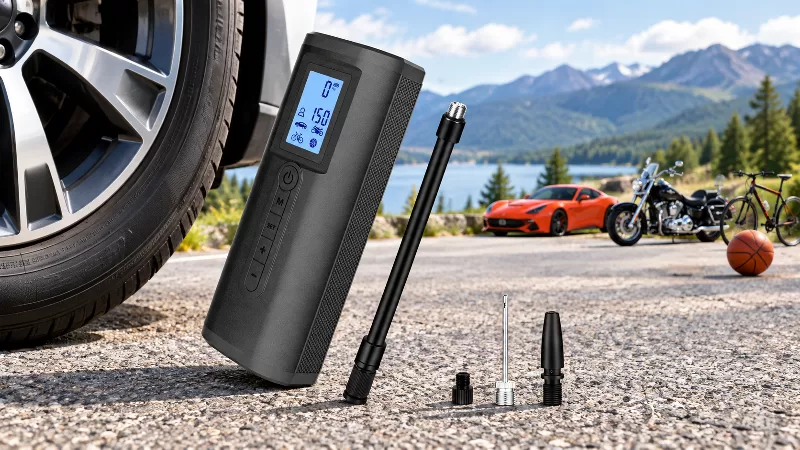
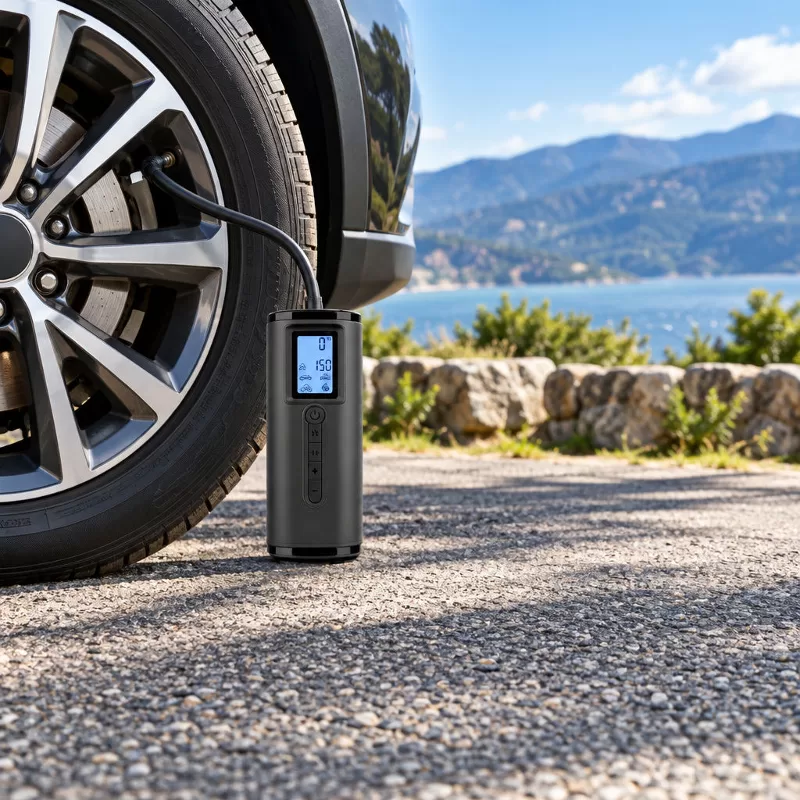
A tire rarely fails all at once; it bleeds pressure molecule by molecule in the dark. Modern portable tire inflators and cordless electric air pumps for car and bike tires give drivers direct control over this slow atmospheric leak before a dashboard warning light ever illuminates. Instead of hunting for a working service station hose on a freezing morning, keeping a compact auto shut-off tire inflator in your glovebox turns pressure calibration into a convenient driveway routine.
Most motorists assume that if a tire looks round against the asphalt, its internal air volume is safe. Visual inspection cannot reliably gauge pneumatic health, and tire pressure should always be checked with a gauge rather than judged by appearance. Understanding why air escapes and how micro-compressors restore it helps you choose equipment that works when you are miles from a garage.
Why Tire Pressure Fails Silently and How Portable Tire Inflators Solve It
Every pneumatic tire acts like a semi-permeable membrane rather than a sealed steel tank. Even when the valve core is tight and the rim bead is spotless, compressed air constantly seeks equilibrium with the lower pressure of the outside atmosphere. Recognizing the physical mechanisms behind pressure loss explains why periodic maintenance is unavoidable for every vehicle on the road.
The Physics of Rubber Permeation and Seasonal Thermal Drops
Butyl rubber inner liners slow down gas migration, yet they cannot stop oxygen and nitrogen molecules from squeezing through microscopic polymer gaps. Under normal driving conditions, a healthy tire is generally understood to lose a small amount of pressure through natural permeation each month. After a single season of neglect, all four corners of a vehicle can end up running noticeably below their intended inflation level.
Ambient weather shifts accelerate this pressure drop overnight. As a general rule of thumb used in automotive maintenance guidance, tire pressure tends to fall by roughly 1 PSI for every 10°F (5.6°C) decrease in outside air temperature. When an autumn cold front rolls through, a tire set to 35 PSI in warm weather can drop several PSI by sunrise, which is often enough to trigger the dashboard tire pressure monitoring system (TPMS) right as your morning commute begins.
The Hidden Cost of Relying on Service Station Air Towers
Waiting to inflate soft tires at a public gas station introduces a fundamental measurement flaw. Vehicle manufacturers specify cold inflation pressure on the driver’s door jamb placard, meaning the tire must sit parked for a few hours before measurement. Driving even a short distance to a coin-operated air tower flexes the rubber carcass and heats the internal air, raising the gauge reading and tricking you into underinflating the tire once it cools back down.
Operating a vehicle on underinflated rubber carries real financial and safety penalties. Underinflation is a commonly cited factor behind uneven tread wear, reduced braking stability, and shortened tire life, while proper inflation helps tread wear more evenly across the contact patch. Excess sidewall flex also increases rolling resistance, which translates into a measurable fuel economy penalty as pressure drops below the recommended level.
How On-Board Micro-Compressors Change Maintenance Habits
Storing a handheld electric air pump inside the vehicle eliminates the friction that makes drivers procrastinate on maintenance. When you check and maintain the recommended pressure at home after the vehicle has been parked for at least three hours, you capture true cold pressure readings. Regular checks help support handling, stopping performance, and even tread wear across the contact patch.
Inside the Housing: Key Specifications That Define Portable Tire Inflators
Evaluating portable tire inflators requires looking past exterior styling to examine the mechanical and electrical architecture inside the shell. A pocket-sized pump must convert chemical battery energy into mechanical piston motion while managing intense compression heat. Using the Auto Shut off Tire Inflator 150PSI AP2-P specification sheet as a reference point illustrates how core hardware parameters work together in the field.
| Technical Parameter | AP2-P Specification | Practical Field Impact |
|---|---|---|
| Maximum Pressure Range | 0 to 150 PSI | Covers low-pressure balls up to high-pressure road bike tires |
| Volumetric Air Flow | 15 to 18 L/min | Determines inflation speed for passenger car and motorcycle tires |
| Motor Power | 35W brushed motor | Balances compact housing width with steady compression |
| Battery Energy | 14.8Wh pack rating (7.4V), per manufacturer | Delivers 20 to 30 minutes of cordless runtime per charge |
| Charging and Output | Type-C 5V/2A input; USB 5V/2A output | Recharges in 2 to 3 hours and doubles as an emergency power bank |
| Dimensions and Weight | 42 x 62 x 154 mm; 386 g net weight | Fits inside a jacket pocket, saddlebag, or car door bin |
| Acoustic Output | 85 dB or less, measured at 1 meter, per manufacturer rating | Manufacturer-rated noise level at one meter |
| Operating Temperature | -10°C to 45°C | Maintains functionality across winter frost and summer heat |
Maximum Pressure (PSI) Versus Volumetric Airflow (L/min)
Shoppers frequently confuse peak pressure rating with actual inflation speed. A 150 PSI maximum pressure rating indicates the ceiling force the piston can push against a closed column of air. Road bicycle tires require pressure levels that depend on tire width, rider weight, and the specific limits stated by the tire and rim manufacturers; the inflator’s 150 PSI maximum rating provides headroom to meet those manufacturer-specified requirements. Passenger-car tire pressure varies by vehicle; use the pressure on the vehicle’s tire-information placard.
Volumetric airflow, measured in liters per minute (L/min), dictates how fast a tire fills. In the AP2-P architecture, a 35W brushed motor drives the piston assembly to deliver an airflow rate of 15 to 18 L/min, according to the manufacturer’s specification sheet. This displacement volume provides a practical balance: the internal pump mechanism stays slim enough to fit a 42 by 62 by 154 mm casing while moving enough air for routine automotive top-offs.
Battery Architecture, Duty Cycles, and Thermal Dissipation
Compressing air inside a reciprocating cylinder generates heat around the cylinder head as a natural consequence of rapid gas compression. If that thermal energy stays trapped inside a sealed plastic shell, piston seals can degrade faster and lithium cells may lose capacity sooner than expected. Effective portable tire inflators integrate a built-in cooling fan alongside heat-emission openings and base ventilation grilles to help purge hot air during operation.
Power delivery must match this thermal envelope to support safe cordless operation. According to the product data for the AP2-P, the manufacturer lists a 14.8Wh pack rating at 7.4V, supporting a continuous working time of 20 to 30 minutes. That energy reserve is stated by the manufacturer to be sufficient to inflate roughly 10 to 15 bicycle tires on a full charge. The manufacturer specifies that the battery retains at least 80 percent of its original capacity after 300 charge cycles, and the product carries a 1-year warranty.
Pressure Sensor Accuracy and Auto-Shutoff Logic
Old analog dial gauges mounted on vibrating compressor housings are difficult to read accurately, especially when the needle bounces with every piston stroke. Digital pressure displays sample line pressure continuously and show the reading on a backlit LCD screen. Users can toggle between PSI, BAR, KPA, and Kg/cm² without doing mental math on the side of the road.
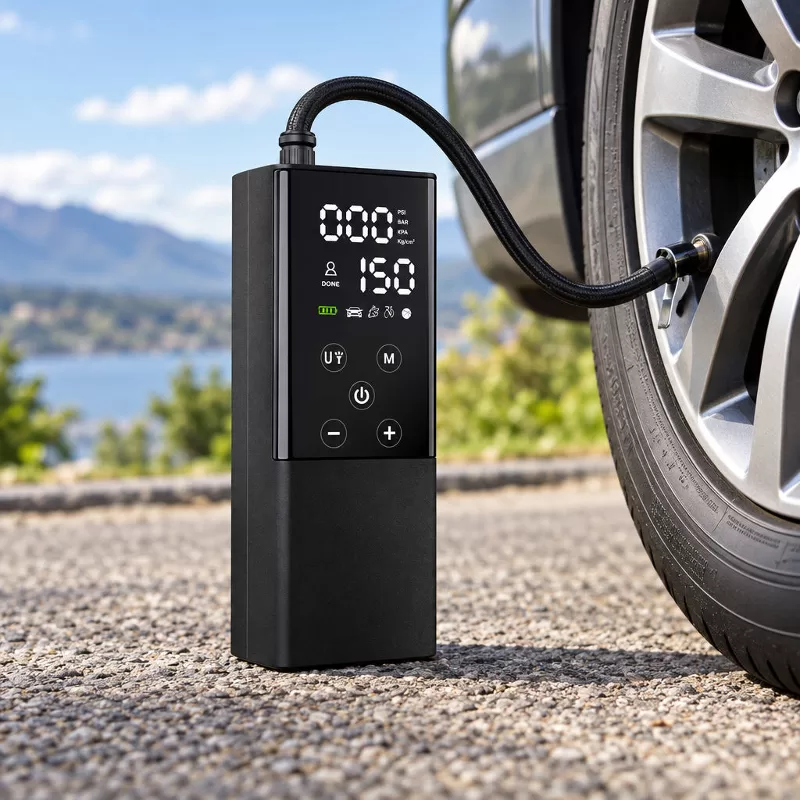
Automatic shut-off logic turns that digital reading into a hands-free safety control. Once you dial in a target value, the onboard control circuit monitors pressure and cuts power to the motor once the preset threshold is reached. Combined with an internal memory function that recalls your last pressure setting, this auto-shutoff behavior is designed to reduce the risk of accidental overinflation and help keep pressure consistent across wheels on the same axle.
Comparing Inflation Architectures: Cordless Handhelds vs. 12V Corded Pumps vs. Manual Pumps
No single air pump design serves every mechanical scenario equally well. An off-road driver airing up four oversized truck tires from 15 PSI back to 40 PSI in soft sand has different energy demands than a daily commuter maintaining a sedan or e-bike. Comparing cordless lithium handhelds against 12V cigarette-lighter units and manual floor pumps clarifies where each tool belongs.
| Evaluation Metric | Cordless Lithium Handheld | 12V Corded Car Compressor | Manual Floor or Frame Pump |
|---|---|---|---|
| Setup Speed | No vehicle power cord required | Requires vehicle power connection | Immediate, but requires sustained physical effort |
| Vehicle Compatibility | Works with listed applications when the correct connection or adapter is available | Restricted to vehicles with working 12V sockets | Best for bicycles; impractical for car tires |
| Portability and Weight | Ultra-compact (around 386 g) | Bulky housing with tangled power cords | Long barrel (floor pump) or low volume (hand pump) |
| Overinflation Protection | Digital preset with automatic shut-off | Available on select digital models; manual on analog | Manual monitoring only |
| Nighttime Roadside Utility | Integrated LED flashlight and USB power bank | Often includes basic work light; no USB battery | Zero electronics or lighting |
When Cordless Lithium Units Outperform 12V Cigarette Lighter Compressors
Traditional 12V corded compressors tether you to the vehicle’s auxiliary power outlet. Using one requires connecting to the vehicle’s 12V socket, uncoiling a stiff electrical cord, and routing it to reach each wheel. The setup depends on the vehicle’s electrical system and the compressor’s power draw.
Cordless portable tire inflators remove that tether restriction entirely. When maintaining a motorcycle, e-bike, mobility wheelchair, or self-balancing scooter, a 12V automotive plug is essentially useless because those machines lack cigarette lighter sockets. A self-contained battery pump moves freely from the trunk of a family sedan to a backpack or bicycle bottle cage without requiring an external power source.
Evaluating Multi-Scenario Versatility Across Vehicles and Gear
Households rarely own just one type of inflatable tire or equipment. During a single weekend, you might check the radial tires on a commuter car, adjust the tire pressure on an e-bike, and pump up a basketball for a neighborhood game. Switching manually between very different pressure targets on a basic pump invites guesswork if you forget the safe ceiling for smaller bladders.
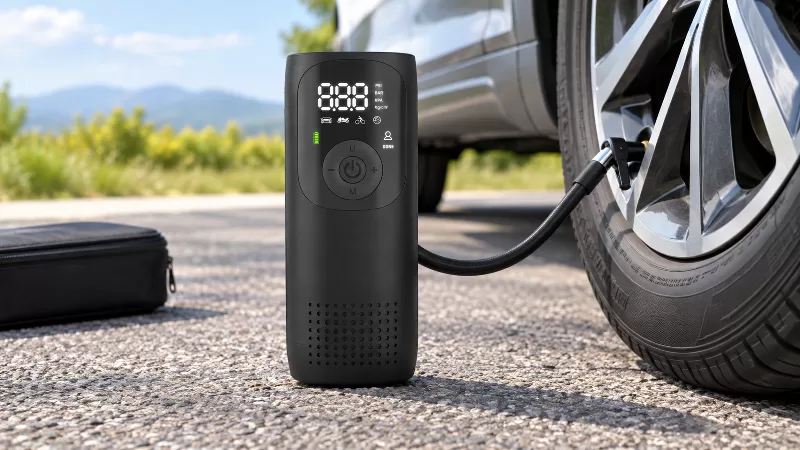
Dedicated mode presets streamline these transitions across different equipment types. On the AP2-P, pressing the mode button cycles through five distinct profiles: car, motorcycle, bicycle, ball, and a custom mode allowing manual selection anywhere from 0 to 150 PSI. The inflator includes three adapters for different inflation tasks.
Secondary Emergency Utilities: Power Bank Output and Roadside Illumination
Roadside tire trouble rarely happens in a well-lit parking lot at noon. Discovering a slow puncture on an unlit highway shoulder at night requires both illumination to locate the valve stem and a charged phone to call for assistance if the sidewall is torn. A single-purpose mechanical tool leaves you juggling a smartphone flashlight in one hand while threading a brass air chuck with the other.
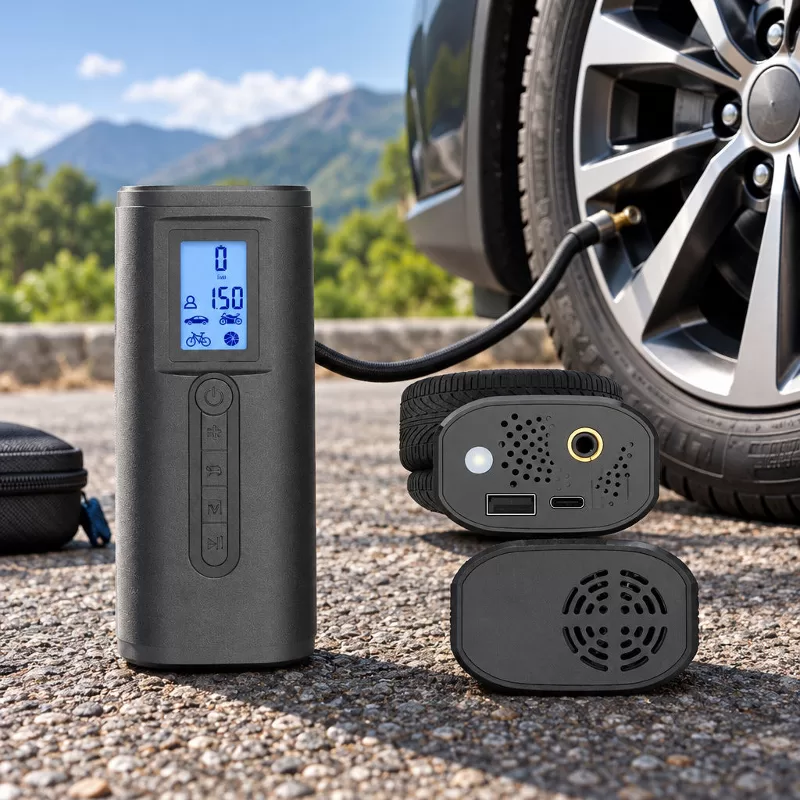
Integrating emergency electronics into the inflator housing helps address both problems at once. An upward-facing LED flashlight built into the casing can illuminate the wheel well and signal your position during dark roadside stops. Additionally, because the internal lithium pack stores meaningful electrical energy, a 5V/2A USB output port allows the pump to double as an emergency power bank for Android or iOS devices.
Step-by-Step Selection Framework: Matching an Inflator to Your Needs
Selecting the right cordless electric air pump requires matching the device’s physical output to your specific fleet and storage constraints. Rather than buying based on peak PSI numbers alone, evaluate how the internal components behave during your most frequent inflation tasks. Reviewing three core engineering indicators will help you filter out underpowered models before you buy:
- Thermal Duty Cycle and Continuous Runtime: Verify that the manufacturer specifies a clear continuous working time, such as up to 30 minutes alongside active fan cooling, so the unit is less likely to overheat halfway through topping off four passenger tires.
- Recharge Interface Standardization: Choose an inflator equipped with a universal Type-C 5V/2A charging port rather than a proprietary barrel plug, allowing you to recharge the battery inside your car using standard phone cables.
- Multi-Unit Display Clarity: Ensure the backlit LCD screen simultaneously shows real-time measured pressure and target preset pressure so you can track inflation progress at a glance in bright sunlight or pitch darkness.
Calculating Your Typical Pressure Top-Off Volume
Before purchasing a compact inflator, audit the air volume of the tires you maintain every month. Follow this three-step decision sequence to confirm whether a handheld cordless unit fits your routine:
- Identify your primary tire volume: If you drive a standard sedan, crossover, motorcycle, or bicycle, a compact 15 to 18 L/min cordless unit handles routine seasonal pressure adjustments without much effort.
- Assess typical top-off needs: For routine pressure checks and topping off tires that are slightly low, the manufacturer’s stated runtime of 20 to 30 minutes supports those tasks; however, if you regularly work with large-volume off-road truck tires or perform frequent deflation and reinflation cycles, pair your handheld unit with a heavy-duty compressor.
- Factor in charging intervals: Check that a 2 to 3 hour recharge window fits your travel schedule, especially when using the device on multi-day cycling or camping trips.
Assessing Acoustic Comfort, Weight, and Storage Footprint
Size and weight determine whether an emergency tool stays in your vehicle or gets left behind on a garage shelf. A heavy, brick-sized compressor is awkward to carry on a commuter bicycle or pack into a motorcycle tail bag. Keeping net weight around 386 grams and dimensions near 42 by 62 by 154 mm means the unit feels no heavier than a standard aluminum water bottle.
Acoustic performance matters when you live in a dense urban neighborhood or apartment complex. Small piston pumps generate mechanical noise as the connecting rod reciprocates thousands of times per minute. Check the manufacturer’s stated acoustic output rating to understand the noise level you can expect during operation.
Manufacturing Standards and Long-Term Reliability
Internal build quality separates a dependable roadside instrument from a disposable gadget that fails after one winter in a cold trunk. When an inflator operates in temperatures ranging from -10°C to 45°C, the quality of components and assembly affects long-term voltage stability and performance. Newo operates as a professional manufacturer specializing in the research, development, and production of smart electric air pumps and portable inflation solutions, providing a wide range of products including portable tire inflators, electric bike pumps, car air pumps, ball pumps, and outdoor inflation solutions. Supported by advanced production capabilities, experienced engineers, and strict quality management, the company is committed to creating high-quality smart inflation products and building long-term partnerships with customers around the world.
Standard Operating Procedure: How to Use Portable Tire Inflators Safely
Even the most accurate digital air pump will deliver poor results if connected improperly or operated against incorrect pressure targets. High-pressure air hoses generate heat during extended compression cycles, and valve cores can leak if cross-threaded. Following a disciplined operational sequence protects both your vehicle’s valve stems and the inflator’s internal motor.
Pre-Inflation Inspection and Cold Pressure Verification
Never use the maximum pressure number molded into the rubber sidewall of your car tire as your daily inflation target. That sidewall figure indicates the structural limit of the tire under maximum load, not the pressure required for balanced handling and braking. Instead, open the driver’s door and locate the Tire and Loading Information placard on the B-pillar to find the exact cold PSI recommended by the automaker.
Inspect the tire tread and valve stem before attaching any hose. Look for embedded screws, sidewall bulges, or cracked rubber around the base of the brass Schrader stem. Unscrew the plastic valve cap and place it in your pocket so it does not roll into a storm drain while you work.
Connecting Adapters, Setting Presets, and Monitoring the Cycle
Once you know your target cold pressure, follow these five operational steps to inflate the tire cleanly and accurately:
- Thread the air hose securely: Attach the flexible air hose to the inflator’s top nozzle connection and select the appropriate valve adapter for your car, bike, or ball.
- Power on and read baseline pressure: Connect the chuck firmly onto the tire valve stem and press the power button; the backlit LCD will immediately display the current internal tire pressure.
- Select your mode and unit: Press the mode button to choose car, motorcycle, bicycle, ball, or custom mode, and verify that the unit indicator is set to PSI, BAR, KPA, or Kg/cm².
- Adjust the target preset: Use the plus and minus control buttons to set your desired pressure value, or rely on the memory function if topping off a matching wheel on the same axle.
- Initiate inflation and allow auto-shutoff: Start the motor, set the inflator stable on the ground so the ventilation grilles remain unobstructed, and let the automatic shut-off stop the pump when the target is reached.
Post-Inflation Cooling and Battery Storage Protocols
Air friction and mechanical compression heat up the metal hose connector and brass valve chuck rapidly during operation. After the pump shuts off automatically, grip the insulated collar rather than the bare metal threads when unscrewing the hose from the valve stem. Twist the connector off briskly to minimize the brief hiss of escaping air, and replace the valve stem cap immediately to keep road grit out of the valve core.
Allow the unit’s built-in fan and ventilation slots to dissipate residual heat for a few minutes before sealing the inflator inside a tight storage pouch. Before placing the pump back in your trunk for long-term storage, check the battery level indicator on the LCD screen. Topping off the lithium battery via the Type-C port helps ensure capacity is available when an unexpected roadside emergency occurs.
Frequently Asked Questions About Portable Tire Inflators
Can a 150 PSI portable tire inflator fill a completely flat car tire?
The AP2-P is designed for pressure top-offs and suitable inflation tasks according to its specifications, but the manufacturer’s stated capabilities do not confirm that it can safely recover a fully flat car tire. A tire that has lost all pressure may have damage, an unseated bead, or a puncture that prevents it from holding air. If a tire is fully flat, inspect it for damage and consult roadside assistance or a tire-service professional. Do not attempt to drive on a punctured or damaged tire.
Why does the digital screen show a slightly different pressure when I reconnect the hose?
When you attach an unpressurized air hose to a pressurized tire, a small volume of air moves out of the tire to fill the dead space inside the flexible hose. That brief equalization, along with the small burst of air released when disconnecting the chuck, typically drops the reading by a fraction of a PSI. After disconnecting the hose, verify the final tire pressure with a gauge and adjust to match your vehicle’s placard pressure if needed.
How often should I recharge a cordless tire inflator stored in my trunk?
Lithium-ion batteries experience a slow, natural self-discharge even when powered off completely. To keep your emergency pump ready for both tire inflation and 5V/2A USB power-bank charging, check the battery indicator and top it off via the Type-C port every few months. Store the unit in a location protected from extreme temperature and physical damage.
What is the difference between PSI, BAR, and KPA on an inflator display?
PSI (pounds per square inch), BAR, KPA (kilopascals), and Kg/cm² are simply different regional scales for measuring the same physical force per unit area. North American vehicle placards primarily list PSI, European manufacturers frequently specify BAR, and many Asian automakers display KPA alongside Kg/cm². As a general conversion, 1 BAR is approximately equal to 14.5 PSI or 100 KPA, and a multi-unit digital screen lets you match your car’s placard directly without converting numbers by hand.
Conclusion: Building a Proactive Tire Maintenance Routine
Treating tire pressure as an active mechanical setting rather than an occasional chore changes how your vehicle rides, stops, and consumes energy. Regular cold pressure checks help guard against the premature shoulder wear and rolling-resistance drag that quietly cost you at the fuel pump and tire shop. More importantly, maintaining the recommended pressure helps your tires perform as designed, including in wet conditions.
Equipping your vehicle with reliable portable tire inflators and cordless electric air pumps for car and bike tires removes much of the guesswork and physical hassle from routine tire care. Whether you are calibrating a road bike before dawn, topping off a family SUV in the driveway, or using an auto shut-off 150 PSI tire inflator with a built-in LED light and power bank during a nighttime breakdown, compact pneumatic engineering puts a useful measure of self-reliance right in the palm of your hand.
-

Meet NEWO at the 140th Canton Fair: Visit Booth 10.3 M03–04
Meet NEWO at the 140th Canton Fair in Guangzhou, October 15–19, 2026. Visit Booth 10.3 M03–04 to explore portable air pumps and discuss OEM, ODM and distribution opportunities.... -

As Shenzhen Welcomes the World for APEC 2026, NEWO Welcomes You to Our Factory
As Shenzhen prepares for APEC 2026, NEWO welcomes international buyers and partners to visit our factory, meet our team and explore future cooperation.... -

Leading the Way in Product Innovation and Excellence
Smartnewo exemplifies professionalism in product innovation and manufacturing. Their collaboration with Xiaomi Youpin on the G01 crowdfunding project highlights their expertise in creating compact, powerful inflatable pumps. Rigorous engineering, meticulous production processes, and advanced quality assurance underscore their commitment to excellence. The success of the G01 project, with significant market... -

Essential Qualities of an Excellent Supplier
In today's competitive market, finding a reliable supplier is crucial for business success. Based on insights from Smartnewo and broader internet research, here are key qualities an excellent supplier must possess:... -

NW06 Tire Inflator: Compact Power for Quick Inflation
Summary The NW06 Tire Inflator delivers quick and efficient tire inflation with a powerful 35L/min airflow. It features a user-friendly LCD screen for real-time pressure monitoring, dual power options with a built-in 6000mAh battery, and multiple nozzle attachments for versatile use. Its compact design and integrated LED light ensure convenience and... -

Unleash the Power of Portability: The SmartNewo Jump Starter with Air Compressor KF03
This guide will walk you through the steps to effectively use a portable tire inflator, helping you stay prepared and safe on the road.... -

Newo Attends The 2024 Consumer Electronics Show (CES)
Smartnewo booth is located at 53672, Halls A-D, Level 2, Venetian Expo, Las Vegas Convention Center (LVCC). ... -

Smartnewo’s Dual-Cylinder Air Pump Rocks the Hong Kong Autumn Electronics Fair!
Smartnewo’s Dual-Cylinder Air Pump Rocks the Hong Kong Autumn Electronics Fair!... -

Meet at the Canton Fair! Smartnewo brings dual-cylinder air pumps, making your inflation experience faster and more stable!
NEWO has went deep communication and negotiation with customers from all over the world on booth.... -

“Hong Kong Autumn Electronics Fair – 1CA18 (October 13th to 16th): Smartnewo invites you to visit our booth!
Hong Kong Autumn Electronics Fair...










-

How to Choose a Reliable Tire Inflator Manufacturer in China
Choose a tire inflator manufacturer in China with a focused RFQ, supplier evidence, configuration checks, and clear sample-to-pilot decisions for your brand.... -

Rechargeable Electric SUP Pump for Paddle Boards: Faster Inflation for SUPs, Kayaks and Inflatable Tents
The BL10-C Portable Electric Bike Tire Inflator is a compact and lightweight mini electric bike pump designed for modern cyclists. With up to 120 PSI pressure, a digital LED display, preset pressure control, automatic shut-off, USB-C charging, and multiple valve adapters, BL10-C offers a convenient inflation solution for road bikes,... -

Are Electric Bike Pumps Worth It in 2026? Electric Pump vs CO₂ vs Mini Hand Pump
Discover whether electric bike pumps are worth it in 2026. This guide compares electric bike pumps, CO₂ inflators, and mini hand pumps for road cycling, gravel riding, commuting, and long-distance rides. Learn the pros, limitations, best use cases, and key features to look for before choosing the right portable tire... -
BL10-C Portable Electric Bike Tire Inflator: Small Size, Reliable Power for Every Ride
The BL10-C Portable Electric Bike Tire Inflator is a compact and lightweight mini electric bike pump designed for modern cyclists. With up to 120 PSI pressure, a digital LED display, preset pressure control, automatic shut-off, USB-C charging, and multiple valve adapters, BL10-C offers a convenient inflation solution for road bikes,... -

Why Mini Electric Bike Pumps Are Becoming Essential for Modern Cycling
Discover why mini electric bike pumps are becoming essential for modern cyclists. Learn how portable electric bike pumps improve tire pressure management, riding safety, and convenience.... -

The Ultimate Smart Solution for Easy Outdoor Adventures in 2026
Discover how a spring travel air pump simplifies outdoor trips with fast inflation, smart features, and powerful performance—perfect for every adventure.... -

Powerful 5-in-1 Portable Car Tire Inflator and Jump Starter: The Ultimate Emergency Tool for Every Driver
Why Every Driver Needs a Portable Car Tire Inflator and Jump Starter Modern drivers face many unexpected situations on the road. A flat tire, low tire pressure, or a dead car battery can happen at the worst possible time. That’s why having a portable car tire inflator and jump starter is... -

7 Real Cycling Scenarios That Show Why Every Rider Should Carry a Mini Bike Pump
Cycling is one of the most freeing activities you can enjoy. Whether you’re commuting to work, riding through city streets, or exploring quiet countryside roads, a bike ride can instantly improve your day. But there’s one small problem that almost every cyclist eventually faces: Low tire pressure. It might happen... -
BL08-A Portable Electric Bike Pump: A Global Distribution Opportunity with Smartnewo
Smartnewo, a professional manufacturer of portable electric air pumps, introduces the BL08-A model — a compact and efficient inflator designed for global distributors, e-commerce sellers, and outdoor accessory brands seeking reliable OEM/ODM solutions. Table of Contents Main Heading Subtopics 1. Introduction: Expanding the Global Market for Smart Inflation Tools Portable... -

Connecting Opportunities at Automechanika Shanghai 2025 — Smartnewo Exhibition Day 1
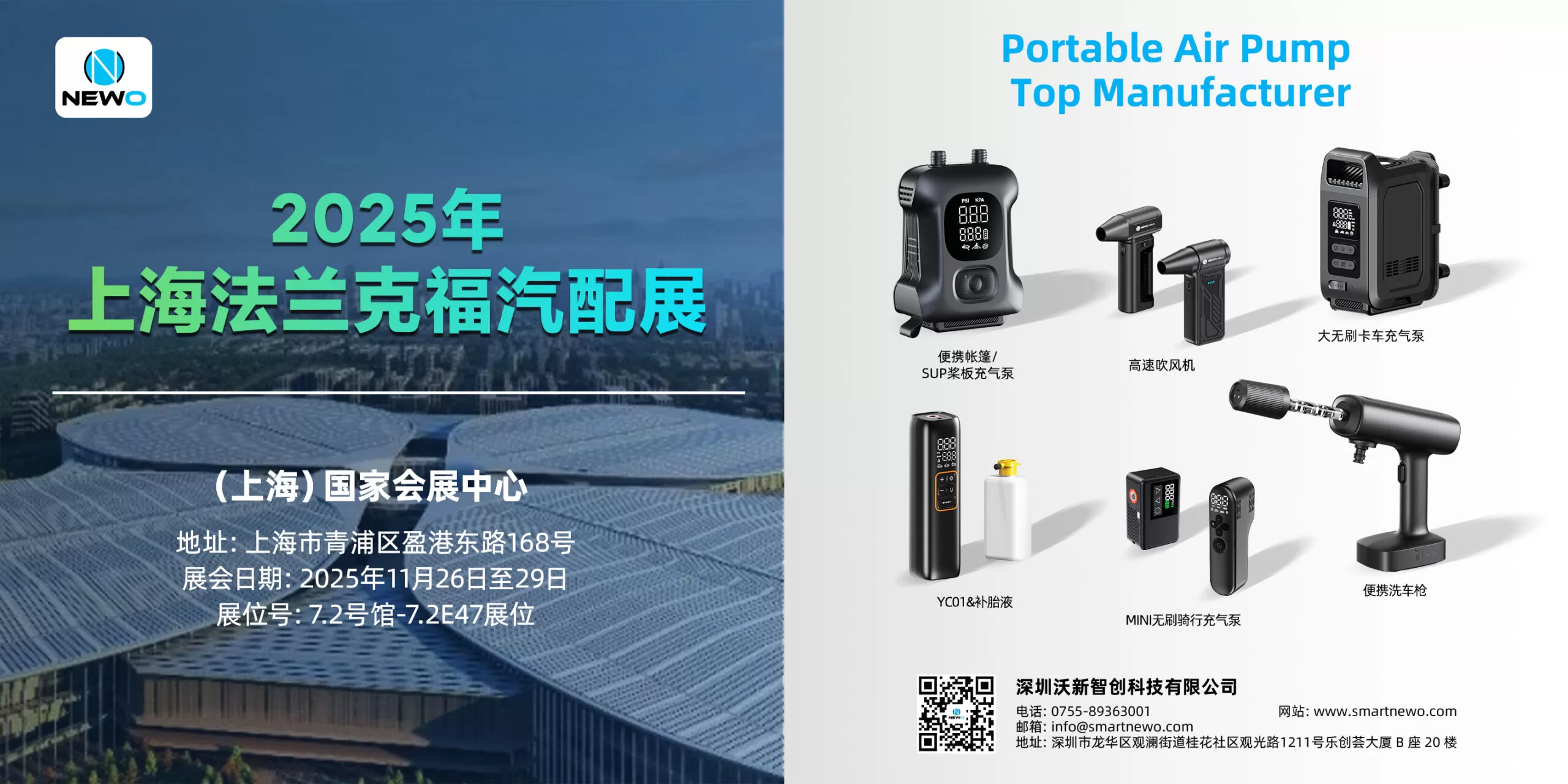
Today marks an exciting beginning as Smartnewo officially opens its booth at Automechanika Shanghai 2025. As one of the largest and most influential automotive aftermarket exhibitions in the world, the show provides an exceptional platform for meaningful conversations, partnership building, and global industry exchange. Located at Booth 7.2E47, Smartnewo presents...







-
How Is a Football Properly Inflated?
The correct inflation of a football - with not too much and not too little air - is a hotly debated topic among footballers.... -
Application Scenarios of Car Inflator Pump
Often long-distance business trips or play car owners because the road may be more remote areas, in this case if you encounter a tire leak....

