

 Portable Tire Inflators
 Electric Air Pumps
 Electric Car Tyre Pumps
 Electric Ball Pumps
 Electric Bike Pump
 SUP Air Pump

Portable Motorcycle Tire Pump: How to Choose and Use One on the Road
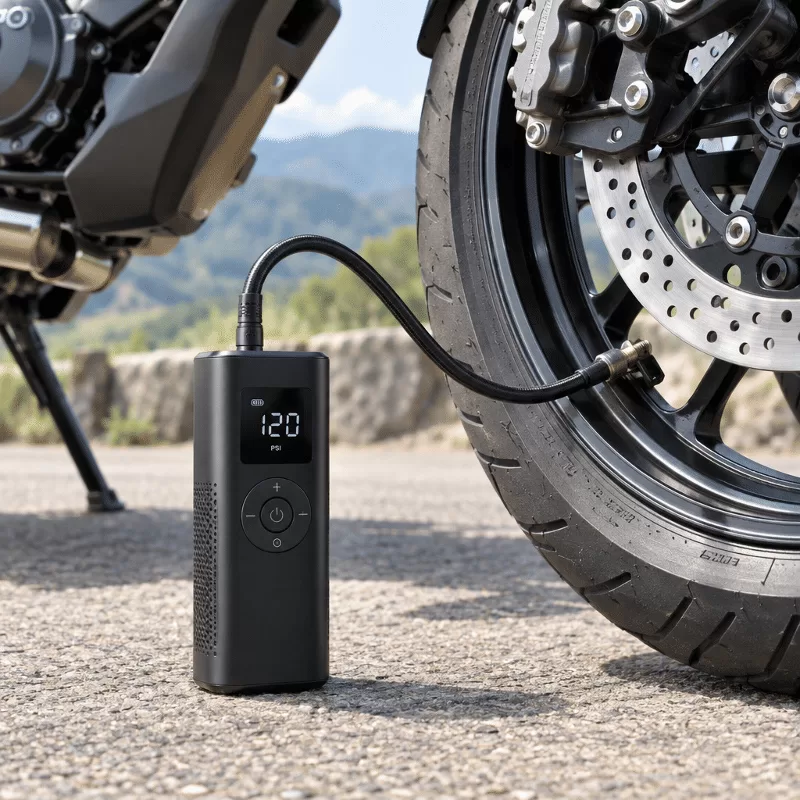
A reliable portable motorcycle tire pump can turn an isolated breakdown into a minor roadside pause. When cruising down an open highway or carving through remote mountain switchbacks, tire integrity is your sole connection to the asphalt. A slow puncture or sudden loss of pneumatic pressure alters handling geometry immediately, making steering heavy and erratic. Carrying a dedicated portable motorcycle tire pump provides peace of mind, freeing riders from relying on distant service stations.
Selecting the right inflator requires a clear understanding of practical mechanical constraints. Motorcyclists face strict cargo limits, where every cubic centimeter inside a pannier, tail bag, or under-seat tray counts. At the same time, motorcycle tires require accurate pressure settings rather than rough guesswork. This guide examines how modern battery-operated inflators perform, what technical specifications matter most on two wheels, and how to maintain proper cold tire pressures safely wherever your journey leads.
Pneumatic management is an indispensable part of motorcycle safety because two-wheeled platforms do not tolerate sloppy tire pressure. An under-inflated motorcycle tire flexes excessively across its carcass plies, causing unpredictable heat buildup and sluggish turn-in characteristics. Conversely, an over-inflated tire reduces compliance over rough pavement, transferring unwanted chassis vibration into the rider’s wrists and footpegs. Carrying an independent inflation solution allows you to establish and verify your contact patch anywhere, whether you are parked at a campsite or stopped on a highway shoulder.
What Riders Expect from a Portable Motorcycle Tire Pump
Roadside Emergency Recovery vs. Routine Garage Maintenance
Motorcycle riders view mobile inflators differently depending on the immediate task at hand. In a home workshop, a heavy stationary air compressor with a massive receiver tank quickly seats tire beads and rapidly fills high-volume touring carcasses. On the side of a highway, however, priorities shift entirely toward self-rescue, portability, and reliable pressure recovery.
Emergency roadside recovery demands that a portable inflator operate independently of mains electricity. Whether you are dealing with a slow valve-core leak or reinflating a tubeless tire after inserting a sticky rope plug, the tool must deliver steady pressure without draining the motorcycle’s starter battery. Routine checks before departure also benefit from a compact tool that eliminates cumbersome hose extensions.
Dedicated workshop compressors remain tied to physical garages due to their weight, power cords, and mechanical bulk. When a rider picks up a nail fifty miles from the nearest town, the volume of a distant workshop tank is completely irrelevant. A portable device bridges this critical vulnerability, ensuring that simple punctures do not leave you stranded waiting for flatbed tow services.
Storage Constraints and On-Bike Portability
Motorcycle luggage capacity is notoriously unforgiving. Adventure riders packing camping gear and commuters carrying daily essentials both require tools that consume minimal space. A heavy, awkward air pump often gets left behind in the garage, offering zero protection when road hazards strike.
Modern lithium-powered inflators address this challenge by condensing the motor, cylinder, and battery pack into a compact handheld housing. Riders can tuck an inflator into a tank bag side pouch, a hydration pack, or under a passenger seat cowl. The balance between casing dimensions, net weight, and stored electrical energy determines how practical the pump is for everyday travel.
Packing an inflator on a motorcycle also means withstanding constant chassis vibration, varying engine heat, and unpredictable weather exposure. Equipment stowed in soft saddlebags must endure continuous mechanical agitation over rough pavement and gravel tracks. A slim, self-contained unit protected by a dedicated sleeve minimizes friction against other metal tools, preventing damage to the pump housing and motorcycle plastics.
Realistic Physical Boundaries of Pocket-Sized Pumps
A miniature inflator operates within definite thermodynamic boundaries. Compressed air naturally generates significant thermal energy inside small piston chambers. Because ultra-compact devices use scaled-down motors and cylinders, inflating a large rear motorcycle tire from completely flat to full pressure takes measurable time.
Riders must understand these physical trade-offs before heading into remote areas. A slim pocket unit excels at pressure top-ups, slow leak mitigation, and post-puncture reinflation. However, it cannot deliver the explosive burst volume (CFM) required to snap an unseated tire bead onto the rim shoulders. Recognizing these operational boundaries prevents unrealistic expectations during a breakdown.
Piston displacement in pocket-sized inflators is inherently limited by their compact form factor. While a large workshop compressor displaces cubic feet of air per minute, a handheld unit moves air in modest increments. Understanding that a small pump requires steady, measured runtime allows the rider to remain patient on the roadside, letting the motorized mechanism complete its cycle without physical strain.
Technical Criteria: How to Choose the Right Motorcycle Inflator
Operating Pressure Limits and Tire Volume Demands
Target tire pressures vary substantially across different motorcycle categories, passenger weights, cargo loads, and chassis designs. Rather than relying on arbitrary assumptions, riders must look to their specific owner’s manual or vehicle frame placard to determine correct pressure targets. A viable mobile inflator must cover the vehicle manufacturer’s specified values while providing sufficient pneumatic headroom to prevent unnecessary mechanical strain on the pump motor.
Inflators engineered to reach 120 PSI offer a wide operational spectrum that comfortably covers motorcycle requirements. While bicycle tires demand high pressure in small air volumes, motorcycle tires involve moderate pressures within substantial air chambers. An airflow rate around 14 liters per minute strikes a practical balance, delivering steady inflation without demanding an oversized, unwieldy chassis.
When evaluating pneumatic headroom, an inflator operating well below its maximum rated ceiling experiences reduced mechanical stress on internal seals. Running a 120 PSI pump at standard motorcycle pressures prevents the motor from laboring at its ultimate stall threshold. This mechanical margin supports consistent performance across repeated roadside top-ups.
Pressure Sensing Precision and Auto-Shutoff Mechanisms
Two-wheeled vehicles respond with noticeable sensitivity to variations in tire inflation. When pneumatic pressure drifts away from the motorcycle manufacturer’s specified setting, the tire profile alters, which can negatively affect steering response, cornering grip, and tread wear patterns. Built-in pressure sensors must provide clear readings on an easy-to-read display.
Automated pressure cut-off mechanisms protect tires from accidental over-inflation. The rider enters the target pressure value on a digital display, connects the chuck, and starts the cycle. The internal circuitry monitors the rising pressure curve and cuts power to the motor precisely when the preset target is reached, preventing over-inflation while the rider handles other roadside tasks.
On roadside shoulders, ambient lighting conditions can vary from direct blinding desert sunlight to pitch-black nighttime gravel roads. An illuminated digital interface allows riders to read baseline and target values without fumbling for an auxiliary flashlight. Having the display integrated into the pump housing streamlines pressure verification during late-night emergency repairs.
Battery Capacity, Charging Protocols, and Duty Cycles
A portable inflator is only as useful as its stored charge. Internal lithium-ion battery packs must hold their energy across long periods of seasonal storage while enduring variable outdoor ambient temperatures. Typical configurations utilize 7.4V systems with dual-cell designs that provide sufficient operational wattage for small electric air motors.
Standardized Type-C charging ports simplify packing by eliminating proprietary charging transformers. According to technical product documentation, devices featuring a 5V / 2A input can recharge in under one hour when connected to compatible power sources with appropriate cables and adapters. Riders using auxiliary motorcycle accessory ports must verify that their power supply matches the inflator’s required electrical input profile.
Duty cycle management is equally essential for preserving internal battery health. Lithium cells discharge current under continuous motor load, which generates internal chemical heat alongside mechanical cylinder friction. Opting for cells with proven cycle endurance, such as designs rated for 300 cycles retaining 80% or more capacity, ensures that the device remains dependable over multiple seasons of active touring.
Valve Stem Architecture and Clearance
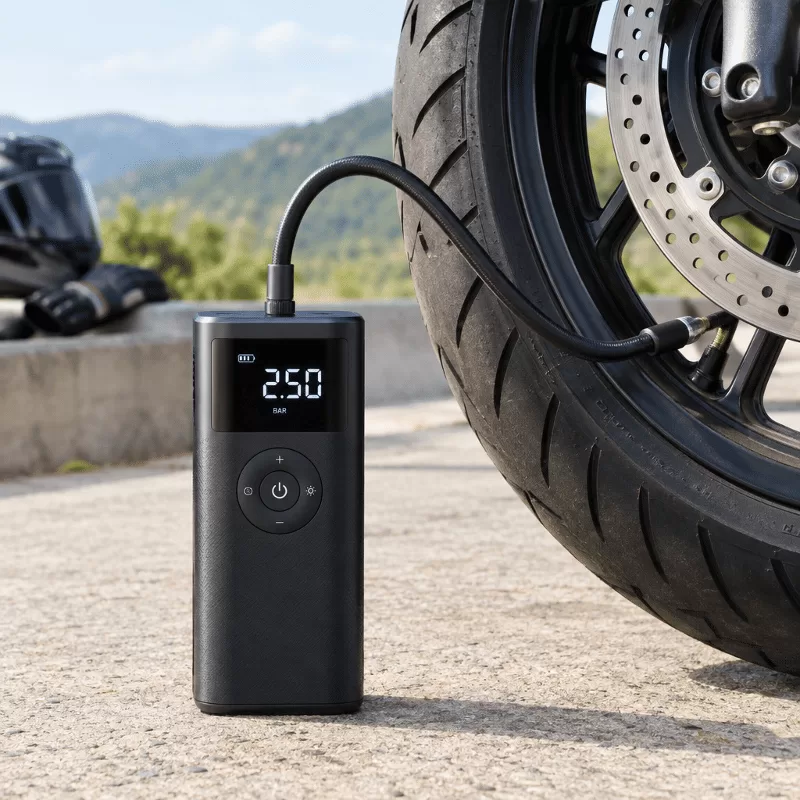
Motorcycle wheels present awkward ergonomic challenges for air chucks. Front wheels equipped with large dual brake discs leave minimal hand clearance around the valve stem. Heavy touring cast wheels and intricate spoked rims complicate direct, rigid hose attachments.
Flexible braided air hoses and threaded brass couplers solve these access problems. An air tube that bends smoothly prevents lateral bending stresses from damaging delicate rubber or aluminum valve stems. Straight push-on locking levers can be tough to release in confined wheel hubs, making threaded Schrader connectors the preferred choice for reliable, leak-free seals.
Many modern motorcycles feature short valve stems that sit perpendicular to the wheel barrel. When trying to attach a rigid pump chuck, the outer rim flange or brake caliper body can obstruct the connection. A flexible, pliable air hose isolates hand movements from the stem, preventing riders from inadvertently tearing rubber stem bases while tightening the fitting.
Thermal Dissipation and Brushless Motor Architecture
Compressing atmospheric air concentrates ambient heat rapidly. In a miniature pump housing, heat builds quickly in both the piston cylinder and the electric drive motor. Unchecked thermal buildup accelerates internal wear, reduces battery life, and triggers premature thermal safety shutdowns.
Modern brushless pump designs improve mechanical efficiency and reduce internal friction. Pairing a brushless architecture with an independent cooling fan and housing vents helps manage heat generation during sustained pumping. However, total run duration and actual inflation completion remain dependent on ambient temperatures, initial tire pressure, tire volume, and the unit’s stated runtime envelope.
Thermal management also influences how soon a rider can repack their gear after an inflation cycle. Devices that lack active internal airflow stay hot to the touch for extended periods, making it risky to stow them immediately next to sensitive synthetic gear or rain jackets. Integrated cooling fans accelerate heat evacuation from the internal chamber, allowing safer post-use handling.
Setting Safe Motorcycle Tire Pressures: Cold Specs vs. Sidewall Limits
Locating the True Manufacturer Specification
Every motorcycle chassis is tuned around specific tire pressure baselines established by vehicle engineers. These baseline pressures account for swingarm geometry, suspension damping, gross vehicle weight rating, and weight transfer under heavy braking. Riders should always prioritize the vehicle manufacturer’s data over generic advice found online.
- Locate the vehicle information placard affixed to the swingarm, chain guard, or steering head frame tube.
- Consult the original vehicle owner’s manual for specific load variants, such as solo commuting versus fully loaded two-up touring.
- Check aftermarket suspension recommendations if the motorcycle has been extensively modified with custom valving or alternate wheel sizes.
Placards installed by the motorcycle manufacturer account for the structural balance of the entire machine. A solo rider commuting without luggage requires different pneumatic support than a rider carrying hard panniers, a top case, and a passenger. Consulting the placard prevents operating the chassis in an unbalanced configuration that compromises road manners.
Cold Inflation Rules and Thermal Pressure Rise
Pneumatic pressure rises systematically as road friction and structural carcass deflection generate thermal energy during travel. As internal temperatures rise, the air inside the chamber expands, naturally driving gauge readings upward. Measuring a warm tire immediately after extended riding yields an elevated figure that does not reflect true baseline conditions.
Always establish your reference baseline when the tires are cold. A tire is technically considered cold when the motorcycle has been parked for at least three hours, or ridden for less than one mile at moderate speeds. Never vent or bleed air from a hot tire to match the cold specification listed in the manual, as doing so leads to severe under-inflation once the rubber cools back down to ambient levels.
If you find yourself forced to check pressure mid-ride due to suspected damage, expect the reading to be higher than your morning cold baseline. Releasing air from a warm tire to bring it down to the manual’s cold rating removes necessary air volume. When that tire eventually rests and returns to ambient temperature, the internal pressure will drop well below safe vehicle specifications.
The Critical Danger of Tire Sidewall Pressure Markings
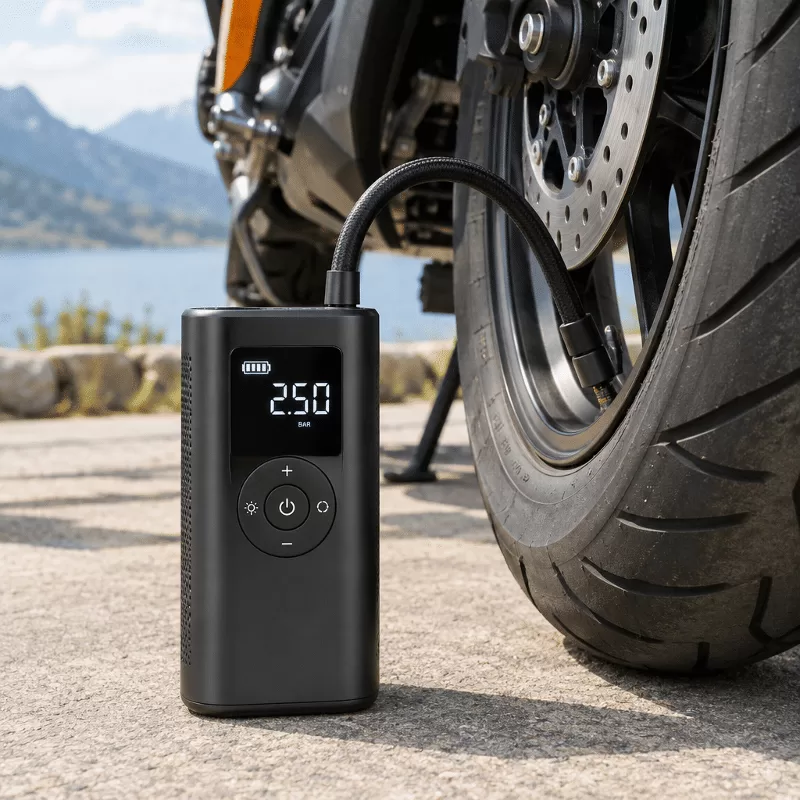
A common and hazardous mistake among inexperienced motorcyclists is inflating tires to the PSI number molded into the tire sidewall. The pressure indicated on the sidewall is tied specifically to the tire’s maximum rated load capacity under certified testing conditions. It is not the vehicle-specific operating pressure recommended by the motorcycle manufacturer for normal road riding.
Tire pressure must always align with the motorcycle manufacturer’s cold specifications, as setting pressures either too high or too low can negatively affect handling, traction, and tire wear patterns. Operating above recommended vehicle baselines stiffens the tire profile and reduces compliance, while exceeding the sidewall maximum cold limit is strictly unsafe. The sidewall stamp marks an upper design boundary for maximum load, not an operational target.
Motorcycle manufacturers spend hundreds of testing hours matching suspension spring rates to tire carcass deflection. Treating the tire sidewall number as an operational target overrides this delicate balance. Adhering to the motorcycle manufacturer’s cold placard ensures that your tires deform predictably across asphalt irregularities, maintaining optimal contact geometry.
Step-by-Step Practical Inflation Guide for the Road
Pre-Inflation Inspection and Valve Preparation
Before attaching an air hose on the roadside, take a moment to assess the situation thoroughly. Ensure the motorcycle is safely parked on level ground using the centerstand or side stand, well clear of moving traffic. Locate the cause of pressure loss before attempting to inflate the tire.
- Inspect the tire tread circumferentially for nails, screws, glass shards, or cuts, rolling the bike forward slowly.
- Verify the mechanical integrity of any temporary tire plug installed in the tread crown.
- Unscrew the valve cap and check the stem for road grit, corrosion, or mechanical damage that could break the hose chuck seal.
Taking time to wipe away road grime from the valve stem threads prevents abrasive grit from entering the pump chuck. When dirt gets pushed into the Schrader core by incoming airflow, it can lodge in the tiny rubber seat, creating a persistent slow leak that is difficult to diagnose trailside.
Operating the Pump and Monitoring Air Delivery
Once the valve stem is clean, retrieve your portable inflator and connect the air line securely. Thread the connector onto the valve stem firmly until the internal gauge registers static tire pressure, taking care not to cross-thread delicate brass fittings. Keep the unit positioned so the hose runs free of sharp brake rotor edges.
Power on the digital unit and observe the initial reading on the LED screen. Select the appropriate pressure unit (PSI or Bar) and set the cutoff threshold to your motorcycle manufacturer’s cold specification. Initiate the pump cycle and let the device rest on the ground or hold it steady, avoiding excess strain on the valve stem while monitoring the pressure readout.
During inflation, listen to the pump’s acoustic rhythm. A steady, consistent motor pitch indicates normal operation against backpressure. If the tone alters abruptly or the housing feels unusually warm, pause the cycle briefly to ensure the hose is not kinked and the valve core remains unblocked.
Verifying Pressure Baseline Before Mounting
When the inflator reaches the preset target and shuts off, disconnect the air chuck promptly to minimize pressure loss. A brief hiss of escaping air is normal as the chuck clears the core, but prolonged leaking indicates a loose valve core or damaged stem threads. An audible check confirms the core is fully seated.
Always re-install a quality valve stem cap equipped with an internal rubber sealing gasket. Threading on a sealed valve cap acts as a secondary seal to help maintain internal pressure integrity while shielding the delicate Schrader spring pin from dirt, grit, and road grime. Maintaining clean valve stems prevents contamination from causing stubborn leaks down the line.
Many roadside slow leaks occur simply because valve caps were omitted or lost during previous maintenance stops. Road salt, water, and brake dust settle directly into uncapped stems, accelerating brass oxidation and fouling internal seals. Keeping fresh, gasketed caps firmly screwed down protects your newly set baseline pressure across thousands of highway miles.
Knowing When Roadside Inflation Is No Longer Safe
A portable motorcycle tire pump is a recovery tool, not a cure for catastrophic tire failure. Riders must recognize the structural limits of damaged rubber to avoid dangerous blowouts at speed. Never risk personal safety on a tire that cannot reliably hold air.
- Sidewall punctures, tears, or shoulder cuts cannot be safely plugged or reinflated under any circumstances.
- Visible casing bulges, tread separation, or internal cord exposure indicate structural carcass failure.
- Bent rim lips that allow air to hiss past the tubeless bead require wheel repair or recovery transport, not reinflation.
Pumping air into a structurally compromised tire is a severe safety hazard. If an internal tire carcass ply has broken, expanding air will create an outward bulge that can rupture catastrophically without warning. In such severe circumstances, calling a recovery truck is the only sensible choice.
Technical Profile: Newo T05 Compact Inflator
Manufacturer-Stated Specifications and Dimensions
Newo is a professional manufacturer specializing in the research, development, and production of smart electric air pumps and portable inflation solutions. With strong expertise in pneumatic technology, product design, and manufacturing, we provide a wide range of innovative products, including portable tire inflators, electric bike pumps, car air pumps, ball pumps, and outdoor inflation solutions. Our products are designed to deliver convenience, efficiency, and reliability for customers worldwide.
The T05 compact electric pump reflects this engineering approach in an ultra-portable footprint. Measuring just 132 × 35 × 51.5 mm and weighing approximately 192.4 grams according to manufacturer specifications, it is built to slip into riding jackets or small luggage compartments without adding bulk. The brushless motor produces an airflow rate of roughly 14 L/min, drawing power from an internal 1200mAh (7.4V / 8.88Wh) battery pack with a rated working power of 40W.
| Technical Parameter | Manufacturer Specification |
|---|---|
| Product Model | T05 Portable Bike & Multi-Vehicle Inflator |
| Pressure Range | 2 to 120 PSI |
| Flow Rate | Approximately 14 L/min |
| Battery Configuration | 1200mAh, 7.4V, 8.88Wh (300 cycles to ≥80%) |
| Charging Input & Interface | 5V / 2A via Type-C (<1 hour recharge) |
| Continuous Runtime | 5 to 10 minutes |
| Operational Noise Ceiling | ≤80 dB at 1.5 meters |
| Product Dimensions | 132 × 35 × 51.5 mm |
| Net Unit Weight | Approximately 192.4 g |
Motorcycle Application Scope and Practical Expectations
While designed primarily as a slim handheld inflator for cyclists and everyday carry, the T05 covers working pressures from 2 to 120 PSI. The manufacturer explicitly includes motorcycle tires among its supported application scenarios alongside bicycles, e-bikes, sports balls, and car tire top-ups. Features such as digital pressure sensing, an LED display, and auto-shutoff help simplify inflation tasks.
Riders must account for the device’s rated continuous runtime of 5 to 10 minutes when planning on-bike use. Practical inflation speed and battery consumption vary based on overall tire displacement and starting pressure. While suitable for minor pressure corrections and roadside reinflation within its duty cycle, large touring tires requiring substantial volume may require staging inflation or allowing cooling pauses to respect device operating parameters.
An independent cooling fan built into the T05 body helps manage internal temperatures during operation. This thermal consideration is valuable when making adjustments on the road, where ambient heat can already be substantial. Observing the device’s operational limits ensures dependable service whenever pressure adjustments are needed.
Included Kit and Valve Compatibility
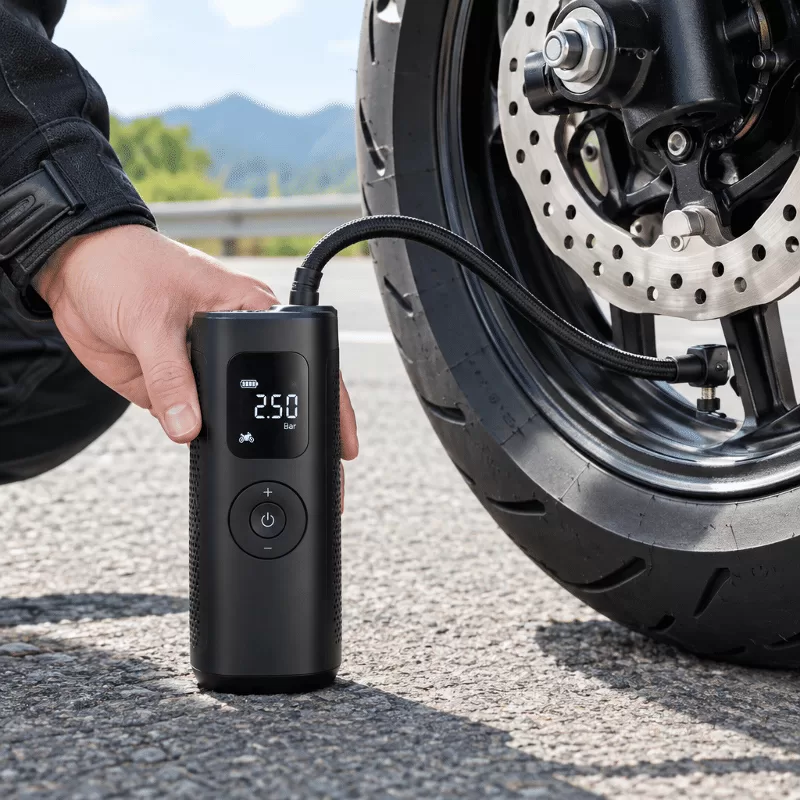
The T05 arrives out of the box with accessories suited for multi-vehicle applications. It includes a flexible air tube, a standard Schrader valve adapter, a French (Presta) valve adapter, a sports ball needle, a Type-C charging cable, and a protective storage bag. Because motorcycles use standard Schrader valves, the hose attaches directly without requiring complex fittings.
The included storage bag keeps the flexible air tube, charging cable, and adapters neatly organized in your luggage. Packing the pump in its pouch keeps grit, dirt, and moisture out of the Type-C port and air outlet threads, ensuring the inflator is clean and ready whenever roadside trouble strikes.
Having the French valve adapter and ball needle stored alongside the unit also adds everyday utility across different activities. Whether you are adjusting mountain bike tires at a trailhead, inflating sports equipment, or managing motorcycle pressures, keeping all hardware consolidated prevents lost adapters during transit.
Comparative Assessment: Portable Electric Pumps vs. Alternative Inflation Tools
Handheld Battery-Powered Inflators vs. Manual Hand Pumps
Manual bicycle-style hand pumps have long been a lightweight backup choice for minimalist riders. However, manually pumping air into a large motorcycle tire on a hot roadside is grueling work. It takes hundreds of vigorous strokes to lift pressure by just a few PSI, leaving the rider fatigued and sweaty on an active roadway shoulder.
A compact electric inflator changes this roadside dynamic entirely. It delivers steady air pressure at the push of a button, letting the rider step back safely from traffic while the tire fills. Although electric pumps rely on battery reserves, their efficiency, speed, and integrated pressure monitoring make them far superior to manual hand pumps for roadside emergencies.
| Inflation Method | Roadside Physical Effort | Airflow Delivery Characteristics | Pressure Monitoring Method | Portability Profile |
|---|---|---|---|---|
| Portable Electric Pump | Automated operation; minimal physical effort | Continuous motorized delivery | Digital display; accuracy varies by device | Handheld unit (e.g., T05 at ~192.4 g) |
| Manual Hand Pump | Severe physical exertion | Manual stroke displacement; slow on large tires | Requires external inline or pencil gauge | Elongated hand cylinder |
| CO2 Compressed Cartridges | Instantaneous discharge | Rapid discharge of compressed gas | Unmonitored during discharge | Pocket-sized cartridges and inflator head |
| 12V Motorcycle Battery Pump | Automated operation via bike electrical system | Continuous motorized delivery | Integrated analog or digital gauge | Requires power leads and storage space |
Manual pumps also introduce physical leverage that stresses the valve stem. Each vigorous downstroke creates lateral rocking forces that can crack aging rubber valve stems at the rim junction. An electric pump rests on the ground or sits supported in your palm, keeping the flexible air line isolated from erratic manual shaking.
Compact Battery Pumps vs. CO2 Cartridge Kits
Compressed carbon dioxide (CO2) kits are popular for their pocket-sized footprint and instant blast of gas. However, CO2 systems have serious functional drawbacks that make them risky as a sole inflation solution on extended trips. Each cartridge offers a single shot; if you botch the seal or discover a second leak, your air supply is gone.
Additionally, discharging pressurized gas causes the metal inflator head and canister to freeze rapidly, requiring gloves to prevent skin frost injuries, and users must follow the manufacturer’s instructions carefully. A rechargeable electric pump offers repeatable, dependable inflation without consumable cartridges or thermal freeze risks.
Relying on single-use canisters also introduces environmental waste and logistical inconvenience. Empty threaded steel cylinders must be carried out and properly disposed of, while replacing spent canisters requires finding specialty cycle or powersports shops. A rechargeable pump is endlessly reusable, needing only standard USB power to restore its operational readiness.
Dedicated Workshop Compressors vs. On-Board Portable Units
Garage-grade workshop compressors excel at initial tire mounting and bead seating thanks to their large air tanks and high CFM delivery. Yet, their sheer mass, noise, and reliance on mains electricity confine them strictly to the home workshop. They offer no help when you run over a piece of debris miles out on a back road.
Carrying an on-board portable pump closes this gap, giving riders true independence wherever they travel. While it cannot replace the bead-seating speed of a shop compressor during workshop tire swaps, a quality portable inflator handles daily pressure tuning, temperature adjustments, and unexpected roadside emergencies with total autonomy.
Many riders rely solely on garage compressors for monthly checks, completely skipping pre-ride inspections when away from home. Touring over thousands of miles without a mobile pressure source means you are perpetually at the mercy of service station pumps, which are often broken, filthy, or equipped with uncalibrated gauges. An on-board unit restores full control over your machine’s safety.
Frequently Asked Questions (FAQs)
Can a pump rated up to 120 PSI easily handle a motorcycle tire?
A 120 PSI rating indicates maximum pressure capability, not volumetric airflow. Motorcycle tires run at moderate pressures specified by the motorcycle maker, but hold a much larger volume of air than bicycle tires. A 120 PSI pump provides ample pressure headroom, though compact air pumps will take longer to fill high-displacement motorcycle tires compared to smaller bicycle tubes.
Because the internal chamber and piston in a pocket inflator are compact, filling a large tire from flat requires steady, continuous operation. Riders should look at flow ratings like 14 L/min to gauge pacing, rather than assuming a high maximum pressure translates into high-speed air volume.
Should I inflate my motorcycle tires to the number stamped on the tire sidewall?
No, you should never use the sidewall number for routine inflation. The pressure molded onto the tire sidewall represents the maximum cold pressure allowed by the manufacturer at maximum load capacity. Always follow the specific cold tire pressures recommended by your motorcycle chassis manufacturer, which can be found in your owner’s manual or on the frame placard.
Chassis engineers specify tire pressures to balance traction, stability, and suspension geometry under defined vehicle weights. Stamping on the sidewall indicates certified safety thresholds under full structural loading, not the optimal handling configuration designed for your specific bike model.
How soon after a long highway ride can I check or adjust tire pressure?
Wait until your tires have fully cooled down before checking or setting baseline pressures. Friction and internal carcass flexing generate heat on the road, which expands the air inside and produces artificially high readings. Allow the motorcycle to rest parked in the shade for at least three hours to get an accurate cold pressure measurement.
If you must add air to a warm tire during an emergency roadside puncture repair, inflate it just enough to reach safe riding condition. Once the machine has rested overnight or cooled for several hours, use your portable inflator to re-check and set the definitive baseline cold pressure.
Can a compact electric pump re-seat a motorcycle tire bead on the rim?
A handheld portable inflator cannot snap an unseated tubeless tire bead onto the rim shoulders. Seating a bead requires an explosive burst of high-volume airflow (high CFM) to overcome rim gaps before pressure can build. Compact pumps provide steady, moderate airflow meant for sealed tires, not the initial mounting blast.
When a tubeless tire unseats completely from the safety bead, air escapes freely through the circumferential gap around the rim. Handheld units do not generate the instantaneous volume necessary to overcome this air loss. Bead seating requires high-flow shop compressors or bead-seating expansion rings.
What should I do if the pump hose does not clear my motorcycle brake rotor?
Front wheels with dual disc brakes often leave very little clearance around straight valve stems. To avoid bending the stem or straining the pump hose, use a flexible braided hose extension or install a 90-degree brass adapter. Many riders switch to permanent angled valve stems during tire replacements to make roadside inflation quick and painless.
Applying forceful side leverage to a rubber valve stem while trying to clear a sharp rotor edge can tear the brass insert out of the rubber boot. Using a flexible air line or a dedicated right-angle adapter ensures the hose threads straight onto the stem without mechanical binding.
Reliable Tire Care for Confident Riding
Maintaining correct tire pressure is one of the easiest ways to safeguard handling stability, improve fuel efficiency, and extend tread life on two wheels. Equipping your travel kit with a capable portable motorcycle tire pump protects against slow leaks, changing ambient temperatures, and remote puncture emergencies. Understanding your bike’s cold pressure specifications and respecting the duty cycles of compact inflators ensures you stay rolling safely on every journey.
-

Meet NEWO at the 140th Canton Fair: Visit Booth 10.3 M03–04
Meet NEWO at the 140th Canton Fair in Guangzhou, October 15–19, 2026. Visit Booth 10.3 M03–04 to explore portable air pumps and discuss OEM, ODM and distribution opportunities.... -

As Shenzhen Welcomes the World for APEC 2026, NEWO Welcomes You to Our Factory
As Shenzhen prepares for APEC 2026, NEWO welcomes international buyers and partners to visit our factory, meet our team and explore future cooperation.... -

Leading the Way in Product Innovation and Excellence
Smartnewo exemplifies professionalism in product innovation and manufacturing. Their collaboration with Xiaomi Youpin on the G01 crowdfunding project highlights their expertise in creating compact, powerful inflatable pumps. Rigorous engineering, meticulous production processes, and advanced quality assurance underscore their commitment to excellence. The success of the G01 project, with significant market... -

Essential Qualities of an Excellent Supplier
In today's competitive market, finding a reliable supplier is crucial for business success. Based on insights from Smartnewo and broader internet research, here are key qualities an excellent supplier must possess:... -

NW06 Tire Inflator: Compact Power for Quick Inflation
Summary The NW06 Tire Inflator delivers quick and efficient tire inflation with a powerful 35L/min airflow. It features a user-friendly LCD screen for real-time pressure monitoring, dual power options with a built-in 6000mAh battery, and multiple nozzle attachments for versatile use. Its compact design and integrated LED light ensure convenience and... -

Unleash the Power of Portability: The SmartNewo Jump Starter with Air Compressor KF03
This guide will walk you through the steps to effectively use a portable tire inflator, helping you stay prepared and safe on the road.... -

Newo Attends The 2024 Consumer Electronics Show (CES)
Smartnewo booth is located at 53672, Halls A-D, Level 2, Venetian Expo, Las Vegas Convention Center (LVCC). ... -

Smartnewo’s Dual-Cylinder Air Pump Rocks the Hong Kong Autumn Electronics Fair!
Smartnewo’s Dual-Cylinder Air Pump Rocks the Hong Kong Autumn Electronics Fair!... -

Meet at the Canton Fair! Smartnewo brings dual-cylinder air pumps, making your inflation experience faster and more stable!
NEWO has went deep communication and negotiation with customers from all over the world on booth.... -

“Hong Kong Autumn Electronics Fair – 1CA18 (October 13th to 16th): Smartnewo invites you to visit our booth!
Hong Kong Autumn Electronics Fair...
-

What to Check Before Ordering Custom Electric Bike Pumps
Plan custom electric bike pumps with a clear requirements freeze for valves, TPU tubes, portability, repeated top-ups, charging, and model-specific documents.... -

OEM vs ODM Air Pumps: Which Manufacturing Model Fits Your Brand?
Compare OEM and ODM air pump projects by design responsibility, change approval, development scope, and written ownership terms before choosing your route.... -

How to Choose a Reliable Tire Inflator Manufacturer in China
Choose a tire inflator manufacturer in China with a focused RFQ, supplier evidence, configuration checks, and clear sample-to-pilot decisions for your brand.... -

Rechargeable Electric SUP Pump for Paddle Boards: Faster Inflation for SUPs, Kayaks and Inflatable Tents
The BL10-C Portable Electric Bike Tire Inflator is a compact and lightweight mini electric bike pump designed for modern cyclists. With up to 120 PSI pressure, a digital LED display, preset pressure control, automatic shut-off, USB-C charging, and multiple valve adapters, BL10-C offers a convenient inflation solution for road bikes,... -

Are Electric Bike Pumps Worth It in 2026? Electric Pump vs CO₂ vs Mini Hand Pump
Discover whether electric bike pumps are worth it in 2026. This guide compares electric bike pumps, CO₂ inflators, and mini hand pumps for road cycling, gravel riding, commuting, and long-distance rides. Learn the pros, limitations, best use cases, and key features to look for before choosing the right portable tire... -
BL10-C Portable Electric Bike Tire Inflator: Small Size, Reliable Power for Every Ride
The BL10-C Portable Electric Bike Tire Inflator is a compact and lightweight mini electric bike pump designed for modern cyclists. With up to 120 PSI pressure, a digital LED display, preset pressure control, automatic shut-off, USB-C charging, and multiple valve adapters, BL10-C offers a convenient inflation solution for road bikes,... -

Why Mini Electric Bike Pumps Are Becoming Essential for Modern Cycling
Discover why mini electric bike pumps are becoming essential for modern cyclists. Learn how portable electric bike pumps improve tire pressure management, riding safety, and convenience.... -

The Ultimate Smart Solution for Easy Outdoor Adventures in 2026
Discover how a spring travel air pump simplifies outdoor trips with fast inflation, smart features, and powerful performance—perfect for every adventure.... -

Powerful 5-in-1 Portable Car Tire Inflator and Jump Starter: The Ultimate Emergency Tool for Every Driver
Why Every Driver Needs a Portable Car Tire Inflator and Jump Starter Modern drivers face many unexpected situations on the road. A flat tire, low tire pressure, or a dead car battery can happen at the worst possible time. That’s why having a portable car tire inflator and jump starter is... -

7 Real Cycling Scenarios That Show Why Every Rider Should Carry a Mini Bike Pump
Cycling is one of the most freeing activities you can enjoy. Whether you’re commuting to work, riding through city streets, or exploring quiet countryside roads, a bike ride can instantly improve your day. But there’s one small problem that almost every cyclist eventually faces: Low tire pressure. It might happen...
-

How Is a Football Properly Inflated?
The correct inflation of a football - with not too much and not too little air - is a hotly debated topic among footballers.... -

Application Scenarios of Car Inflator Pump
Often long-distance business trips or play car owners because the road may be more remote areas, in this case if you encounter a tire leak....