

 Portable Tire Inflators
 Electric Air Pumps
 Electric Car Tyre Pumps
 Electric Ball Pumps
 Electric Bike Pump
 SUP Air Pump

Engineering Roadside Resilience: The Practical Guide to the 2-in-1 Jump Starter Air Compressor
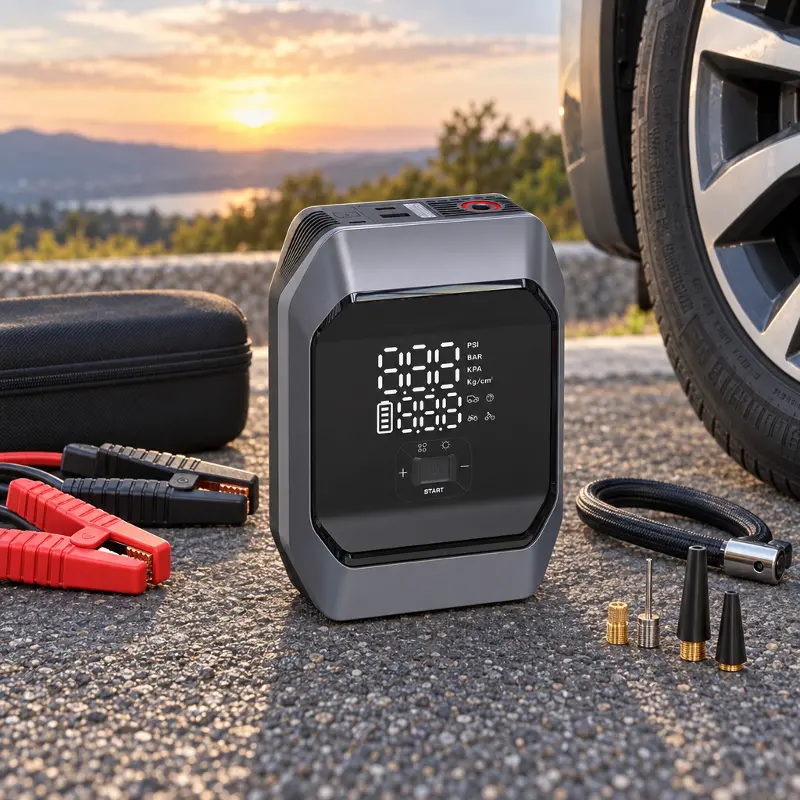
When a vehicle fails on an unlit shoulder, the breakdown can often involve one of two common culprits: a weak lead-acid battery or a low, damaged tire. Carrying separate tools for each scenario consumes trunk space and complicates roadside emergencies. Equipping your vehicle with a modern 2-in-1 jump starter air compressor eliminates this logistical clutter. Instead of juggling loose jumper cables, an auxiliary vehicle, and a noisy standalone pump, drivers gain a single portable module. This integrated tool is designed to deliver cranking assistance to a depleted 12V battery and meter high-pressure airflow for tire-pressure top-ups, although some breakdown situations, such as mechanical failures requiring a tow, will still call for professional roadside assistance.
Why Modern Drivers Are Replacing Single-Purpose Roadside Gear
Traditional breakdown tools belong to an older era of motoring. Cold weather can reduce a lead-acid battery’s ability to deliver the starting power an engine needs, and standard jumper cables remain useless without a donor car nearby. Modern motorists encounter varied driving conditions where external help is unavailable, which is why a compact device that handles both power and air has practical appeal for everyday trips as well as longer road journeys.
The Anatomy of Double Failure: Dead Batteries and Flat Tires
Automotive batteries and tires share an operational vulnerability: sensitivity to ambient temperature drops. When seasonal cold snaps hit, engine oil thickens while the chemical reactions inside a standard lead-acid battery slow down. At the exact moment your starter motor demands maximum amperage, the battery delivers its weakest output, which is precisely when a reliable backup source matters most and when a stranded driver has the fewest good options nearby.
Tires experience a related effect. As a general rule of thumb used in the tire industry, pressure can drop by about 1 PSI for every 10°F decrease in ambient temperature. A tire that had marginal inflation during autumn can lose enough pressure during a cold snap to trigger a dashboard TPMS warning, though whether that warning actually appears depends on the tire’s starting pressure and the vehicle’s own threshold. Encountering both a low tire and a weak starting battery within the same season is a common enough pairing that carrying a combined tool makes practical sense for many drivers, rather than relying on two separate devices that both need their own charge and storage space.
Consolidation Without Compromise: The Architecture of Integrated Units
Combining battery storage with a tire-inflation pump in one housing is mainly a matter of practical convenience rather than a deep engineering breakthrough. The core benefit is straightforward: one compact device covers two of the most common roadside problems, so drivers do not need to carry, charge, and remember two separate tools for a dead battery and a soft tire.
By consolidating both systems into a single handheld chassis, drivers save valuable trunk cargo room. A single battery pack powers the motor for tire inflation and supplies current to assist with cranking a 12V vehicle. This combined format means that keeping one device charged covers two of the more common roadside inconveniences, which is a meaningful convenience advantage even without claiming any particular internal engineering design.
Demystifying Core Electrical Specs: Starting Current vs. Peak Amps
Automotive electrical specifications often confuse buyers because marketing literature frequently highlights peak ratings over sustained cranking numbers. Understanding how a manufacturer lists these two figures helps buyers read product specifications more carefully before choosing a unit, rather than assuming a bigger number always means a better fit for their particular vehicle.
Cranking Current vs. Instantaneous Peak: Reading the Real Numbers
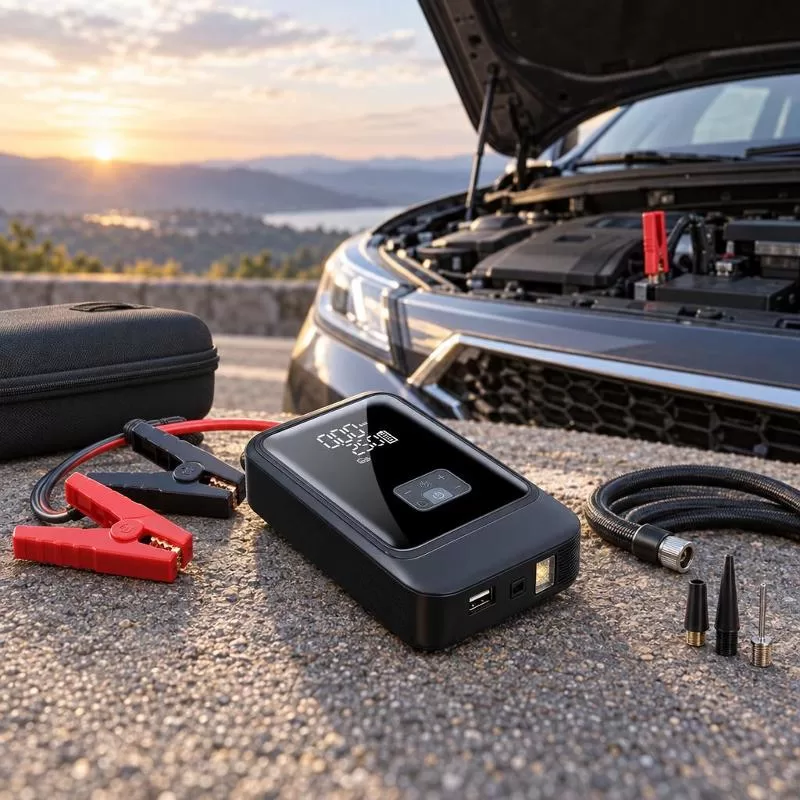
Manufacturers commonly publish two current figures for jump starters: a starting current rating and a higher peak current rating. For the S03, the listed specifications are 400A, 500A, or 600A starting current alongside 1000A, 1200A, or 1400A peak current. These figures are presented by the manufacturer as the unit’s rated output rather than as a single standardized industry test value, so buyers should treat them as the product’s stated capability rather than a universally defined benchmark.
Because engines vary widely in displacement, compression, and condition, it is worth checking your vehicle’s own battery and starting requirements against these figures before relying on any jump starter. If in doubt, consulting your vehicle’s manual or a qualified mechanic is a safer step than assuming any portable unit will suit every engine, since the consequences of an incompatible connection can include damage to the vehicle’s electronics.
Battery Architecture: Listed Capacity and Protection Values
According to the product specifications, the S03 uses a battery pack rated at 2000mAh x 4, with a nominal 14.8V rating and 29.6Wh of energy storage. The manufacturer also lists battery protection voltage values of 16.8V and 12V, which represent the upper and lower voltage points referenced in the product data rather than a behavior independently verified here, so they are best read as stated specification values rather than confirmed circuit behavior.
The manufacturer’s listed cycle life for the battery is 300 cycles, with 80 percent or above of original capacity retained at that point. This figure is presented as the product specification rather than a claim of unlimited longevity, and actual results in the field can vary with charging habits, storage temperature, and how frequently the unit sees heavy use, much like any other rechargeable battery pack carried in a vehicle.
| Technical Parameter | Specification Value | Practical Roadside Relevance |
|---|---|---|
| Vehicle System Support | 12V Automotive Systems | Listed for use with standard 12V passenger vehicle electrical systems |
| Cranking Current Stages | 400A / 500A / 600A | Manufacturer-listed starting current ratings |
| Peak Current Ceiling | 1000A / 1200A / 1400A | Manufacturer-listed peak current ratings |
| Battery Configuration | 2000mAh x 4 (14.8V, 29.6Wh) | Listed battery capacity and voltage specification |
| Working Power Rating | 100W | Manufacturer-listed working power rating |
| Battery Cycle Longevity | 300 cycles, 80%+ capacity retained | Manufacturer-listed cycle life specification |
Pneumatic Performance: What Cylinder Bore and Airflow Mean on the Road
Tire inflator performance depends directly on mechanical displacement and motor torque. Reliable roadside inflators depend on a pump structure built to handle sustained backpressure over several minutes of continuous operation, since a tire sitting at highway pressure resists the incoming airflow far more than an empty balloon does.
Inside the 19-Cylinder Pump: Moving Volume Against Backpressure
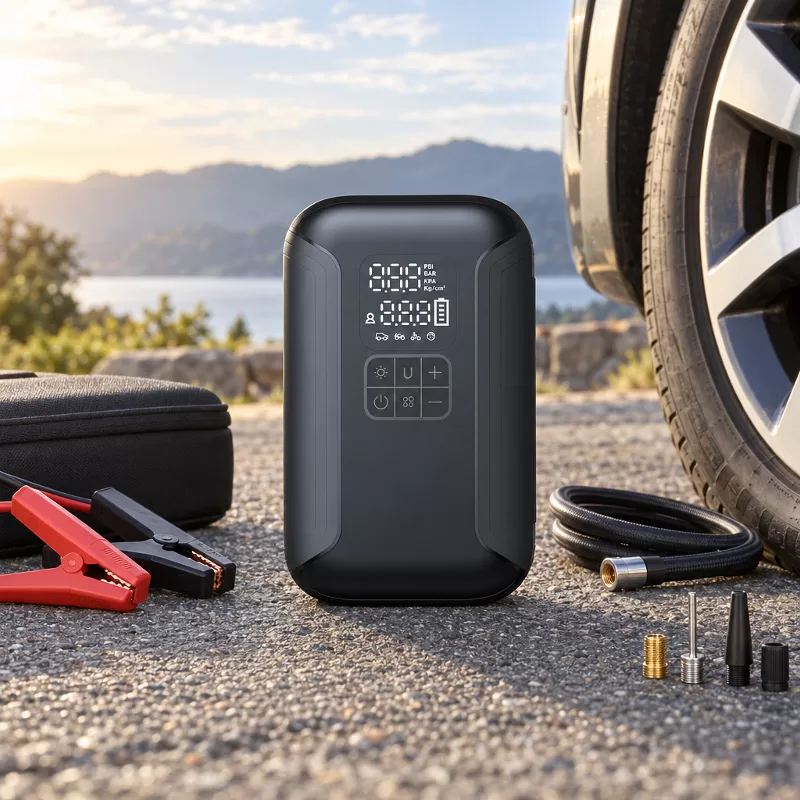
The internal air pump uses a 19-cylinder structure, and the manufacturer lists a working power rating of 100W for the unit. The manufacturer separately lists an airflow output between 26 and 28 liters per minute. These figures reflect the product’s stated specifications rather than an independently measured result, so they should be read as the manufacturer’s own performance claims.
Airflow speed matters when you are topping off a tire on an active highway shoulder, where time spent exposed to traffic is a real safety concern. According to the manufacturer, a full charge provides 25 to 40 minutes of operational runtime, with a listed capacity of approximately 2.5 tires sized 285/70R17 per full charge. The specification does not indicate that this figure assumes inflating from a completely flat tire, so it is best understood as a general inflation-capacity reference rather than a bead-to-full-pressure guarantee for a tire that started at zero PSI.
Pressure Control and Presets: Mitigating Over-Inflation Hazards
Operating across a span from 2 to 160 PSI, the pneumatic module is listed as suitable for bicycle tires, sports balls, and automotive tires within that range. The unit includes dual LED displays and multiple selectable pressure units: PSI, BAR, KPA, and Kg/cm2, according to the manufacturer’s specifications. A digital readout is generally easier for most drivers to check at a glance than an analog pencil-style gauge, particularly in poor lighting at the roadside.
The manufacturer lists five preset inflation modes in addition to a custom pressure setting, which together are intended to simplify routine inflation tasks across different types of equipment. The product information does not specify the individual target pressures or naming of each preset, so this guide does not assign specific values to them here. What is documented is that operators can select one of the five built-in presets for routine use, or switch to the custom setting to dial in any target between 2 and 160 PSI, with the selected pressure unit and reading shown on the dual LED display throughout the process.
Once the connected tire reaches the selected pressure, the automatic shut-off feature is designed to stop the pump. The manufacturer presents this as a safeguard against over-inflation, which is a sensible feature given how easy it is to lose track of a rising gauge reading while distracted at the roadside.
Operational Safety and Circuit Protection Mechanisms
High-density battery packs and pressurized pneumatic lines call for physical and electrical safety barriers. Human error during roadside emergencies is common, particularly in wet, dark, or freezing weather when hands are cold and visibility is poor. The manufacturer lists several built-in protections intended to reduce the risk of equipment damage or harm to the vehicle’s electrical system.
Listed Safety Protections
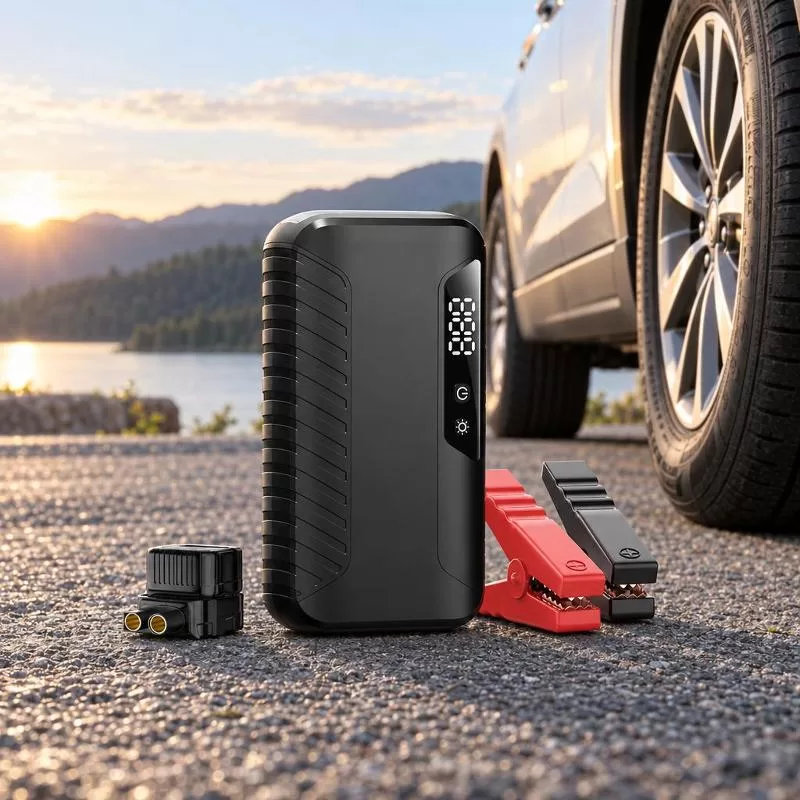
The product specifications list protection against high voltage, low voltage, high temperature, reverse connection, and short circuit conditions. The supplied product information does not describe the exact internal behavior of these protections, so they are best understood as manufacturer-stated safety features rather than independently verified mechanisms, and drivers should not assume a specific fault response beyond what the manual describes.
The unit carries a listed working temperature range of 0°C to 45°C. This range should be treated as the manufacturer’s stated operating window, and use outside that range is not something the supplied specifications address. Drivers in regions that regularly see sub-zero mornings should keep this limitation in mind rather than assuming the device is rated for below-freezing conditions, since operating electronics outside their stated range can affect both performance and longevity.
Field Operation: Following the Manufacturer and Vehicle Instructions
Jump-starting a vehicle involves real electrical and mechanical risk, and the correct sequence can differ depending on the vehicle and the jump starter’s own manual. Rather than follow a generic script, drivers should treat the following as a general outline to be read alongside the S03 user manual and the vehicle owner’s manual, since the two documents take priority over any generic advice.
-
Check the unit’s charge level using its 4-level LED indicator before attempting a jump start, and recharge first if the level looks low.
-
Confirm both manuals agree on connection order and clamp placement; many vehicle manufacturers recommend attaching the final ground connection to a bare metal point in the engine bay rather than directly to the battery’s negative terminal, to reduce sparking near the battery.
-
Do not attempt a jump start if the battery appears damaged, swollen, leaking, or frozen, and do not proceed if the two manuals give conflicting instructions.
-
Start the vehicle only after all connections are confirmed secure, following the specific guidance in the product manual for how long to attempt cranking.
-
Disconnect the cables in the sequence specified by the manufacturer once the engine is running, rather than relying on a fixed universal timing.
For tire inflation, connect the pneumatic hose chuck to the valve stem, read the resting pressure on the dual LED display, then select a preset mode or set a custom target with the adjustment buttons before starting the compressor. The unit is designed to stop automatically once it reaches the target pressure, which lets you step away briefly rather than watching the gauge the entire time.
Secondary Utility: Power Bank Delivery and Multi-Mode Illumination
A stranded vehicle becomes harder to manage if your phone runs out of charge at the same time, since most drivers now rely on a phone to call for help or navigate to the nearest service station. Supplementary features like backup power and visible lighting add practical value alongside the primary jump-starting and inflation functions.
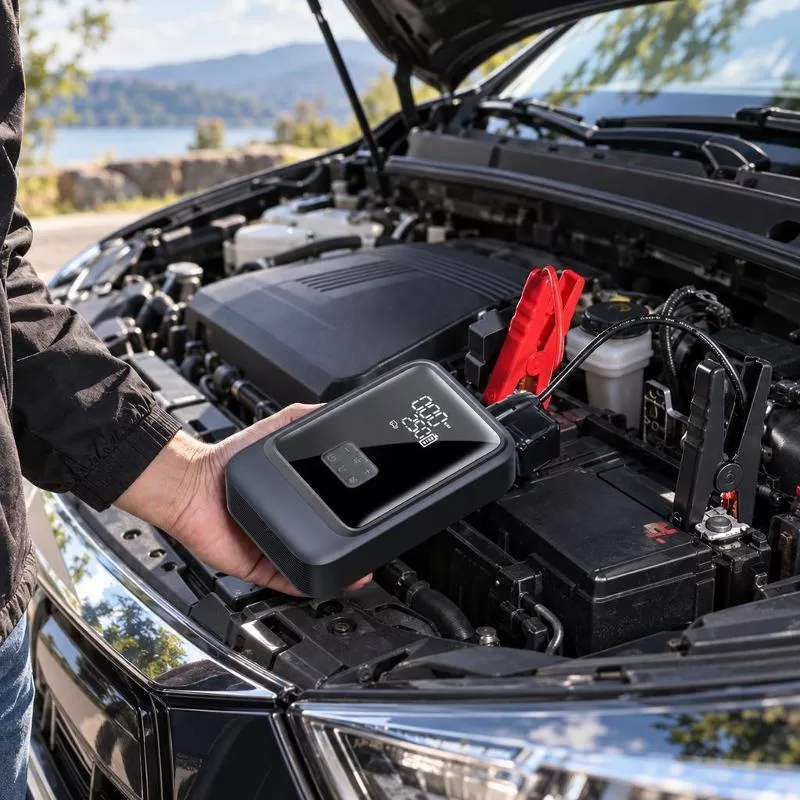
Type-C Charging Input and Power Bank Output
The S03 lists charging input support across several profiles: 5V/3A, 9V/3A, 12V/2.5A, 15V/2A, and 20V/1.5A, delivered through its Type-C port. Reaching one of these profiles requires a compatible charging source, such as a USB-C wall adapter or power source that actually supplies one of the listed voltage and current combinations; a basic cigarette-lighter socket will not provide a compatible connection without a suitable adapter. Under a compatible input, the manufacturer states a charging time of 3 to 4 hours.
For outgoing power, the unit provides a 5V/2A power-bank output. In a stranding situation, this reserve can help keep a phone or small flashlight running for a while, which can matter when waiting for a tow truck or a friend to arrive. The exact runtime this provides will depend on the connected device’s own power draw, which the supplied specifications do not quantify, so results will vary between a phone and a larger device.
Night Roadside Visibility: Lighting Modes and Noise Level
Changing a wheel on a dark rural lane presents real hazards from passing traffic, and visibility becomes one of the most important safety factors in that situation. The built-in LED light offers three listed modes: a constant-on setting for inspecting an engine bay, a flashing mode to draw the attention of oncoming drivers, and an SOS pattern intended for distress situations.
Noise is also worth considering for any compressor used near traffic or at night, since a loud pump can be startling in an otherwise quiet roadside setting. The manufacturer lists an operating noise level of 85dB or below at a 1-meter distance for the pump assembly. This figure is presented here as the manufacturer’s stated specification rather than an independently measured or comparative claim about how it sounds relative to other inflators.
How to Select the Right 2-in-1 Emergency Unit for Your Needs
Selecting roadside equipment means checking the unit’s specifications against your own vehicle and driving habits rather than assuming any single model fits every case. The supplied S03 product information does not specify which particular engine sizes its current ratings are designed for, so the following points focus on what buyers should verify rather than fixed compatibility claims that could be misleading for a specific vehicle.
A Practical Checklist Before Buying
-
Compare the starting current and peak current figures against your vehicle manufacturer’s recommended jump-starting guidance, where available, rather than estimating fitment from engine size alone.
-
Check the listed working temperature range of 0°C to 45°C against the climate where the unit will typically be stored and used.
-
Review the tire inflation range of 2 to 160 PSI against the tire types you expect to service, including bicycle, motorcycle, or sports-ball inflation needs.
-
When in doubt about a specific vehicle, consult the vehicle owner’s manual or a qualified mechanic before relying on any portable jump starter as a primary emergency tool.
Maintenance: Keeping the Battery Ready for Use
Batteries stored inside a vehicle cabin or trunk experience a wide range of temperatures across the seasons, from summer heat behind glass to winter cold overnight, which can affect how well they hold a charge over time. Checking the charge level periodically, rather than assuming the unit stays ready indefinitely, is a reasonable habit for anyone relying on this type of device for genuine emergencies rather than occasional convenience use.
Follow the storage and recharging guidance in the product manual for specific intervals and charge targets, since the supplied specifications do not define an exact recharge schedule for long-term storage. Storing the unit in a protective pouch away from direct sunlight through vehicle glass is a reasonable general precaution for most battery-powered electronics kept in a vehicle, and it can help avoid unnecessary heat exposure during parked summer days.
Frequently Asked Questions (FAQs)
Can a 2-in-1 jump starter air compressor inflate a tire on a large truck?
The manufacturer lists a capacity of approximately 2.5 tires sized 285/70R17 per full charge for the S03, within its 2 to 160 PSI pressure range. This figure covers that documented tire size and is presented as the manufacturer’s stated specification rather than an independently verified test result; it does not by itself establish compatibility with every large truck or tire size. The supplied product information does not specify a recommended rest interval during continuous use, so operators should check the vehicle and product manuals and follow the manufacturer’s guidance on duty cycle if one is provided.
What is the practical difference between starting current and peak current when jump-starting?
Manufacturers typically list two figures: a starting current rating and a higher peak current rating, as the S03 does with 400A to 600A starting current and 1000A to 1400A peak current. These are the manufacturer’s stated ratings for the unit rather than a standardized test result described in the supplied specifications. Checking both figures against your vehicle’s own requirements, ideally with reference to the vehicle manual, is more useful than relying on either number alone when deciding if a unit is a good match.
How often should the unit be recharged if left in the vehicle trunk?
The supplied specifications do not define an exact recharge interval for storage. A reasonable general practice is to check the charge level periodically using the 4-level indicator and to follow the storage guidance in the product manual, rather than assuming a fixed schedule applies regardless of how the unit is stored or how often it sees use.
Will the tire inflator automatically stop when the target pressure is reached?
The unit’s digital display and control system are designed to monitor air pressure against the preset or custom target, according to the manufacturer. The automatic shut-off feature is intended to trigger once the tire reaches that target, which is meant to reduce the risk of over-inflation while the pump is running unattended for a moment during a routine roadside top-up.
Can this unit be safely charged via a vehicle’s 12V cigarette lighter port or USB socket?
The Type-C port is listed as accepting several charging input profiles, including 5V/3A, 9V/3A, 12V/2.5A, 15V/2A, and 20V/1.5A. Reaching one of these profiles requires a compatible charging source; a standard cigarette-lighter socket will need a suitable USB-C adapter rather than a direct connection to deliver a matching profile. Under a compatible input, the manufacturer states a charging time of approximately 3 to 4 hours.
Autonomous Roadside Readiness
Securing your vehicle against sudden roadside hazards does not require filling your trunk with multiple separate accessories. By combining listed jump-starting support of up to 1400A peak current with a 160 PSI-rated tire inflator, the modern 2-in-1 jump starter air compressor offers a practical backup option for common situations like a weak battery on a cold morning or a slow leak discovered far from the nearest service station, while more serious mechanical problems will still call for professional roadside assistance.
-

Meet NEWO at the 140th Canton Fair: Visit Booth 10.3 M03–04
Meet NEWO at the 140th Canton Fair in Guangzhou, October 15–19, 2026. Visit Booth 10.3 M03–04 to explore portable air pumps and discuss OEM, ODM and distribution opportunities.... -

As Shenzhen Welcomes the World for APEC 2026, NEWO Welcomes You to Our Factory
As Shenzhen prepares for APEC 2026, NEWO welcomes international buyers and partners to visit our factory, meet our team and explore future cooperation.... -

Leading the Way in Product Innovation and Excellence
Smartnewo exemplifies professionalism in product innovation and manufacturing. Their collaboration with Xiaomi Youpin on the G01 crowdfunding project highlights their expertise in creating compact, powerful inflatable pumps. Rigorous engineering, meticulous production processes, and advanced quality assurance underscore their commitment to excellence. The success of the G01 project, with significant market... -

Essential Qualities of an Excellent Supplier
In today's competitive market, finding a reliable supplier is crucial for business success. Based on insights from Smartnewo and broader internet research, here are key qualities an excellent supplier must possess:... -

NW06 Tire Inflator: Compact Power for Quick Inflation
Summary The NW06 Tire Inflator delivers quick and efficient tire inflation with a powerful 35L/min airflow. It features a user-friendly LCD screen for real-time pressure monitoring, dual power options with a built-in 6000mAh battery, and multiple nozzle attachments for versatile use. Its compact design and integrated LED light ensure convenience and... -

Unleash the Power of Portability: The SmartNewo Jump Starter with Air Compressor KF03
This guide will walk you through the steps to effectively use a portable tire inflator, helping you stay prepared and safe on the road.... -

Newo Attends The 2024 Consumer Electronics Show (CES)
Smartnewo booth is located at 53672, Halls A-D, Level 2, Venetian Expo, Las Vegas Convention Center (LVCC). ... -

Smartnewo’s Dual-Cylinder Air Pump Rocks the Hong Kong Autumn Electronics Fair!
Smartnewo’s Dual-Cylinder Air Pump Rocks the Hong Kong Autumn Electronics Fair!... -

Meet at the Canton Fair! Smartnewo brings dual-cylinder air pumps, making your inflation experience faster and more stable!
NEWO has went deep communication and negotiation with customers from all over the world on booth.... -

“Hong Kong Autumn Electronics Fair – 1CA18 (October 13th to 16th): Smartnewo invites you to visit our booth!
Hong Kong Autumn Electronics Fair...










-

How to Choose a Reliable Tire Inflator Manufacturer in China
Choose a tire inflator manufacturer in China with a focused RFQ, supplier evidence, configuration checks, and clear sample-to-pilot decisions for your brand.... -

Rechargeable Electric SUP Pump for Paddle Boards: Faster Inflation for SUPs, Kayaks and Inflatable Tents
The BL10-C Portable Electric Bike Tire Inflator is a compact and lightweight mini electric bike pump designed for modern cyclists. With up to 120 PSI pressure, a digital LED display, preset pressure control, automatic shut-off, USB-C charging, and multiple valve adapters, BL10-C offers a convenient inflation solution for road bikes,... -

Are Electric Bike Pumps Worth It in 2026? Electric Pump vs CO₂ vs Mini Hand Pump
Discover whether electric bike pumps are worth it in 2026. This guide compares electric bike pumps, CO₂ inflators, and mini hand pumps for road cycling, gravel riding, commuting, and long-distance rides. Learn the pros, limitations, best use cases, and key features to look for before choosing the right portable tire... -
BL10-C Portable Electric Bike Tire Inflator: Small Size, Reliable Power for Every Ride
The BL10-C Portable Electric Bike Tire Inflator is a compact and lightweight mini electric bike pump designed for modern cyclists. With up to 120 PSI pressure, a digital LED display, preset pressure control, automatic shut-off, USB-C charging, and multiple valve adapters, BL10-C offers a convenient inflation solution for road bikes,... -

Why Mini Electric Bike Pumps Are Becoming Essential for Modern Cycling
Discover why mini electric bike pumps are becoming essential for modern cyclists. Learn how portable electric bike pumps improve tire pressure management, riding safety, and convenience.... -

The Ultimate Smart Solution for Easy Outdoor Adventures in 2026
Discover how a spring travel air pump simplifies outdoor trips with fast inflation, smart features, and powerful performance—perfect for every adventure.... -

Powerful 5-in-1 Portable Car Tire Inflator and Jump Starter: The Ultimate Emergency Tool for Every Driver
Why Every Driver Needs a Portable Car Tire Inflator and Jump Starter Modern drivers face many unexpected situations on the road. A flat tire, low tire pressure, or a dead car battery can happen at the worst possible time. That’s why having a portable car tire inflator and jump starter is... -

7 Real Cycling Scenarios That Show Why Every Rider Should Carry a Mini Bike Pump
Cycling is one of the most freeing activities you can enjoy. Whether you’re commuting to work, riding through city streets, or exploring quiet countryside roads, a bike ride can instantly improve your day. But there’s one small problem that almost every cyclist eventually faces: Low tire pressure. It might happen... -
BL08-A Portable Electric Bike Pump: A Global Distribution Opportunity with Smartnewo
Smartnewo, a professional manufacturer of portable electric air pumps, introduces the BL08-A model — a compact and efficient inflator designed for global distributors, e-commerce sellers, and outdoor accessory brands seeking reliable OEM/ODM solutions. Table of Contents Main Heading Subtopics 1. Introduction: Expanding the Global Market for Smart Inflation Tools Portable... -

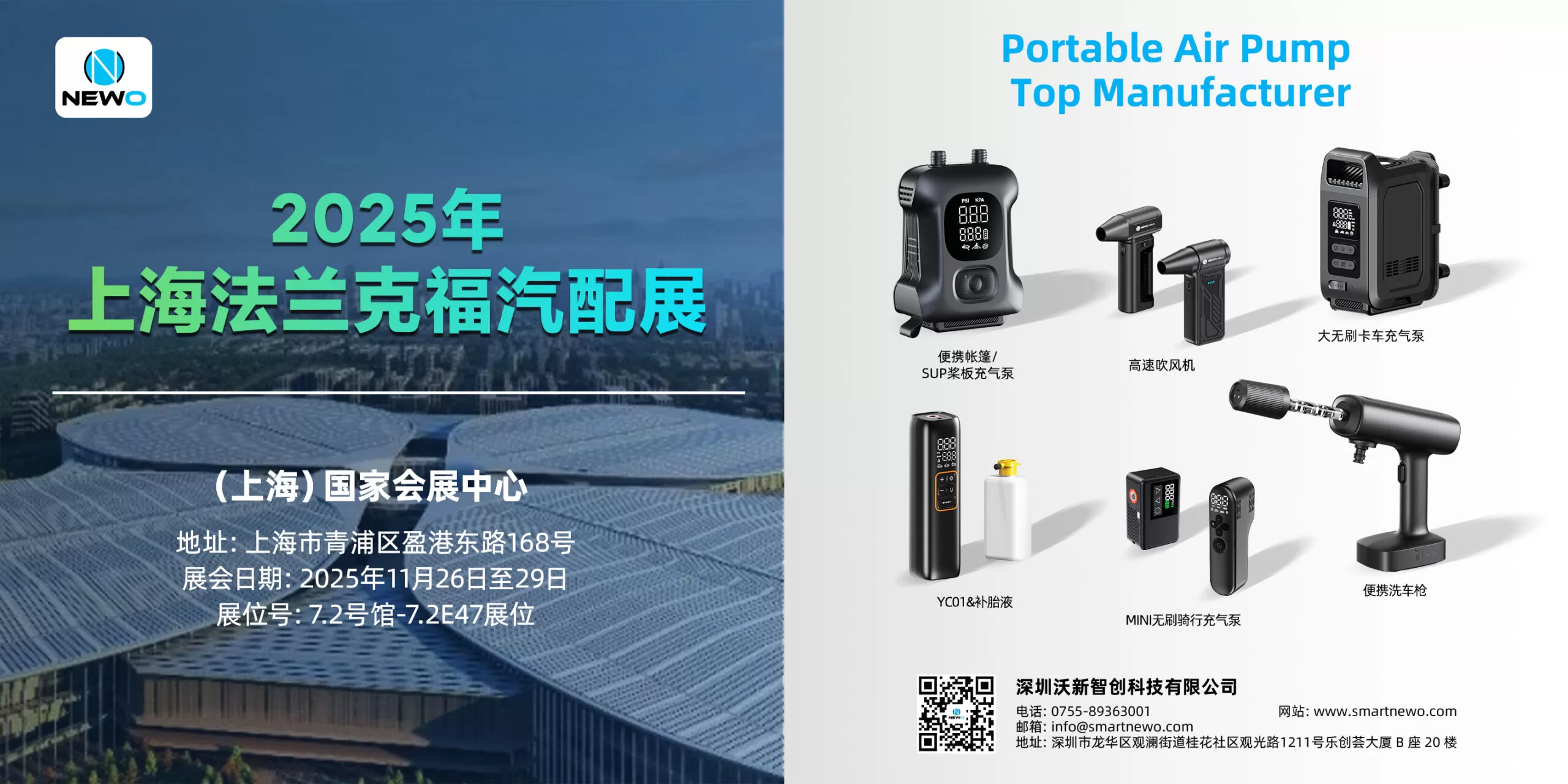
Connecting Opportunities at Automechanika Shanghai 2025 — Smartnewo Exhibition Day 1
Today marks an exciting beginning as Smartnewo officially opens its booth at Automechanika Shanghai 2025. As one of the largest and most influential automotive aftermarket exhibitions in the world, the show provides an exceptional platform for meaningful conversations, partnership building, and global industry exchange. Located at Booth 7.2E47, Smartnewo presents...







-
How Is a Football Properly Inflated?
The correct inflation of a football - with not too much and not too little air - is a hotly debated topic among footballers.... -
Application Scenarios of Car Inflator Pump
Often long-distance business trips or play car owners because the road may be more remote areas, in this case if you encounter a tire leak....

