

 Portable Tire Inflators
 Electric Air Pumps
 Electric Car Tyre Pumps
 Electric Ball Pumps
 Electric Bike Pump
 SUP Air Pump

How to Choose and Use a Portable Electric Car Tyre Pump: The Complete Driver’s Guide
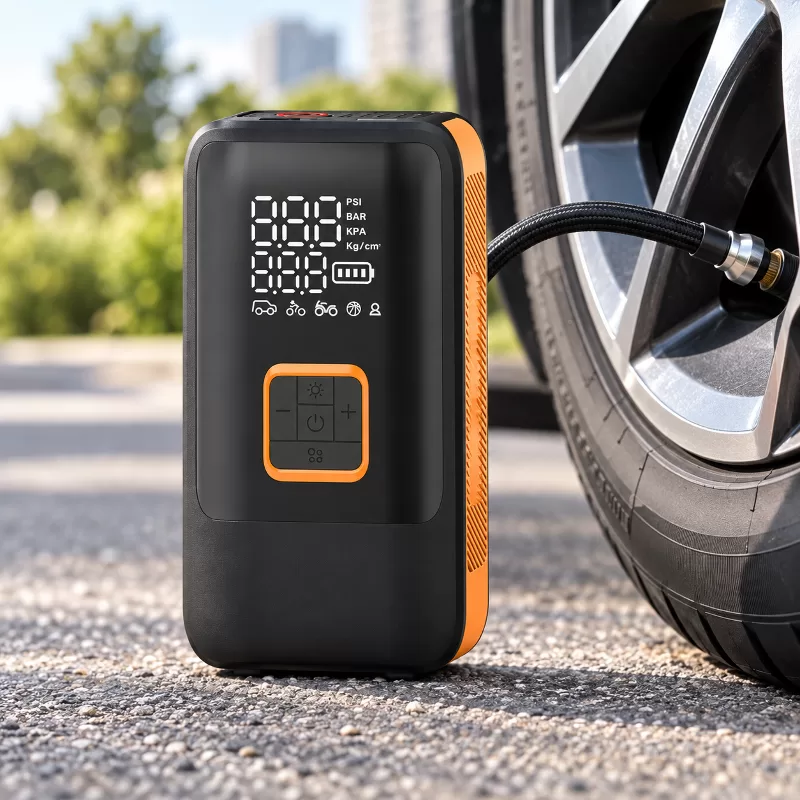
Maintaining correct pneumatic pressure in automotive tyres is one of the most critical safety routines a driver faces, yet it remains routinely neglected until a dashboard warning triggers. Investing in a reliable portable electric car tyre pump eliminates the unpleasant scramble for functional fuel station compressors, letting you manage inflation precisely from your driveway or on a deserted shoulder. Natural pressure seepage, seasonal temperature swings, and gradual rim leaks constantly work against road safety, making a compact cordless inflator an indispensable companion for daily journeys and extended road trips alike.
Why Modern Drivers Rely on a Portable Electric Car Tyre Pump
Understanding Natural Pressure Drop and Ambient Temperature Fluctuations
Vehicle tyres are not hermetically sealed air vaults. Through natural permeation across the inner butyl rubber liner, tyres gradually lose air over time, although the exact rate varies based on tyre condition, age, wheel seal, and ambient factors.
Thermal conditions also alter air density noticeably over seasonal shifts. As a rule of thumb, tyre pressure changes by about 1 PSI for each 10°F change in temperature, meaning early morning cold weather often triggers unexpected pressure drops.
Visual checks cannot detect these marginal losses on modern steel-belted radial tyres. A tyre may be substantially underinflated while still appearing normal from the outside on flat asphalt.
Under-inflation increases rolling resistance, accelerating tread wear along the outer tyre shoulders while decreasing overall fuel economy. Under heavy highway loads, excessive flex in the rubber generates hazardous internal heat that degrades internal bonding layers.
TPMS Alerts Versus Regular Proactive Maintenance
Modern vehicles feature Tyre Pressure Monitoring Systems, but these sensors serve as reactive safety warnings rather than regular maintenance aids. TPMS is designed to warn when a tyre is significantly underinflated; for vehicles covered by the U.S. federal standard, the specified warning threshold is generally 25% below the recommended cold pressure.
Driving on a tyre that is already down by a quarter of its required volume compromises braking distances on wet pavement and slows steering response in sudden avoidance maneuvers.
Visiting commercial forecourts often presents broken air lines, inaccurate mechanical gauges, or demanding coin-operated meters. A dedicated portable electric car tyre pump delivers exact digital readings on demand, allowing you to top off cold tyres without leaving your garage.
Versatile Pneumatic Support Across Multiple Applications
While passenger sedans and crossover utility vehicles represent the primary use case, cordless electric inflators solve pressure needs across varied equipment. The same portable electric car tyre pump easily adapts to mountain bicycles, commuter e-bikes, scooters, and mobility wheelchairs.
Seasonal gear such as sports balls or small recreation inflatables require modest volumes at strict pressure tolerances. Dedicated smart inflators handle these items without the risk of bursting from excessive, unregulated industrial compressor bursts.
Key Technical Features in Portable Inflation Systems
Pressure Capacity and Real-World Requirements
Consumer inflators frequently boast maximum ratings reaching 120 or 150 PSI. Many passenger vehicles use pressures in the low-to-mid 30 PSI range, but the correct value is the vehicle placard or owner’s-manual specification.
A maximum capability of 150 PSI provides a broad operating window well above typical passenger-vehicle requirements, allowing the device to support compatible higher-pressure inflatables as well.
Broader ranges also accommodate high-pressure road bike tyres that demand substantial pneumatic force. Having a dynamic window spanning from 2 to 150 PSI ensures wide versatility across varied vehicle fleets.
Airflow Rates and Compressor Cylinder Architecture
Air delivery rates, measured in litres per minute, determine how fast an electric inflator can lift a tyre to nominal road specification. Compact handheld devices generally provide between 15 and 30 L/min of free airflow.
Compressor output relates directly to motor wattage and cylinder sizing. A 19-cylinder assembly driven by a 60W motor establishes a balance between physical exterior dimensions and practical delivery rates around 26 to 28 L/min.
- Top-Up Versus Full Inflation: Small pressure corrections are generally faster than inflating a severely deflated tyre; actual inflation time varies based on tyre size, battery charge, and initial starting pressure.
- Thermal Dissipation and Ventilation: Compressing air generates heat during operation; the LP8’s rear housing includes ventilation slots, and users should follow the manufacturer’s operating and cooling instructions during repeated inflation.
- Acoustic Output: Compact high-speed compressors generate noise; units maintaining sound levels at or below 85 dB at 1 metre minimise disturbance during early morning driveway adjustments.
Battery Pack Architecture and Power Flexibility
True portability requires self-contained lithium-ion battery packs that supply stable voltage under direct mechanical loads. Operating a pneumatic compressor motor draws substantial current, quickly overwhelming poorly arranged cells.
High-performance designs frequently utilize a series arrangement of three 18650 lithium cells (yielding 11.1V nominal output, typically 22.2Wh). This configuration maintains consistent motor torque against rising tyre counter-pressure.
Modern inflators have phased out obsolete proprietary barrel-plug adapters in favour of universal Type-C charging ports. Supporting standard 5V/2A and faster 9V/1.5A inputs means the inflator charges easily from existing vehicle USB-C sockets or household phone chargers.
Certain units also incorporate secondary power output circuitry on their charging interface. While specifications list both 5V/2A and 9V/1.5A input and output ratings on the Type-C port, users should always verify manufacturer documentation regarding external device-charging support.
Digital Sensing, Dual Displays, and Auto-Stop Functions
Analogue dial gauges rely on internal mechanical springs that can drift out of calibration when dropped or stored in cold vehicle boots. Digital pressure sensors provide repeatable readouts with direct digital signal conversion.
Dual LED displays provide clear visual readouts in low light conditions, displaying diagnostic information and pressure values cleanly during roadside operations.
Modern smart inflators incorporate automatic shut-off systems. The pump is designed to stop automatically when its measured pressure reaches the preset target; check the pressure afterward with a reliable gauge to verify exact compliance.
Users can instantly switch between imperial PSI and metric BAR units depending on local road standards or vehicle handbook specifications.
Spotlight: Newo Electric Car Tire Air Pump 150PSI LP8
Engineering Profile and Manufacturer Specifications
For us at Newo, pneumatic technology must unite functional performance with uncompromised portability. As an experienced manufacturer developing smart electric air pumps and outdoor solutions, we engineered the LP8 to address everyday vehicle upkeep and urgent travel scenarios.
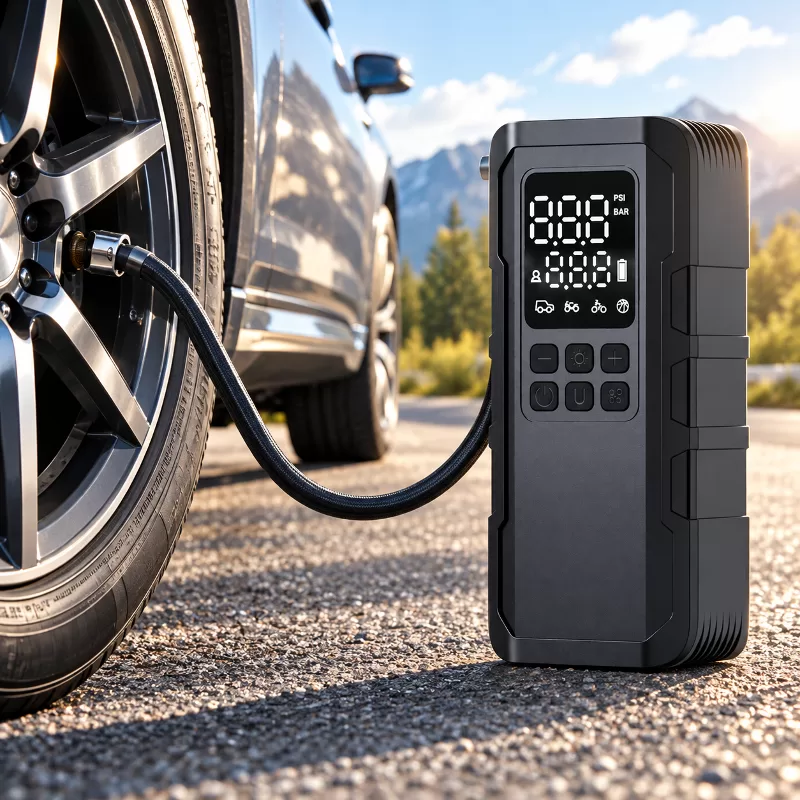
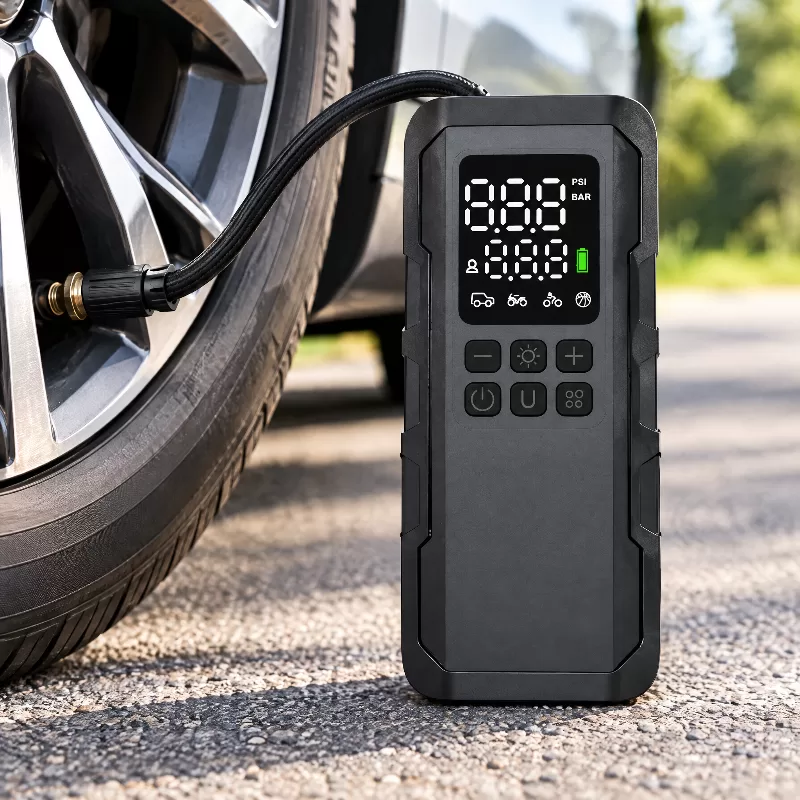
The LP8 combines a 19-cylinder compressor with a 60W motor, delivering approximately 26 to 28 L/min of airflow. Measuring 70.5 × 50 × 165 mm and weighing 522 g, this portable electric car tyre pump fits conveniently in door pockets or under-boot compartments.
| Technical Specification | LP8 Parameter Profile |
|---|---|
| Model Designation | Electric Car Tire Air Pump 150PSI LP8 |
| Working Pressure Range | 2 to 150 PSI (Supports PSI and BAR units) |
| Compressor Power / Cylinder | 60W / 19 cylinder |
| Airflow Output | Approximately 26 to 28 L/min |
| Internal Battery Setup | 3 × 18650, 2000mAh cells (11.1V / 22.2Wh) |
| Power Interface | Type-C port; 5V/2A, 9V/1.5A input and output |
| Recharge Time | Approximately 2 to 3 hours |
| Continuous Runtime | 20 to 25 minutes per charge cycle |
| Operational Noise | ≤ 85 dB measured at 1 metre |
| Working Temperature | -10°C to 45°C (14°F to 113°F) |
| Dimensions & Weight | 70.5 × 50 × 165 mm; 522 g net weight |
Note: Technical parameters are sourced directly from Newo manufacturer documentation. The estimated capacity to top off approximately 3.5 tyres (size 205/55 R16) represents rated laboratory test cycles; real-world volume varies based on ambient temperature and initial pressure levels.
Ergonomic Design, Dual Displays, and Lighting
The LP8 features a textured, low-gloss dark gray housing fitted with raised protective side ribs. This outer geometry shields the internal pneumatic assembly from accidental knocks and scratches during roadside use.
Five selectable preset modes along with custom pressure control let users toggle swiftly between preferred operating targets. Front tactile buttons provide immediate adjustment for custom pressure values across different inflatables.
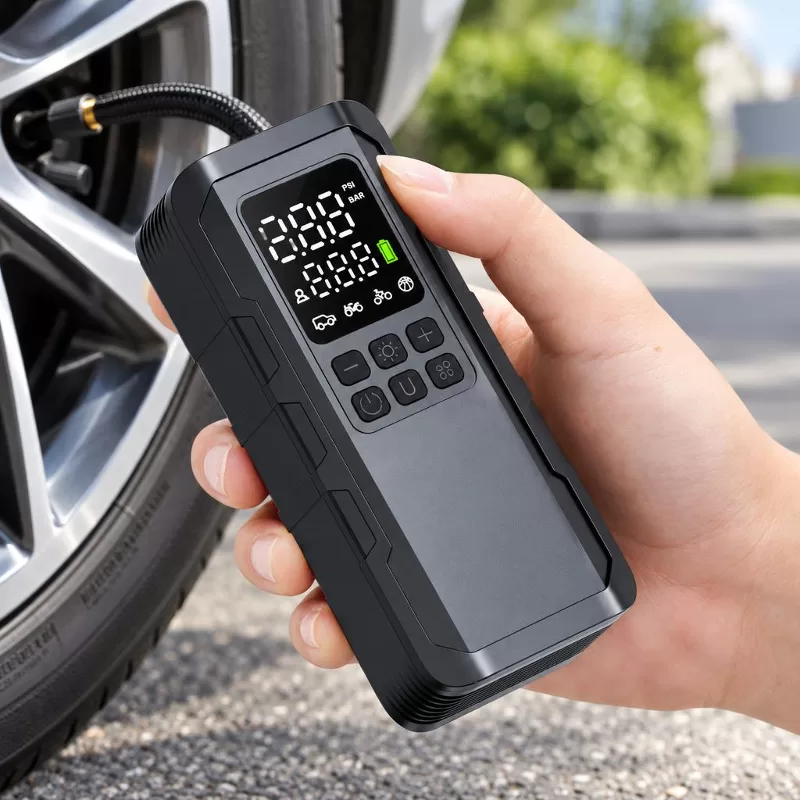
Integrated illumination adds practical security during nighttime breakdowns. The LP8 includes constant, flashing, and SOS light modes to support various visibility needs.
Step-by-Step Guide: How to Safely Inflate Car Tyres
- Locate the cold tyre pressure specification on the vehicle door jamb placard.
- Inspect the valve stem and unscrew the protective dust cap.
- Thread the inflator hose securely onto the valve stem.
- Read the detected pressure on the display and select the target pressure.
- Run the inflator until it automatically stops, then verify the final pressure with an accurate gauge.
Step 1: Finding Your Vehicle Placard Specification
Never inflate your car tyres to the maximum pressure stamped on the tyre sidewall itself. The sidewall marking gives the tyre’s maximum inflation pressure; it is not the vehicle’s recommended everyday pressure. Use the cold pressure listed on the vehicle placard or in the owner’s manual.
Open the driver’s door and locate the vehicle tire specification placard attached to the B-pillar or door frame edge. This yellow-and-white label lists the exact cold inflation pressure determined by vehicle chassis engineers.
If the driver’s pillar lacks this placard, consult your owner’s handbook or check the inside of the fuel filler flap. Always adhere to these chassis values rather than arbitrary numbers printed on the rubber casing.
Step 2: Measuring Cold Pressure Correctly
Pneumatic pressure measurements must always be taken when tyres are cold. Driving causes continuous rubber flexing and road friction, which heats the air inside the tyre and increases internal pressure above baseline resting values.
A tyre is considered cold when the car has remained stationary for at least three hours, or has traveled less than 1 mile at low urban speeds.
If you discover an underinflated tyre after driving, never bleed air from the warm tyre down to the placard figure, as this causes severe under-inflation once cooled. Consult your vehicle manual for specific warm tyre guidance, add sufficient air to drive safely, and recheck the tyre when it is fully cold.
Step 3: Threading the Hose and Choosing Preset Modes
Unscrew the plastic dust cap from the wheel’s Schrader valve stem and store it safely in your pocket or vehicle cup holder.
Thread the braided inflation hose of your portable electric car tyre pump clockwise onto the brass valve stem until the seal engages. You may hear a momentary hiss of escaping air before the connection tightens completely.
Once connected, the inflator activates its digital screen, registering the current pressure inside the tyre. Compare this detected reading directly against the vehicle manufacturer’s cold specification.
Select your desired preset or adjust the target pressure manually using the front controls. Toggle between PSI and BAR so that the displayed unit matches your vehicle documentation.
Step 4: Activating Auto-Stop and Disconnecting
Press the power switch to start the compressor pump. The inflator will begin delivering air into the tyre while the digital display updates the rising pressure level.
Stand clear of the wheel assembly during inflation, keeping the flexible air hose unkinked and free from sharp wheel rim edges.
The pump is designed to stop automatically when its measured pressure reaches the preset target. It remains good practice to check the final pressure with an accurate separate gauge after inflation completes.
After extended operation, allow the hose and connector to cool before disconnecting, and follow the manufacturer’s handling instructions. Unscrew the air hose connector swiftly from the valve stem to prevent residual air loss, then thread the plastic valve cap back onto the stem firmly to protect the internal valve core from road grit, moisture, and road salt.
Practical Operating Limits and Compressor Maintenance
Understanding Duty Cycles and Thermal Management
Every compact portable electric car tyre pump operates on precise thermodynamic principles. Compressing atmospheric air naturally generates considerable heat within the cylinder and surrounding hose fittings.
Compact 12V and battery-powered inflators feature specific operating limits to safeguard internal mechanical components. Do not exceed the manufacturer’s stated runtime, stop if the unit becomes excessively hot, and follow the product instructions for cooling between repeated inflation cycles.
When topping off multiple tyres from low levels, monitor device temperatures carefully. Allowing adequate pauses between cycles helps protect internal components and avoids thermal overload shutdowns.
After operation, handle the air hose and metal fittings with care, as compression heat naturally transfers to connection points during use. Allow these components to cool before packing the unit away.
Distinguishing Pressure Drops from Structural Failures
A cordless tyre inflator serves as an exceptional tool for routine pressure correction, slow bead leaks, and seasonal air top-offs. However, it cannot repair structural tyre failure.
If a tyre loses pressure rapidly within minutes of inflation, immediately inspect the tread face for nails, screws, road debris, or sidewall lacerations.
Never attempt to re-inflate or drive on a tyre with visible sidewall cracking, structural bulging, or significant rim damage. Doing so risks catastrophic tread separation or sudden blowout at speed.
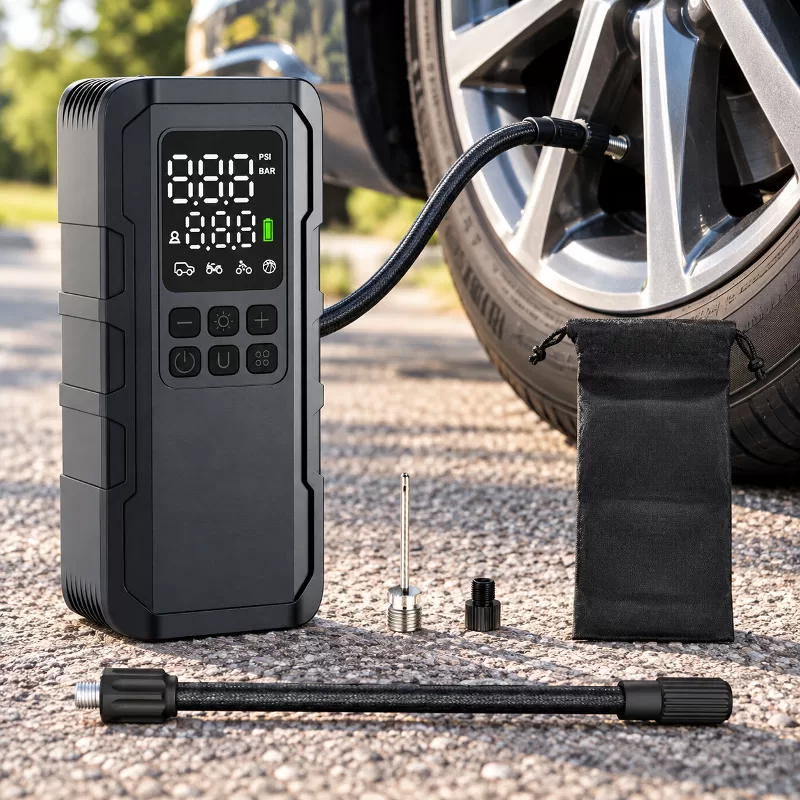
Use the inflator within the stated -10°C to 45°C working range, and follow the manufacturer’s separate storage guidance for the battery. Keeping the unit protected inside its storage pouch shields the casing from accidental impacts inside the vehicle boot.
Frequently Asked Questions (FAQs)
Can I run my cordless tyre pump while it is plugged into a charger?
Most modern cordless inflators, including the LP8, rely on dedicated high-drain internal lithium-ion battery configurations. Standard vehicle USB ports and small wall bricks provide 5V or 9V at low current ratings, whereas an active 60W compressor motor requires substantially greater electrical power. Attempting to run the motor while charging can place unnecessary stress on battery management circuits. It is best practice to let the internal battery charge adequately before running the compressor mechanism.
Why does my tyre pressure read higher after driving on the motorway?
Driving warms the air inside the tyre, which raises the measured pressure. Mechanical friction against the road surface and continuous sidewall flexing increase internal air temperature, resulting in higher pressure readings than when the vehicle is stationary. Check and set pressure when the tyres are cold to ensure the inflation level reflects the manufacturer’s baseline specification.
How often should tyre pressure be checked with a portable inflator?
Automotive safety authorities recommend checking all four tyres—and your spare wheel—at least once every month and before embarking on any long-distance motorway journey. Natural permeation causes gradual pressure drops that escape naked-eye detection. Checking tyres monthly ensures optimum braking distances, prevents irregular tread wear patterns, and maximizes fuel economy.
What is the difference between placard pressure and sidewall PSI?
The figure printed on your vehicle door jamb is the vehicle manufacturer’s engineered cold tyre pressure. This value is tuned specifically to balance braking performance, cabin comfort, vehicle load distribution, and stability control calibration. In contrast, the pressure molded into the tyre sidewall represents the maximum safe pressure the rubber tyre structure can withstand under absolute maximum load. You should never inflate everyday tyres to the maximum sidewall figure.
What does the 19-cylinder specification signify on the LP8?
In the LP8 technical data, "19 cylinder" is the manufacturer’s specified cylinder classification for the internal micro-compressor mechanism. Together with the 60W motor, this setup is rated to deliver approximately 26 to 28 L/min of airflow while keeping the entire device compact and lightweight for glove-box or boot storage.
Will an automatic electric pump drain my car battery if plugged into 12V?
Standalone rechargeable inflators like the LP8 rely entirely on their self-contained lithium-ion battery cells, eliminating drain on your vehicle’s starter battery during use. If you use a corded 12V car cigarette lighter compressor, it is advisable to keep the vehicle engine idling while running the pump to avoid depleting the car’s 12V lead-acid starter battery.
Reliable Tyre Maintenance on Your Own Terms
Consistent tyre pressure maintenance remains one of the simplest, most vital responsibilities of vehicle ownership. Carrying an accurate portable electric car tyre pump helps drivers check and correct pressure whenever needed, supporting safe vehicle handling, predictable braking distances, and consistent fuel economy. Compact pneumatic engineering, a dual LED display, and intelligent auto shut-off features make modern inflators practical tools that any driver can operate with confidence. Keeping a well-maintained portable electric car tyre pump on hand provides valuable peace of mind, ensuring your tyres remain properly supported on every journey.
-

Meet NEWO at the 140th Canton Fair: Visit Booth 10.3 M03–04
Meet NEWO at the 140th Canton Fair in Guangzhou, October 15–19, 2026. Visit Booth 10.3 M03–04 to explore portable air pumps and discuss OEM, ODM and distribution opportunities.... -

As Shenzhen Welcomes the World for APEC 2026, NEWO Welcomes You to Our Factory
As Shenzhen prepares for APEC 2026, NEWO welcomes international buyers and partners to visit our factory, meet our team and explore future cooperation.... -

Leading the Way in Product Innovation and Excellence
Smartnewo exemplifies professionalism in product innovation and manufacturing. Their collaboration with Xiaomi Youpin on the G01 crowdfunding project highlights their expertise in creating compact, powerful inflatable pumps. Rigorous engineering, meticulous production processes, and advanced quality assurance underscore their commitment to excellence. The success of the G01 project, with significant market... -

Essential Qualities of an Excellent Supplier
In today's competitive market, finding a reliable supplier is crucial for business success. Based on insights from Smartnewo and broader internet research, here are key qualities an excellent supplier must possess:... -

NW06 Tire Inflator: Compact Power for Quick Inflation
Summary The NW06 Tire Inflator delivers quick and efficient tire inflation with a powerful 35L/min airflow. It features a user-friendly LCD screen for real-time pressure monitoring, dual power options with a built-in 6000mAh battery, and multiple nozzle attachments for versatile use. Its compact design and integrated LED light ensure convenience and... -

Unleash the Power of Portability: The SmartNewo Jump Starter with Air Compressor KF03
This guide will walk you through the steps to effectively use a portable tire inflator, helping you stay prepared and safe on the road.... -

Newo Attends The 2024 Consumer Electronics Show (CES)
Smartnewo booth is located at 53672, Halls A-D, Level 2, Venetian Expo, Las Vegas Convention Center (LVCC). ... -

Smartnewo’s Dual-Cylinder Air Pump Rocks the Hong Kong Autumn Electronics Fair!
Smartnewo’s Dual-Cylinder Air Pump Rocks the Hong Kong Autumn Electronics Fair!... -

Meet at the Canton Fair! Smartnewo brings dual-cylinder air pumps, making your inflation experience faster and more stable!
NEWO has went deep communication and negotiation with customers from all over the world on booth.... -

“Hong Kong Autumn Electronics Fair – 1CA18 (October 13th to 16th): Smartnewo invites you to visit our booth!
Hong Kong Autumn Electronics Fair...










-

What to Check Before Ordering Custom Electric Bike Pumps
Plan custom electric bike pumps with a clear requirements freeze for valves, TPU tubes, portability, repeated top-ups, charging, and model-specific documents.... -

OEM vs ODM Air Pumps: Which Manufacturing Model Fits Your Brand?
Compare OEM and ODM air pump projects by design responsibility, change approval, development scope, and written ownership terms before choosing your route.... -
How to Choose a Reliable Tire Inflator Manufacturer in China
Choose a tire inflator manufacturer in China with a focused RFQ, supplier evidence, configuration checks, and clear sample-to-pilot decisions for your brand.... -

Rechargeable Electric SUP Pump for Paddle Boards: Faster Inflation for SUPs, Kayaks and Inflatable Tents
The BL10-C Portable Electric Bike Tire Inflator is a compact and lightweight mini electric bike pump designed for modern cyclists. With up to 120 PSI pressure, a digital LED display, preset pressure control, automatic shut-off, USB-C charging, and multiple valve adapters, BL10-C offers a convenient inflation solution for road bikes,... -

Are Electric Bike Pumps Worth It in 2026? Electric Pump vs CO₂ vs Mini Hand Pump
Discover whether electric bike pumps are worth it in 2026. This guide compares electric bike pumps, CO₂ inflators, and mini hand pumps for road cycling, gravel riding, commuting, and long-distance rides. Learn the pros, limitations, best use cases, and key features to look for before choosing the right portable tire... -
BL10-C Portable Electric Bike Tire Inflator: Small Size, Reliable Power for Every Ride
The BL10-C Portable Electric Bike Tire Inflator is a compact and lightweight mini electric bike pump designed for modern cyclists. With up to 120 PSI pressure, a digital LED display, preset pressure control, automatic shut-off, USB-C charging, and multiple valve adapters, BL10-C offers a convenient inflation solution for road bikes,... -

Why Mini Electric Bike Pumps Are Becoming Essential for Modern Cycling
Discover why mini electric bike pumps are becoming essential for modern cyclists. Learn how portable electric bike pumps improve tire pressure management, riding safety, and convenience.... -

The Ultimate Smart Solution for Easy Outdoor Adventures in 2026
Discover how a spring travel air pump simplifies outdoor trips with fast inflation, smart features, and powerful performance—perfect for every adventure.... -

Powerful 5-in-1 Portable Car Tire Inflator and Jump Starter: The Ultimate Emergency Tool for Every Driver
Why Every Driver Needs a Portable Car Tire Inflator and Jump Starter Modern drivers face many unexpected situations on the road. A flat tire, low tire pressure, or a dead car battery can happen at the worst possible time. That’s why having a portable car tire inflator and jump starter is... -

7 Real Cycling Scenarios That Show Why Every Rider Should Carry a Mini Bike Pump
Cycling is one of the most freeing activities you can enjoy. Whether you’re commuting to work, riding through city streets, or exploring quiet countryside roads, a bike ride can instantly improve your day. But there’s one small problem that almost every cyclist eventually faces: Low tire pressure. It might happen...









-
How Is a Football Properly Inflated?
The correct inflation of a football - with not too much and not too little air - is a hotly debated topic among footballers.... -
Application Scenarios of Car Inflator Pump
Often long-distance business trips or play car owners because the road may be more remote areas, in this case if you encounter a tire leak....

