

 Portable Tire Inflators
 Electric Air Pumps
 Electric Car Tyre Pumps
 Electric Ball Pumps
 Electric Bike Pump
 SUP Air Pump

Portable Air Pump for Car: How to Choose and Use the Right Tire Inflator
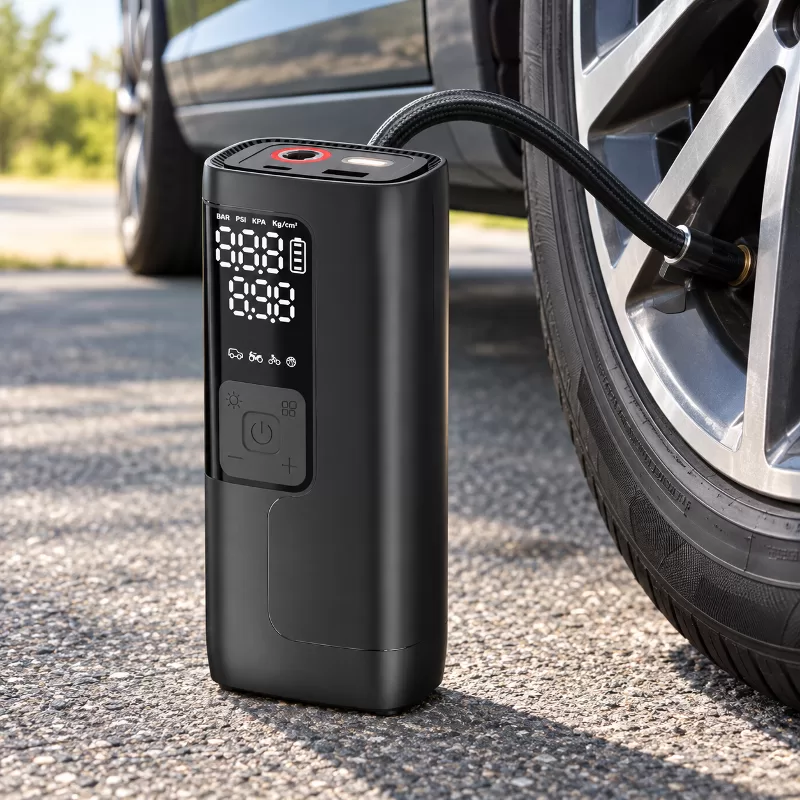
Tire pressure drops silently over time, long before an onboard monitoring light blinks across the instrument cluster. Having a dependable portable air pump for car tires transforms an inconvenient roadside emergency into a calm, controlled routine without relying on uncertain service-station air hoses. Whether managing seasonal temperature drops or preparing for a remote journey, carrying a portable tire inflator for car safety provides constant self-reliance whenever workshop compressors are out of reach.
Maintaining proper tire pressure directly influences vehicle steering balance, directional stability, braking distance, fuel economy, and tread life. Modern portable air inflators combine compact rechargeable battery systems with accurate cutoff sensors, eliminating the guesswork once associated with analog dial gauges and long pneumatic lines. Understanding how to select the right equipment protects both your tire investment and passenger safety on every trip.
Understanding What a Portable Air Pump for Car Does (and What It Cannot)
Defining the Modern Portable Electric Inflator
A modern portable tire inflator is an electrically powered reciprocating piston compressor designed for handheld convenience. Rather than relying on industrial storage tanks, the device draws electrical energy from internal rechargeable lithium-ion cells or a 12V vehicle auxiliary power socket to compress ambient air and direct it straight through a valve stem.
Unlike bulky workshop compressors that store dozens of gallons of compressed air, direct-displacement portable pumps operate continuously on demand. The piston moves rapidly within its cylinder bore, drawing in surrounding atmospheric air, compressing it through a mechanical check valve, and driving it down a reinforced hose into the pneumatic tire carcass.
Because direct-displacement tools lack a pressurized receiver reservoir, their functional capability depends on motor power, cylinder dimensions, electrical efficiency, and thermal heat management. These portable devices are built specifically for precise pressure adjustments, regular monthly maintenance, and unexpected roadside pressure top-ups.
Emergency Inflation vs. Permanent Tire Repair
A common driver misconception involves treating a portable compressor as a permanent repair tool for flat tires. In reality, an air pump merely replaces lost pneumatic volume; it cannot seal penetrations, fix severed tread cords, or re-seat a broken bead against an alloy wheel rim.
When a tire sustains a structural puncture from a foreign steel screw, nail, or sharp road hazard, running a compressor provides temporary diagnostic support at best. If air escapes as fast as the pump delivers it, attempting continuous inflation only creates dangerous mechanical stress and risks running the battery completely flat.
Driving on an unsealed tire that cannot maintain internal pneumatic pressure causes the internal sidewall structure to flex excessively, generating rapid heat that leads to sudden carcass delamination. Recognizing the boundary between an air-top-up situation and a physical wheel-changing scenario remains fundamental to roadside survival.
Key Factors When Choosing a Portable Tire Inflator
Matching Inflator Capability to Vehicle Types
Selecting the correct portable compressor begins with matching mechanical displacement against the actual air volume of your tires. Small passenger sedans operate with compact tires containing relatively small internal air cavities, meaning basic airflow output can easily bring them to recommended levels.
Conversely, light trucks, crossovers, and full-size SUVs use wide, tall tires that demand a much larger volume of compressed air to achieve every single pound-per-square-inch increase. Inflating an all-terrain tire with an undersized commuter pump forces the miniature piston to run continuously under high back-pressure, risking thermal cutoff before reaching proper specification.
Carefully evaluating whether you need to service low-volume commuter tires, larger truck profiles, or high-pressure two-wheel equipment prevents purchasing a tool that leaves you stranded when an inflation task exceeds its mechanical envelope.
Demystifying Pressure (PSI) vs. Airflow (L/min)
Marketing literature frequently highlights peak pressure ratings, often advertising 150 PSI as the premier capability indicator. However, passenger cars typically require operational inflation levels between 30 and 36 PSI, which means a lofty pressure ceiling does not directly guarantee practical roadside speed.
Volumetric airflow—measured in liters per minute (L/min)—determines how quickly an inflator can fill a given space. A pump featuring a higher displacement rating delivers more cubic air volume per stroke, substantially shortening the time you spend exposed beside moving highway traffic during an inflation cycle.
Maximum pressure simply reflects the hydraulic force the motor and mechanical piston can push against before stalling. Real-world inflation speed stems from the diameter of the cylinder bore, the stroke length of the connecting rod, and the electrical wattage delivered to the drive assembly.
Power Systems Compared: Cordless Battery vs. 12V DC vs. Hybrid
Selecting the right power platform involves balancing unencumbered mobility against continuous runtime requirements.
| Power Architecture | Primary Advantage | Operational Limitation | Best Suited For |
|---|---|---|---|
| Cordless Lithium-Ion | Cable-free mobility around all four tires | Requires regular recharging between trips | Routine top-offs and remote recreation |
| 12V DC Cigarette Lighter | Continuous runtime from vehicle battery | Limited reach; cord management hassles | Long road trips and emergency trunk storage |
| Hybrid Dual-Input | Flexible power sourcing | Slightly larger casing profile | Varied, multi-vehicle household use |
Cordless battery inflators eliminate the frustration of untangling stiff power cords in freezing weather or stretching cables through dirty passenger doors. They allow seamless movement around the vehicle, letting you access rear tires without pulling cables past tailpipes.
However, lithium battery packs experience gradual shelf discharge and require occasional top-off charging to remain dependable. Dedicated 12V DC plug-in units deliver uninterrupted runtime as long as your vehicle electrical system functions, making them dependable for multi-vehicle road trips where recharging internal batteries is inconvenient.
Digital Sensors, Auto Shut-Off, and Real-Time Accuracy
Traditional mechanical pressure gauges with analogue needles can lose calibration when subjected to the persistent vibrations, bumps, and drops common inside a moving car trunk. Modern digital inflators rely on internal electronic pressure sensors to deliver readable, stable figures on an illuminated digital screen.
Automated shut-off capabilities prevent inadvertent over-inflation. Once you set the target pressure value on the digital interface and start the motor, the internal circuitry monitors pressure continuously and halts the motor immediately upon reaching the preset number.
This automatic cutoff feature frees the operator from crouching uncomfortably beside a spinning tire in the dark or rain, squinting at an oscillating mechanical gauge needle. It reduces operator error and delivers consistent results across all four vehicle tires.
Thermal Duty Cycles and Heat Dissipation Limits
Compressing atmospheric gas generates thermal energy as air molecules are driven into a tighter space under mechanical resistance. Small reciprocating compressor pistons generate noticeable heat around the cylinder sleeve, valve assembly, and air discharge coupling.
Every portable pump is constrained by an operating duty cycle—the proportion of time it can safely run before requiring passive cooling. Operating a small inflator past its intended duty limit causes thermal breakdown of lubricants, accelerates piston seal wear, and can trigger internal electronic protections.
Manufacturers incorporate cooling vents, metal cylinder housings, and internal thermal cutoff switches to dissipate heat and prevent component failure during demanding inflation tasks.
Deep Dive into Product Specifications: Evaluating the NW08 Inflator
Technical Benchmark & First-Party Parameters
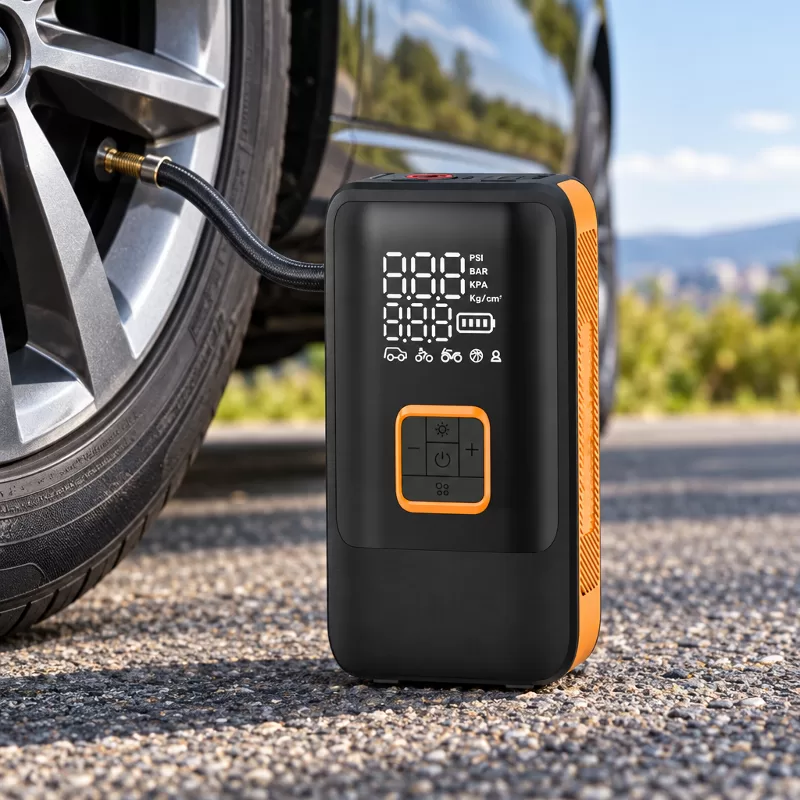
For drivers who require high airflow throughput alongside broad multi-vehicle capability, the Compact Air Pump for Car 150PSI NW08 presents a balanced, engineering-focused hardware layout. At Newo, our continuous development in pneumatic hardware focuses on bridging the gap between pocket pumps and cumbersome workshop equipment.
| Engineering Specification | Manufacturer Metric (NW08) |
|---|---|
| Maximum Working Pressure | 150 PSI (operating range 2 to 150 PSI) |
| Rated Working Airflow | 32 L/min |
| Motor Power Rating | 100W |
| Mechanical Architecture | Dual 24-cylinder configuration |
| Battery Power Supply | 3 × 4000mAh cells (11.1V, 44.4Wh) |
| Charging & Input | Type-C interface, up to 20V / 3A input |
| Auxiliary Power Bank Output | Up to 20V / 2A via Type-C connection |
| Continuous Operational Runtime | 12 to 15 minutes |
| Working Temperature Range | -10°C to 45°C |
| Acoustic Profile | ≤85 dB at 1 meter distance |
| Dimensions & Weight | 185 × 96 × 63.6 mm; 1035g |
Understanding Dual-Cylinder Output and 100W Motor Delivery
The NW08 departs from standard single-bore portable inflators by incorporating a dual 24-cylinder structure driven by a 100W working power motor. The manufacturer notes that this layout produces an airflow rating of 32 L/min across its 2 to 150 PSI operating spectrum.
According to product data, this output profile delivers stronger airflow and more efficient inflation than entry-level compact pumps. The increased volumetric rate is engineered to service larger car tires, off-road equipment, and sport recreational equipment without subjecting the drive mechanism to excessive strain.
Distributing mechanical compression across dual cylinders provides an efficient means of generating displacement without requiring an excessively large external shell. The resulting 1035g chassis remains compact enough for easy vehicle storage while maintaining practical roadside throughput.
Battery Architecture and Reverse Power Bank Functionality
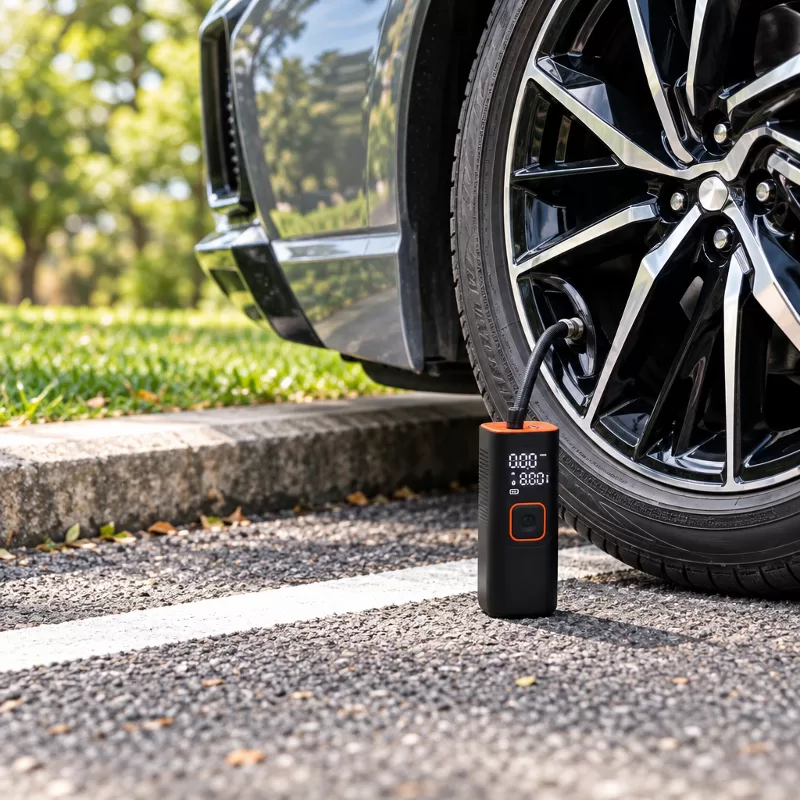
The internal energy system consists of three 4000mAh battery cells operating at a nominal 11.1V, generating a total capacity of 44.4Wh. The manufacturer specifies a battery cycle life of 300 cycles while retaining 80% or more of original capacity, providing stable energy reserves over years of ownership.
In addition to pneumatic duties, the NW08 includes modern Type-C charging and an auxiliary power-bank output rated up to 20V/2A through a C-to-C connection. It accepts fast-charging inputs up to 20V/3A, with a specified recharge window between 2 and 3 hours from a suitable power source.
This auxiliary electrical functionality provides valuable utility during travel, offering emergency power output when mobile devices require a charge during unexpected delays or outdoor excursions.
Step-by-Step Guide: How to Safely Inflate Car Tires
Step 1: Identifying Cold Tire Pressure via Vehicle Placard
Never guess your required tire pressure based on casual suggestions or numbers stamped on the tire rubber. Open your driver-side door and check the vehicle safety placard mounted to the B-pillar jamb, or consult your vehicle owner’s manual.
This authoritative placard specifies the exact cold inflation pressure required for your vehicle’s original tire dimensions and load ratings. Front and rear values often differ to account for vehicle weight distribution, passenger capacity, and drivetrain layout.
Always verify that your tires are cold before taking target readings or initiating inflation. Cold tire conditions mean the vehicle has remained stationary for at least three hours or has traveled less than one mile at moderate city speeds, preventing operational heat from inflating the measurement.
Step 2: Conducting a Visual and Tactile Tire Inspection
Before connecting any compressor, perform a careful visual and physical check of the tire surface. Examine the tread face and outer sidewall for embedded nails, sharp gravel, cuts, dry rot cracks, or structural bulges that suggest internal carcass damage.
If you discover deep sidewall slices, separated tread belts, or visible reinforcement cords, applying pressurized air introduces significant safety risks. In such circumstances, mount the spare tire or summon roadside recovery rather than attempting pneumatic inflation.
Take a moment to check rim integrity as well. A severely bent wheel bead will leak air as quickly as it enters, rendering portable inflation futile until a technician repairs the metal wheel surface.
Step 3: Establishing a Secure Stem Seal
Unscrew the plastic or metal dust cap from your wheel valve stem and clear away any accumulated road dust from the exterior brass threads. Align the inflator’s air chuck squarely with the valve stem to avoid cross-threading the fine brass grooves.
Press the connector firmly down onto the valve stem and secure the connection mechanism completely. A secure, airtight seal prevents pressure loss and ensures the inflator’s internal sensor reads an accurate baseline pressure figure.
Hearing a continuous hissing sound indicates an imperfect seal or loose engagement. Disconnect the chuck, check for obstructions inside the connector gasket, and reattach it until the connection remains quiet and stable.
Step 4: Setting Presets and Monitoring Inflation Progress
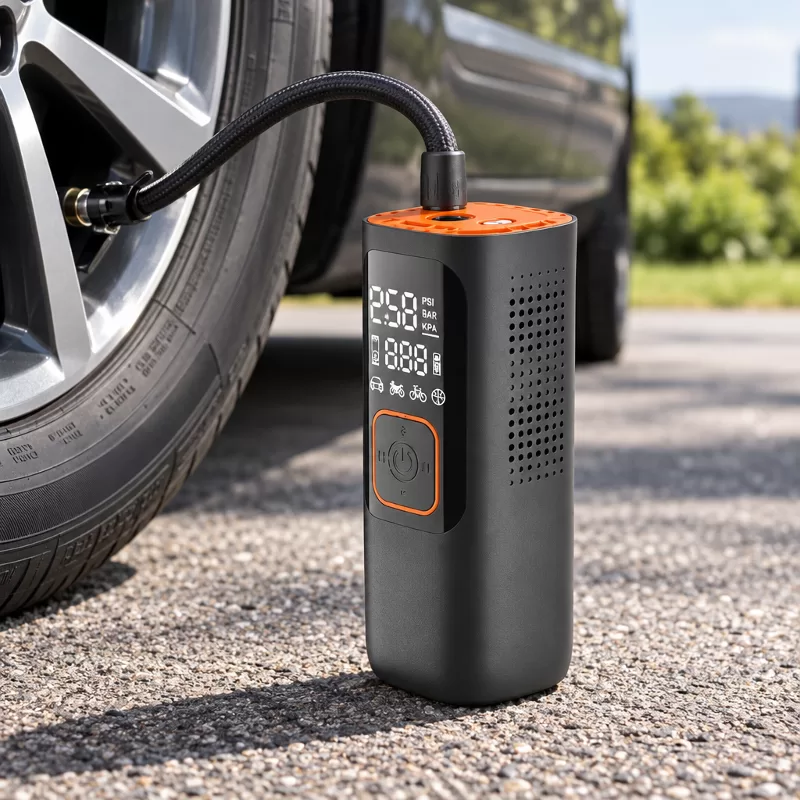
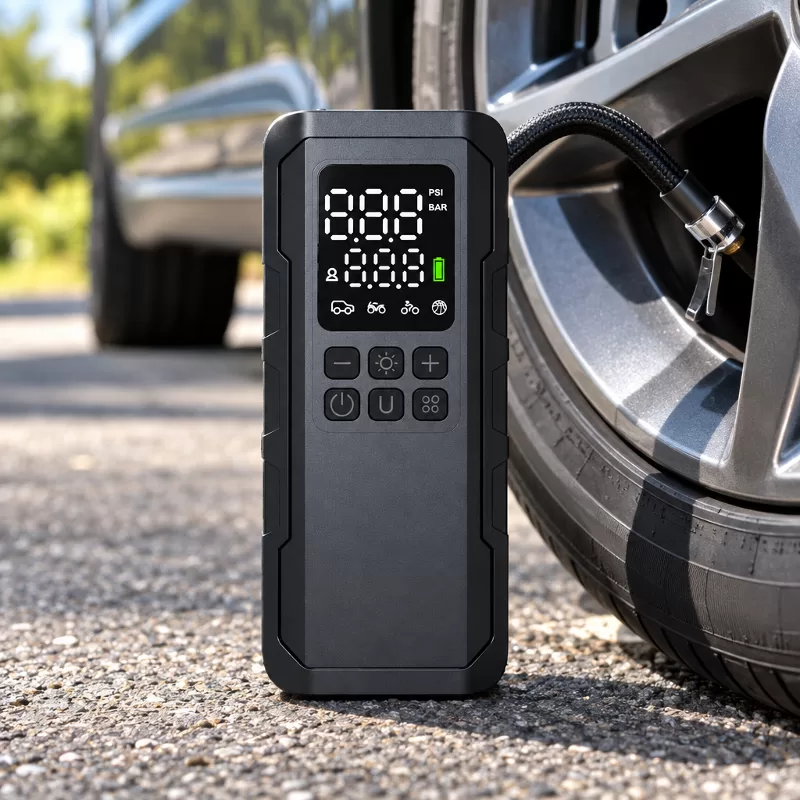
Turn on the device display and choose the relevant preset mode or manually enter your target cold pressure using the digital adjustment buttons. The illuminated screen will show your current baseline pressure alongside the intended cutoff value.
- Ensure the high-pressure air hose extends straight without sharp bends, kinks, or pinch points under the tire.
- Rest the inflator body upright on stable, flat ground to prevent vibration-induced tipping.
- Press the power switch to start the motor and watch the real-time pressure readout climb.
- Listen for consistent mechanical sounds and note any excessive vibration or hose pulling.
- Allow the automated cutoff circuitry to stop the compressor motor once reaching the preset pressure value.
Step 5: Post-Inflation Verification and Stem Capping
Once the compressor motor halts automatically, release the connector chuck with a quick, deliberate motion to minimize air bleed-off. Take a final glance at the settled pressure reading on the display screen to confirm the target level.
Promptly screw the protective valve stem dust cap back into position. This small cap serves as a critical secondary barrier that stops road grime, moisture, and de-icing salt from corroding the spring-loaded internal Schrader valve core.
Store the high-pressure hose neatly within its designated compartment or wrap it loosely to avoid sharp kinks that can weaken the internal rubber lining over time.
Critical Tire Maintenance Pitfalls to Avoid
The Sidewall Max PSI vs. Door-Jamb Placard Confusion
A frequent mistake among motorists is confusing the maximum pressure stamped on the tire sidewall with the vehicle’s recommended operating pressure. The sidewall marking designates the maximum cold pressure the tire structure can safely contain under its absolute maximum load capacity.
Setting tire pressure to this maximum sidewall rating impairs vehicle handling, creates an unnecessarily stiff ride, and accelerates wear along the center ribs of the tire tread. Drivers should always rely on the vehicle placard or owner’s manual for proper inflation targets.
Under-inflation brings its own severe hazards, causing excessive shoulder wear, sluggish steering response, and dangerous internal heat buildup. Sticking strictly to the door-jamb placard ensures the tire maintains its designed contact footprint and suspension characteristics.
The Thermal Expansion Trap: Inflating Hot Tires
Tire pressure shifts naturally as ambient weather and internal air temperatures change. As an approximate rule of thumb, tire pressure changes roughly 1 to 2 PSI for every 10°F change in ambient air temperature.
Normal driving friction also heats up the tire carcass and the air trapped inside, naturally elevating internal pressure readings. Do not bleed air from a warm tire simply because its pressure reads higher than the cold door-jamb placard value.
Dropping pressure on a hot tire can result in under-inflation once the rubber cools down to ambient temperatures. If you suspect a tire is underinflated while it is warm, add air as needed to reach the vehicle’s recommended cold pressure, then recheck it when cold. Seek professional help if pressure loss continues or the tire shows damage.
Assuming Stated Pressure Equals Inflation Speed
Many buyers mistakenly assume an inflator advertising a 150 PSI maximum pressure will inflate vehicle tires twice as fast as one rated for 80 PSI. In reality, maximum pressure indicates only the mechanical pressure threshold the pump can push against before the drive motor stalls.
A compact pump capable of achieving high pressures for narrow road bicycle tires can still take considerable time on large vehicle tires if its volumetric displacement is modest. Always prioritize airflow ratings (L/min) rather than peak PSI when inflation speed is your primary performance objective.
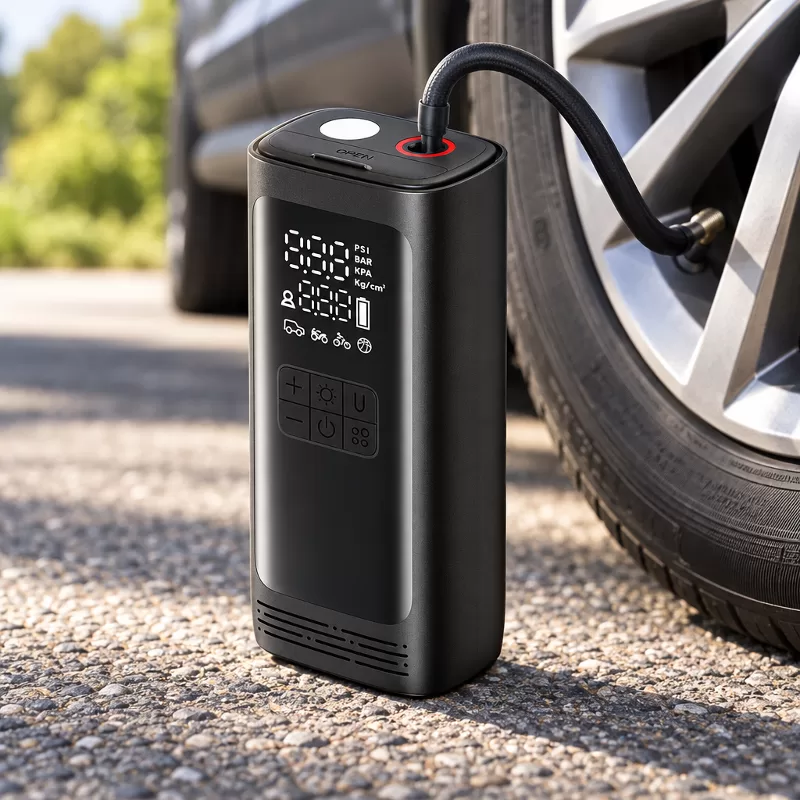
Piston displacement volume, motor wattage, and cooling efficiency determine how briskly a tool moves atmospheric air into a high-capacity automotive tire under load.
Over-Relying on Chemical Sealants with Digital Inflators
Emergency aerosol chemical sealants inject liquid adhesive compounds through the tire valve to plug small tread holes. While valuable in extreme emergencies, these sticky chemicals can coat the valve stem interior and foul sensitive pneumatic equipment.
Attaching a digital inflator directly to a valve stem coated with wet sealant risks pulling liquid residue into the inflator hose, obstructing internal air passages and damaging pressure transducers. If chemical sealants have been deployed, follow product precautions and consult a professional tire technician before attaching portable inflator hardware.
Versatile Applications Beyond Passenger Cars
Handling Larger Air Volumes: SUVs, Crossovers, and Off-Road Tires
All-terrain, crossover, and SUV tires hold substantial air mass even when operating at standard pressure ranges. Inflating these large air chambers requires continuous, high-volume throughput and dependable thermal endurance.
With its dual-cylinder structure delivering 32 L/min and 100W working power, the NW08 is specified for SUVs and off-road vehicles. Its stated continuous runtime of 12 to 15 minutes provides the operational window needed to top up high-volume tires during overland travel.
Drivers who air down their tires for traction on soft sand or rocky trails need a capable compressor to re-inflate tires before returning to highway asphalt. A high-output portable unit provides the necessary volume to bring low-pressure tires back to road-ready condition safely.
Two-Wheel Commuting: Motorcycles, E-Bikes, and Bicycles
Motorcycles, electric commuter bikes, and standard bicycles operate across varied inflation specifications. Motorcycle tires demand strict adherence to vehicle manual guidelines for stability, while bicycle tires must match specific rim and tire manufacturer pressure limits.
Digital inflators featuring adjustable settings simplify managing diverse pressure requirements across two-wheel transport. Users can select preset modes or set custom values to achieve target inflation without relying on unpredictable manual hand pumps.
The wide pressure range of modern inflators allows them to handle high-pressure bicycle tires and delicate motorcycle tires with equal precision, preventing fatigue and ensuring correct operational pressure.
Sports Balls and Recreational Gear
Low-pressure sports equipment requires careful control to avoid over-stressing internal bladders. Inflatables like soccer balls and basketballs operate at modest pressure levels where small overages can stress material seams.
Using an inflator with dedicated ball presets and custom pressure control allows users to match the ball manufacturer’s stamped pressure specifications cleanly, preventing over-inflation during routine maintenance.
From basketball courts to weekend camping sites, a multi-mode digital inflator serves as a versatile utility tool, easily transitioning from automotive duties to household and recreational inflation tasks.
Maintenance, Storage, and Battery Care for Longevity
Lithium-Ion Battery Maintenance and Shelf Discharge
Rechargeable lithium battery cells undergo gradual self-discharge when stored over extended periods. Storing an inflator in a completely depleted state can degrade overall cell health over time.
To ensure readiness during roadside emergencies, periodically verify the unit’s remaining charge according to the manufacturer’s user manual. Regular inspections help preserve battery functionality across its stated 300-cycle life.
Developing a habit of checking your emergency gear every few months ensures your equipment has sufficient electrical charge when an unexpected puncture or slow pressure leak occurs on the highway.
Vehicle Trunk Temperature Extremes and Safe Storage
Vehicle interiors experience sharp temperature variations between summer heat and winter cold snaps. The NW08 lists a working temperature range of -10°C to 45°C for operational conditions.
To safeguard sensitive digital displays and battery chemistry, store the device in an enclosed carrying bag or dedicated compartment out of direct sunlight. Keep the air intake and cooling vents free from trunk dust and carpet fibers to maintain clean airflow.
Avoid leaving portable electronic tools exposed on open rear parcel shelves where glass magnifies direct solar radiation. Proper trunk storage shields internal solder points and battery seals from unnecessary environmental wear.
Frequently Asked Questions (FAQs)
Is a portable air pump for car worth keeping in the vehicle?
Yes. Carrying an onboard inflator ensures you can handle low-pressure alerts anywhere without driving to commercial air stations, which may be out of order. It also enables convenient cold-tire pressure top-offs at home, helping optimize fuel efficiency and tire life.
What PSI should I use for my car tires?
Always consult the tire information placard located on the driver-side door B-pillar or check your vehicle owner’s manual. That label specifies the required cold inflation pressure for your vehicle’s original tire setup, which provides the proper baseline for safe driving.
Is 150 PSI enough for an SUV?
A 150-PSI maximum rating is an engineering ceiling rather than an operating target, and it easily covers the operational pressure requirements of consumer SUVs. Always refer to your vehicle placard for the actual recommended cold pressure rather than treating the maximum rating as a goal.
How long does a cordless tire inflator run on a single charge?
Runtime depends on battery capacity, target pressure, and operational load. The NW08 lists a continuous runtime of 12 to 15 minutes powered by its 44.4Wh battery pack, providing adequate operating time for routine tire adjustments on a single charge.
Can the NW08 inflate bicycle and motorcycle tires?
Yes. The manufacturer lists bicycle, motorcycle, and e-bike tires among the supported application scenarios. The pump provides five preset modes and a custom pressure adjustment range from 2 to 150 PSI to suit different inflation requirements.
Can a portable inflator fix a flat tire?
A portable inflator only replenishes lost air volume; it cannot repair structural tire damage. If a tire has suffered a puncture, an inflator might provide temporary pressure to reach a nearby repair shop, but punctured tires require professional mechanical inspection.
Should tire pressure be checked when tires are hot or cold?
Tire pressure should always be checked and adjusted when tires are cold. Driving warms the tire and temporarily elevates internal pressure. Testing warm tires produces higher readings that can result in under-inflation once the tires cool down.
Conclusion: Making the Right Inflation Investment for Road Safety
Equipping your vehicle with a reliable portable air pump for car tires turns tire maintenance from an inconvenient chore into a dependable safety habit. Matching your vehicle’s air volume requirements with the right balance of airflow, thermal resilience, and digital shut-off accuracy ensures smooth travel. By following manufacturer door-placard guidelines, inspecting tires regularly, and carrying a capable portable tire inflator for car use, you safeguard tire longevity, optimize fuel economy, and stay prepared for unexpected roadside pressure drops on every journey.
-

Meet NEWO at the 140th Canton Fair: Visit Booth 10.3 M03–04
Meet NEWO at the 140th Canton Fair in Guangzhou, October 15–19, 2026. Visit Booth 10.3 M03–04 to explore portable air pumps and discuss OEM, ODM and distribution opportunities.... -

As Shenzhen Welcomes the World for APEC 2026, NEWO Welcomes You to Our Factory
As Shenzhen prepares for APEC 2026, NEWO welcomes international buyers and partners to visit our factory, meet our team and explore future cooperation.... -

Leading the Way in Product Innovation and Excellence
Smartnewo exemplifies professionalism in product innovation and manufacturing. Their collaboration with Xiaomi Youpin on the G01 crowdfunding project highlights their expertise in creating compact, powerful inflatable pumps. Rigorous engineering, meticulous production processes, and advanced quality assurance underscore their commitment to excellence. The success of the G01 project, with significant market... -

Essential Qualities of an Excellent Supplier
In today's competitive market, finding a reliable supplier is crucial for business success. Based on insights from Smartnewo and broader internet research, here are key qualities an excellent supplier must possess:... -

NW06 Tire Inflator: Compact Power for Quick Inflation
Summary The NW06 Tire Inflator delivers quick and efficient tire inflation with a powerful 35L/min airflow. It features a user-friendly LCD screen for real-time pressure monitoring, dual power options with a built-in 6000mAh battery, and multiple nozzle attachments for versatile use. Its compact design and integrated LED light ensure convenience and... -

Unleash the Power of Portability: The SmartNewo Jump Starter with Air Compressor KF03
This guide will walk you through the steps to effectively use a portable tire inflator, helping you stay prepared and safe on the road.... -

Newo Attends The 2024 Consumer Electronics Show (CES)
Smartnewo booth is located at 53672, Halls A-D, Level 2, Venetian Expo, Las Vegas Convention Center (LVCC). ... -

Smartnewo’s Dual-Cylinder Air Pump Rocks the Hong Kong Autumn Electronics Fair!
Smartnewo’s Dual-Cylinder Air Pump Rocks the Hong Kong Autumn Electronics Fair!... -

Meet at the Canton Fair! Smartnewo brings dual-cylinder air pumps, making your inflation experience faster and more stable!
NEWO has went deep communication and negotiation with customers from all over the world on booth.... -

“Hong Kong Autumn Electronics Fair – 1CA18 (October 13th to 16th): Smartnewo invites you to visit our booth!
Hong Kong Autumn Electronics Fair...










-

What to Check Before Ordering Custom Electric Bike Pumps
Plan custom electric bike pumps with a clear requirements freeze for valves, TPU tubes, portability, repeated top-ups, charging, and model-specific documents.... -

OEM vs ODM Air Pumps: Which Manufacturing Model Fits Your Brand?
Compare OEM and ODM air pump projects by design responsibility, change approval, development scope, and written ownership terms before choosing your route.... -
How to Choose a Reliable Tire Inflator Manufacturer in China
Choose a tire inflator manufacturer in China with a focused RFQ, supplier evidence, configuration checks, and clear sample-to-pilot decisions for your brand.... -

Rechargeable Electric SUP Pump for Paddle Boards: Faster Inflation for SUPs, Kayaks and Inflatable Tents
The BL10-C Portable Electric Bike Tire Inflator is a compact and lightweight mini electric bike pump designed for modern cyclists. With up to 120 PSI pressure, a digital LED display, preset pressure control, automatic shut-off, USB-C charging, and multiple valve adapters, BL10-C offers a convenient inflation solution for road bikes,... -

Are Electric Bike Pumps Worth It in 2026? Electric Pump vs CO₂ vs Mini Hand Pump
Discover whether electric bike pumps are worth it in 2026. This guide compares electric bike pumps, CO₂ inflators, and mini hand pumps for road cycling, gravel riding, commuting, and long-distance rides. Learn the pros, limitations, best use cases, and key features to look for before choosing the right portable tire... -
BL10-C Portable Electric Bike Tire Inflator: Small Size, Reliable Power for Every Ride
The BL10-C Portable Electric Bike Tire Inflator is a compact and lightweight mini electric bike pump designed for modern cyclists. With up to 120 PSI pressure, a digital LED display, preset pressure control, automatic shut-off, USB-C charging, and multiple valve adapters, BL10-C offers a convenient inflation solution for road bikes,... -

Why Mini Electric Bike Pumps Are Becoming Essential for Modern Cycling
Discover why mini electric bike pumps are becoming essential for modern cyclists. Learn how portable electric bike pumps improve tire pressure management, riding safety, and convenience.... -

The Ultimate Smart Solution for Easy Outdoor Adventures in 2026
Discover how a spring travel air pump simplifies outdoor trips with fast inflation, smart features, and powerful performance—perfect for every adventure.... -

Powerful 5-in-1 Portable Car Tire Inflator and Jump Starter: The Ultimate Emergency Tool for Every Driver
Why Every Driver Needs a Portable Car Tire Inflator and Jump Starter Modern drivers face many unexpected situations on the road. A flat tire, low tire pressure, or a dead car battery can happen at the worst possible time. That’s why having a portable car tire inflator and jump starter is... -

7 Real Cycling Scenarios That Show Why Every Rider Should Carry a Mini Bike Pump
Cycling is one of the most freeing activities you can enjoy. Whether you’re commuting to work, riding through city streets, or exploring quiet countryside roads, a bike ride can instantly improve your day. But there’s one small problem that almost every cyclist eventually faces: Low tire pressure. It might happen...








-
How Is a Football Properly Inflated?
The correct inflation of a football - with not too much and not too little air - is a hotly debated topic among footballers.... -
Application Scenarios of Car Inflator Pump
Often long-distance business trips or play car owners because the road may be more remote areas, in this case if you encounter a tire leak....

