

 Portable Tire Inflators
 Electric Air Pumps
 Electric Car Tyre Pumps
 Electric Ball Pumps
 Electric Bike Pump
 SUP Air Pump

Portable Air Pump for Car Tyres: Complete Technical and Buyer Guide
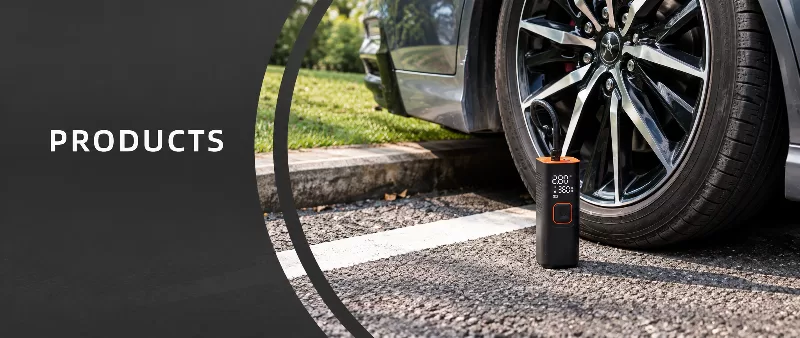
Finding a dependable portable air pump for car tyres has become an essential priority for vehicle owners who want consistent road safety, optimal fuel economy, and absolute independence from service station queues. Modern tire maintenance no longer requires bulky shop compressors or erratic coin-operated forecourt pumps. Compact, battery-driven pneumatic devices now deliver precision air pressure directly in your driveway or along the highway shoulder, transforming roadside emergency readiness into a predictable and routine operational check.
Driving on incorrectly inflated tires degrades handling, lengthens stopping distances, and accelerates irregular tread wear. Temperature shifts throughout the year steadily sap pressure, often triggering dashboard warnings before morning commutes. An on-board portable air pump for car tyres bridges the gap between major workshop visits and daily travel, ensuring your vehicle runs on manufacturer-specified pressures wherever your journey takes you.
Understanding What a Portable Air Pump for Car Tyres Does
What Problem Does a Portable Tire Inflator Solve?
Vehicle tires operate as pressurized air chambers supporting dynamic loads across harsh pavement, meaning air volume naturally escapes over time through microscopic rubber pores and temperature variations. A 10°F ambient temperature shift can alter tire pressure by roughly 1 to 2 PSI, though the exact drop varies with ambient conditions and tire volume. This gradual drop often remains unnoticed until the tire pressure monitoring system illuminates.
Without an on-board compressor, drivers frequently put off routine inflation checks because locating a convenient service station with an available air line takes time. A portable inflator eliminates this hurdle, placing continuous maintenance directly within reach before highway speeds generate destructive internal friction inside the rubber carcass.
Portable Inflator Versus Service-Station Air Compressors
Commercial service stations rely on stationary pneumatic lines that deliver air, yet they present practical operational drawbacks for everyday drivers. Forecourt equipment experiences heavy public use, which can lead to damaged hose fittings or worn mechanical dials that make exact inflation difficult to confirm on site.
Furthermore, driving several miles to reach a gas station heats the tire casing, causing internal air expansion that artificially skews pressure readouts upwards. Using a dedicated portable pump on your vehicle allows you to check tires when cold—typically after the car has been parked for at least three hours—preventing deceptive pressure adjustments.
When a Portable Pump Is Most Useful
Everyday driving exposes passenger vehicles to slow leaks caused by tiny road debris, valve core seepage, or cold-weather contraction. Having an electric inflator in the trunk eliminates anxiety during morning pre-trip inspections, letting you top up low tires without taking an inconvenient detour.
Road trips, remote camping excursions, and multi-vehicle garage setups equally benefit from compact inflators. The flexibility to adjust tire inflation on passenger cars, trail bikes, and utility trailers from a single handheld chassis provides comprehensive preparedness for unexpected pneumatic drops.
How to Choose the Right Portable Air Pump for Car Tyres
Check the Recommended Tire Pressure First
Before selecting any inflation hardware, you must verify your vehicle’s specific pneumatic load requirements. Many motorists mistakenly treat the maximum pressure stamped on the tire sidewall as their operating target, which can lead to over-inflation, harsh rides, and center-tread bald spots.
The genuine target baseline is engineered specifically for your vehicle chassis and is located on the vehicle certification placard inside the driver-side door jamb. Standard passenger sedans, hatchbacks, and crossovers generally demand between 30 and 36 PSI cold inflation, while heavy utility pickups may require significantly more.
Evaluate Airflow, Maximum Pressure, and Operating Time
Air compressor mechanisms convert motor rotational power into linear piston strokes within a sealed cylinder. Cylinder diameter and motor wattage directly dictate airflow capacity, which is measured in liters per minute (L/min). Higher airflow numbers mean faster inflation cycles and less waiting on cold mornings.
Handheld pumps inevitably face internal heat generation because compressing gas concentrates thermal energy inside the head assembly. Checking continuous runtime ratings alongside maximum pressure capabilities ensures the tool can complete maintenance cycles without cutting out from thermal overload.
Consider Battery Capacity and Power Delivery
Cordless battery systems provide total freedom of movement around the chassis without snagging long power cords on dirty wheel rims. Rechargeable lithium-ion packs must balance energy density, overall unit weight, and maximum discharge current to keep the pneumatic motor operating under rising compression resistance.
Series-connected lithium cell configurations deliver the electrical energy required to operate onboard motors during inflation cycles. Additional power delivery options, including bidirectional USB ports for charging external accessories, add versatile functionality during unforeseen travel delays.
Look for Pressure Sensing and Automatic Shut-Off
Traditional manual inflators require the user to crouch beside the wheel, constantly squinting at an analog needle while repeatedly toggling a switch. Modern digital pneumatic devices feature digital sensors paired with automatic shut-off thresholds.
Setting a target pressure value on a digital interface allows the pump to manage the inflation cycle independently. When the pressure sensor detects that the selected target pressure has been reached, the automatic shut-off stops the pump, according to the product specification, helping protect the tire against over-inflation.
Check Portability, Noise Rating, and Operating Temperature Range
Trunk space is precious, so an emergency inflator must remain compact enough to fit inside spare tire wells, door pockets, or glove compartments. Protective outer casings help shield internal motor assemblies against road shocks and vibration encountered during travel.
Operating acoustics and thermal envelopes represent vital operational considerations. Reciprocating pistons generate sound and mechanical vibration, making sound ratings at or below 85 decibels desirable for residential areas, alongside stable circuitry capable of operating from freezing winter mornings to scorching summer heat.
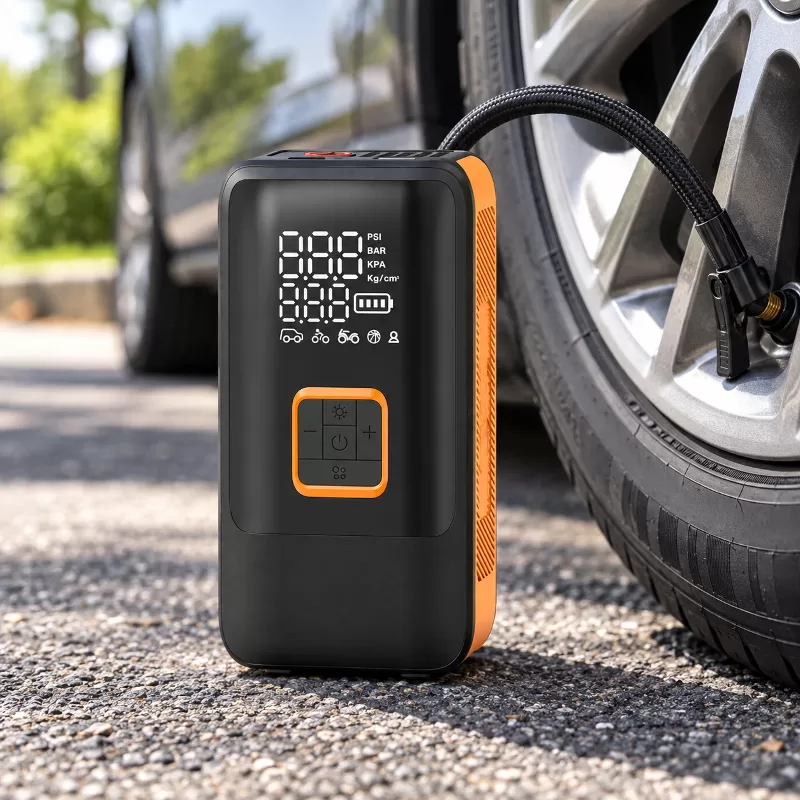
Product Profile: Electric Air Pump for Car Tires 160PSI T22
Intended Applications and Form Factor
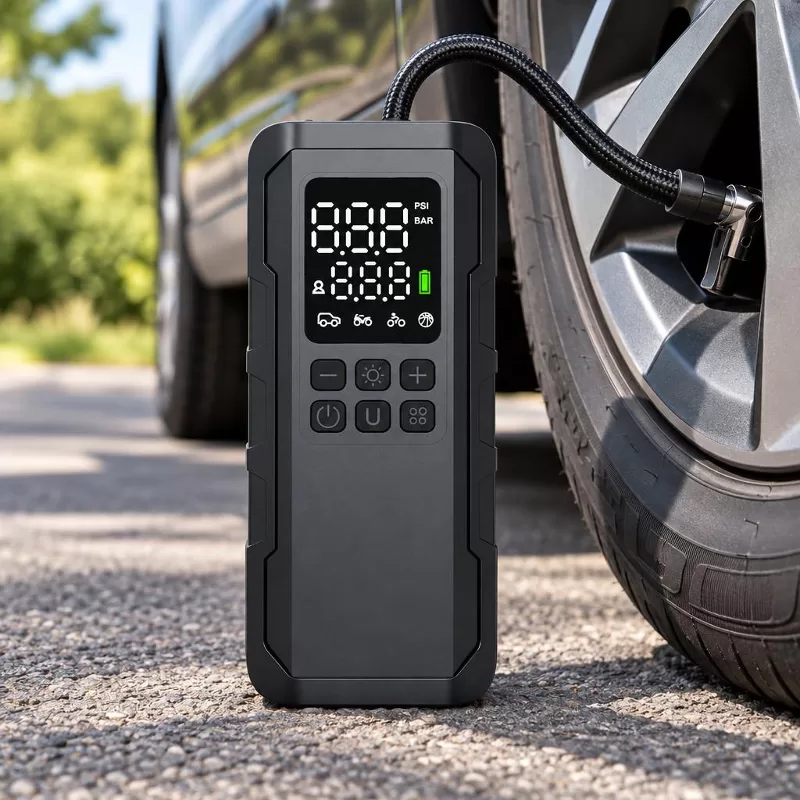
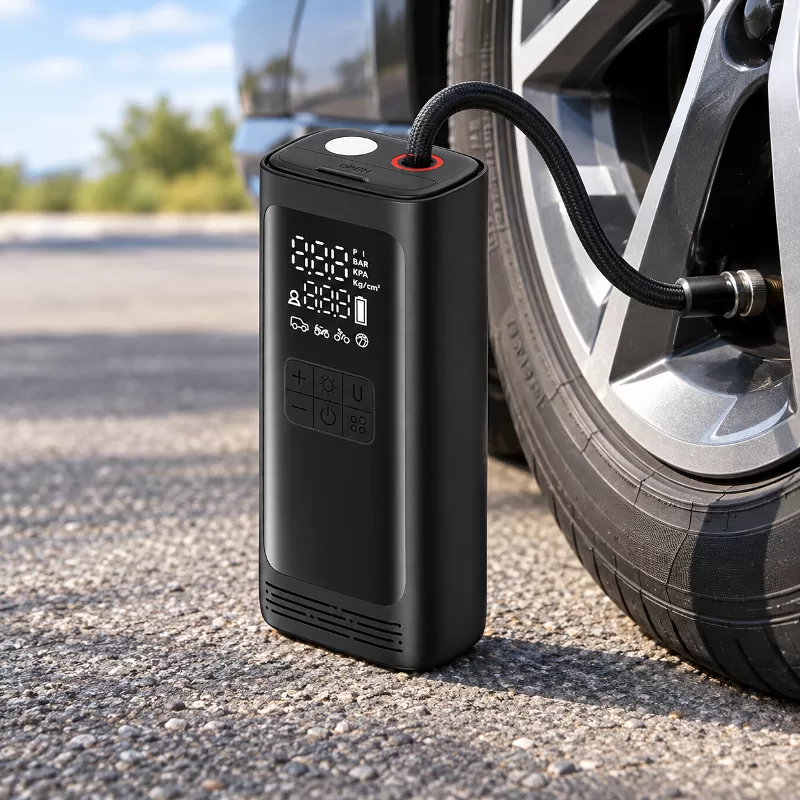
The T22 is engineered as a dedicated handheld rechargeable electric air pump built for cars, motorcycles, bicycles, electric bikes, and sports equipment. Measuring 161 × 68 × 53 mm and weighing approximately 508 grams, the device slips easily into compact compartments without adding burdensome weight to your payload.
Its compact design houses a complete pneumatic assembly, an integrated lithium power plant, and an intuitive control face. The form factor eliminates clumsy external hoses during storage, making it practical for daily urban commutes and long cross-country expeditions alike.
Main Operating Features
Internally, the T22 incorporates a specialized 22-cylinder compression structure driven by up to 100 watts of working power according to manufacturer specifications. The documentation indicates an airflow rate of approximately 32 to 36 liters per minute for tire inflation tasks.
A dual LED numeric screen continuously displays the target preset and real-time tire pressure simultaneously, eliminating mode confusion. The system includes five operating modes, Type-C charging compatibility, and a dedicated 5V/2A auxiliary power-bank output for emergency gadget charging.
Technical Specification Table
The engineering parameters of the T22 demonstrate a focused balance between electrical storage, mechanical compression output, and physical size. All values listed below represent original manufacturer product specifications:
| Technical Metric | Stated Specification |
|---|---|
| Model Designation | T22 Portable Tire Inflator |
| Cylinder Architecture | 22 Cylinders |
| Maximum Pressure Rating | 160 PSI (0.1 to 11.0 BAR) |
| Pressure Adjustment Range | 2 to 160 PSI (Custom Mode) |
| Stated Airflow Rate | 32 to 36 L/min |
| Working Motor Power | Up to 100W |
| Battery Architecture | 3 × 18650 Rechargeable Cells (5C Discharge) |
| Battery Capacity & Energy | 2600mAh / 11.1V / 28.86Wh |
| Battery Protection | Overcharge and undercharge circuitry |
| Continuous Runtime | 20 to 25 minutes |
| Charging Input & Time | Type-C (5V/2A or 9V/1.5A) / 2 to 3 hours |
| Power-Bank Output | 5V / 2A USB Output |
| Operating Temperature Envelope | -10°C to 45°C |
| Operating Sound Output | 85dB or below at 1 meter |
| Physical Dimensions & Weight | 161 × 68 × 53 mm / 508g |
| Display Interface | LED dual numeric screen with 4-level battery status |
| Selectable Pressure Units | PSI, BAR, KPA, Kg/cm² |
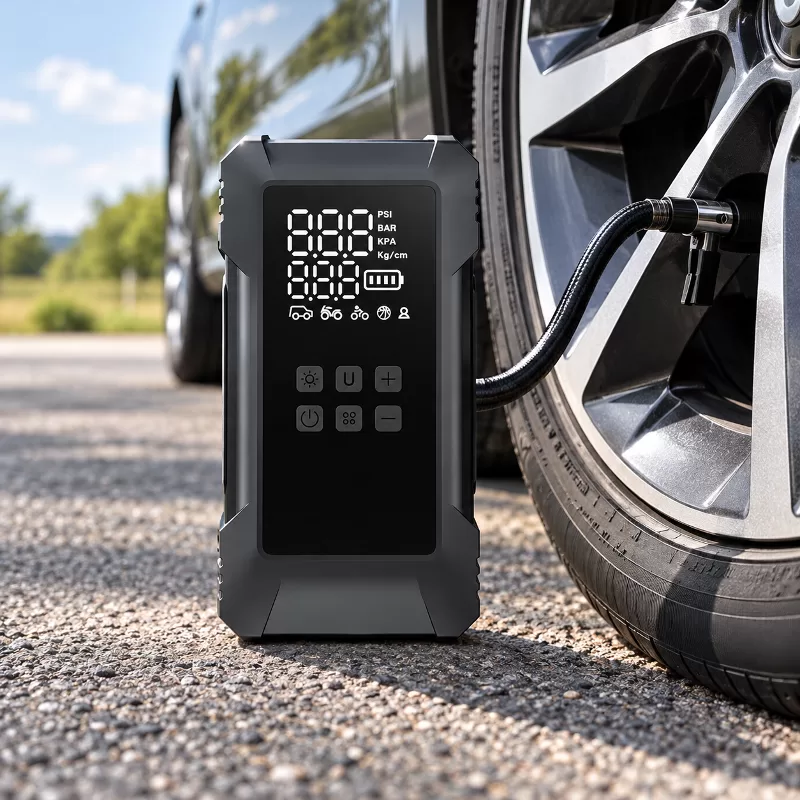
What the T22 Features Mean in Everyday Use
160 PSI Maximum Pressure: Capability Versus Application
The T22 features an adjustable pressure range extending from 2 PSI up to a stated maximum of 160 PSI (11.0 BAR). It is crucial to understand that 160 PSI represents the upper mechanical limit of the device rather than a target setting for standard passenger automobile tires.
While passenger cars typically require between 30 and 36 PSI as specified on the door jamb placard, an expansive pressure range accommodates higher-pressure inflatables such as certain bicycle tires. Users should always input the vehicle manufacturer’s cold placard pressure rather than aiming for maximum device output.
32–36 L/min Airflow and 22-Cylinder Performance
Airflow volume dictates how long you must wait while standing beside your vehicle during inflation. The manufacturer rates the 22-cylinder compression structure for approximately 32 to 36 liters of air per minute, which supports regular pressure top-ups across consumer tires.
The motor draws up to 100 watts of working power according to official specifications. Delivering steady mechanical output across its operational cycle helps maintain effective air transfer within the rated continuous runtime envelope.
Five Preset Operating Modes
To simplify operation across different applications, the T22 provides five distinct operating modes: Car, Motorcycle, Bicycle, Ball, and Custom. Having dedicated settings allows users to switch between vehicle tires and recreational equipment without manual reconfiguration.
The Custom mode provides manual pressure selection across the entire 2 to 160 PSI range. This allows users to select a target within the stated 2–160 PSI range for applications that require a pressure different from the listed modes.
Automatic Shut-Off and Dual LED Monitoring
Human error remains a major source of improper tire maintenance, especially when reading single-display analog pumps in the dark. The T22 incorporates an LED dual numeric display that clearly separates real-time tire pressure from your target programmed value.
Built-in precision pressure sensing actively monitors line pressure as the unit runs. When the pressure sensor detects that the selected target pressure has been reached, the automatic shut-off stops the pump, according to the product specification, allowing users to monitor inflation progress without guessing.
Cordless Battery Pack and Power-Bank Utility
The cordless architecture incorporates three series-connected 18650 rechargeable cells producing 11.1 volts and 28.86Wh of energy with a 5C discharge rating. Official specifications state up to 100W working power alongside a continuous runtime of 20 to 25 minutes.
Beyond pneumatic duties, the onboard battery serves as a mobile emergency reservoir via a 5V/2A power-bank port. If unexpected road delays leave your phone depleted, the T22 can recharge personal communication gear while remaining ready for tire pressure duties.
How to Inflate a Car Tire with a Portable Air Pump
Step 1: Find the Correct Target Pressure on the Vehicle Placard
Accurate tire inflation begins by identifying your vehicle manufacturer’s engineered cold inflation pressure. Check the Tire and Loading Information placard or certification label on the driver-side door edge, door pillar, or in the owner’s manual.
This label displays exact target values for both front and rear axles, which often differ depending on front-to-rear vehicle weight distribution. Keep these numbers in mind, making sure to avoid the maximum pressure stamped on the tire rubber itself.
Step 2: Inspect Tire Condition and Tread Integrity
Before connecting any air delivery hardware, take a moment to visually inspect the entire visible tire tread and sidewall. Look for embedded screws, nails, glass fragments, unusual bulges, or severe shoulder wear that could compromise carcass strength.
If the tire bead has separated from the wheel rim or deep cuts expose structural cords, introducing high-pressure air can be unsafe. In such situations, mounting the spare wheel or calling roadside recovery is the appropriate procedure.
Step 3: Ensure the Tire Is in a Cold Operating State
For comparison with the vehicle placard, check pressure when the tires are cold. Warm readings can still indicate the current pressure, but they should not be used to bleed air down to the cold target.
In technical terms, cold means the vehicle has been parked for at least three hours, or has been driven less than one mile after that period. Do not bleed air from a warm tire simply to match the cold placard value; if a warm tire is visibly underinflated, add air as needed to reach a safe operating level and recheck the pressure once the tire has fully cooled.
Step 4: Select Pressure Units and Set Target Value
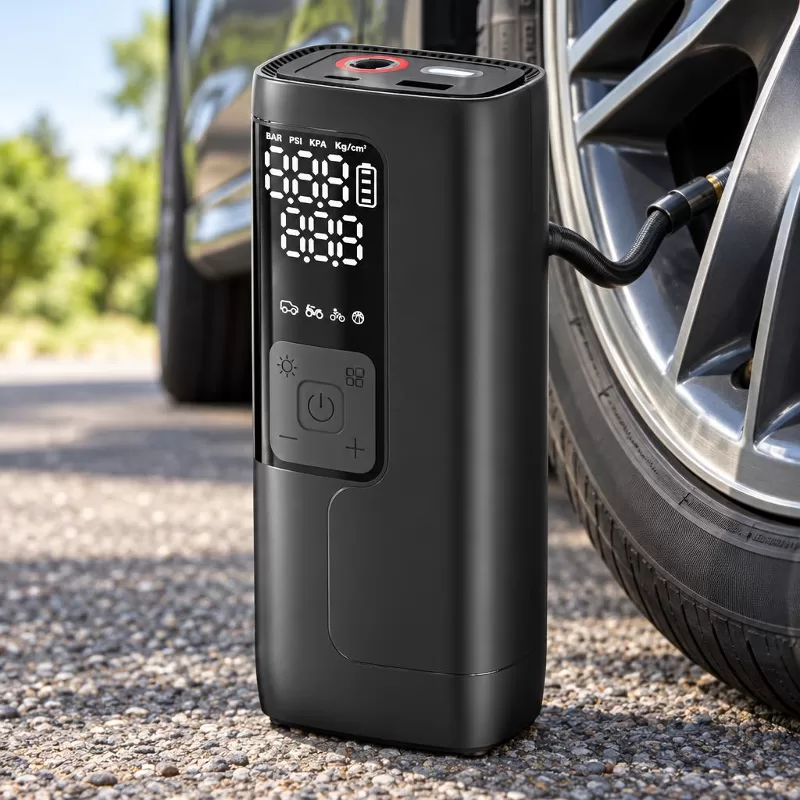
Power on your portable air pump and select your preferred unit of measurement, choosing between PSI, BAR, KPA, or Kg/cm² to match your vehicle documentation. For most domestic passenger vehicles, PSI remains the standard benchmark.
Toggle the mode selector to Car mode or enter Custom mode to dial in your target pressure using the plus and minus keys. The dual LED display updates your programmed value, locking it into the auto shut-off memory.
Step 5: Secure the Air Chuck and Start Inflation
Unscrew the protective dust cap from the tire’s Schrader valve stem and set it aside safely. Attach the air connection securely to the valve stem according to the T22 instructions, ensuring it forms a tight seal without continuous hissing.
The display should show a pressure reading after the air connection is secured. Place the pump upright on flat ground to isolate motor vibration, then press the power button to initiate airflow.
Step 6: Disconnect, Verify, and Replace the Valve Cap
Monitor the progress as the dual display tracks rising pressure toward your preset number. Once the automatic shut-off stops the motor, remove the air connector according to the T22 instructions to minimize transient air loss.
Thread the protective valve cap back onto the stem firmly with your fingers. The valve cap acts as a primary seal against road salt, mud, and water droplets that could otherwise corrode the internal spring valve core.
Practical Limitations and Safety Considerations
A Portable Inflator Is Not a Puncture Repair Tool
A portable air pump for car tyres compresses atmospheric air into the tire, but it cannot repair physical damage to the rubber structure. If a puncture penetrates the steel belts or sidewall, inflating the tire offers only brief utility.
Re-inflating a leaking tire without removing the foreign object or applying a certified internal patch risks catastrophic pressure loss at highway speeds. Drivers must treat portable pumps as diagnostic and stabilization tools rather than permanent repair solutions.
Operational Thermal Management and Continuous Runtime
Mechanical air compression generates substantial heat inside compact motor housings. The manufacturer lists the continuous runtime for the T22 at 20 to 25 minutes, after which the unit should be allowed to rest and cool down.
If you are dealing with significant volume demands, pause between extended duty cycles and allow the unit to cool according to the manufacturer’s instructions. Following these cooling intervals prevents unnecessary thermal strain on internal mechanical components.
Acoustic Awareness and Stable Positioning
All reciprocating piston compressors produce mechanical sound and vibration during operation. The listed sound specification for the T22 is 85 dB or below at a distance of 1 meter.
Always rest the device flat on pavement or asphalt rather than letting it hang freely from the valve stem. Placing it on a level surface protects the valve stem from unnecessary bending stress and prevents the housing from wandering across the pavement.
Battery Maintenance, Ambient Heat, and Storage Safety
Modern lithium-ion cells require sensible storage practices to maintain capacity across their service life. While the T22 operates safely between -10°C and 45°C, leaving the pump under direct windshield sunlight during extreme summer heat can accelerate cell degradation.
Store your portable inflator inside a glove box, center console, or dedicated trunk tool well away from direct heat. As a general maintenance habit, check the four-level battery status indicator before major road trips and follow manufacturer guidelines for routine charging.
Comparing Portable Inflator Types
Cordless Rechargeable Inflator
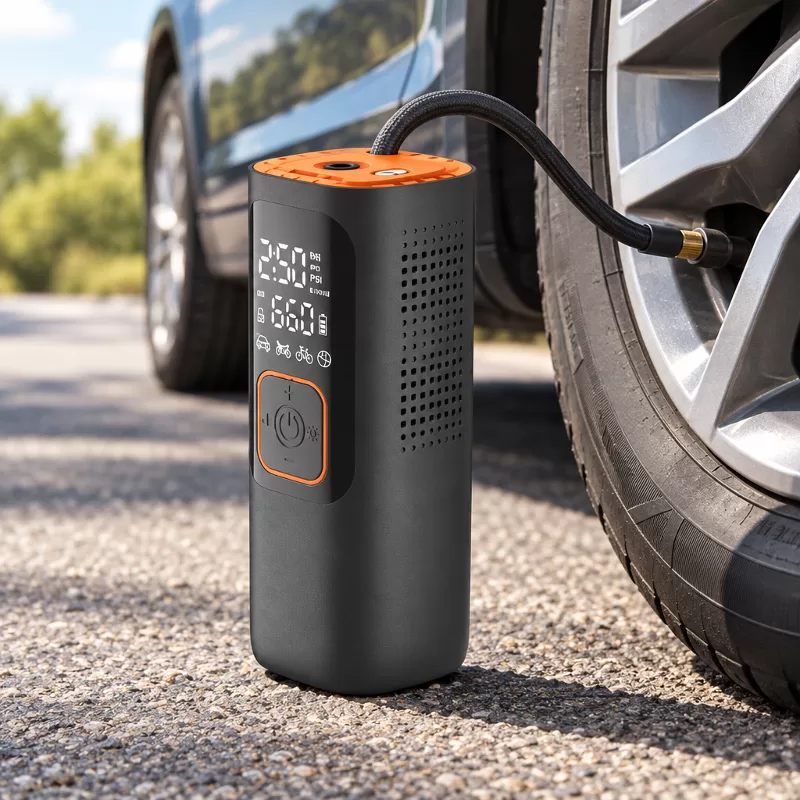
Rechargeable cordless pumps, such as the T22 profile, represent modern convenience in mobile tire maintenance. Operating without 12V automotive accessory wires means you can walk freely around the car without tangling cords across greasy hubs or scuffing door paint.
Internal battery cells deliver power for routine top-ups and unexpected commuter emergencies. The trade-off involves managing charge levels periodically so the tool remains ready for unexpected roadside tasks.
12-Volt DC Corded Tire Compressor
Traditional corded inflators connect directly to your vehicle’s 12-volt cigarette lighter socket or clamp onto the car battery terminals. They draw power from the vehicle’s 12V electrical system; with the engine running, the alternator can help supply that power. Drivers should follow vehicle and compressor instructions to avoid draining the battery or overloading the electrical circuit.
However, managing 10 to 15 feet of stiff electrical cord in freezing temperatures can be frustrating. Cords can also struggle to reach the rear wheels of long pickups and trailers unless extended cables are utilized.
Fixed Workshop Compressor
Workshop compressors featuring stationary air tanks and heavy-duty electric motors are primarily intended for commercial garage bays and tire mounting facilities. These stationary units supply air volumes for continuous shop workloads.
Yet, their massive bulk, reliance on mains electricity, and stationary nature mean they cannot assist you when a pressure alert appears miles away from home. A dedicated mobile inflator fills this gap, offering independent roadside autonomy.
Structural Comparison Table
Understanding how these three distinct inflation technologies compare helps drivers select the right tool for their specific travel and garage requirements:
| Compressor Class | Primary Power Source | Physical Portability | Ideal Operating Scenario | Primary Operational Limitation |
|---|---|---|---|---|
| Cordless Rechargeable (T22 Style) | Internal Lithium-ion Cells | Excellent (Handheld under 1 kg) | Daily commute top-ups & multi-vehicle maintenance | Requires periodic battery recharging |
| 12V DC Auxiliary Corded | Vehicle 12V Electrical Socket | Moderate (Requires cable stowage) | Extended remote road-tripping | Limited cord reach & circuit load considerations |
| Stationary Workshop Compressor | Mains AC Electrical Grid | None (Stationary shop installation) | Full tire mounting & commercial repair bays | Non-portable stationary design |
Brand Perspective: Pneumatic Engineering and Manufacturing Excellence
Newo is a professional manufacturer specializing in the research, development, and production of smart electric air pumps and portable inflation solutions. With strong expertise in pneumatic technology, product design, and manufacturing, we provide a wide range of innovative products, including portable tire inflators, electric bike pumps, car air pumps, ball pumps, and outdoor inflation solutions. Our products are designed to deliver convenience, efficiency, and reliability for customers worldwide.
Supported by advanced production capabilities, experienced engineers, and strict quality management, we are committed to creating high-quality smart inflation products and building long-term partnerships with customers around the world. Newo states that it supports its products with production capabilities, engineering experience, and quality-management practices to deliver dependable performance.
FAQs
Can a portable air pump inflate a completely flat car tire?
A portable inflator may be able to add air to a completely flat tire if the bead remains seated and the tire has no serious damage, but success depends on the tire and inflator. Do not rely on it to reseat a bead.
Inflating a fully flat passenger tire demands significant air volume, which will consume a substantial portion of a compact inflator’s battery reserve. For everyday slow punctures, topping up a partially soft tire to reach a repair facility is practical, but an unseated bead requires professional shop intervention.
What PSI should I use for my car tires?
Always use the exact tire pressure figures listed on your vehicle safety certification placard, typically located on the driver-side door jamb or pillar. This placard specifies the cold inflation pressure calculated by vehicle engineers for optimal braking, traction, and tire wear.
Never inflate your tires to the maximum pressure printed on the tire sidewall itself. That sidewall figure represents the absolute maximum pressure the tire structure can contain safely, not the balanced operating pressure meant for your specific car.
Is 160 PSI necessary for ordinary passenger car tires?
Passenger automobiles do not require 160 PSI; standard passenger car tires typically operate within a modest range of 30 to 36 PSI. The high 160 PSI ceiling of the T22 reflects the mechanical design of its 22-cylinder compression mechanism.
This broad pneumatic range allows the tool to serve diverse inflatable equipment, while automotive users simply select their vehicle’s placarded pressure on the digital interface.
Can the T22 inflate bicycle, e-bike, and motorcycle tires?
The T22 features distinct operating presets specifically configured for car tires, bicycles, e-bikes, motorcycles, and sports balls, along with a free-range Custom mode. This covers the typical pneumatic maintenance requirements across household vehicles.
Users should ensure appropriate connection fittings match their specific valve stems when servicing various two-wheel applications, following the pressure guidelines marked on each tire.
How long does the T22 take to fully recharge?
Recharging the internal 3 × 18650 battery pack (2600mAh total capacity at 11.1V) requires approximately 2 to 3 hours from full depletion. The unit charges through a Type-C input port that accepts either 5V/2A or 9V/1.5A power supplies.
The integrated LED display features four individual battery indicators, giving you clear visibility over current charge levels so you know when the unit is fully charged and ready for the road.
What is the purpose of the 5V/2A output port?
The built-in 5V/2A USB port enables the pump to function as an emergency power bank for mobile phones, GPS units, and small electronic devices. If unexpected vehicle trouble leaves you stranded without phone battery, the inflator can power your phone so you can call for roadside assistance.
While primary energy reserves should remain dedicated to tire inflation duties, this auxiliary power-bank feature adds practical utility during unexpected travel delays or outdoor activities.
Should tire pressure be adjusted immediately after highway driving?
You should avoid bleeding air from tires immediately after sustained highway driving. High-speed travel causes internal air to expand from friction heat, which raises line pressure readings above standard baseline numbers.
Releasing air from a warm tire to match a cold placard target will leave it under-inflated once the rubber cools. If a tire is significantly low while hot, add air conservatively to establish safe driving pressure, then verify the setting the following morning when the tire is cold.
Summary and Maintenance Recommendations
Keeping a portable air pump for car tyres stored neatly in your vehicle transforms tire safety from a sporadic chore into a simple, reliable habit. Proper tire inflation protects your fuel economy, guarantees predictable emergency braking, and prevents premature tread wear across every mile of travel.
To ensure your emergency inflator is always ready, check its battery status indicator before long journeys and recharge it using its Type-C charging port according to product instructions. Storing the tool in a secure, climate-stable compartment keeps it protected from extreme cabin temperatures and ensures your portable air pump for car tyres is primed to deliver fast, accurate inflation whenever duty calls.
-

Meet NEWO at the 140th Canton Fair: Visit Booth 10.3 M03–04
Meet NEWO at the 140th Canton Fair in Guangzhou, October 15–19, 2026. Visit Booth 10.3 M03–04 to explore portable air pumps and discuss OEM, ODM and distribution opportunities.... -

As Shenzhen Welcomes the World for APEC 2026, NEWO Welcomes You to Our Factory
As Shenzhen prepares for APEC 2026, NEWO welcomes international buyers and partners to visit our factory, meet our team and explore future cooperation.... -

Leading the Way in Product Innovation and Excellence
Smartnewo exemplifies professionalism in product innovation and manufacturing. Their collaboration with Xiaomi Youpin on the G01 crowdfunding project highlights their expertise in creating compact, powerful inflatable pumps. Rigorous engineering, meticulous production processes, and advanced quality assurance underscore their commitment to excellence. The success of the G01 project, with significant market... -

Essential Qualities of an Excellent Supplier
In today's competitive market, finding a reliable supplier is crucial for business success. Based on insights from Smartnewo and broader internet research, here are key qualities an excellent supplier must possess:... -

NW06 Tire Inflator: Compact Power for Quick Inflation
Summary The NW06 Tire Inflator delivers quick and efficient tire inflation with a powerful 35L/min airflow. It features a user-friendly LCD screen for real-time pressure monitoring, dual power options with a built-in 6000mAh battery, and multiple nozzle attachments for versatile use. Its compact design and integrated LED light ensure convenience and... -

Unleash the Power of Portability: The SmartNewo Jump Starter with Air Compressor KF03
This guide will walk you through the steps to effectively use a portable tire inflator, helping you stay prepared and safe on the road.... -

Newo Attends The 2024 Consumer Electronics Show (CES)
Smartnewo booth is located at 53672, Halls A-D, Level 2, Venetian Expo, Las Vegas Convention Center (LVCC). ... -

Smartnewo’s Dual-Cylinder Air Pump Rocks the Hong Kong Autumn Electronics Fair!
Smartnewo’s Dual-Cylinder Air Pump Rocks the Hong Kong Autumn Electronics Fair!... -

Meet at the Canton Fair! Smartnewo brings dual-cylinder air pumps, making your inflation experience faster and more stable!
NEWO has went deep communication and negotiation with customers from all over the world on booth.... -

“Hong Kong Autumn Electronics Fair – 1CA18 (October 13th to 16th): Smartnewo invites you to visit our booth!
Hong Kong Autumn Electronics Fair...










-

What to Check Before Ordering Custom Electric Bike Pumps
Plan custom electric bike pumps with a clear requirements freeze for valves, TPU tubes, portability, repeated top-ups, charging, and model-specific documents.... -

OEM vs ODM Air Pumps: Which Manufacturing Model Fits Your Brand?
Compare OEM and ODM air pump projects by design responsibility, change approval, development scope, and written ownership terms before choosing your route.... -
How to Choose a Reliable Tire Inflator Manufacturer in China
Choose a tire inflator manufacturer in China with a focused RFQ, supplier evidence, configuration checks, and clear sample-to-pilot decisions for your brand.... -

Rechargeable Electric SUP Pump for Paddle Boards: Faster Inflation for SUPs, Kayaks and Inflatable Tents
The BL10-C Portable Electric Bike Tire Inflator is a compact and lightweight mini electric bike pump designed for modern cyclists. With up to 120 PSI pressure, a digital LED display, preset pressure control, automatic shut-off, USB-C charging, and multiple valve adapters, BL10-C offers a convenient inflation solution for road bikes,... -

Are Electric Bike Pumps Worth It in 2026? Electric Pump vs CO₂ vs Mini Hand Pump
Discover whether electric bike pumps are worth it in 2026. This guide compares electric bike pumps, CO₂ inflators, and mini hand pumps for road cycling, gravel riding, commuting, and long-distance rides. Learn the pros, limitations, best use cases, and key features to look for before choosing the right portable tire... -
BL10-C Portable Electric Bike Tire Inflator: Small Size, Reliable Power for Every Ride
The BL10-C Portable Electric Bike Tire Inflator is a compact and lightweight mini electric bike pump designed for modern cyclists. With up to 120 PSI pressure, a digital LED display, preset pressure control, automatic shut-off, USB-C charging, and multiple valve adapters, BL10-C offers a convenient inflation solution for road bikes,... -

Why Mini Electric Bike Pumps Are Becoming Essential for Modern Cycling
Discover why mini electric bike pumps are becoming essential for modern cyclists. Learn how portable electric bike pumps improve tire pressure management, riding safety, and convenience.... -

The Ultimate Smart Solution for Easy Outdoor Adventures in 2026
Discover how a spring travel air pump simplifies outdoor trips with fast inflation, smart features, and powerful performance—perfect for every adventure.... -

Powerful 5-in-1 Portable Car Tire Inflator and Jump Starter: The Ultimate Emergency Tool for Every Driver
Why Every Driver Needs a Portable Car Tire Inflator and Jump Starter Modern drivers face many unexpected situations on the road. A flat tire, low tire pressure, or a dead car battery can happen at the worst possible time. That’s why having a portable car tire inflator and jump starter is... -

7 Real Cycling Scenarios That Show Why Every Rider Should Carry a Mini Bike Pump
Cycling is one of the most freeing activities you can enjoy. Whether you’re commuting to work, riding through city streets, or exploring quiet countryside roads, a bike ride can instantly improve your day. But there’s one small problem that almost every cyclist eventually faces: Low tire pressure. It might happen...









-
How Is a Football Properly Inflated?
The correct inflation of a football - with not too much and not too little air - is a hotly debated topic among footballers.... -
Application Scenarios of Car Inflator Pump
Often long-distance business trips or play car owners because the road may be more remote areas, in this case if you encounter a tire leak....

