

 Portable Tire Inflators
 Electric Air Pumps
 Electric Car Tyre Pumps
 Electric Ball Pumps
 Electric Bike Pump
 SUP Air Pump

Portable Air Pump for Truck Tires: Engineering Evaluation and Practical Field Guide
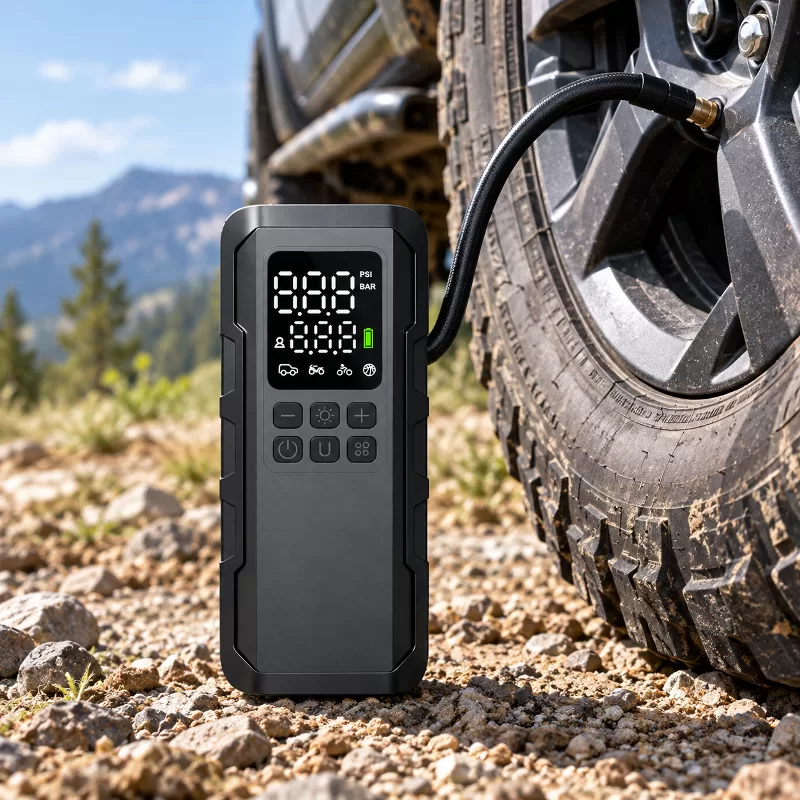
Finding a dependable portable air pump for truck tires requires looking past generic consumer marketing and confronting physical realities. Light-duty pickups, utility haulers, and off-road rigs carry significant air volumes under demanding pressures. When a cold snap strikes or a slow puncture develops on a remote washboard road, a sluggish handheld pump built for sports balls will struggle before completing the task.
Selecting the right portable tire inflator demands a firm grasp of pneumatic throughput, realistic electrical limits, thermal duty cycles, and strict roadside safety protocols. This guide cuts through inflated claims to explore how mobile compression works on high-capacity rubber, how to interpret inflation ratings, and how to maintain field readiness.
Search Intent and Technical Realities: What Truck Tires Actually Require
The Volumetric Difference Between Passenger Cars and Work Trucks
Pneumatic volume does not scale linearly with rim diameter. Larger light-truck tires contain more air and may require higher pressures than passenger-car tires, so inflation time depends on tire size, starting pressure, and the vehicle manufacturer’s placard.
When you hook an underpowered compressor to a large truck tire, the pump must fight both the internal back-pressure inside the valve stem and the substantial physical volume of the tire cavity. An undersized compressor may require substantially longer runtimes to raise pressure in a large tire, increasing heat buildup and battery demand. If the hardware cannot move sufficient volume against existing pressure, inflation stalls while thermal energy builds up inside the cylinder.
Distinguishing Light Trucks and Pickups from Commercial Heavy-Duty Transport
Drivers often search for a portable air pump for truck tires while meaning two completely different vehicular classes. Consumer trucks—such as midsize pickups, half-ton platforms, and heavy-duty 2500/3500 series single-rear-wheel rigs—use pneumatic systems that modern, high-output 12V or multi-cell battery platforms can realistically service for regular top-ups and emergencies.
Commercial Class 7 and Class 8 transport vehicles operate in a separate industrial category. A commercial tractor-trailer rolls on 11R22.5 or 295/75R22.5 tires running cold inflation pressures of 100 to 120 PSI across dual-wheel assemblies. Those high-tension commercial casings demand sustained cubic feet per minute (CFM) delivery from engine-driven shop air compressors or heavy dedicated utility systems. Expecting a compact consumer battery pack to inflate a completely flat semi tire from the rim is a misunderstanding of thermodynamics.
Common Field Demands: Seasonal Air Loss and Trail Airing-Down
Pneumatic pressure inside a sealed tire is directly proportional to absolute ambient temperature. Tire pressure commonly changes by approximately 1 PSI for every 10°F temperature change, although the exact change depends on the tire and conditions. When severe cold fronts arrive, an overnight drop of several PSI across all four wheels can occur, which is frequently enough to trigger onboard monitoring sensors.
Off-highway driving creates an opposite operational requirement. Enthusiasts routinely deflate their truck tires down to lower pressures across deep sand, mud, or rock crawls to expand the tire contact patch. Driving at highway speed or carrying heavy loads while tires remain substantially below the vehicle or tire manufacturer’s guidance can increase heat, damage, and loss-of-control risk. A reliable mobile pump bridges that hazardous gap directly at the trailhead.
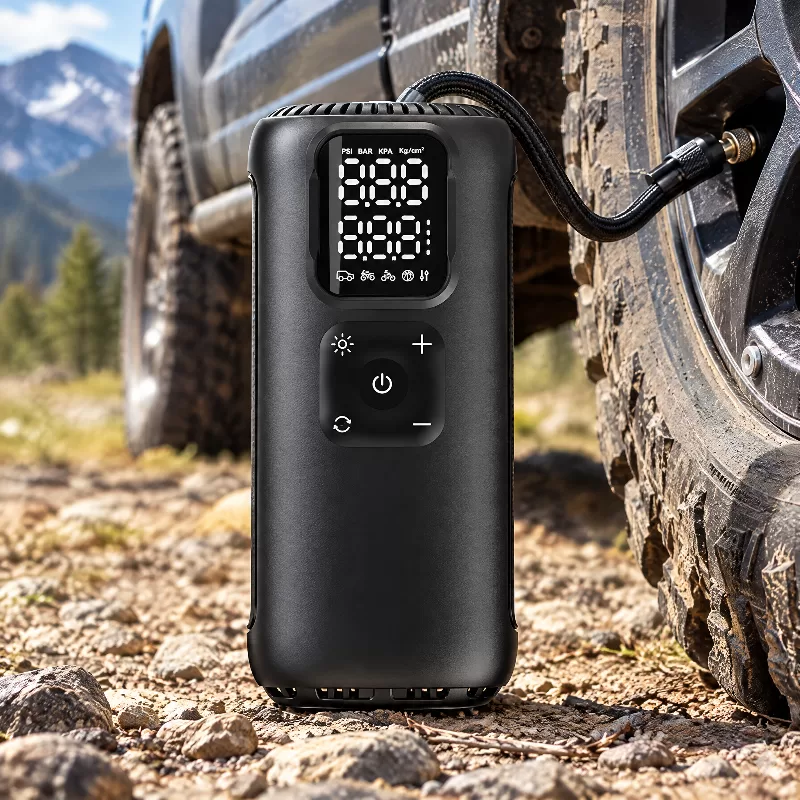
Core Engineering Metrics for Evaluating Mobile Compressors
Maximum Output Pressure Versus Dynamic Airflow Delivery
Inflator marketing materials often highlight high maximum pressure ratings in oversized fonts. In pneumatic engineering, maximum pressure is a capability rating reached under specified test conditions; it does not show how quickly the pump delivers air at the pressure required by a tire. It reveals virtually nothing about how quickly the compressor delivers air at real-world operational thresholds.
Airflow is one important factor in field performance. Tire size, starting pressure, hose losses, power supply, and thermal limits also affect inflation time. For larger vehicle tires, dual-cylinder architectures or enlarged cylinder structures capable of sustaining higher airflow ratings can help keep inflation times within practical roadside limits.
Qualitative Selection Framework for Portable Inflator Classes
Choosing the proper portable air pump for truck tires requires balancing electrical sourcing, physical size, continuous output, and intended service frequency. Operating limits, fuse requirements, and duty cycles must be verified for any specific model.
| Inflator Class | Primary Power Source | Stated Pressure Rating | Airflow Characteristics | Practical Considerations | Best Application Scope |
|---|---|---|---|---|---|
| Compact Cordless Pump | Internal 11.1V–12V Lithium Battery | Up to 150 PSI | Moderate displacement for compact volumes | Brief operational windows; verify cooldown between tires | Passenger cars, seasonal top-ups, compact spares |
| Dual-Cylinder Hybrid | Lithium Pack + 12V Auxiliary Socket | Up to 150 PSI | Higher airflow via dual-cylinder structure | Designed for multi-tire top-ups; approximately 20 min runtime | SUVs, off-road tires, larger cars, light-truck top-ups |
| Direct-Battery Clamping Unit | 12V Alligator Clamps to Car Battery | Up to 150 PSI | High displacement drawing direct vehicle current | Chosen when higher electrical input and longer runtimes are needed | Heavy utility trucks, frequent 4×4 reinflation, high-volume needs |
| Vehicle-Mounted Hardwired | Dedicated 12V/24V Chassis Circuit | 150–200 PSI | High continuous displacement | Requires permanent vehicle wiring and fused circuit protection | Dedicated expedition builds, remote utility service |
The Thermodynamics of Duty Cycle and Heat Dissipation
Compressing atmospheric gas creates intense thermal energy. As gas molecules are forced into tighter volumes within the reciprocating piston assembly, mechanical friction and thermodynamic compression heat up the cylinder barrel, reed valves, and outlet air hose. In small-chassis designs without liquid cooling jackets, that heat must conduct outward through aluminum heat sinks and plastic housings.
Users should follow the manufacturer’s stated runtime and cooldown instructions, because portable compressors can become hot during extended operation. Ignoring thermal limits softens internal seals, hardens check valves, and degrades motor components over time. Operating within prescribed cycles ensures internal mechanical tolerances remain intact when servicing demanding vehicle tires.
Dual Power Architecture: Battery Agility Meets Direct 12V Backup
Cordless convenience eliminates the annoyance of tangling 15-foot cords across wet pavement, but battery cells face physical limits in freezing environments. Sub-zero temperatures severely impede lithium-ion chemical reactions, dropping discharge rates and reducing usable capacity precisely when winter drivers face low tire warnings.
A dual-power design that supports both onboard rechargeable cells and a 12V to 14V auxiliary vehicle socket (cigarette-lighter port) provides practical flexibility. If the onboard lithium pack loses charge during long storage in the center console, plugging into a compatible 12V–14V vehicle socket can provide a backup power source, subject to the vehicle’s socket rating, fuse, and operating instructions.
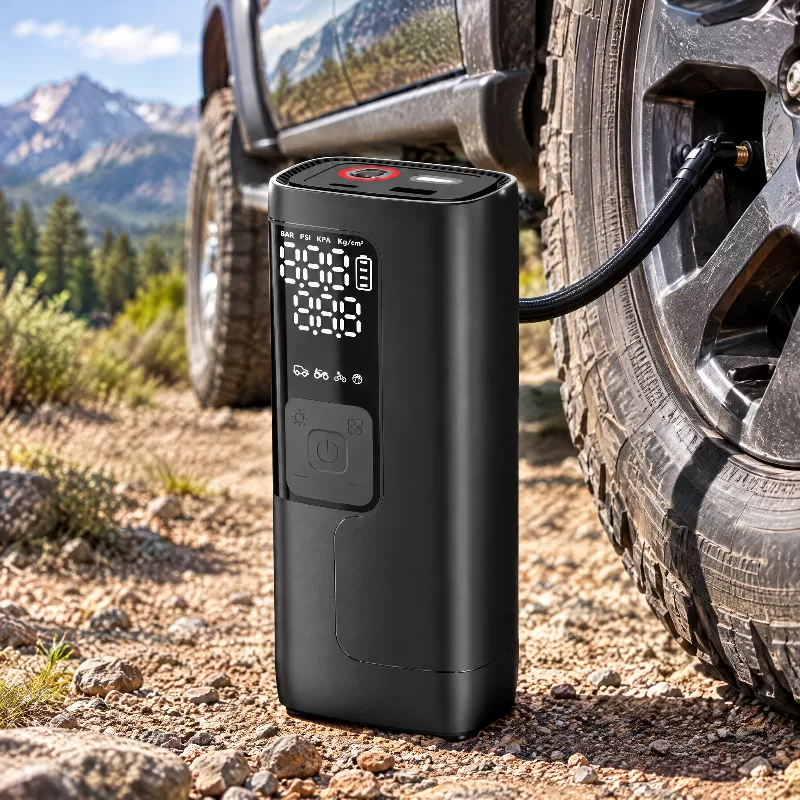
Technical Profile: Dual-Cylinder Architecture and Specifications
Newo is a professional manufacturer specializing in the research, development, and production of smart electric air pumps and portable inflation solutions. With strong expertise in pneumatic technology, product design, and manufacturing, we provide a wide range of innovative products, including portable tire inflators, electric bike pumps, car air pumps, ball pumps, and outdoor inflation solutions. For us, balancing physical portability with reliable pneumatic output remains the central engineering objective.
The SH03 is positioned for SUVs, off-road vehicles, and larger car tires; it may be useful for some light-truck pressure top-ups, but tire size, starting pressure, and the vehicle manufacturer’s requirements should be checked before relying on it.
Dual-Piston Mechanical Architecture and Output
At the mechanical center of the SH03 is the manufacturer-specified dual-cylinder structure with 100W working power and a stated airflow of 42 L/min, with a stated maximum pressure of 150 PSI. Unlike entry-level inflators that rely on a single compact chamber, dual reciprocating structures divide mechanical displacement across two cylinders.
This architecture helps reduce inflation times on larger vehicle tires compared to standard single-cylinder compact pumps. The product specification states an inflation capacity of approximately four 205-size car tires per full charge. Actual results will vary with tire size, starting pressure, temperature, and connection losses.
Energy Storage and Modern Charging Topology
The internal electrical architecture features a three-cell lithium battery configuration providing 3 × 4000mAh cells, 11.1V nominal voltage, and 44.4Wh rated energy. The battery subsystem is rated for longevity, sustaining at least 300 charge cycles while maintaining 80 percent or more of its original operational capacity.
Charging occurs through a bi-directional USB Type-C port utilizing Power Delivery (PD) protocols up to 30W (supporting profiles from 5V/3A through 20V/1.5A). This interface allows recharging within two to three hours using compatible charging adapters, while also serving as a reverse power bank to charge mobile phones, navigation tools, or auxiliary equipment on long road trips.
Physical and Operational Specifications of the SH03
To help fleet managers, outdoor drivers, and retail partners evaluate the physical footprint against vehicle payload space, the baseline technical specifications of the SH03 are detailed below:
- Mechanical Structure: Dual-cylinder structure with 100W working power
- Maximum Pressure Rating: Stated maximum pressure of 150 PSI (usable control range from 2 to 150 PSI)
- Airflow Rating: 42 L/min stated airflow
- Working Power: 100W rated input
- Energy Capacity: 3 × 4000mAh, 11.1V, 44.4Wh internal battery
- Dual Power Input: USB-C PD30W input alongside 12V–14V auxiliary vehicle socket support
- Runtime: Approximately 20 minutes, according to the product specification (actual runtime varies with pressure, tire size, temperature, and operating conditions)
- Acoustic Profile: 85 dB or below measured at a 1.5-meter radius
- Operating Ambient Temperature: Minus 10°C to 45°C
- Form Factor: 188 mm × 97 mm × 63 mm
- Unit Weight: Approximately 1014 grams
Presets, Monitoring, and Intelligent Safety Logic
Controlling air delivery on a high-pressure tire requires precise readouts. The SH03 provides five preset modes, custom pressure control, LED monitoring, and automatic shutoff when the selected target is reached. The segmented digital screen allows operators to monitor progress in multiple common units, including PSI and BAR.
This automatic shutoff mechanism helps prevent accidental over-inflation when managing tire pressures during roadside stops. By presetting the required figure on the interface, users ensure the inflator stops cycling once the selected threshold has been reached.
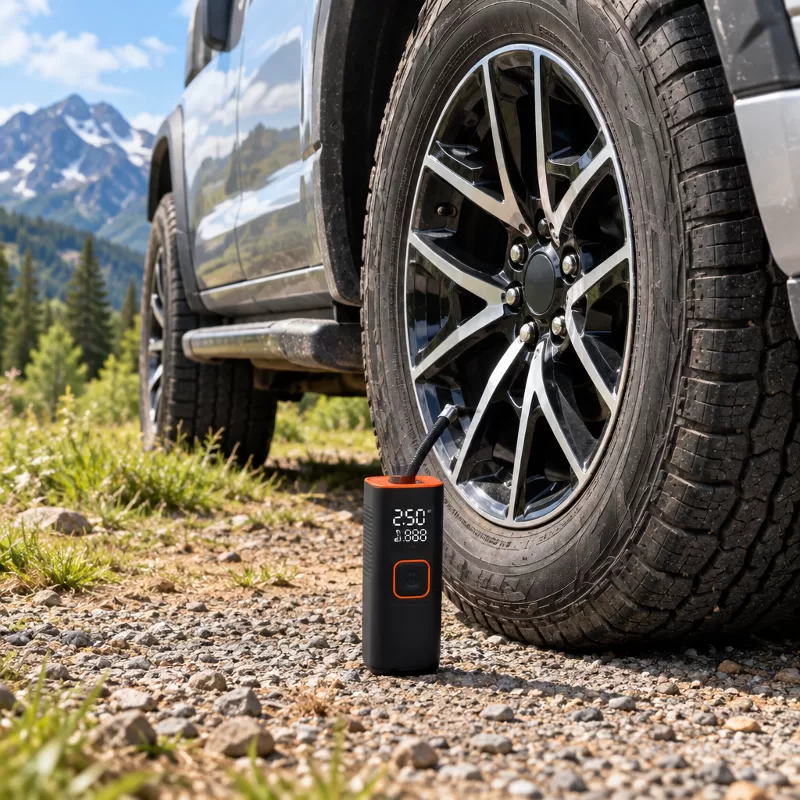
Step-by-Step Field Operation: Inflating Light Truck Tires Safely
Step 1: Pre-Inflation Safety Positioning
Roadside tire inflation exposes operators to traffic and mechanical hazards. Before deploying equipment, park the vehicle completely clear of traffic lanes on solid, level pavement or hard-packed dirt.
- Engage the emergency parking brake firmly and shift the transmission into Park (or reverse on manual transmissions).
- Turn on hazard lights to alert passing motorists, especially during dawn, dusk, or foul weather.
- Inspect the tire tread and sidewall for visible structural delamination, deep slices, rim separation, or embedded metal objects before adding compressed air.
Step 2: Determining Target Pressure Accurately
Never determine working inflation targets from the numbers molded onto the tire sidewall. The figure on the sidewall indicates the maximum cold inflation pressure permitted by the tire casing at its maximum structural load capacity, not the vehicle manufacturer’s engineered baseline.
Locate the vehicle’s Tire and Loading Information label on the driver’s door edge or doorjamb, or consult the owner’s manual. This label specifies the precise cold tire inflation pressure engineered for your truck’s chassis, suspension geometry, and factory-specified load rating. Take note of whether your front and rear axles mandate different pressure levels, which is standard practice on pickup trucks designed to support cargo payloads.
Step 3: Coupling and Connection Mechanics
- Unscrew the protective dust cap from the valve stem and inspect the valve stem, valve-core area, and chuck sealing surface for dirt or damage without removing the valve core.
- Connect the threaded or quick-clamp air chuck of the portable air pump for truck tires directly onto the valve stem, ensuring a tight, concentric seat without cross-threading.
- Power on the digital display and check the initial static reading shown on the screen.
- If relying on 12V auxiliary power, plug the cord into the vehicle’s accessory port, keeping the vehicle engine idling if recommended by the vehicle manual to maintain steady battery bus voltage.
Step 4: Setting Parameters and Running the Compression Cycle
- Select the desired pressure unit (PSI, BAR, or KPA) on the digital interface.
- Use the adjustment buttons to select the target pressure derived from your door jamb placard.
- Initiate the inflation cycle; stay within arm’s reach of the equipment throughout operation.
- Observe the pump during inflation; do not let the air hose kink, and keep the compressor body upright so its ventilation ports can draw ambient cooling air freely.
- Once the automatic shut-off triggers upon hitting your target pressure, switch off the main power switch.
Step 5: Disconnection and Post-Fill Verification
- Uncouple the chuck swiftly to minimize pressure loss from the valve core.
- Use an independent, calibrated mechanical or digital tire gauge to cross-verify the tire pressure.
- Reinstall the valve stem dust cap snugly; the cap serves as a secondary seal to stop road grit from jamming the internal Schrader spring valve.
- If the unit becomes hot or reaches its stated runtime limit, switch it off and let it cool fully according to the manufacturer’s instructions before storage or another inflation cycle.
Operational Decision Flow:
[Inspect Placard Pressure] -> [Cold Tire Check] -> [Connect Air Chuck Concentrically]
         |
         v
[Target Set on Digital LED] -> [Engage Motor] -> [Auto-Shutoff Verification]
         |
         v
[Secondary Pressure Gauge Cross-Check] -> [Seal Valve Stem Dust Cap]
Operational Boundaries: When a Portable Pump Is Not the Answer
Sidewall Ruptures and Major Punctures
Portable tire inflators are pneumatic delivery tools, not tire repair kits. Do not rely on an inflator to make a tire with major tread damage, a rapidly leaking puncture, shoulder damage, or any sidewall cut safe for continued driving. Have the tire inspected by a qualified tire professional. Pumping air into a structurally compromised tire casing risks a catastrophic sidewall blowout that can cause severe personal injury or vehicle damage.
Unseated Beads on Off-Road Rims
When rock crawlers air down excessively without beadlock wheels, side-loading forces can pop the tire bead off the wheel rim shelf. A compact portable inflator is not a substitute for approved bead-seating equipment. Do not attempt to reseat an unseated bead roadside; have the tire inspected and serviced with the appropriate restraint and inflation equipment.
Commercial Fleet Tire Maintenance
Owner-operators handling 18-wheel commercial rigs must recognize equipment limitations. The SH03 should not be presented as a commercial semi-truck tire compressor unless the manufacturer provides tire-size, pressure-range, and operating-time validation. Its stated application is SUVs, off-road vehicles, and larger car tires. Inflating an eight-tire commercial setup from zero would generally be impractical for the SH03 and is outside the product’s stated SUV, off-road, and larger-car applications.
Troubleshooting Common Portable Inflator Field Issues
Symptom 1: Compressor Shuts Down Prematurely
If the selected target is below the tire’s current pressure, the inflator may stop immediately or may not operate as expected; check the current pressure and reset the target accordingly.
Another possible cause is the thermal protection mechanism. If the unit has reached its runtime or thermal limit, switch it off and allow it to cool fully according to the manufacturer’s instructions before restarting.
Symptom 2: Hose Fitting or Chuck Runs Abnormally Hot
Pneumatic compression concentrates thermal energy right at the discharge port. The metal adapter coupling the air hose to the inflator body often becomes quite warm during continuous multi-minute cycles. This is an unavoidable thermodynamic reality of air compression, not an electrical short. Always grasp the textured rubber sleeve or protective collar rather than bare metal fittings when disconnecting the hose.
Symptom 3: Slow Pressure Build-Up
If the pump runs with a normal acoustic rhythm but the tire’s pressure reading fails to climb, inspect the air chuck interface. An improperly seated quick-connector will depress the Schrader valve pin while venting air around the stem threads. Detach the chuck, verify the rubber O-ring seal inside is clean and uncrushed, and clamp it down straight onto the valve stem.
Frequently Asked Questions (FAQs)
Can a portable air pump for truck tires run commercial semi-truck tires?
A 150 PSI rating alone does not establish suitability for commercial semi-truck tires. The SH03 should be limited in this article to its stated SUV, off-road, larger-car, and routine top-up applications unless the manufacturer supplies commercial-tire test data. Commercial transport tires generally require appropriately rated high-output compressor or tire-service equipment selected for the tire size, pressure, and operating duty.
How often should I check and top up my truck tire pressure?
You should verify cold truck tire pressures at least once a month and before every long-distance hauling trip or heavy towing haul. Always measure pressures when the vehicle has been parked for at least three hours, ensuring ambient heat rather than braking or road friction determines the baseline reading.
Why does my portable tire inflator get warm during operation?
When gas molecules are compressed mechanically into a confined volume, their internal kinetic energy rises, releasing intense heat. That heat transfers through the metal cylinder barrel and air chuck during normal operation. High-quality inflators use heat-tolerant seals and ventilation ports to manage this thermal rise within their rated duty cycle.
Can I leave my portable inflator stored in my truck during freezing winter weather?
You can store the unit in your vehicle, but severe sub-zero temperatures temporarily diminish the discharge capacity of internal lithium-ion battery cells. If you store your pump in an unheated truck cab over the winter, choose a dual-powered model that can run off your 12V vehicle cigarette-lighter port if the battery runs cold.
Is it safe to inflate a completely flat truck tire on the roadside?
Inflating a completely flat tire on the side of the road is only safe if you have thoroughly inspected the casing for punctures, structural cracks, sidewall separation, and rim detachment. If the vehicle was driven on a flat tire for even a short distance, the internal sidewall plies may be destroyed; attempting to re-inflate a damaged casing can cause a hazardous blowout.
How accurate are the digital displays on portable air pumps compared to dedicated pressure gauges?
Display accuracy varies by model and calibration. Use the SH03 display for setting and monitoring, then verify the final pressure with a separate quality gauge when precision is required for specialized hauling or demanding axle loads.
Summary: Ensuring Dependable Roadside Air Capacity
Equipping your pickup, utility vehicle, or overland rig with an appropriate portable air pump for truck tires protects against unexpected pressure drops, improves fuel economy, and preserves tread life. By matching airflow ratings and dual-power options to your vehicle’s physical air volume, you avoid being stranded by an underpowered pump. Use your truck’s door jamb placard to set your baseline pressures, respect the thermal limits of your equipment, and keep a dependable inflator stored securely to handle whatever challenges the highway throws your way.
-

Meet NEWO at the 140th Canton Fair: Visit Booth 10.3 M03–04
Meet NEWO at the 140th Canton Fair in Guangzhou, October 15–19, 2026. Visit Booth 10.3 M03–04 to explore portable air pumps and discuss OEM, ODM and distribution opportunities.... -

As Shenzhen Welcomes the World for APEC 2026, NEWO Welcomes You to Our Factory
As Shenzhen prepares for APEC 2026, NEWO welcomes international buyers and partners to visit our factory, meet our team and explore future cooperation.... -

Leading the Way in Product Innovation and Excellence
Smartnewo exemplifies professionalism in product innovation and manufacturing. Their collaboration with Xiaomi Youpin on the G01 crowdfunding project highlights their expertise in creating compact, powerful inflatable pumps. Rigorous engineering, meticulous production processes, and advanced quality assurance underscore their commitment to excellence. The success of the G01 project, with significant market... -

Essential Qualities of an Excellent Supplier
In today's competitive market, finding a reliable supplier is crucial for business success. Based on insights from Smartnewo and broader internet research, here are key qualities an excellent supplier must possess:... -

NW06 Tire Inflator: Compact Power for Quick Inflation
Summary The NW06 Tire Inflator delivers quick and efficient tire inflation with a powerful 35L/min airflow. It features a user-friendly LCD screen for real-time pressure monitoring, dual power options with a built-in 6000mAh battery, and multiple nozzle attachments for versatile use. Its compact design and integrated LED light ensure convenience and... -

Unleash the Power of Portability: The SmartNewo Jump Starter with Air Compressor KF03
This guide will walk you through the steps to effectively use a portable tire inflator, helping you stay prepared and safe on the road.... -

Newo Attends The 2024 Consumer Electronics Show (CES)
Smartnewo booth is located at 53672, Halls A-D, Level 2, Venetian Expo, Las Vegas Convention Center (LVCC). ... -

Smartnewo’s Dual-Cylinder Air Pump Rocks the Hong Kong Autumn Electronics Fair!
Smartnewo’s Dual-Cylinder Air Pump Rocks the Hong Kong Autumn Electronics Fair!... -

Meet at the Canton Fair! Smartnewo brings dual-cylinder air pumps, making your inflation experience faster and more stable!
NEWO has went deep communication and negotiation with customers from all over the world on booth.... -

“Hong Kong Autumn Electronics Fair – 1CA18 (October 13th to 16th): Smartnewo invites you to visit our booth!
Hong Kong Autumn Electronics Fair...
-

What to Check Before Ordering Custom Electric Bike Pumps
Plan custom electric bike pumps with a clear requirements freeze for valves, TPU tubes, portability, repeated top-ups, charging, and model-specific documents.... -

OEM vs ODM Air Pumps: Which Manufacturing Model Fits Your Brand?
Compare OEM and ODM air pump projects by design responsibility, change approval, development scope, and written ownership terms before choosing your route.... -

How to Choose a Reliable Tire Inflator Manufacturer in China
Choose a tire inflator manufacturer in China with a focused RFQ, supplier evidence, configuration checks, and clear sample-to-pilot decisions for your brand.... -

Rechargeable Electric SUP Pump for Paddle Boards: Faster Inflation for SUPs, Kayaks and Inflatable Tents
The BL10-C Portable Electric Bike Tire Inflator is a compact and lightweight mini electric bike pump designed for modern cyclists. With up to 120 PSI pressure, a digital LED display, preset pressure control, automatic shut-off, USB-C charging, and multiple valve adapters, BL10-C offers a convenient inflation solution for road bikes,... -

Are Electric Bike Pumps Worth It in 2026? Electric Pump vs CO₂ vs Mini Hand Pump
Discover whether electric bike pumps are worth it in 2026. This guide compares electric bike pumps, CO₂ inflators, and mini hand pumps for road cycling, gravel riding, commuting, and long-distance rides. Learn the pros, limitations, best use cases, and key features to look for before choosing the right portable tire... -
BL10-C Portable Electric Bike Tire Inflator: Small Size, Reliable Power for Every Ride
The BL10-C Portable Electric Bike Tire Inflator is a compact and lightweight mini electric bike pump designed for modern cyclists. With up to 120 PSI pressure, a digital LED display, preset pressure control, automatic shut-off, USB-C charging, and multiple valve adapters, BL10-C offers a convenient inflation solution for road bikes,... -

Why Mini Electric Bike Pumps Are Becoming Essential for Modern Cycling
Discover why mini electric bike pumps are becoming essential for modern cyclists. Learn how portable electric bike pumps improve tire pressure management, riding safety, and convenience.... -

The Ultimate Smart Solution for Easy Outdoor Adventures in 2026
Discover how a spring travel air pump simplifies outdoor trips with fast inflation, smart features, and powerful performance—perfect for every adventure.... -

Powerful 5-in-1 Portable Car Tire Inflator and Jump Starter: The Ultimate Emergency Tool for Every Driver
Why Every Driver Needs a Portable Car Tire Inflator and Jump Starter Modern drivers face many unexpected situations on the road. A flat tire, low tire pressure, or a dead car battery can happen at the worst possible time. That’s why having a portable car tire inflator and jump starter is... -

7 Real Cycling Scenarios That Show Why Every Rider Should Carry a Mini Bike Pump
Cycling is one of the most freeing activities you can enjoy. Whether you’re commuting to work, riding through city streets, or exploring quiet countryside roads, a bike ride can instantly improve your day. But there’s one small problem that almost every cyclist eventually faces: Low tire pressure. It might happen...
-

How Is a Football Properly Inflated?
The correct inflation of a football - with not too much and not too little air - is a hotly debated topic among footballers.... -

Application Scenarios of Car Inflator Pump
Often long-distance business trips or play car owners because the road may be more remote areas, in this case if you encounter a tire leak....