

 Portable Tire Inflators
 Electric Air Pumps
 Electric Car Tyre Pumps
 Electric Ball Pumps
 Electric Bike Pump
 SUP Air Pump

Portable Electric Air Pump for Car: Practical Guide to Safe Tire Inflation and Selection
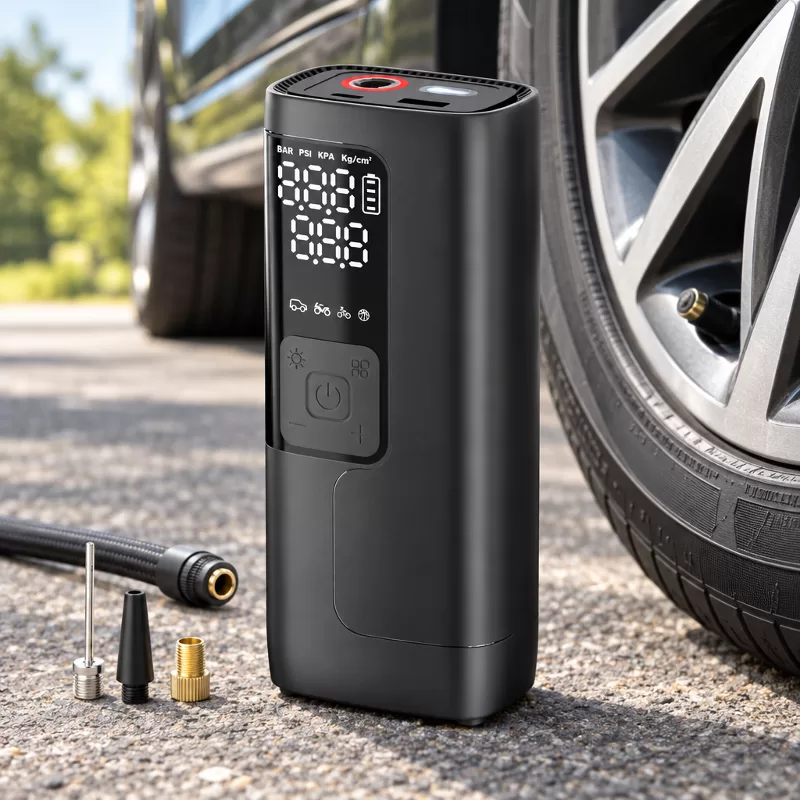
A dependable portable electric air pump for car maintenance has transitioned from an optional road accessory into an indispensable piece of emergency gear. Modern automotive tires lose pressure naturally through microscopic permeation, road vibration, and shifting outdoor temperatures. Having an immediate inflation source in the trunk gives you direct control over vehicle safety and performance.
Driving with sub-optimal tire pressure creates uneven tread wear, increases fuel consumption, and elevates the risk of sudden sidewall overheating. By understanding the core pneumatic mechanisms, proper inflation targets, and product specifications, drivers can handle roadside top-ups calmly without relying on broken gas-station compressors or waiting hours for roadside dispatch.
1. What a Portable Electric Air Pump for a Car Does
Understanding how a portable tire inflator functions helps you manage tire maintenance routines effectively while recognizing the boundaries of handheld equipment.
Portable Tire Inflator vs. Service-Station Air Compressors
Service-station inflators are generally larger, continuously powered systems designed to deliver air faster than compact battery-powered pumps. However, they frequently suffer from irregular station maintenance, worn hoses, or damaged mechanical dial gauges that make precise pressure management frustrating for everyday motorists.
In contrast, a portable electric air pump for car use pairs an internal DC motor with a miniaturized piston cylinder mechanism. It compresses ambient air incrementally and channels it directly into the tire through a threaded or quick-connect chuck. They allow pressure checks and top-ups at the vehicle, but the displayed pressure should be compared periodically with a separate quality gauge if accuracy is important.
Primary Use Cases: Routine Top-Ups and Mixed-Inflatable Demands
Handheld tire inflators are primarily engineered to manage routine tire pressure adjustments and seasonal atmospheric drops. A small pressure correction is generally faster than inflating a completely flat tire, but actual time depends on the tire and pump conditions.
Beyond passenger sedans, many multi-purpose units accommodate broader inflation needs, including off-road vehicle tires, light commercial vans, motorcycles, e-bikes, and sports balls. This versatility makes a compact inflator valuable for weekend campers, bicycle commuters, and sports coaches who regularly encounter varied inflation fittings.
Realistic Mechanical Boundaries: What a Portable Pump Cannot Fix
A compact electric inflator is a pressure-management instrument, not a vulcanizing patch or puncture repair system. When a tire suffers an active puncture from a screw, a sliced sidewall, or an unseated bead, pumping air into the casing is merely temporary.
A continuous leak may prevent the tire from holding pressure and can force the pump to run for an extended period. Stop if pressure does not build and arrange inspection or roadside assistance. Recognizing when a tire requires a tire plug, an internal patch, or a spare wheel replacement protects your pump from unnecessary wear.
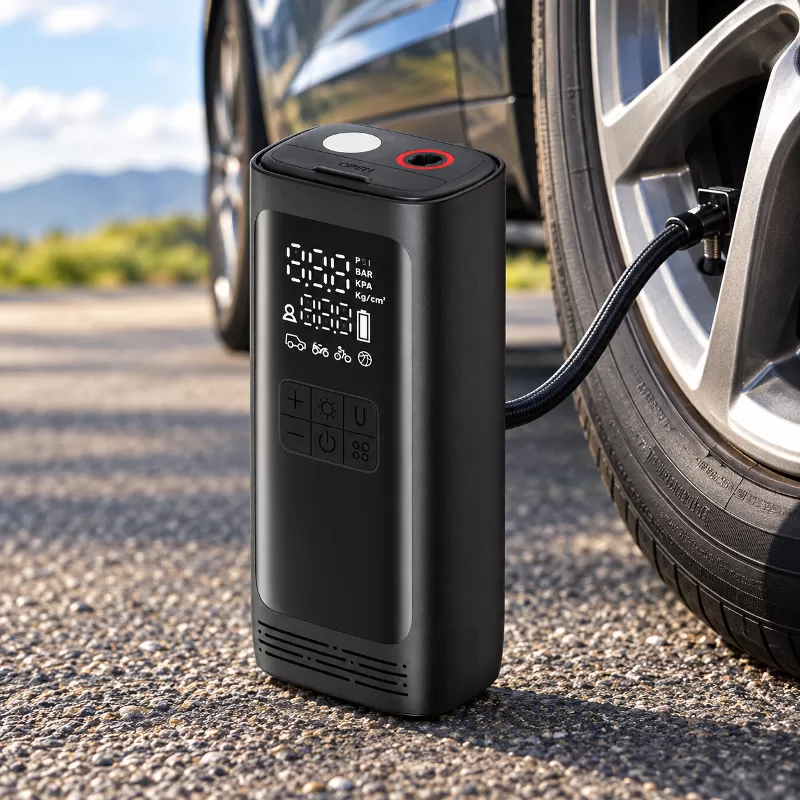
2. Why Accurate Tire Pressure Matters for Road Safety
Tire pressure influences the tire’s contact patch, handling response, rolling resistance, and heat generation, alongside factors such as speed, load, tread condition, and road surface.
Locating Manufacturer Cold Placard Pressure vs. Tire Sidewall Maximum
A frequent mistake among motorists is inflating tires to the pressure figure molded directly onto the tire sidewall. The sidewall marking gives the tire’s maximum permissible inflation pressure under the applicable tire labeling; it is not the vehicle manufacturer’s recommended cold pressure.
- Door Jamb Placard: Indicates the vehicle manufacturer’s specified cold inflation pressure, calculated for vehicle weight distribution, ride stability, and suspension geometry.
- Owner’s Manual: The owner’s manual may provide additional guidance for towing, heavy loads, or special operating conditions. Follow the pressure information supplied for your specific vehicle.
- Tire Sidewall Number: For the vehicle’s standard tire fitment, use the cold pressure on the vehicle placard or in its manual; follow manufacturer guidance if the vehicle or tire fitment has been changed.
Temperature Fluctuations and Natural Pressure Permeation
Air density is tied directly to ambient temperature according to basic gas laws. As a reliable rule of thumb, tire pressure shifts by approximately 1 PSI for every 10°F change in air temperature.
A temperature decrease of about 40°F can reduce a tire’s measured pressure by roughly 4 PSI, although the actual change varies with conditions. Furthermore, compressed air molecules gradually permeate through the inner butyl rubber liner, resulting in an average natural pressure drop of 1 to 2 PSI each month.
Why Onboard TPMS Does Not Replace Manual Gauge Verification
Tire Pressure Monitoring Systems (TPMS) are valuable safety features, but they do not serve as proactive maintenance tools. Federal TPMS requirements generally address significant underinflation, but the warning threshold and timing depend on the applicable standard and vehicle. Check tire pressure monthly rather than waiting for the warning light.
By the time a warning indicator illuminates on the dashboard, the tire may have been noticeably underinflated for miles, degrading steering response and driving up rolling resistance. Performing regular monthly checks with a calibrated portable gauge keeps tires within their optimal efficiency window long before warning lights appear.
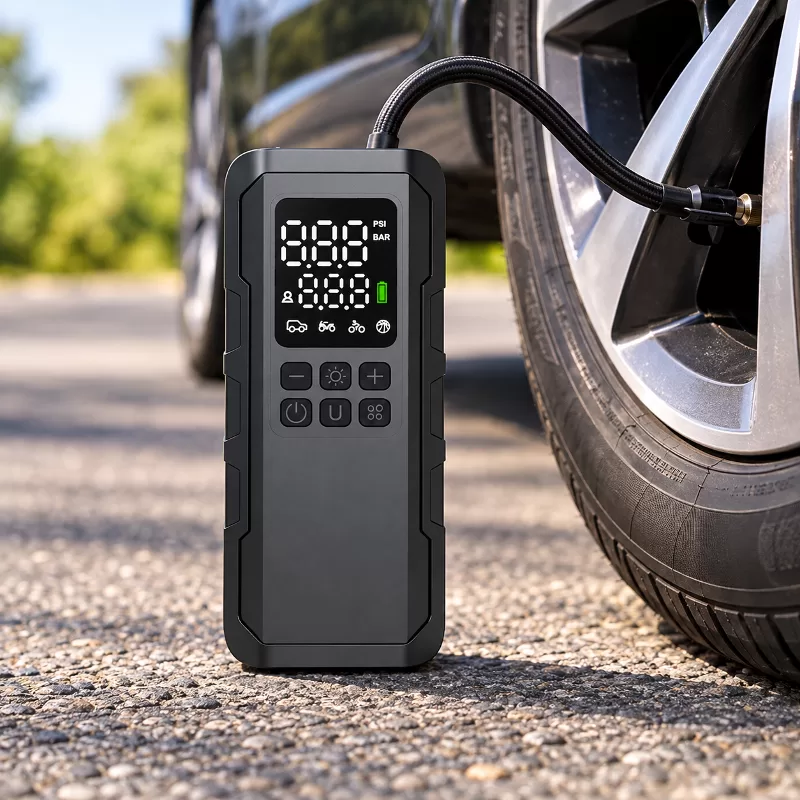
3. How to Choose a Portable Electric Air Pump for a Car
Selecting the correct portable inflator requires evaluating mechanical specifications rather than cosmetic features. The internal motor design and cooling properties dictate whether a device can handle large vehicle tires reliably.
Airflow Rate (L/min) and Cylinder Architecture
The airflow rating of an inflator, expressed in liters per minute (L/min), determines how fast it fills a given tire volume. Airflow varies widely by model and internal displacement, but higher volumetric delivery remains a key factor in reducing inflation times.
For larger sedans, SUVs, and light trucks, higher airflow rates significantly shorten the time you spend kneeling on the road shoulder. Multi-chamber or dual-cylinder configurations divide mechanical displacement across reciprocating chambers, boosting volume delivery while lowering the mechanical stress on individual components.
Power Delivery: Internal Battery Cells vs. 12V Auxiliary Sockets
Drivers must decide between cordless, battery-powered inflators and wired 12V auxiliary power models connected to the vehicle cigarette lighter. Each configuration presents distinct operational trade-offs for road readiness.
| Power System Type | Key Advantages | Practical Limitations |
|---|---|---|
| Cordless Battery Pack | Total portability; no tangled vehicle cords; inflates bicycles and sports equipment anywhere | Requires periodic recharge; battery runtime is limited by internal capacity |
| 12V Auxiliary Socket | Powered by the vehicle’s 12V outlet; convenient for in-car storage | Operating time and whether the engine must be running depend on the vehicle, outlet rating, and pump instructions |
| Hybrid (Dual Power) | Offers emergency battery independence along with wired 12V backup power | Slightly larger footprint; higher unit cost due to redundant power circuits |
Pressure Range and Sensor Accuracy
A practical portable electric air pump for car applications should operate smoothly across a wide operational pressure span. Vehicle and bicycle pressure targets vary widely depending on the chassis, rim configuration, and load distribution.
Use the vehicle placard or manual for car tires, and the tire or equipment manufacturer’s guidance for bicycles and spares. Choose a pump whose pressure range covers the target pressure of your vehicle and other intended inflatables, while also checking airflow, runtime, and the manufacturer’s vehicle-compatibility guidance. Prefer a pump that publishes pressure-sensor accuracy or compare its reading with a separate quality gauge.
Auto-Shutoff Mechanisms and Digital Readouts
Manual tire inflation carries an inherent risk of overinflation if the operator gets distracted while checking analog needle dials. Digital pumps equipped with an automatic shut-off feature help streamline routine operation.
Automatic shutoff can reduce the risk of continued inflation, but confirm the target setting and periodically compare the displayed pressure with a separate quality gauge. This feature can help limit inflation at the selected target, provided the target and pressure reading are correct.
Thermal Management, Duty Cycles, and Form Factor
Compressing atmospheric gas generates thermal energy inside the pump cylinder. In compact housings, inadequate heat dissipation can cause the piston sleeve to overheat, melting internal seals or tripping thermal protection sensors.
Inspect the inflator body for explicit cooling slots, aluminum motor sleeves, and manufacturer-stated duty cycles. The NW08 is specified for 12–15 minutes of runtime. Users should follow the supplied manual’s duty-cycle and cooling instructions rather than assume that four tires can be inflated continuously.
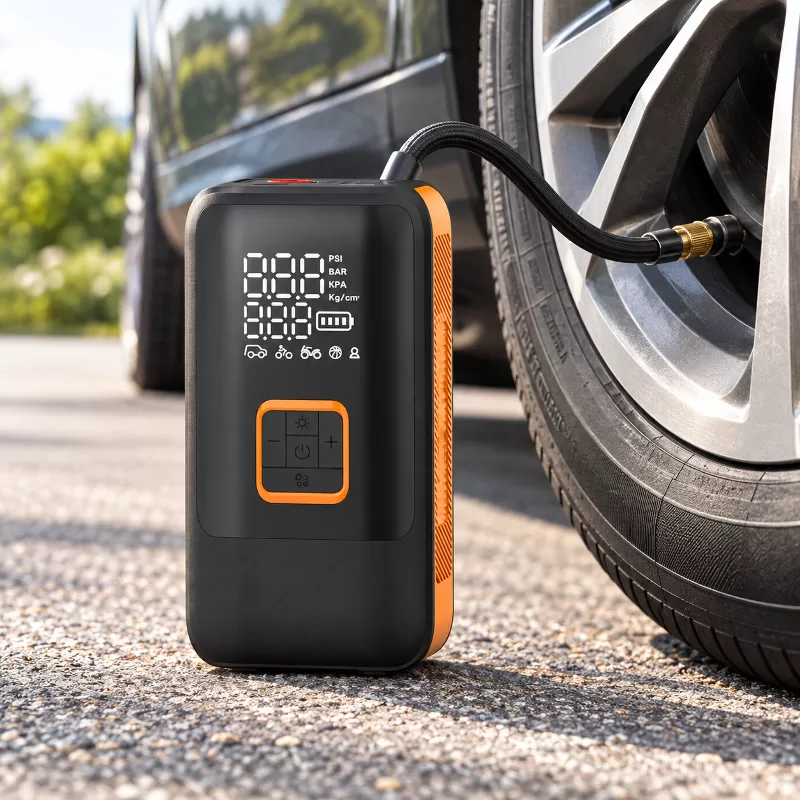
4. Technical Analysis: The NW08 Portable Air Pump
As a professional manufacturer specializing in smart electric air pumps and portable inflation solutions, Newo focuses on combining compact engineering with dependable pneumatic output. Examining the specifications of the NW08 model illustrates how these technical considerations translate into practical hardware.
Dual 24-Cylinder Internal Structure and 100W Working Power
The NW08 departs from conventional single-piston mini pumps by utilizing a dual 24-cylinder internal configuration driven by a 100W motor. Newo positions this configuration as providing stronger airflow and better inflation efficiency than entry-level models.
The 100W rating describes the pump’s stated working power; actual output can vary with pressure, battery condition, and operating temperature. By splitting displacement across twin cylinders, the design balances mechanical movement during everyday use.
Working Pressure Range (2–150 PSI) and 32 L/min Flow Delivery
Operating across a pressure range of 2 to 150 PSI, the NW08 adapts easily to multiple tire types, from low-pressure recreation inflatables to high-pressure bicycle tires. Its displacement rate reaches 32 L/min of air delivery.
The NW08 is specified at 32 L/min, a useful metric when comparing models intended for larger tires. Actual inflation time will vary with tire volume, starting pressure, temperature, and battery condition.
44.4Wh Battery Pack and Type-C Power-Bank Integration
Cordless convenience depends heavily on battery chemistry and cell layout. The NW08 is specified with a three-cell battery rated at 3 × 4000mAh, 11.1V, and 44.4Wh of energy storage.
- Fast Input Recharging: Recharges in 2 to 3 hours through a modern Type-C port supporting input rates up to 20V/3A.
- Cycle Longevity: The battery pack is rated for 300 charge cycles while retaining at least 80% of its initial capacity.
- Emergency Power Delivery: Features reverse power-bank output supplying up to 20V/2A through a C-to-C link to recharge mobile phones and emergency devices during road trips.
Operating Limits: 12–15 Minute Runtime and Thermal Range (-10°C to 45°C)
The operational envelope of the NW08 specifies a runtime of 12 to 15 minutes. Users should follow the supplied instructions for operating intervals and cooling. Operating noise is rated at 85dB or lower at a 1-meter distance, remaining within acceptable boundaries for automotive machinery.
The stated working temperature is −10°C to 45°C. Do not treat this figure as a storage specification; consult the manual for storage limits and allow the unit to return to its permitted operating range before use.
Preset Modes and Automotive Application Fit
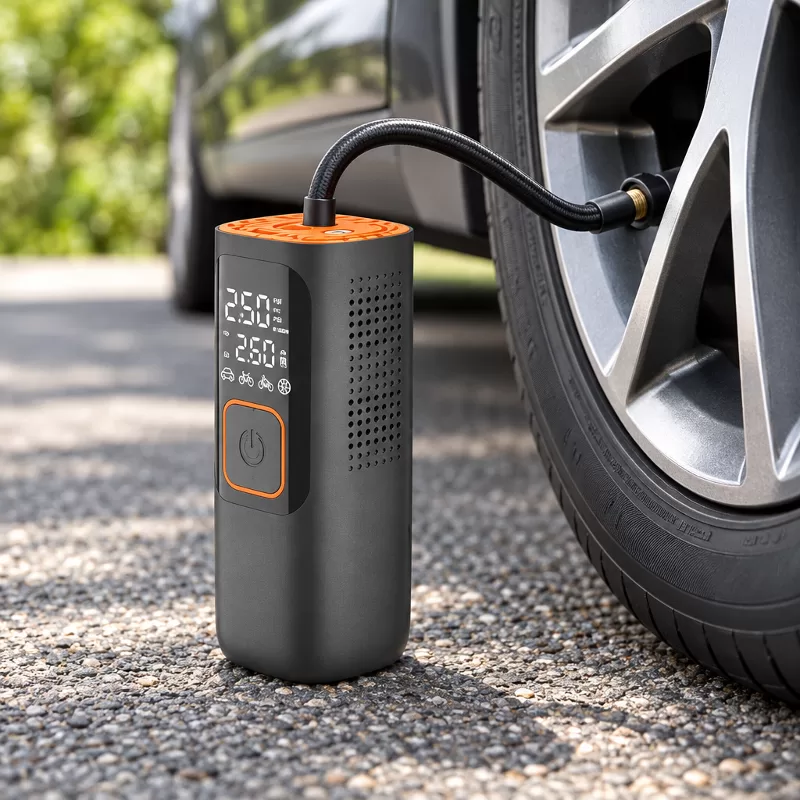
Weighing 1035g and measuring 185 × 96 × 63.6 mm, the NW08 integrates five preset inflation modes alongside custom manual controls on its high-contrast LED screen. Users can switch between car, motorcycle, bicycle, ball, and customized pressure profiles with a single button press.
These presets can simplify setup, but users must still confirm the selected mode, target pressure, unit, and valve connection before starting. Once connected to the valve stem, the unit displays real-time tire pressure before pumping begins.
5. Step-by-Step Guide: How to Inflate a Car Tire Safely
Following a systematic procedure protects your valve stems, guarantees precise pressure readings, and keeps you safe during roadside top-ups.
Pre-Inflation Inspection: Cold Tire Verification and Physical Damage Check
Tire pressure must always be measured when the rubber is cold. A tire is considered cold when the vehicle has been stationary for at least three hours or driven for less than one mile at moderate speed.
- Park the vehicle on solid, level ground away from moving traffic, engage the emergency brake, and switch on your hazard lights.
- Locate the manufacturer cold tire inflation pressure on the driver-side door pillar placard.
- Unscrew the plastic valve stem dust cap, inspecting the stem threads for corrosion, dirt buildup, or physical bending.
- Check the exterior tread face for embedded construction nails, glass shards, or irregular bulges along the outer sidewall.
Setting the Target Pressure and Connecting the Valve Chuck
Modern digital pumps simplify setup, but establishing an airtight valve seal remains critical for accurate internal sensor readings.
- Power on your portable electric air pump for car use and select the appropriate vehicle pressure mode (PSI or BAR).
- Adjust the target setting on the screen using the plus or minus buttons to match your door placard cold pressure.
- Press the air chuck firmly onto the tire valve stem, threading the brass connector or flipping the locking lever securely.
- Confirm that the initial pressure readout on the LED display matches your expected baseline, verifying that air is not hissing from an imperfect connection.
Monitoring the Inflation Cycle and Verifying Cold Pressure
Once the connection is secured, activate the compressor motor and remain within arm’s reach of the equipment throughout the cycle.
- Start the inflation cycle and watch the live pressure increase on the digital display.
- Keep the air hose straight without tight kinks or sharp bends that could restrict internal airflow.
- Allow the pump’s auto-shutoff mechanism to halt operation once the target pressure is reached.
- Disconnect the chuck briskly to minimize air escape, then reinstall the valve dust cap firmly to keep road grit out of the Schrader core.
Identifying Serious Tread Damage and Puncture Warnings
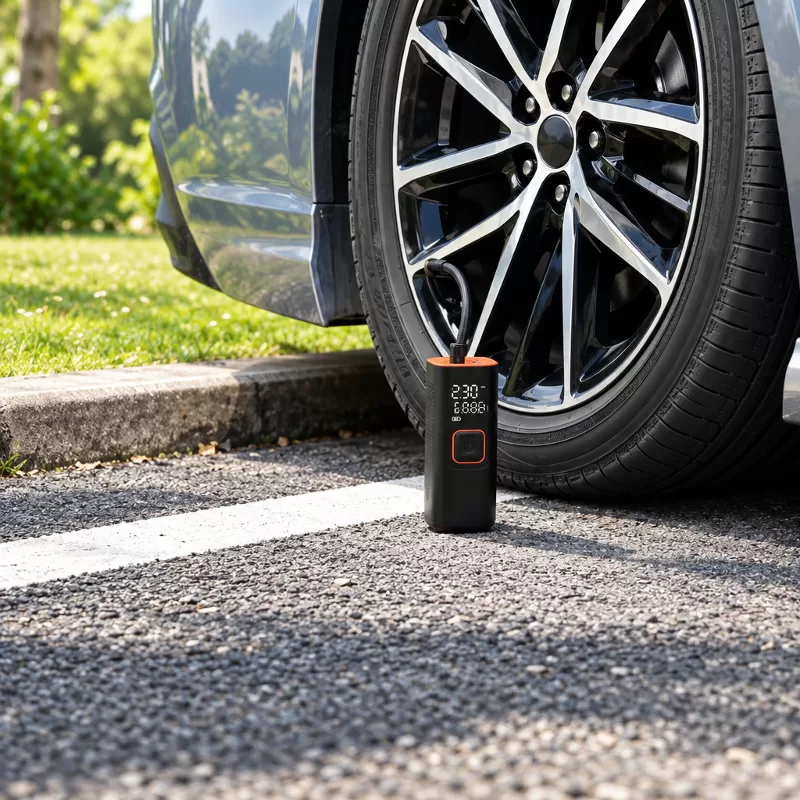
If the pump runs for several minutes without registering an increase in tire pressure, immediately shut off the unit and inspect the wheel assembly. Air escaping as fast as it enters indicates a structural puncture, an unseated bead, or a severed valve stem.
In these severe scenarios, attempting to drive on the tire will ruin the internal casing cords and damage the alloy wheel rim. Switch your hazard flashers on and proceed with installing the vehicle spare tire or requesting roadside recovery equipment.
6. Common Mistakes When Selecting and Using Car Air Pumps
Avoiding common operational pitfalls ensures your inflator lasts for years while keeping your tire casings in optimal working condition.
Confusing Maximum Pressure Ratings with Flow Delivery
A common misconception among buyers is assuming a 150 PSI rating means an inflator will fill a flat car tire rapidly. Maximum pressure indicates the highest pressure claimed for the pump under its specified conditions; it does not indicate how quickly the pump reaches that pressure or how it performs on a fully flat tire.
Flow delivery is an important factor in inflation time, but real-world results also depend on tire volume, starting pressure, battery condition, temperature, and duty cycle. While high-pressure ratings allow compatibility with high-resistance chambers, volume output dictates real-world inflation speed across passenger vehicle tires.
Relying on an Inflator to Manage Active Punctures
Drivers sometimes treat a portable electric air pump for car emergencies as a way to limp a punctured tire home over long distances. Repeatedly stopping every few miles to pump up a failing tire creates severe friction and internal heat buildup.
Driving while significantly underinflated can generate excessive heat and cause hidden damage to the tire’s innerliner and body ply, even if the tire is later reinflated. Once this internal degradation starts, the tire faces sudden blowout risk even if re-inflated later.
Exceeding the Rated Duty Cycle and Thermal Boundaries
Compact pump motors operate at high rotational speeds, generating rapid friction heat inside the cylinder sleeve. Running a compact pump beyond its recommended duty cycle can melt solder connections or degrade the piston seal.
- Respect the Limit: If your unit has a stated runtime limit, allow the housing to cool down before inflating another set of tires.
- Avoid Hot Enclosures: Do not operate the pump while it sits inside a closed carrying pouch or inside an unventilated vehicle area.
- Monitor the Chuck: Be aware that brass chuck connectors get warm during prolonged inflation cycles; handle the metal fittings carefully when disconnecting.
Neglecting Valve Stem Cleaning and Post-Inflation Seal Checks
Road grime, salt, and brake dust settle inside unprotected valve stems over time. Attaching an inflator chuck over dirty threads can force debris straight into the internal spring-loaded Schrader valve core.
Keep the valve area clean, reinstall the valve cap, and if a leak is suspected, have the valve and tire checked with an appropriate leak-detection method. Maintaining intact dust caps protects the small internal sealing gasket from exposure to harsh road contaminants.
7. Frequently Asked Questions (FAQs)
Can a compact electric pump inflate SUV and light truck tires?
Newo lists the NW08 for SUVs, off-road vehicles, and larger car tires. Its 32 L/min specification may be useful when comparing pumps, but actual suitability and inflation time depend on tire size, starting pressure, battery condition, and the manufacturer’s operating instructions.
Why should target pressure come from the door jamb rather than the sidewall?
The figure on the driver-side door jamb placard is calculated by vehicle engineers specifically for your car’s chassis weight, handling balance, and suspension setup. The pressure stamped on the tire sidewall is the maximum permissible pressure under applicable tire labeling, not the recommended operating cold pressure for your vehicle.
Can a portable electric inflator resolve a slow bead or nail leak?
An inflator may restore pressure for diagnostic purposes, but do not drive on a tire that is visibly damaged, repeatedly loses pressure, or has been driven while severely underinflated. Have it inspected by a qualified tire professional or use the spare/roadside assistance.
How often should car tire pressure be inspected?
Tire pressure should be inspected manually with an accurate gauge at least once a month and prior to departing on extended highway road trips. Inspections must be conducted when the tires are cold to avoid skewed readings caused by driving heat.
Does an auto-shutoff feature eliminate the need for a separate pressure gauge?
A digital auto-shutoff pump can simplify routine top-ups, but its displayed pressure should be compared periodically with a separate quality gauge because the NW08 specifications do not state sensor accuracy.
Is the NW08 suitable for bicycle tires and sports equipment?
Newo lists the NW08 for bicycles, e-bikes, and sports balls, with a stated 2–150 PSI range and five preset modes. Confirm the supplied valve adapters and the correct pressure for each item before use.
8. Summary: Selecting the Right Inflation Solution for Your Driving Needs
Choosing a dependable portable electric air pump for car safety comes down to matching mechanical capability with your driving demands. Drivers operating larger crossover platforms and off-road vehicles benefit directly from twin-cylinder pump architectures, generous airflow ratings of 30 L/min or higher, and robust thermal protection ranges.
Investing in a solid portable tire inflator turns a potentially hazardous roadside emergency into a calm, five-minute maintenance check. By maintaining proper door-placard cold inflation pressures every month, you preserve your tire investment, maximize vehicle fuel mileage, and ensure dependable handling across every mile of highway.
-

Meet NEWO at the 140th Canton Fair: Visit Booth 10.3 M03–04
Meet NEWO at the 140th Canton Fair in Guangzhou, October 15–19, 2026. Visit Booth 10.3 M03–04 to explore portable air pumps and discuss OEM, ODM and distribution opportunities.... -

As Shenzhen Welcomes the World for APEC 2026, NEWO Welcomes You to Our Factory
As Shenzhen prepares for APEC 2026, NEWO welcomes international buyers and partners to visit our factory, meet our team and explore future cooperation.... -

Leading the Way in Product Innovation and Excellence
Smartnewo exemplifies professionalism in product innovation and manufacturing. Their collaboration with Xiaomi Youpin on the G01 crowdfunding project highlights their expertise in creating compact, powerful inflatable pumps. Rigorous engineering, meticulous production processes, and advanced quality assurance underscore their commitment to excellence. The success of the G01 project, with significant market... -

Essential Qualities of an Excellent Supplier
In today's competitive market, finding a reliable supplier is crucial for business success. Based on insights from Smartnewo and broader internet research, here are key qualities an excellent supplier must possess:... -

NW06 Tire Inflator: Compact Power for Quick Inflation
Summary The NW06 Tire Inflator delivers quick and efficient tire inflation with a powerful 35L/min airflow. It features a user-friendly LCD screen for real-time pressure monitoring, dual power options with a built-in 6000mAh battery, and multiple nozzle attachments for versatile use. Its compact design and integrated LED light ensure convenience and... -

Unleash the Power of Portability: The SmartNewo Jump Starter with Air Compressor KF03
This guide will walk you through the steps to effectively use a portable tire inflator, helping you stay prepared and safe on the road.... -

Newo Attends The 2024 Consumer Electronics Show (CES)
Smartnewo booth is located at 53672, Halls A-D, Level 2, Venetian Expo, Las Vegas Convention Center (LVCC). ... -

Smartnewo’s Dual-Cylinder Air Pump Rocks the Hong Kong Autumn Electronics Fair!
Smartnewo’s Dual-Cylinder Air Pump Rocks the Hong Kong Autumn Electronics Fair!... -

Meet at the Canton Fair! Smartnewo brings dual-cylinder air pumps, making your inflation experience faster and more stable!
NEWO has went deep communication and negotiation with customers from all over the world on booth.... -

“Hong Kong Autumn Electronics Fair – 1CA18 (October 13th to 16th): Smartnewo invites you to visit our booth!
Hong Kong Autumn Electronics Fair...










-

What to Check Before Ordering Custom Electric Bike Pumps
Plan custom electric bike pumps with a clear requirements freeze for valves, TPU tubes, portability, repeated top-ups, charging, and model-specific documents.... -

OEM vs ODM Air Pumps: Which Manufacturing Model Fits Your Brand?
Compare OEM and ODM air pump projects by design responsibility, change approval, development scope, and written ownership terms before choosing your route.... -
How to Choose a Reliable Tire Inflator Manufacturer in China
Choose a tire inflator manufacturer in China with a focused RFQ, supplier evidence, configuration checks, and clear sample-to-pilot decisions for your brand.... -

Rechargeable Electric SUP Pump for Paddle Boards: Faster Inflation for SUPs, Kayaks and Inflatable Tents
The BL10-C Portable Electric Bike Tire Inflator is a compact and lightweight mini electric bike pump designed for modern cyclists. With up to 120 PSI pressure, a digital LED display, preset pressure control, automatic shut-off, USB-C charging, and multiple valve adapters, BL10-C offers a convenient inflation solution for road bikes,... -

Are Electric Bike Pumps Worth It in 2026? Electric Pump vs CO₂ vs Mini Hand Pump
Discover whether electric bike pumps are worth it in 2026. This guide compares electric bike pumps, CO₂ inflators, and mini hand pumps for road cycling, gravel riding, commuting, and long-distance rides. Learn the pros, limitations, best use cases, and key features to look for before choosing the right portable tire... -
BL10-C Portable Electric Bike Tire Inflator: Small Size, Reliable Power for Every Ride
The BL10-C Portable Electric Bike Tire Inflator is a compact and lightweight mini electric bike pump designed for modern cyclists. With up to 120 PSI pressure, a digital LED display, preset pressure control, automatic shut-off, USB-C charging, and multiple valve adapters, BL10-C offers a convenient inflation solution for road bikes,... -

Why Mini Electric Bike Pumps Are Becoming Essential for Modern Cycling
Discover why mini electric bike pumps are becoming essential for modern cyclists. Learn how portable electric bike pumps improve tire pressure management, riding safety, and convenience.... -

The Ultimate Smart Solution for Easy Outdoor Adventures in 2026
Discover how a spring travel air pump simplifies outdoor trips with fast inflation, smart features, and powerful performance—perfect for every adventure.... -

Powerful 5-in-1 Portable Car Tire Inflator and Jump Starter: The Ultimate Emergency Tool for Every Driver
Why Every Driver Needs a Portable Car Tire Inflator and Jump Starter Modern drivers face many unexpected situations on the road. A flat tire, low tire pressure, or a dead car battery can happen at the worst possible time. That’s why having a portable car tire inflator and jump starter is... -

7 Real Cycling Scenarios That Show Why Every Rider Should Carry a Mini Bike Pump
Cycling is one of the most freeing activities you can enjoy. Whether you’re commuting to work, riding through city streets, or exploring quiet countryside roads, a bike ride can instantly improve your day. But there’s one small problem that almost every cyclist eventually faces: Low tire pressure. It might happen...








-
How Is a Football Properly Inflated?
The correct inflation of a football - with not too much and not too little air - is a hotly debated topic among footballers.... -
Application Scenarios of Car Inflator Pump
Often long-distance business trips or play car owners because the road may be more remote areas, in this case if you encounter a tire leak....

