

 Portable Tire Inflators
 Electric Air Pumps
 Electric Car Tyre Pumps
 Electric Ball Pumps
 Electric Bike Pump
 SUP Air Pump

Portable Electric Tyre Pump: Comprehensive Guide to Selection, Technical Performance, and Safe Operation
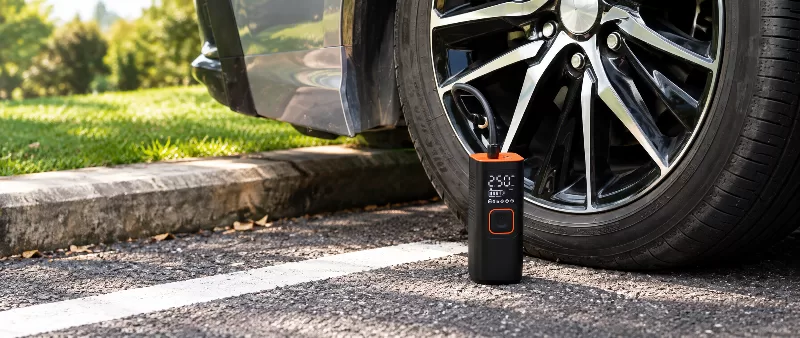
Maintaining correct tire pressure is one of the most effective ways to preserve vehicle safety, optimize fuel efficiency, and extend tread life. For decades, drivers and cyclists relied on clumsy manual floor pumps or awkward station compressors that demanded loose coins and patience. The emergence of the modern portable electric tyre pump has transformed this chore into a quick, push-button procedure. Whether addressing seasonal pressure drops in a family car, dialing in gravel bike tires before a ride, or tackling an unexpected emergency roadside top-up, choosing a capable cordless inflator requires an understanding of pneumatic mechanics, battery architectures, and practical duty cycles.
Understanding the Portable Electric Tyre Pump: Architecture and Working Principles
Miniature air compressors operate on physical principles similar to larger workshop machinery, yet they are packaged into handheld enclosures. Knowing how these devices draw ambient air and build pressure helps users establish realistic performance expectations across diverse inflation tasks.
How Miniature Compressors Generate Pressure
Many portable electric inflators use a motor-driven compression mechanism, but the exact internal architecture varies by model. Ambient air is drawn into an internal chamber through intake pathways and compressed into the delivery hose.
During compression cycles, air volume is forced into the connected tire carcass. Air pressure increases progressively inside the tire as repeated mechanical strokes transfer additional atmospheric mass into a fixed volume.
Because air molecules heat up rapidly when compressed, heat dissipation is an intrinsic engineering consideration. Managing heat around the internal assembly is essential to prevent thermal expansion from degrading internal components during extended run cycles.
Portable Electric Inflators vs. Traditional Workshop Compressors
Workshop compressors generally provide greater air volume and may inflate large tires faster, while portable inflators supply air directly without a large receiver tank. Actual inflation time varies by equipment and tire conditions.
A portable electric tyre pump delivers continuous displacement airflow directly through the delivery hose into the tire stem. While stationary shop compressors rely on large accumulated air reserves, portable models offer self-contained autonomy.
The practical advantage of the portable unit lies in mobile convenience. It eliminates dependence on fixed shop airlines, stationary electrical outlets, or heavy equipment, providing on-demand inflation wherever travel takes you.
Critical Purchase Factors: Evaluating Specifications and Real-World Needs
Selecting an electric inflator requires looking past headline marketing claims and evaluating core mechanical and electrical benchmarks. The relationship between pressure thresholds, volumetric throughput, and electrical energy storage determines practical performance.
Maximum Pressure (PSI) vs. Actual Airflow (L/min)
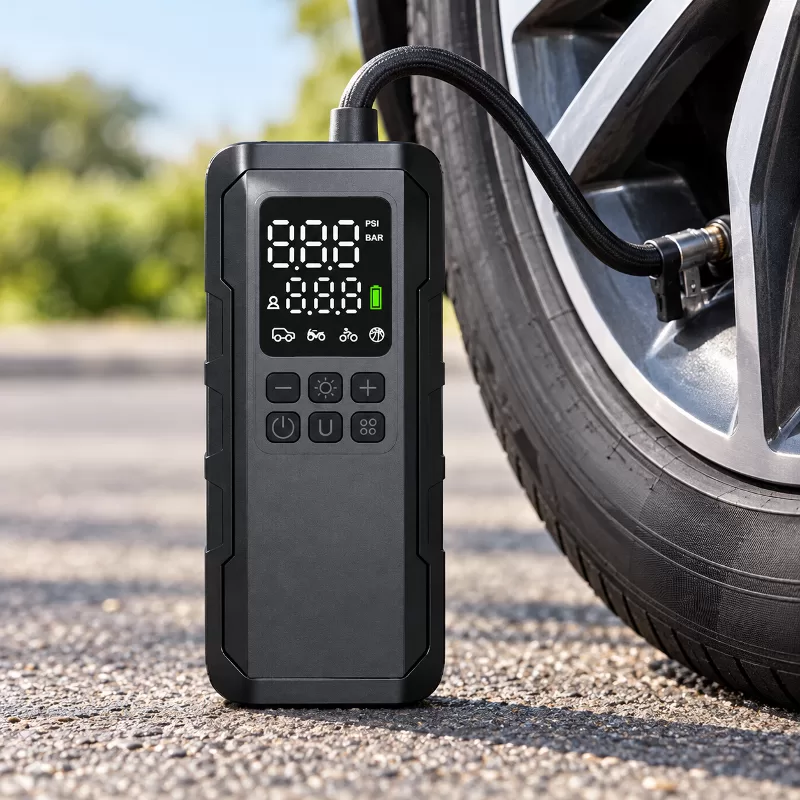
A common misconception among buyers is assuming that higher maximum pressure translates directly into faster tire inflation. Maximum pressure indicates the highest pressure the pump is specified to reach under its test conditions.
- Maximum Pressure Specification: The NW05-P is specified for a maximum pressure of 150 PSI, although users should select an inflator based on the pressure and volume needs of their own equipment.
- Volumetric Airflow Output: Measured in liters per minute (L/min), airflow represents volumetric delivery under given conditions. A higher rated airflow may reduce inflation time, but actual results depend on tire volume, starting pressure, hose losses, and operating conditions.
- Working Load Realities: Higher-pressure inflation generally places greater load on the pump and can reduce practical airflow. Large vehicle tires also require moving more total air, so actual inflation time depends on both target pressure and tire volume.
Battery Architecture, Runtime, and Thermal Management
Cordless convenience depends heavily on internal battery specifications and thermal resilience. Compact inflators integrate multi-cell battery packs to deliver consistent operating power under mechanical load.
The product lists a 2600mAh × 3 battery configuration rated at 11.1V and 28.86Wh. The product lists battery protection voltage values of 12.6V and 9V.
The NW05-P is specified with a runtime of approximately 15 to 18 minutes. Actual operating time depends on load, pressure, temperature, battery condition, and the manufacturer’s duty-cycle instructions.
Dual Power Flexibility: Cordless Freedom vs. 12V Auxiliary Direct Power
Rechargeable batteries can lose charge during storage, especially under unsuitable temperature conditions. The NW05-P also supports 12V–14V vehicle power, providing an alternative power source when that feature is available and connected as instructed.
Dual-power configurations support everyday cordless maintenance while providing auxiliary power flexibility during roadside travel.
Modern platforms also incorporate Type-C charging inputs compatible with standard USB charging sources, accompanied by secondary 5V/1.5A power-bank outputs suitable for charging mobile devices during outdoor outings.
Digital Pressure Monitoring and Automatic Shut-Off
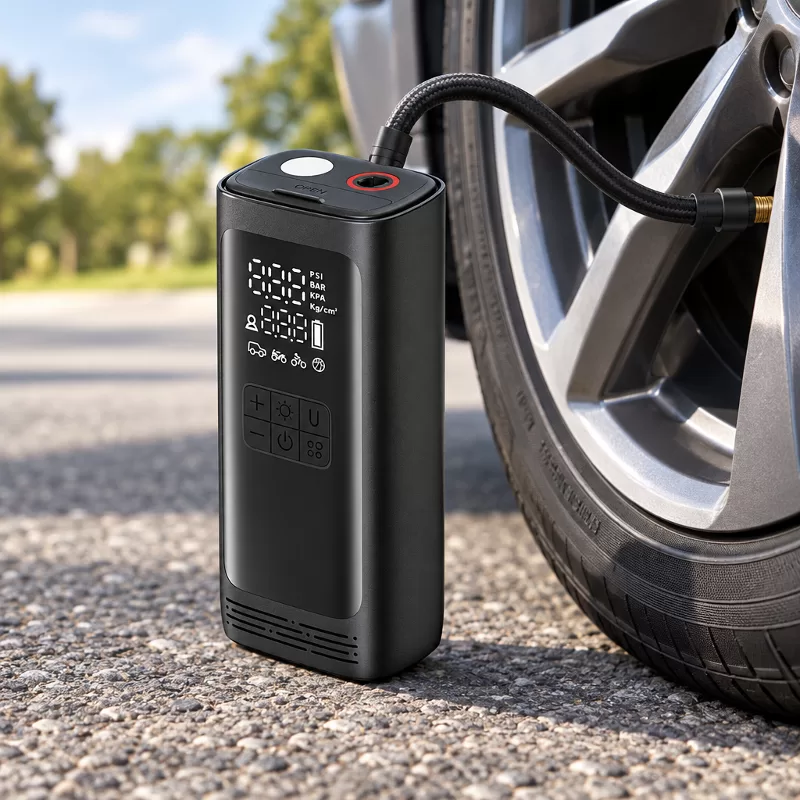
Mechanical dial gauges can be vulnerable to vibration and parallax viewing errors. Digital pressure displays provide clear numerical readouts of detected pressure levels.
The NW05-P uses an LED display, custom pressure settings, and auto shut-off to help users monitor and control inflation. Confirm the final pressure after inflation rather than assuming that cutoff guarantees a perfect reading.
An automated shut-off function helps simplify routine inflation. It stops the motor when the designated pressure value is reached, reducing the need for constant manual monitoring.
Technical Spotlight: NW05-P Portable Electric Tire Pump
When engineering mobile pneumatic tools, achieving an effective balance between mechanical air displacement, overall physical dimensions, and battery life requires deliberate structural choices. The NW05-P portable electric tire pump provides a clear benchmark for what modern compact platforms can deliver.
Engineering Highlights: 26-Cylinder Design and 120W Motor
The NW05-P uses a 26-cylinder structure and 120W working power. According to the supplied product specifications, it delivers an airflow rate of 34 to 36 L/min.
The mechanical assembly operates across an adjustable working pressure range from 2 to 150 PSI, with an operating temperature window between -10°C and 45°C. The product manages operational sound to 85dB or below at a distance of one meter.
The product lists a 2600mAh × 3 battery configuration rated at 11.1V and 28.86Wh, with an advertised runtime of approximately 15 to 18 minutes per charge. The manufacturer lists an inflation capacity of about 30 mountain-bike tires per full charge; actual capacity varies with tire size, starting pressure, temperature, and battery condition.
Complete Technical Specifications
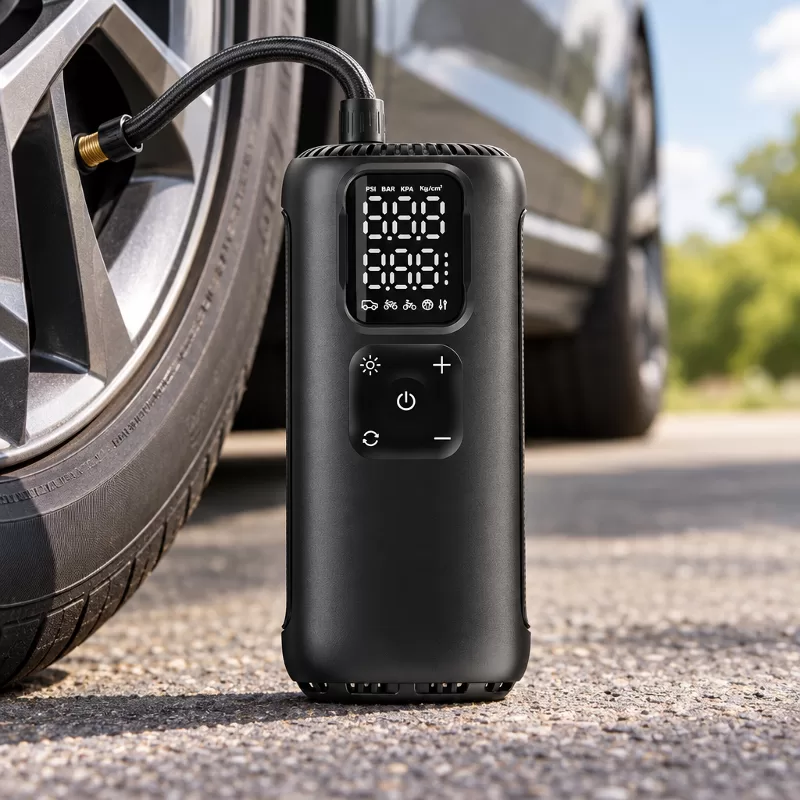
The following technical matrix details the engineering and hardware parameters of the NW05-P portable electric tire pump:
| Technical Parameter | Specification / Metric Value |
|---|---|
| Model Designation | NW05-P |
| Product Classification | Portable Electric Air Pump |
| Cylinder Architecture | 26-cylinder structure |
| Motor Rated Power | 120W |
| Pressure Range | 2 to 150 PSI |
| Volumetric Air Flow | 34 to 36 L/min |
| Battery Capacity | 2600mAh × 3 (11.1V, 28.86Wh) |
| Battery Protection Voltage | 12.6V / 9V, as specified by the manufacturer |
| Battery Cycle Life | 300 cycles (at ≥80% original capacity) |
| Charging Time | 2.5 to 3.5 hours |
| Charging Input | 5V / 2A, 9V / 1.5A (Type-C) |
| Power-Bank Output | 5V / 1.5A |
| Auxiliary Vehicle Power | 12V to 14V cigarette-lighter direct input |
| Maximum Runtime | Approximately 15 to 18 minutes |
| Inflation Capacity | Approximately 30 mountain-bike tires per charge |
| Operating Temperature | -10°C to 45°C |
| Operating Acoustic Noise | ≤85dB at 1 meter |
| Product Dimensions | 130 × 112 × 56 mm |
| Net Weight / Gross Weight | 650g / 978g |
Application Scenarios
The broad pressure baseline and versatile power management of the NW05-P support a wide variety of personal mobility and recreational demands:
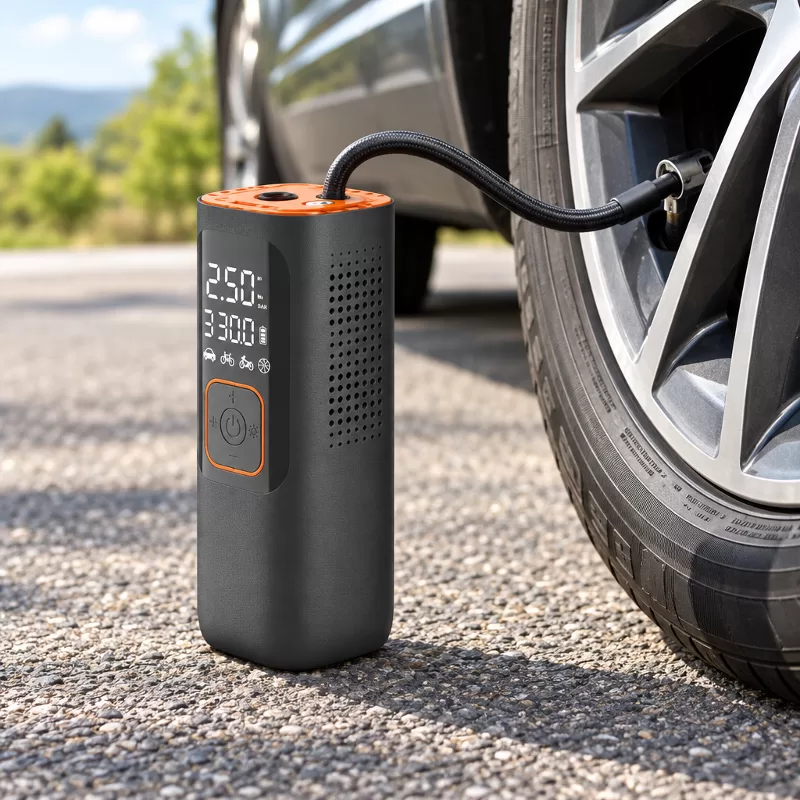
- Automotive Routine Upkeep: Topping up passenger car tires during scheduled monthly checks, regional road trips, and cold-weather pressure dips.
- Emergency Roadside Use: Restoring safe driving pressure following slow valve leaks or temporary pressure loss, within safe operating limits.
- Bicycles and Performance E-Bikes: Setting target pressures on commuter bicycles, e-bikes, and mountain bikes; preset modes are starting points, so always verify target values against equipment specifications.
- Motorcycles and Scooters: Maintaining responsive contact patches on high-load touring motorcycles, scooters, and lightweight mopeds.
- Specialized Wheelchairs and Balance Vehicles: Ensuring consistent rolling efficiency and stability for daily mobility equipment and personal transport devices.
- Sports and Leisure Equipment: Rapidly inflating basketballs, soccer balls, and athletic equipment using customized low-pressure presets.
Step-by-Step Selection Decision Framework
Selecting the right inflation tool requires matching hardware capabilities with your specific equipment profile. Following an organized evaluation sequence helps avoid underpowered or overly cumbersome inflators.
- Evaluate Volume Demands Against Airflow Capacity: If the pump will reside in a vehicle to service wide automotive tires, prioritize models with strong airflow ratings (such as 34 to 36 L/min) to complete pressure top-offs in a practical timeframe.
- Confirm Valve Connector Compatibility: Before purchase, verify which valve connectors and accessories are included, especially if you need Schrader, Presta, or sports-ball compatibility.
- Assess Secondary Power Redundancy: For frequent road trips or rural driving, choose a platform that combines internal battery power with an auxiliary 12V to 14V vehicle socket input to eliminate cold-weather battery drainage surprises.
- Check Physical Enclosure Constraints: Check the actual dimensions and 650g net weight against your intended storage location, such as a vehicle compartment, motorcycle storage area, or cycling bag.
Safe Operating Protocols and Field Best Practices
Even an advanced digital inflator requires careful operation to ensure personal safety, accurate pressure readings, and prolonged equipment lifespan.
Pre-Inflation Inspection: Finding the Manufacturer Cold PSI
Tire pressure must always be measured when tires are cold, meaning the vehicle has been stationary for at least three hours or driven less than one mile at moderate speed. Driving generates friction that heats the trapped air, producing elevated readings.
Always locate the vehicle manufacturer’s target pressure on the tire information placard fixed to the driver-side doorjamb or in the owner’s manual. Never use the maximum cold inflation pressure printed on the tire sidewall itself.
That sidewall number represents the extreme structural limit of the tire casing under maximum allowable load, not the engineered balance of traction, braking distance, and ride comfort designed by the vehicle manufacturer.
Operational Safety: Heat Cycles and Pressure Monitoring
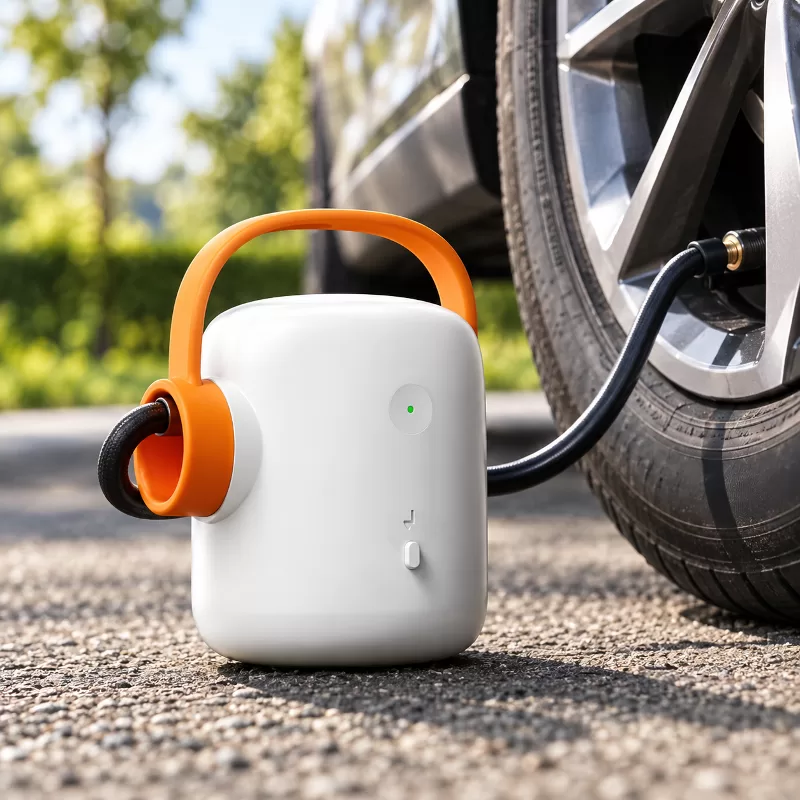
Begin by attaching the air hose firmly onto the tire valve stem. Listen carefully for any hissing sounds that indicate an incomplete seal, which can skew digital pressure readings and allow air to escape.
Select the proper operating preset or set your custom target value. Preset modes are starting points; always verify the target pressure against the vehicle, tire, bicycle, wheelchair, or equipment manufacturer’s recommendation. Confirm your vehicle’s specified cold inflation value, verify the air line remains straight without tight kinks, and switch on the compressor motor.
Keep hands clear of the hose connector during and immediately after operation because the pump, hose, or connector may become hot during extended inflation.
Follow the product manual’s duty-cycle instructions, stop if the unit becomes excessively hot, and allow it to cool fully before continuing to service additional tires.
Post-Inflation Procedure and Safe Stowage
When the auto shut-off stops inflation at the target pressure, power down the main switch before unscrewing the chuck. Disconnect the fitting cleanly to minimize pressure bleed from the valve core.
Reinstall the valve cap to help keep dirt and moisture away from the valve core. While the valve core maintains internal tire pressure, the exterior cap prevents debris from contaminating internal sealing surfaces.
Store the inflator inside a protective case away from direct sun exposure and extreme cabin heat. For inflators kept in vehicle trunks, inspect the battery status periodically and recharge it to maintain cell longevity.
Comparative Overview: Electric Inflators vs. Alternative Solutions
Understanding how portable electric inflators compare against older mechanical alternatives illustrates why digital air pumps have become central to modern emergency travel gear.
| Inflation Method | Inflation Speed | User Effort Required | Pressure Monitoring | Portability & Stowage |
|---|---|---|---|---|
| Portable Electric Inflator | Rated airflow: 34–36 L/min; actual speed varies | Push-button automated operation | Digital display with auto shut-off; accuracy depends on device and conditions | Compact handheld design, ~650g net weight |
| Manual Floor Pump | Moderate; depends on manual stroke volume | High; demands sustained physical pumping | Analog dial gauge reading | Moderate; rigid barrel and handle geometry |
| 12V Corded-Only Compressor | Moderate to Fast depending on motor size | Low; powered via vehicle auxiliary socket | Dial or digital readout | Moderate; requires managing connection cords |
| CO2 Gas Cartridge | Rapid single-use inflation; time varies by cartridge, tire volume, and target pressure | Minimal trigger actuation | Manual check required; no automatic shut-off | Ultra-compact single-use metal canisters |
Hand and Floor Pumps vs. Electric Tyre Pumps
Manual floor pumps are reliable tools that require no electrical charge, making them durable fixtures in home bicycle workshops. However, pumping an automotive tire back up to recommended pressure by hand requires hundreds of strenuous strokes.
In rainy, cold, or dark roadside conditions, physical exhaustion combined with awkward footing creates unnecessary hazards. A portable electric tyre pump eliminates physical strain entirely, delivering precise pressure while the user remains safely positioned away from traffic.
12V-Only Corded Compressors vs. Dual-Power Battery Inflators
A corded inflator requires access to a suitable vehicle socket and enough cable length to reach the tire. Check the supplied cable length before relying on it for trailers or equipment away from the vehicle.
Dual-power platforms resolve this reach constraint by offering cordless freedom for daily checks, while retaining a 12V auxiliary vehicle input as an emergency power alternative.
CO2 Cartridge Inflators vs. Rechargeable Battery Units
CO2 cartridges provide a limited, single-use inflation source popular for rapid cycling repairs. If an adapter threads on crookedly or an inner tube pinches during inflation, the cartridge is spent, leaving the rider stranded without secondary options.
For tubeless tires, follow the sealant manufacturer’s guidance because CO2 may adversely affect some sealants. A rechargeable inflator allows repeated attempts, draws atmospheric air, and avoids dependence on disposable single-use canisters.
Dedicated Engineering for Modern Pneumatic Demands
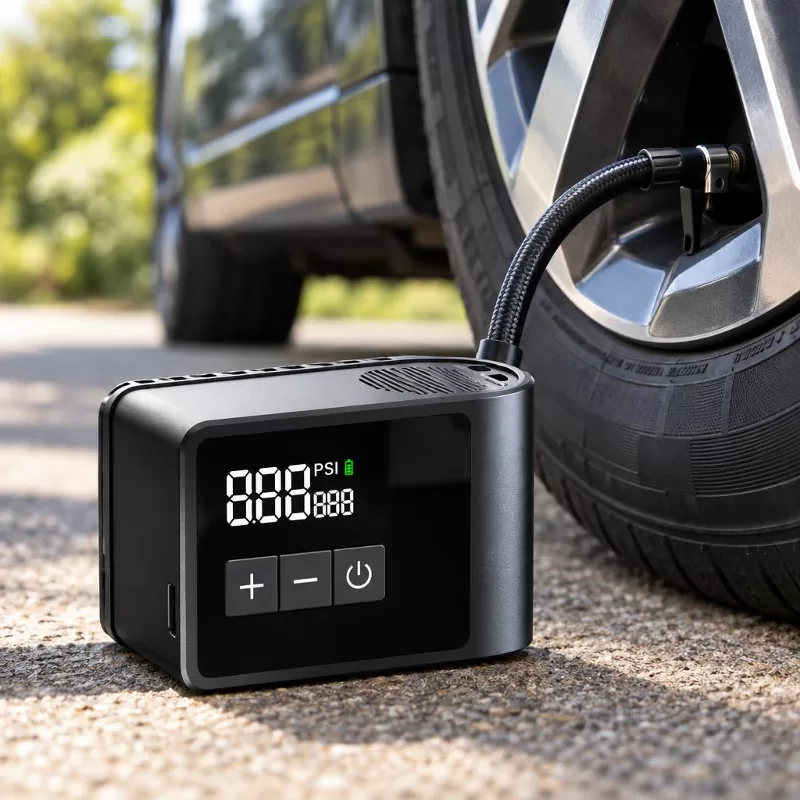
At Newo, we focus on pneumatic research, engineering development, and the manufacturing of smart electric air pumps and mobile inflation equipment. Drawing on our background in pneumatic mechanics and product design, for us the goal is to build dependable solutions spanning portable tire inflators, electric bike pumps, automotive air devices, sports ball inflators, and outdoor gear.
Our manufacturing operations, development engineers, and quality inspection protocols help create high-performance inflation products that deliver convenience and reliability for clients worldwide. By combining compact pump structures with digital controls, portable inflators provide a practical alternative to larger workshop equipment.
Frequently Asked Questions (FAQs)
How many car or bike tires can a portable electric tyre pump inflate on a single charge?
Inflation capacity depends directly on the tire’s internal air volume and the starting pressure. The manufacturer lists an inflation capacity of about 30 mountain-bike tires per full charge; actual capacity varies with tire size, starting pressure, temperature, and battery condition.
When topping up automotive tires—such as adjusting a passenger car tire from slightly low pressure back to factory cold specification—a fully charged unit can typically service several tires before requiring a recharge, depending on battery state and ambient temperature.
Can a portable electric tyre pump inflate a completely flat tire on the road?
It may restore pressure when the tire remains seated on the wheel rim and has no severe structural damage, but it is not guaranteed to reseat an unseated tire bead or make a compromised tire safe to drive on.
If the tire bead has separated from the wheel rim or the sidewall has suffered cuts, roadside inflation will not resolve the underlying failure. Do not drive on a tire that may have sustained internal structural damage.
Does a 150 PSI pump run hot during operation, and how should it be cooled?
Compressing atmospheric air concentrates thermal energy inside the internal cylinder, causing the compressor housing and the air hose connector to warm up during extended use. This is a normal physical result of air compression rather than an electrical fault.
To ensure long-term equipment reliability, follow the product manual’s duty-cycle instructions, stop if the unit becomes excessively hot, and allow it to cool fully before continuing.
Why is cold tire pressure reading recommended over warm tire pressure?
Driving can raise tire pressure by several PSI; the exact change varies with temperature, speed, load, and driving duration. Do not bleed air from a hot tire simply to reach the cold placard value.
If you set a warm tire only to the cold placard value, its pressure may fall below the recommended cold value after cooling. If a warm tire is visibly or significantly underinflated, follow the vehicle manufacturer’s guidance, then recheck it when cold.
Can the NW05-P pump run directly from a 12V car socket if the battery is empty?
The product specifications state that it supports 12V to 14V cigarette-lighter power, which may provide an alternative power source when the internal battery is depleted. Confirm the supplied cable and operating instructions before relying on this feature.
This auxiliary input offers helpful versatility during roadside emergencies, supplementing the unit’s standard rechargeable Type-C charging port.
Does an electric tyre pump replace the need for roadside puncture repair?
An inflator can provide temporary mobility, but it does not repair a puncture. Do not treat an external plug or sealant as a permanent repair; follow the tire manufacturer’s instructions and have the tire inspected by a qualified tire professional. Damage outside the repairable tread area may require replacement.
For an eligible passenger or light-truck puncture, industry guidance calls for removing the tire for inspection and using a plug-and-patch or approved combination repair. Repairability depends on the tire manufacturer’s limits, puncture size, and location.
Safe Driving Through Dependable Inflation
Tire pressure maintenance should not be an afterthought left for sporadic service station visits. Carrying a reliable, precision-engineered portable electric tyre pump provides the peace of mind that comes with complete roadside independence. By understanding the mechanical differences between airflow and pressure ratings, adhering to cold inflation guidelines, and utilizing versatile dual-power configurations, drivers and outdoor enthusiasts can protect their equipment, boost efficiency, and travel with confidence.
-

Meet NEWO at the 140th Canton Fair: Visit Booth 10.3 M03–04
Meet NEWO at the 140th Canton Fair in Guangzhou, October 15–19, 2026. Visit Booth 10.3 M03–04 to explore portable air pumps and discuss OEM, ODM and distribution opportunities.... -

As Shenzhen Welcomes the World for APEC 2026, NEWO Welcomes You to Our Factory
As Shenzhen prepares for APEC 2026, NEWO welcomes international buyers and partners to visit our factory, meet our team and explore future cooperation.... -

Leading the Way in Product Innovation and Excellence
Smartnewo exemplifies professionalism in product innovation and manufacturing. Their collaboration with Xiaomi Youpin on the G01 crowdfunding project highlights their expertise in creating compact, powerful inflatable pumps. Rigorous engineering, meticulous production processes, and advanced quality assurance underscore their commitment to excellence. The success of the G01 project, with significant market... -

Essential Qualities of an Excellent Supplier
In today's competitive market, finding a reliable supplier is crucial for business success. Based on insights from Smartnewo and broader internet research, here are key qualities an excellent supplier must possess:... -

NW06 Tire Inflator: Compact Power for Quick Inflation
Summary The NW06 Tire Inflator delivers quick and efficient tire inflation with a powerful 35L/min airflow. It features a user-friendly LCD screen for real-time pressure monitoring, dual power options with a built-in 6000mAh battery, and multiple nozzle attachments for versatile use. Its compact design and integrated LED light ensure convenience and... -

Unleash the Power of Portability: The SmartNewo Jump Starter with Air Compressor KF03
This guide will walk you through the steps to effectively use a portable tire inflator, helping you stay prepared and safe on the road.... -

Newo Attends The 2024 Consumer Electronics Show (CES)
Smartnewo booth is located at 53672, Halls A-D, Level 2, Venetian Expo, Las Vegas Convention Center (LVCC). ... -

Smartnewo’s Dual-Cylinder Air Pump Rocks the Hong Kong Autumn Electronics Fair!
Smartnewo’s Dual-Cylinder Air Pump Rocks the Hong Kong Autumn Electronics Fair!... -

Meet at the Canton Fair! Smartnewo brings dual-cylinder air pumps, making your inflation experience faster and more stable!
NEWO has went deep communication and negotiation with customers from all over the world on booth.... -

“Hong Kong Autumn Electronics Fair – 1CA18 (October 13th to 16th): Smartnewo invites you to visit our booth!
Hong Kong Autumn Electronics Fair...










-

What to Check Before Ordering Custom Electric Bike Pumps
Plan custom electric bike pumps with a clear requirements freeze for valves, TPU tubes, portability, repeated top-ups, charging, and model-specific documents.... -

OEM vs ODM Air Pumps: Which Manufacturing Model Fits Your Brand?
Compare OEM and ODM air pump projects by design responsibility, change approval, development scope, and written ownership terms before choosing your route.... -
How to Choose a Reliable Tire Inflator Manufacturer in China
Choose a tire inflator manufacturer in China with a focused RFQ, supplier evidence, configuration checks, and clear sample-to-pilot decisions for your brand.... -

Rechargeable Electric SUP Pump for Paddle Boards: Faster Inflation for SUPs, Kayaks and Inflatable Tents
The BL10-C Portable Electric Bike Tire Inflator is a compact and lightweight mini electric bike pump designed for modern cyclists. With up to 120 PSI pressure, a digital LED display, preset pressure control, automatic shut-off, USB-C charging, and multiple valve adapters, BL10-C offers a convenient inflation solution for road bikes,... -

Are Electric Bike Pumps Worth It in 2026? Electric Pump vs CO₂ vs Mini Hand Pump
Discover whether electric bike pumps are worth it in 2026. This guide compares electric bike pumps, CO₂ inflators, and mini hand pumps for road cycling, gravel riding, commuting, and long-distance rides. Learn the pros, limitations, best use cases, and key features to look for before choosing the right portable tire... -
BL10-C Portable Electric Bike Tire Inflator: Small Size, Reliable Power for Every Ride
The BL10-C Portable Electric Bike Tire Inflator is a compact and lightweight mini electric bike pump designed for modern cyclists. With up to 120 PSI pressure, a digital LED display, preset pressure control, automatic shut-off, USB-C charging, and multiple valve adapters, BL10-C offers a convenient inflation solution for road bikes,... -

Why Mini Electric Bike Pumps Are Becoming Essential for Modern Cycling
Discover why mini electric bike pumps are becoming essential for modern cyclists. Learn how portable electric bike pumps improve tire pressure management, riding safety, and convenience.... -

The Ultimate Smart Solution for Easy Outdoor Adventures in 2026
Discover how a spring travel air pump simplifies outdoor trips with fast inflation, smart features, and powerful performance—perfect for every adventure.... -

Powerful 5-in-1 Portable Car Tire Inflator and Jump Starter: The Ultimate Emergency Tool for Every Driver
Why Every Driver Needs a Portable Car Tire Inflator and Jump Starter Modern drivers face many unexpected situations on the road. A flat tire, low tire pressure, or a dead car battery can happen at the worst possible time. That’s why having a portable car tire inflator and jump starter is... -

7 Real Cycling Scenarios That Show Why Every Rider Should Carry a Mini Bike Pump
Cycling is one of the most freeing activities you can enjoy. Whether you’re commuting to work, riding through city streets, or exploring quiet countryside roads, a bike ride can instantly improve your day. But there’s one small problem that almost every cyclist eventually faces: Low tire pressure. It might happen...








-
How Is a Football Properly Inflated?
The correct inflation of a football - with not too much and not too little air - is a hotly debated topic among footballers.... -
Application Scenarios of Car Inflator Pump
Often long-distance business trips or play car owners because the road may be more remote areas, in this case if you encounter a tire leak....

