

 Portable Tire Inflators
 Electric Air Pumps
 Electric Car Tyre Pumps
 Electric Ball Pumps
 Electric Bike Pump
 SUP Air Pump

Air Pump for Car Portable: Technical Guide to Cordless Inflation, Engineering Specs, and Safe Roadside Operation
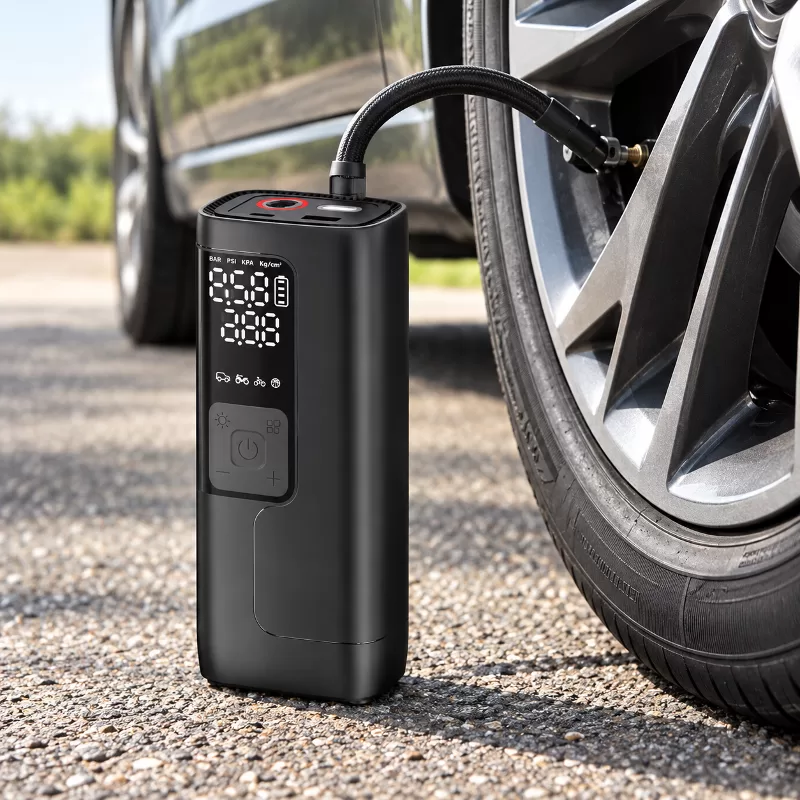
Maintaining correct tire pressure remains a cornerstone of road safety, fuel efficiency, and tread longevity. When drivers search for an air pump for car portable setup, they often need a reliable tool to resolve sudden pressure loss or seasonal drops without relying on gas station equipment. Carrying a compact compressor in your vehicle ensures independence, yet selecting the right device requires understanding volumetric flow, thermal boundaries, and mechanical construction.
A compressor forces ambient air through the valve into the tire-and-wheel assembly. Compression and motor operation generate heat, especially at higher pressures and during extended use. Selecting an inadequate unit leads to premature motor burnout or prolonged roadside wait times, whereas a well-engineered tool handles emergency top-ups smoothly.
Search Intent and Real-World Requirements for Drivers
Core Drivers Behind the Search for a Portable Air Pump
Motorists looking for a portable tire inflator typically face immediate or preventative needs. Commuters encounter low-pressure warnings on dashboard displays during sudden temperature shifts, while road-trippers seek self-sufficiency in remote areas lacking service infrastructure.
A quality pump must deliver adequate pressure tolerance, steady airflow, and dependable battery stamina. Understanding these operational parameters prevents purchasing an inflator that struggles on standard passenger vehicles.
The Engineering Reality of Compact Inflation
A portable car tire inflator compresses ambient air and forces it through the Schrader valve into the tire’s internal air cavity. It is crucial to recognize that an air pump is not a puncture repair kit; it cannot mend ruptured internal belts, seal nail penetrations, or seat damaged beads on a rim.
Instead, it provides calibrated pneumatic volume to compensate for gradual air loss through tire materials, valves, or minor leaks until professional inspection is accessible. Recognizing these boundaries ensures safer equipment handling under stressful travel conditions.
Technical Criteria for Selecting a Portable Car Tire Inflator
Volumetric Airflow Versus Peak Pressure Ratings
Retail descriptions frequently highlight impressive maximum pressure ratings, such as 150 PSI, yet high pressure alone does not equate to rapid air delivery. Maximum pressure describes the highest stated pressure capability, while airflow and real inflation performance depend on load, tire volume, and operating conditions.
Moving substantial air volume through miniature cylinder sleeves demands torque and effective heat dissipation. When a pump operates against higher backpressures, motor load climbs rapidly, elevating internal temperatures.
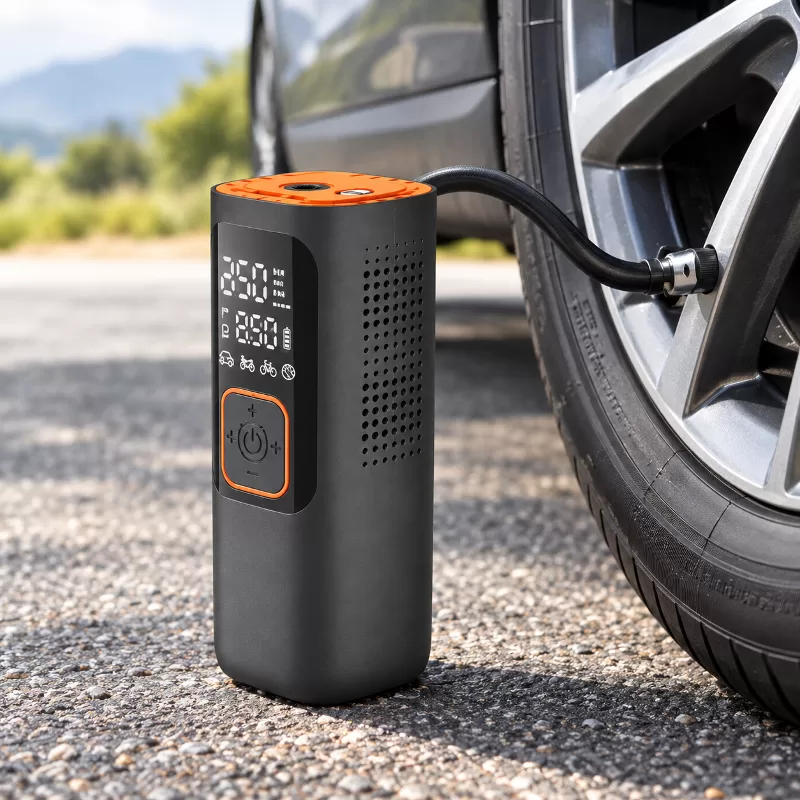
Evaluating pumps strictly by peak PSI is comparable to judging an automobile engine solely by top speedometer marking rather than usable torque. Actual inflation time depends on tire volume, starting pressure, hose and valve losses, battery condition, and the pump’s airflow under load rather than free-air ratings alone.
Cordless Lithium Packs Versus 12V Auxiliary Direct Cords
The debate between battery-powered inflators and hardwired 12V auxiliary vehicle accessories centers on deployment speed versus runtime continuity. Battery-powered units eliminate tangling power cords around wheels, allowing swift access to all four corners of a vehicle.
Rechargeable battery performance and service life can be affected by prolonged exposure to extreme heat or cold. Store and charge the pump according to the manufacturer’s temperature guidance. Conversely, a 12V cord avoids depletion of the inflator’s internal battery, but it draws power from the vehicle and may discharge the vehicle battery if used with the engine off. Follow the vehicle and pump instructions.
The NW08 is specified with a 44.4 Wh battery pack, 100 W working power, and a listed runtime of 12 to 15 minutes. Actual operating time depends on pressure, tire volume, temperature, and load.
Digital Precision, Preset Thresholds, and Automatic Cut-Off
Analog pressure dials frequently suffer from parallax error and mechanical needle drift caused by compressor vibration. In contrast, digital pressure sensors estimate the pressure in the connected air path and show the reading directly on the display.
Because no accuracy tolerance is provided here, users should confirm critical readings with a reliable tire gauge. Integrated controllers monitor pressure levels during active operation, shutting off drive power once target values match pre-programmed thresholds to help avoid accidental over-pressurization.
Technical Evaluation: Compact Air Pump for Car 150PSI NW08
Documented Technical Specifications
For users requiring a dependable air pump for car portable application, examining concrete engineering specifications provides clear insight into field readiness. The NW08 compact electric air pump is designed for SUVs, off-road vehicle tires, passenger cars, motorcycles, e-bikes, and sporting equipment.
| Engineering Specification | Documented Parameter | Operational Significance |
|---|---|---|
| Working Pressure Range | 2 to 150 PSI | Covers low-pressure inflatables up to high-pressure cycle tires |
| Air Flow | 32 L/min | Published airflow rating; real delivery may vary with pressure, hose, valve, and operating conditions |
| Working Power | 100 W | Documented operating power during inflation cycles |
| Cylinder Architecture | Dual 24-cylinder structure | Stated mechanical architecture per product documentation |
| Internal Battery Pack | 3 × 4000 mAh (11.1 V, 44.4 Wh) | Published battery capacity and voltage |
| Runtime Window | 12 to 15 minutes | Listed operating runtime duration per product specification |
| Power Input Interface | Type-C (up to 20V / 3A) | Supports direct charging through a Type-C connection |
| Auxiliary Power Output | Up to 20V / 2A via Type-C | Documented power-bank output via C-to-C connection |
| Acoustic Noise Emission | ≤ 85 dB at 1 meter | Operational decibel output under active pumping load |
| Dimensions and Mass | 185 × 96 × 63.6 mm; 1035 g | Compact handheld footprint for glovebox or trunk storage |
| Operating Temperature | -10°C to 45°C | Published working-temperature range; follow separate manufacturer guidance for storage and charging |
All parameters listed above derive strictly from published manufacturer technical specifications, illustrating how mechanical packaging influences portable utility.
Mechanical Architecture and Air Delivery
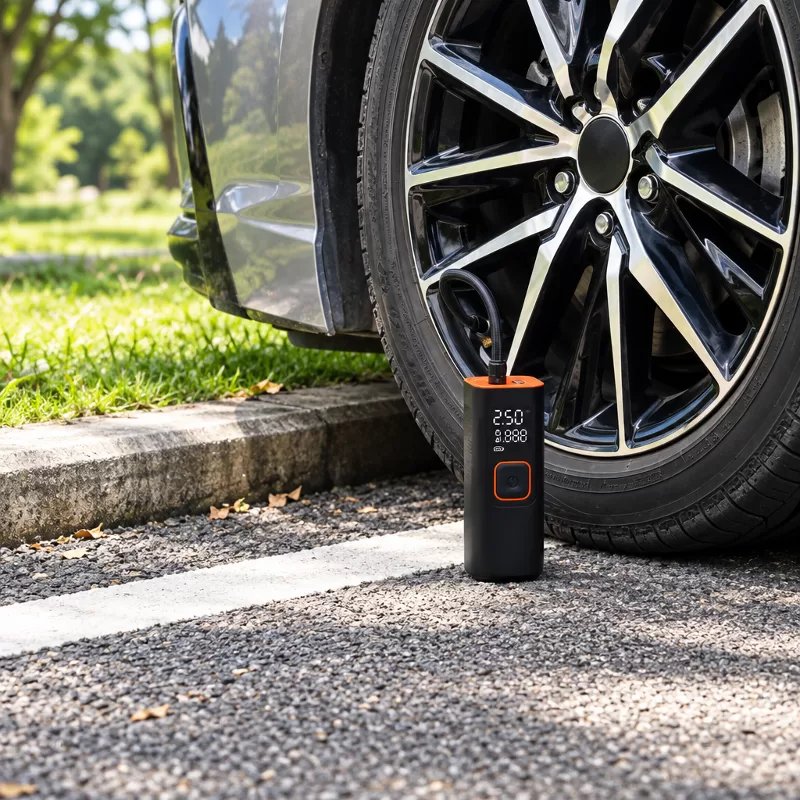
The manufacturer specifies a dual 24-cylinder structure and 100 W working power, delivering a published airflow rating of 32 L/min. The supplied documentation does not provide further internal mechanical details regarding crankpin layout or piston arrangements.
The product is specified at 185 × 96 × 63.6 mm and 1035 g, giving it a compact format for portable storage. The supplied documentation does not provide further details about internal component packaging or handling stability.
Thermal Constraints and Duty Cycles
Thermodynamics governs every air compressor regardless of physical footprint; compressing air releases energy as thermal waste inside the cylinder head. Operating the pump beyond the manufacturer’s stated limits can increase heat and may reduce reliability. Because the supplied specifications do not define a cooling schedule, users should follow the instructions provided with the specific unit.
The product specification lists a runtime of 12 to 15 minutes. Keep the housing ventilation openings unobstructed and follow the manufacturer’s operating guidance to assist normal thermal dissipation.
Practical Operating Instructions: Step-by-Step Roadside Use
Pre-Inflation Safety Inspection and Setup
Safe tire servicing begins with establishing a secure physical environment, especially during highway breakdowns or rural travel emergencies. Never compromise situational awareness for equipment operation.
- Steer the vehicle fully off the active roadway onto flat, level, load-bearing ground away from moving traffic.
- Select Park for an automatic transmission or neutral for a manual transmission, apply the parking brake firmly, and follow the vehicle owner’s manual while activating hazard flashers.
- Open the driver-side door and locate the vehicle placard on the B-pillar to identify the precise cold inflation pressure rating.
- Examine the tire tread and sidewalls for physical gashes, protruding cords, or structural blisters; do not pressurize compromised casings.
- Confirm your portable inflator has sufficient battery capacity indicated on its screen before threading hoses.
Connecting, Setting, and Running the Inflator
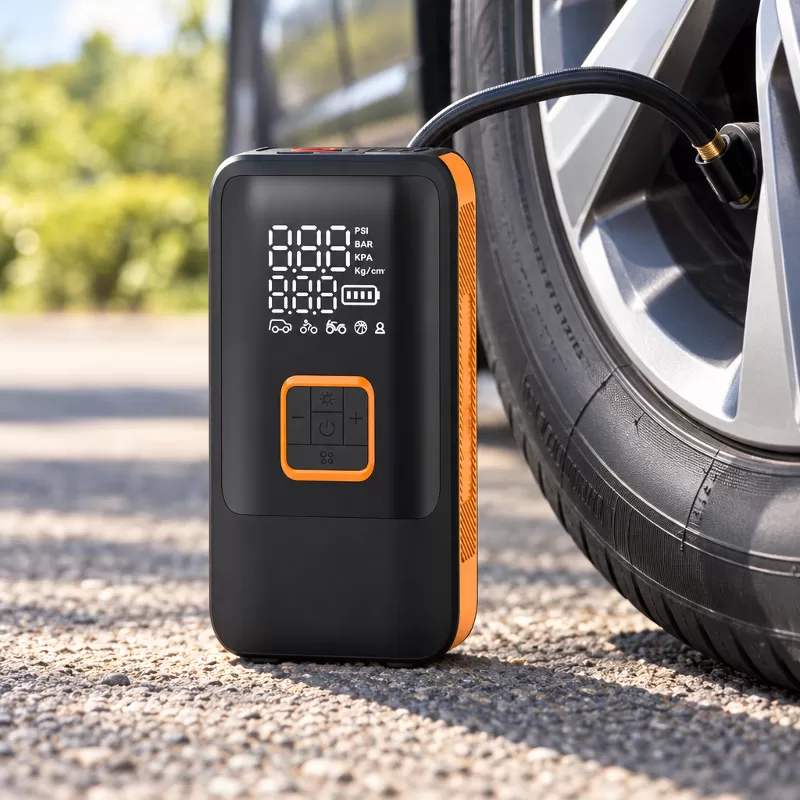
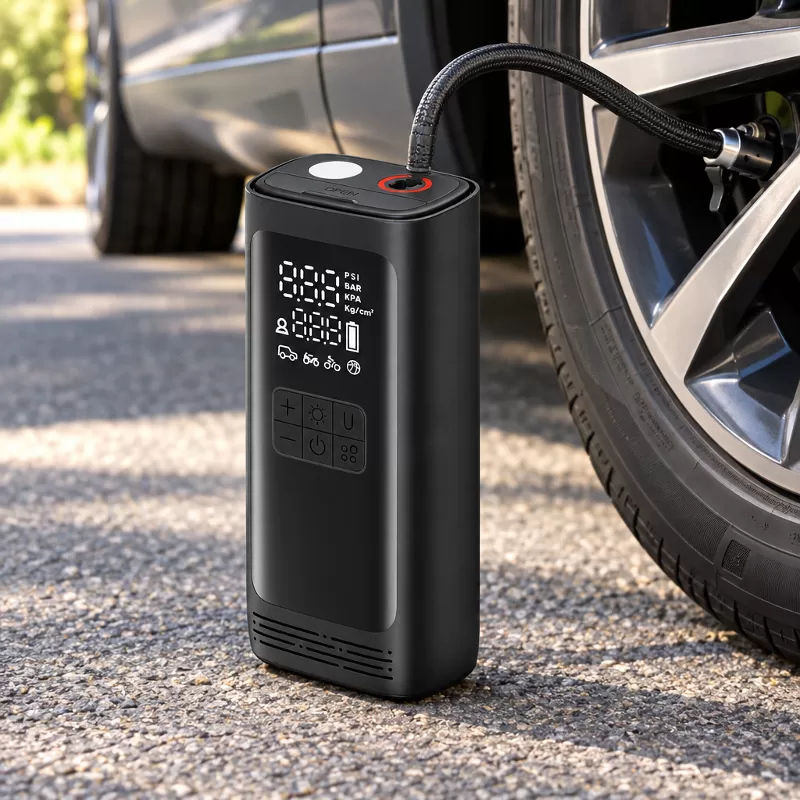
- Remove the threaded valve dust cap and secure the inflator’s air hose chuck squarely onto the tire valve stem without cross-threading.
- Power on the unit and observe the initial pressure shown on the digital display to estimate the tire’s current inflation pressure.
- Select the pressure unit shown on the vehicle placard, then set the target pressure manually or use the appropriate documented preset.
- Treat the display as an operating aid and verify important readings with a reliable gauge.
- Press the activation switch to begin compression, staying beside the wheel to monitor vibration and hose stability.
- Allow the automatic shut-off mechanism to halt operation once the target pressure threshold is satisfied.
- Unthread the hose briskly to minimize air escape, verify the valve pin sits flush, and replace the protective dust cap.
Critical Mistakes to Avoid During Purchase and Field Operation
Buying Based Solely on Maximum Pressure Figures
Many consumers mistakenly believe that a 150 PSI label implies rapid filling speed across all automotive applications. High maximum PSI indicates the mechanical pressure ceiling before internal motor stalling, not volumetric output.
Actual inflation performance depends on tire displacement, starting pressure, connection losses, and compressor behavior under real counterpressure. Always evaluate motor power, cylinder structure, and airflow ratings alongside peak pressure metrics.
Over-Inflating to Tire Sidewall Thresholds
A persistent driving misconception involves inflating car tires to the maximum pressure stamped along the outer tire bead lettering. That sidewall figure denotes the absolute maximum cold pressure the tire structure can hold under maximum rated load, not the car’s dynamic specification.
Inflating to the sidewall maximum instead of the vehicle placard pressure can alter handling, ride comfort, contact-patch behavior, and tread wear. Always adhere to the vehicle manufacturer placard located on the door jamb.
Neglecting Thermal Rests Between Successive Tires
Running small cordless compressors continuously across multiple flat tires without mandatory cool-down breaks invites equipment breakdown. Friction inside the pump housing rapidly transfers heat toward nearby electrical components.
Allowing the machine to cool between demanding cycles can reduce heat stress. Follow the manufacturer’s operating and rest guidance rather than assuming a specific cooling interval, ensuring consistent operation across seasonal temperature extremes.
Multi-Scenario Applications: Versatility Beyond Passenger Sedans
SUV and Light Crossover Management
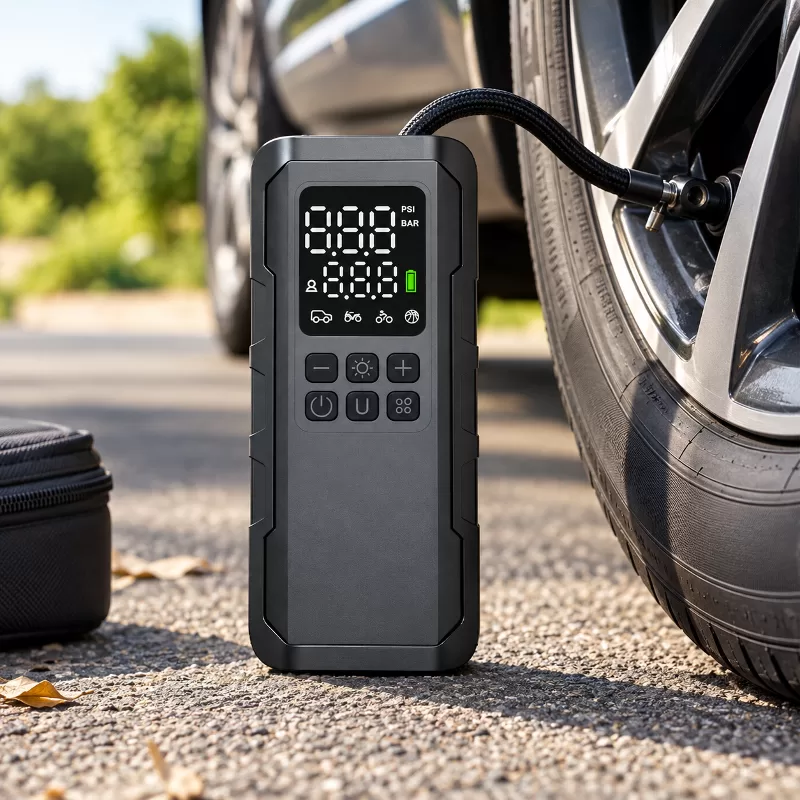
Larger vehicle tires hold considerable air volume even when target operating pressures remain near standard ranges (32 to 36 PSI). Lifting an under-inflated crossover tire demands sustained airflow delivery across continuous runtime.
The NW08 is specified at 32 L/min airflow and is marketed for SUVs, off-road vehicles, and larger car tires. Actual top-up time depends on tire size, starting pressure, and airflow under load.
Two-Wheel Commuting: Motorcycles, E-Bikes, and Bicycles
Motorcycles and high-performance bicycles operate across broad pressure boundaries requiring adaptable coupling mechanisms. Bicycles often demand higher pressures inside narrow volumes, while commuter e-bikes require accurate calibration for battery range.
Bicycle and sports-ball use requires the correct valve or adapter. Confirm which accessories are included with the specific package before purchase to ensure compatibility with Presta valves or needle ports.
Auxiliary Power Capabilities During Travel
Modern road-trip equipment increasingly combines pneumatic functions with emergency power storage for added travel utility. Devices with Type-C charging and power-bank output can provide limited backup power when mobile equipment runs low.
The NW08 is specified for output up to 20V/2A through a C-to-C connection, drawing from its 44.4Wh battery array. While secondary to primary tire maintenance, auxiliary charging provides valuable backup during remote travel.
Newo is a professional manufacturer specializing in the research, development, and production of smart electric air pumps and portable inflation solutions. With strong expertise in pneumatic technology, product design, and manufacturing, we provide a wide range of products, including portable tire inflators, electric bike pumps, car air pumps, ball pumps, and outdoor inflation solutions designed to deliver convenience and reliability for customers worldwide.
Frequently Asked Questions
What pressure setting should I use on my portable car air pump?
Always reference the tire information placard positioned along the driver-side door jamb, B-pillar, or vehicle fuel door. This label lists precise cold inflation pressure engineered for your car’s specific suspension geometry, curb weight, and load rating. Never inflate to the maximum cold pressure molded on the outer rubber sidewall of the tire itself.
Can a 150 PSI portable pump inflate heavy-duty truck or large SUV tires?
The NW08 is specified for SUVs, off-road vehicles, and larger car tires. Do not assume it is suitable for heavy-duty truck tires; confirm tire volume, required pressure, operating limits, and the manufacturer’s application guidance before use.
Does a portable car tire inflator run continuously until all tires are inflated?
The NW08 lists a runtime of 12 to 15 minutes, but the supplied specification does not define the test conditions or required rest intervals. Follow the manufacturer’s operating instructions and stop the unit if it becomes excessively hot.
How does ambient temperature affect portable compressor operation and tire readings?
Tire pressure changes with temperature; a common rule of thumb is about 1 PSI for every 12°F change, although the actual change varies. Check pressure when the tires are cold and follow the vehicle placard. Avoid prolonged exposure to extreme heat, freezing conditions, and direct sunlight, and store and charge the inflator according to the manufacturer’s temperature guidance.
Can I use a car air pump for bicycles and sports equipment?
Portable car inflators accommodate bicycles and athletic equipment when paired with appropriate adapter accessories. The five preset modes and custom pressure setting can help users select an intended target, but users should confirm the correct pressure for the specific bicycle tire or sports equipment. Because valve fittings differ across equipment, verify which adapter accessories come supplied with your unit.
How long does a cordless tire inflator hold its battery charge during trunk storage?
Battery charge decreases during storage, and heat can accelerate degradation. Check the charge periodically and follow the manufacturer’s storage-temperature and charging guidance. Inspecting and recharging your portable tire inflator every few months ensures readiness when unexpected pressure drops occur.
Ensuring Preparedness with the Right Inflation Gear
Selecting a dependable air pump for car portable setup transforms routine tire maintenance from an inconvenient chore into a controlled, proactive habit. Prioritizing verified airflow output, robust battery capacity, sound thermal boundaries, and intuitive digital controls ensures your tool performs reliably during roadside emergencies. Checking cold tire pressures monthly preserves tread life, optimizes fuel consumption, and keeps every journey safe.
-

Meet NEWO at the 140th Canton Fair: Visit Booth 10.3 M03–04
Meet NEWO at the 140th Canton Fair in Guangzhou, October 15–19, 2026. Visit Booth 10.3 M03–04 to explore portable air pumps and discuss OEM, ODM and distribution opportunities.... -

As Shenzhen Welcomes the World for APEC 2026, NEWO Welcomes You to Our Factory
As Shenzhen prepares for APEC 2026, NEWO welcomes international buyers and partners to visit our factory, meet our team and explore future cooperation.... -

Leading the Way in Product Innovation and Excellence
Smartnewo exemplifies professionalism in product innovation and manufacturing. Their collaboration with Xiaomi Youpin on the G01 crowdfunding project highlights their expertise in creating compact, powerful inflatable pumps. Rigorous engineering, meticulous production processes, and advanced quality assurance underscore their commitment to excellence. The success of the G01 project, with significant market... -

Essential Qualities of an Excellent Supplier
In today's competitive market, finding a reliable supplier is crucial for business success. Based on insights from Smartnewo and broader internet research, here are key qualities an excellent supplier must possess:... -

NW06 Tire Inflator: Compact Power for Quick Inflation
Summary The NW06 Tire Inflator delivers quick and efficient tire inflation with a powerful 35L/min airflow. It features a user-friendly LCD screen for real-time pressure monitoring, dual power options with a built-in 6000mAh battery, and multiple nozzle attachments for versatile use. Its compact design and integrated LED light ensure convenience and... -

Unleash the Power of Portability: The SmartNewo Jump Starter with Air Compressor KF03
This guide will walk you through the steps to effectively use a portable tire inflator, helping you stay prepared and safe on the road.... -

Newo Attends The 2024 Consumer Electronics Show (CES)
Smartnewo booth is located at 53672, Halls A-D, Level 2, Venetian Expo, Las Vegas Convention Center (LVCC). ... -

Smartnewo’s Dual-Cylinder Air Pump Rocks the Hong Kong Autumn Electronics Fair!
Smartnewo’s Dual-Cylinder Air Pump Rocks the Hong Kong Autumn Electronics Fair!... -

Meet at the Canton Fair! Smartnewo brings dual-cylinder air pumps, making your inflation experience faster and more stable!
NEWO has went deep communication and negotiation with customers from all over the world on booth.... -

“Hong Kong Autumn Electronics Fair – 1CA18 (October 13th to 16th): Smartnewo invites you to visit our booth!
Hong Kong Autumn Electronics Fair...










-

What to Check Before Ordering Custom Electric Bike Pumps
Plan custom electric bike pumps with a clear requirements freeze for valves, TPU tubes, portability, repeated top-ups, charging, and model-specific documents.... -

OEM vs ODM Air Pumps: Which Manufacturing Model Fits Your Brand?
Compare OEM and ODM air pump projects by design responsibility, change approval, development scope, and written ownership terms before choosing your route.... -
How to Choose a Reliable Tire Inflator Manufacturer in China
Choose a tire inflator manufacturer in China with a focused RFQ, supplier evidence, configuration checks, and clear sample-to-pilot decisions for your brand.... -

Rechargeable Electric SUP Pump for Paddle Boards: Faster Inflation for SUPs, Kayaks and Inflatable Tents
The BL10-C Portable Electric Bike Tire Inflator is a compact and lightweight mini electric bike pump designed for modern cyclists. With up to 120 PSI pressure, a digital LED display, preset pressure control, automatic shut-off, USB-C charging, and multiple valve adapters, BL10-C offers a convenient inflation solution for road bikes,... -

Are Electric Bike Pumps Worth It in 2026? Electric Pump vs CO₂ vs Mini Hand Pump
Discover whether electric bike pumps are worth it in 2026. This guide compares electric bike pumps, CO₂ inflators, and mini hand pumps for road cycling, gravel riding, commuting, and long-distance rides. Learn the pros, limitations, best use cases, and key features to look for before choosing the right portable tire... -
BL10-C Portable Electric Bike Tire Inflator: Small Size, Reliable Power for Every Ride
The BL10-C Portable Electric Bike Tire Inflator is a compact and lightweight mini electric bike pump designed for modern cyclists. With up to 120 PSI pressure, a digital LED display, preset pressure control, automatic shut-off, USB-C charging, and multiple valve adapters, BL10-C offers a convenient inflation solution for road bikes,... -

Why Mini Electric Bike Pumps Are Becoming Essential for Modern Cycling
Discover why mini electric bike pumps are becoming essential for modern cyclists. Learn how portable electric bike pumps improve tire pressure management, riding safety, and convenience.... -

The Ultimate Smart Solution for Easy Outdoor Adventures in 2026
Discover how a spring travel air pump simplifies outdoor trips with fast inflation, smart features, and powerful performance—perfect for every adventure.... -

Powerful 5-in-1 Portable Car Tire Inflator and Jump Starter: The Ultimate Emergency Tool for Every Driver
Why Every Driver Needs a Portable Car Tire Inflator and Jump Starter Modern drivers face many unexpected situations on the road. A flat tire, low tire pressure, or a dead car battery can happen at the worst possible time. That’s why having a portable car tire inflator and jump starter is... -

7 Real Cycling Scenarios That Show Why Every Rider Should Carry a Mini Bike Pump
Cycling is one of the most freeing activities you can enjoy. Whether you’re commuting to work, riding through city streets, or exploring quiet countryside roads, a bike ride can instantly improve your day. But there’s one small problem that almost every cyclist eventually faces: Low tire pressure. It might happen...









-
How Is a Football Properly Inflated?
The correct inflation of a football - with not too much and not too little air - is a hotly debated topic among footballers.... -
Application Scenarios of Car Inflator Pump
Often long-distance business trips or play car owners because the road may be more remote areas, in this case if you encounter a tire leak....

