

 Portable Tire Inflators
 Electric Air Pumps
 Electric Car Tyre Pumps
 Electric Ball Pumps
 Electric Bike Pump
 SUP Air Pump

Selecting and Using the Right Portable Air Pump for Bike Tires
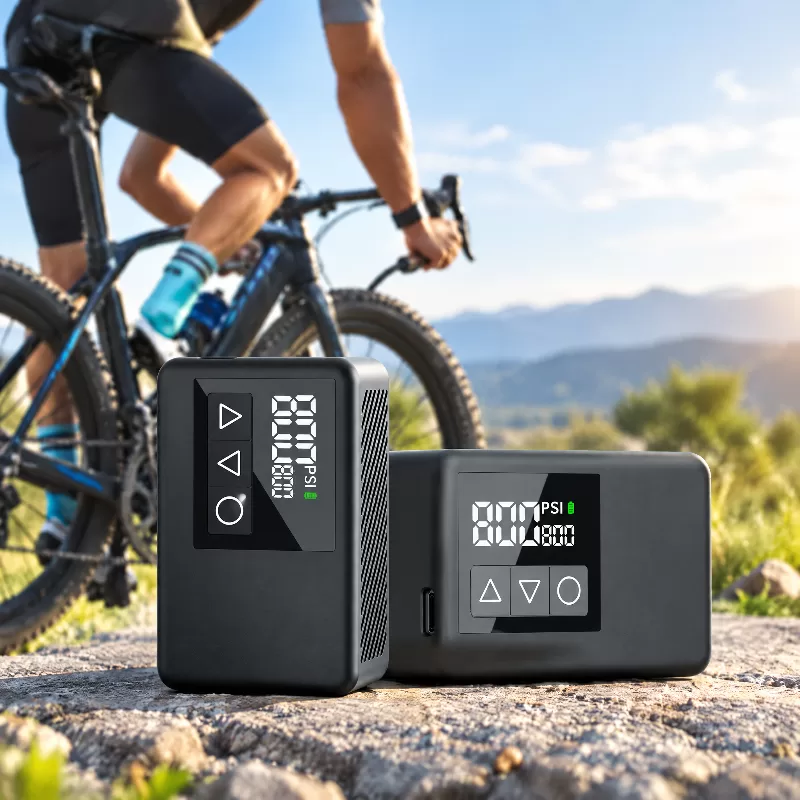
Every cyclist eventually discovers that tire pressure dictates the entire personality of a ride. When rolling resistance climbs or a sharp piece of road debris pinches an inner tube miles away from home, having an effective portable air pump for bike tires turns a stranded walk into a minor roadside pause. Compact inflation tools have evolved rapidly, expanding beyond purely mechanical hand pumps into motorized battery devices engineered for immediate pressure restoration.
Selecting the right inflation tool requires balancing physical volume against real mechanical capability. Carrying unnecessary dead weight on steep climbs penalizes cadence, yet carrying a tool incapable of reaching target operational pressures leaves you vulnerable. Navigating the modern landscape of compact inflators involves weighing pneumatic trade-offs, valve mechanics, and practical trailside ergonomics.
Why Carry a Portable Bike Tire Pump?
The necessity of roadside reliability
Pneumatic bicycle tires are permeable membranes under continuous mechanical stress. Even without a puncture, inner tubes gradually lose air over time, with the rate depending on the tube, valve, pressure, temperature, and tire system, while modern tubeless setups can burp small volumes of air during violent rim strikes on rocky descents.
Being stranded along a remote bridleway or an empty rural tarmac strip creates real physical vulnerability. Relying on good fortune or the generosity of passing riders introduces unnecessary risk to any journey. A suitable portable air pump for bike tires can improve roadside self-sufficiency across many riding conditions.
Understanding manual vs. rechargeable inflators
Traditional manual mini pumps rely entirely on upper-body exertion, transferring force through miniature piston shafts that demand hundreds of rapid strokes to reach moderate pressure levels. They offer the advantage of never running out of battery charge, making them durable backstops for multi-week wilderness tours.
Rechargeable electric inflators substitute manual labor with miniature mechanical motors and internal batteries. Instead of wrestling against rising backpressure while trying to avoid bending delicate valve cores, the rider attaches a nozzle, sets a parameter, and lets internal mechanical chambers do the pneumatic lifting.
Aligning your pump with your specific cycling needs
No single device universally satisfies every cycling discipline without compromise. Commuters navigating urban debris fields require rapid turnarounds to avoid missing work schedules, where fast inflation directly reduces roadside downtime.
Conversely, gravel explorers and bikepackers traversing isolated regions prioritize weight, weather sealing, and absolute hardware simplicity. Matching pump volume, maximum delivery pressure, and recharging logistics directly dictates how smoothly unexpected deflation events are resolved.
| Inflation Type | Primary Advantage | Major Mechanical Trade-off | Ideal Cycling Discipline |
|---|---|---|---|
| Traditional Mini Hand Pump | Zero battery dependency | Requires high physical effort and hundreds of strokes | Multi-week remote bikepacking |
| Single-Use CO2 Cartridge | Instantaneous burst inflation | Single-shot limitation and thermal freezing risks | Criterium or cross-country racing |
| Rechargeable Electric Inflator | Automated delivery with zero physical fatigue | Requires managed battery reserves | Commuting, road cycling, and local trail rides |
| High-Volume Frame Pump | Excellent volume displacement per stroke | Cumbersome exterior mounting footprint | Classic touring and utilitarian trekking |
Essential Features to Consider for Bike Tire Pumps
Maximum pressure and realistic tire requirements
Pump manufacturers routinely advertise peak laboratory pressure ratings, yet operational cycling demands vary dramatically. Modern high-volume gravel or trail setups rarely exceed 25 to 40 PSI, whereas narrow road tires on traditional rims may still demand upwards of 80 to 90 PSI to prevent pinch flats.
A 120 PSI maximum rating covers the stated pressure range for many road and bicycle applications, but actual inflation time and capacity depend on tire volume and target pressure. Running a miniature pump near its absolute engineering ceiling generates substantial friction heat, making thermal efficiency and duty cycles important factors during purchase decisions.
Valve compatibility: Presta versus Schrader
Bicycle wheels commonly use Schrader or Presta valves, while Woods/Dunlop valves are also found on some bicycles. Schrader valves, standard on automotive wheels and everyday utility bikes, use an internal spring-loaded pin within a wider barrel.
Presta valves use a narrower stem with a small locknut that must be loosened before air can enter. A suitable inflator should support the valve types on your wheels, either through an integrated head or compatible adapters. The BL01 includes Schrader and French/Presta adapters for the valve types specified by the product.
- Threaded Adapters: Provide an airtight mechanical seal that reduces accidental blowout under higher delivery pressures.
- Push-on Lever Chucks: Enable quick attachment and detachment but can stress delicate Presta valve cores if removed with excessive lateral force.
- Dedicated Flexible Hoses: Isolate the fragile tire valve stem from the vibration or movement of the pump body during active operation.
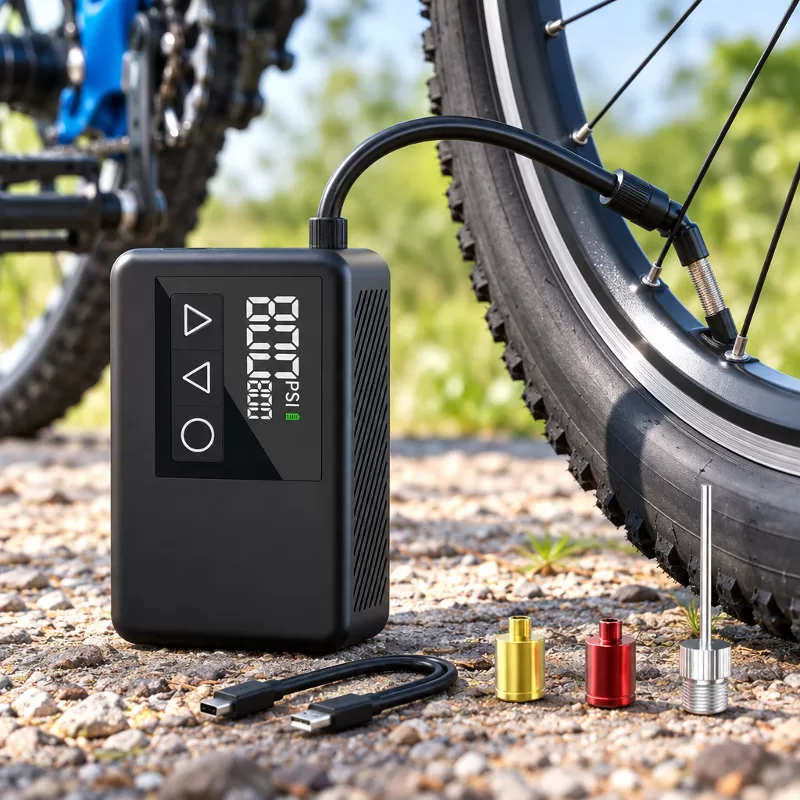
Form factor: Portability versus performance
Pneumatic displacement is fundamentally constrained by cylinder volume. An ultra-compact pump slips neatly into a cycling jersey pocket or saddle roll, but its smaller internal chambers mean either more manual strokes or smaller battery cell capacities.
Carrying a slightly larger device rewards the rider with faster delivery times and greater reserve energy. The optimal choice balances pack space against the physical reality of how often you expect to inflate tires during normal riding patterns.
Battery technology and charging convenience
Rechargeable electric inflators rely on dense cell configurations to deliver the instantaneous current required by high-RPM mini compressors. High-discharge polymer cells provide the burst power necessary to push air through restrictive valve cores against rising resistance.
Charging infrastructure matters just as much as cell chemistry. The BL01 supports A-to-C and C-to-C charging cables. Use a compatible 5V source capable of meeting the stated 1.5A input requirement; a suitable wall adapter or power bank may be used with the correct charging cable.
Smart features: Pressure sensing and auto shut-off
Historically, roadside tire pressure was assessed by squeezing rubber casings with bare thumbs, an imprecise method prone to underinflation or improper pressure estimation. Modern smart pumps incorporate digital transducers that sample internal line pressure during operation.
Digital pressure sensing and automatic shut-off reduce manual guesswork, but users must select an appropriate target and observe tire and rim limits. Automatic shut-off can help reduce the risk of unintended overinflation when the selected target is appropriate, but the rider must still verify compatibility with the rim manufacturer’s ratings.
Choosing the Best Pump for Your Riding Style
Road cycling: High-pressure precision
Road riders encounter high pneumatic backpressure within relatively small air volumes. Inflating a 25c or 28c tire from flat to 80 or 90 PSI requires consistent mechanical compression against tight valve seals.
When evaluating a portable air pump for bike tires intended for asphalt riding, look for adequate pressure delivery limits and secure valve connections. Air loss during disconnection can be noticeable in small, high-pressure road tires, so remove the adapter carefully to maintain target pressure.
Mountain biking: Higher volume and durability
Off-road riding trades high pressure for substantial displacement. Pushing air into a 29×2.4 trail casing requires moving considerable volume, meaning an underpowered inflator will take longer to establish comfortable riding pressures.
For trail use, consider enclosure protection, ventilation, and the manufacturer’s stated operating-temperature range. The BL01 should be kept within its specified operating conditions and protected from water and impact unless additional protection is documented.
Daily commuting and e-bike utility
Urban commuters and e-bike riders frequently run heavier puncture-resistant tires or cargo-rated casings that resist roadside thumb checks. E-bikes carry substantial curb weights that place continuous strain on pneumatic contact patches.
For e-bikes, following the tire and rim manufacturer’s pressure guidance can help balance rolling resistance, handling, and impact protection. It cannot guarantee that rims will avoid damage from potholes, but proper inflation helps maintain intended ride characteristics.
Limitations of compact electric inflators
While motorized mini pumps offer effortless inflation, they possess inherent engineering limits that riders must recognize before venturing into deep wilderness. Small battery packs naturally restrict total operational runtime before needing an external power source.
Furthermore, internal compressor chambers generate friction heat rapidly during continuous cycling, necessitating short cooling intervals between consecutive fills. Recognizing these boundaries ensures you pack redundant backups when embarking on expeditions far removed from electrical grids.
Operating a Portable Pump Safely
Determining correct pressure from tire sidewalls
Tire manufacturers stamp nominal minimum and maximum pressure ranges directly into the rubber sidewall casing. These molded numbers provide baseline containment parameters based on casing thread count and bead wire composition.
Never exceed the lower maximum pressure specified by the tire, rim, or complete wheel-system manufacturer, and follow any hookless-rim limits. Lower pressures enhance traction over rough gravel, while firmer settings guard against impact rim strikes on unforgiving tarmac.
- Examine the Rubber Sidewall and Rim: Locate the molded or printed text showing bar or PSI boundaries, noting the safe operating ceiling.
- Calculate Effective Target: Adjust based on rider mass, cargo weight, and road or trail conditions within the allowed range.
- Inspect the Bead Seat: Confirm that the tire bead is evenly positioned around the approved rim profile before applying full pressure.
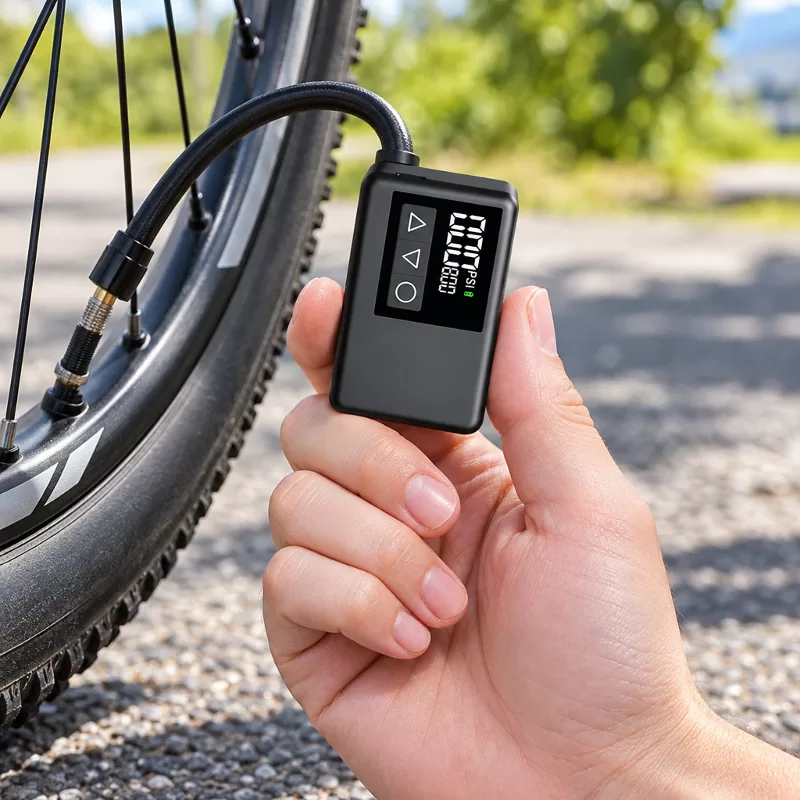
Preparing Presta and Schrader valves
Before attaching any inflation head, clean any accumulated grit or road grime from around the valve core. Debris pushed into the air channel will damage internal seals and create stubborn slow leaks.
Loosen the Presta locknut by hand, then attach the adapter squarely. Do not force or bend the valve stem during attachment, ensuring air passes freely through the valve channel without binding.
Connecting the pump and monitoring target pressure
Attach the appropriate adapter squarely and check the displayed pressure reading before starting inflation, if the device provides a reading at that stage. A straight attachment avoids cross-threading soft aluminum barrels.
Program your desired inflation value into the device interface. Initiate operation while keeping the pump steady, avoiding harsh downward leverage on long, unsupported valve stems that could bend or snap the core.
Disconnecting to maintain tire seals
Once the pump cuts out upon reaching target pressure, swift detachment protects your gains. An unwieldy removal process bleeds air volume, which is particularly noticeable on low-capacity road tires.
Unthread or unlock the chuck cleanly in a straight motion perpendicular to the rim. After removing the adapter, tighten the Presta valve locknut finger-tight and replace the dust cap to shield the mechanism from environmental dirt.
Post-inflation maintenance and checks
After packing away your tools, spin the wheel slowly by hand while looking down the center axis of the frame. Ensure the tire’s molded reference line sits at an identical distance from the rim edge across the entire circumference.
Take a brief test roll under light pedal force to confirm braking surfaces remain clear of tire sidewall contact. Catching a misaligned tire bead immediately prevents violent blowouts under full riding torque.
BL01 Portable Rechargeable Bike Pump: Technical Overview
Understanding the BL01 specification sheet
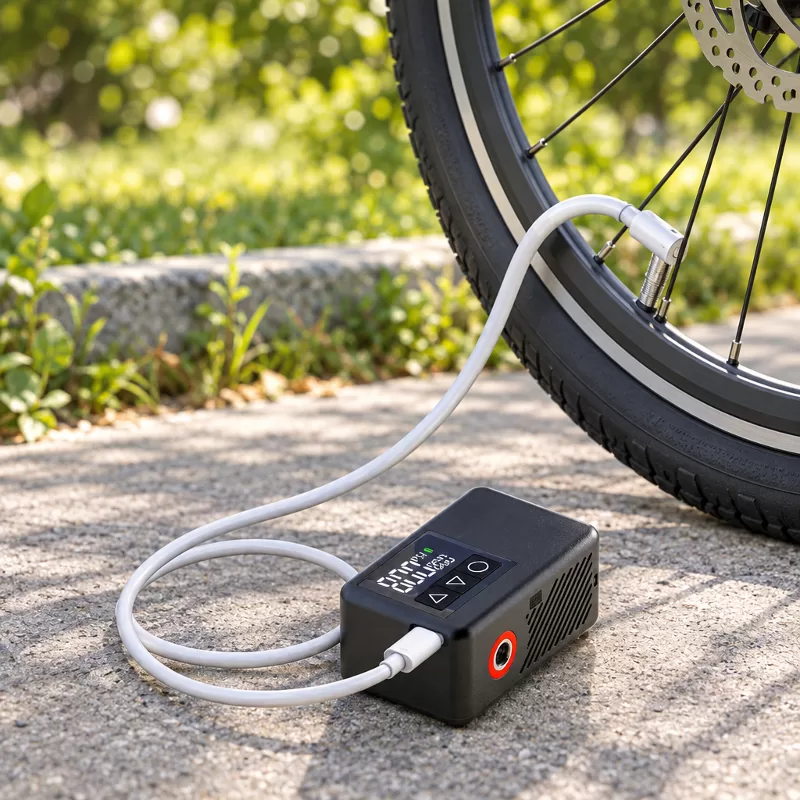
Within the evolving space of micro-inflation hardware, the Portable Rechargeable Bike Pump 120PSI BL01 illustrates modern engineering optimization. Manufactured by Newo—a professional manufacturer specializing in the research, development, and production of smart electric air pumps and portable inflation solutions—the device delivers automated roadside inflation. Newo describes the BL01 as a compact cycling-focused inflator for everyday portability.
The BL01 packages a functional 2 to 120 PSI working range inside an enclosure measuring just 71.5 × 45 × 32 mm. The BL01 uses a small brushless pump, with stated working power of about 40 W and an advertised airflow of 14 L/min.
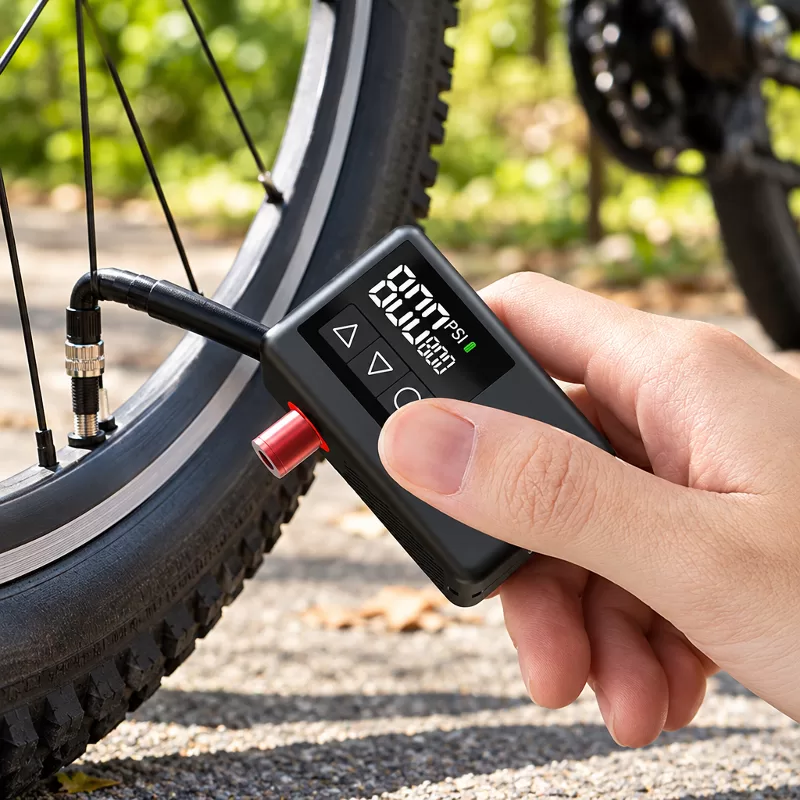
Key technical attributes and accessories
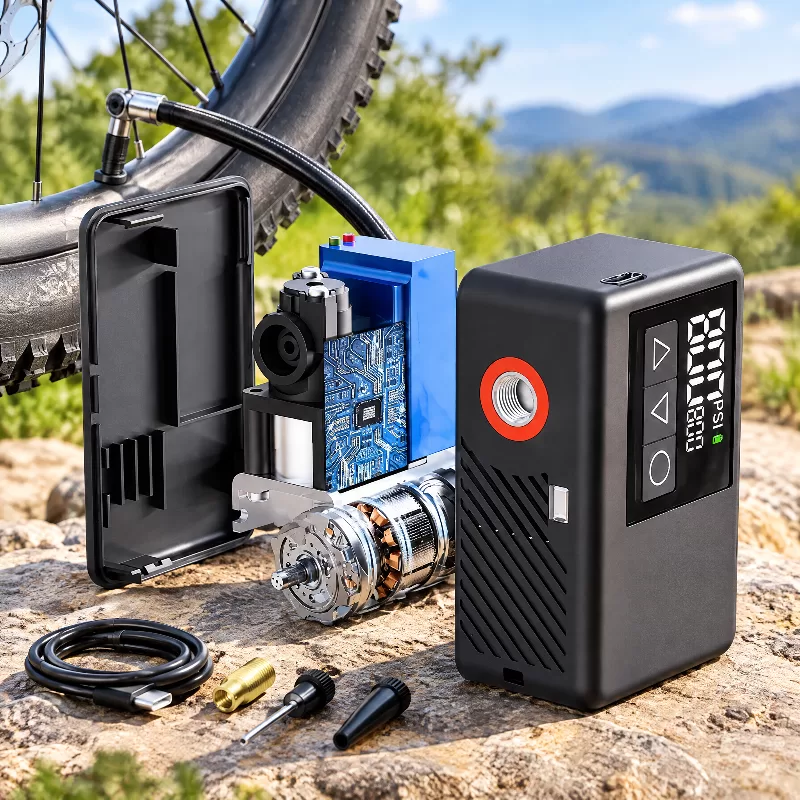
Pneumatic reliability in micro compressors relies heavily on internal stability. The BL01 combines a built-in pressure sensor with a dual LCD display and automatic shut-off to manage routine inflation tasks.
Power is supplied by an internal 7.4V, 500mAh 25C high-rate polymer battery delivering 3.7Wh of energy. In addition to the host unit, the standard equipment kit provides essential hardware for varying equipment needs:
- Dedicated Charging Cable: Compatible across standard USB-A and USB-C output ports for flexible power sourcing.
- Threaded Schrader Valve Fitting: Standard direct coupling for utility bikes, mountain wheels, and standard inner tubes.
- French (Presta) Valve Adapter: The included French/Presta adapter supports compatible Presta-valve bicycle tires.
- Sports Ball Needle: Converts the brushless inflation system for recreational athletic balls.
| Specification Parameter | BL01 Stated Specification | Cycling Application Significance |
|---|---|---|
| Physical Dimensions | 71.5 × 45 × 32 mm | Fits easily into jersey pockets or compact saddle bags |
| Working Pressure Limits | 2 to 120 PSI | Covers standard bicycle pressure ranges up to road limits |
| Battery Specification | 7.4V, 500mAh 25C polymer battery (3.7Wh) | Delivers high current draw to power the compact pump assembly |
| Airflow Volume | 14 L/min | Supports supported bicycle tire maintenance efficiently |
| Operating Runtime | 5 to 7 continuous minutes | Sufficient for routine inflation cycles in single riding sessions |
| Recharging Time | Under 2 hours (5V / 1.5A Input) | Quick turnaround between daily urban commutes |
| Acoustic Output | ≤ 80dB at 1.5 meters | Reported sound level; users should expect noticeable operating noise |
| Operating Temperature | -10°C to 45°C | Use within the manufacturer’s stated -10°C to 45°C operating range |
Realistic usage expectations for the BL01
First-party testing data outlines clear operational capacities for the BL01. From a full charge, the unit delivers sufficient runtime to inflate approximately seven mountain bike tires to 38 PSI, or roughly two road bike tires up to 100 PSI.
These first-party figures indicate that the BL01 is intended for routine and emergency inflation in the supported bicycle applications, subject to tire volume, target pressure, and battery condition. It eliminates upper-body pumping fatigue, delivering selected target pressures through its automatic shut-off functionality.
Maintenance, Charging, and Readiness
Charging protocols for polymer batteries
The BL01’s polymer battery delivers remarkable energy density in a miniature footprint, yet it demands disciplined storage habits. Leaving an electric inflator completely depleted inside a freezing garage throughout winter accelerates capacity loss.
Replenish the cell after significant inflation sessions. The stated charging time is less than two hours under the specified 5V / 1.5A input conditions, making it easy to establish a regular recharging routine alongside front lights and cycling computers.
Storage of adapters and accessories
A portable pump is completely useless if its small Presta adapter went missing on the last trailside repair. Keep your loose adapters secured in a small zippered pouch or tethered inside your saddle roll.
Periodically check the tiny rubber O-rings seated within valve adapters. If these elastomeric seals crack or degrade from road salt and sun exposure, the pump will bleed air past the threads, distorting sensor readings and slowing inflation.
Periodic testing of your inflation kit
Never wait for a dark, rainy evening along a remote bike path to discover that your equipment has lost charge or sustained damage. Perform a functional systems check every few months from the comfort of your home.
Check that the display and controls operate normally, and compare any tire-pressure reading with a trusted gauge if accuracy is important. Routine testing provides peace of mind that your emergency gear will perform reliably when called upon.
FAQs
How do I know the correct tire pressure for my bike?
Begin by checking the sidewall of your tire and the specifications of your rim, where the manufacturer prints safe operating boundaries. From there, adjust according to your total weight, rim dimensions, and surface conditions. Heavier riders and paved surfaces benefit from firmer pressures within the designated range, whereas loose gravel, wet roots, and rough trails demand lower pressures to expand the rubber contact patch and improve traction.
Does a single portable pump accommodate different valve types?
Most modern pumps support both Presta and Schrader systems, though the mechanical method varies. Some inflators feature switchable internal rubber chucks, while compact units like the BL01 use dedicated screw-on adapters. Always ensure your carry kit contains the appropriate adapter for your current wheelset, and confirm the threads are free of grit before tightening.
Should I rely solely on an electric pump for long rides?
For daily commuting, urban fitness loops, and weekend road routes, a fully charged electric pump offers dependable stand-alone performance. However, for multi-day bikepacking trips through remote backcountry without access to electrical outlets, carrying a miniature manual hand pump as a backup remains wise practice. Electric pumps free you from exhausting manual pumping, but mechanical hand pumps require no battery power.
How does the BL01 handle different types of bike tires?
The BL01 provides an adjustable 2 to 120 PSI working range, allowing it to adapt across diverse cycling categories. According to its specification sheet, the 500mAh polymer battery and brushless pump can inflate approximately seven mountain bike tires to 38 PSI or about two road bike tires up to 100 PSI on a single charge. The stated 14 L/min airflow is intended for the product’s supported bicycle applications; actual inflation time varies with tire volume, pressure, and battery condition.
Can I use these pumps for non-cycling equipment?
Compact cycling inflators can service a variety of low-volume inflatable goods. The included ball needle allows the BL01 to be used for compatible sports-ball inflation. Follow the ball manufacturer’s pressure limit during use. The supplied specifications document bicycle and sports-ball applications, not inflation performance for stand-up paddleboards or passenger-car tires; do not assume those uses without manufacturer confirmation.
Conclusion
Selecting an effective portable air pump for bike tires transforms emergency roadside punctures from frustrating disruptions into manageable trailside pauses. Whether you rely on the uninterrupted mechanical simplicity of a traditional hand pump or the automated precision of modern electric tools like the BL01, pairing the right inflation system with your riding discipline ensures every outing remains safe, predictable, and enjoyable across any terrain.
-

Meet NEWO at the 140th Canton Fair: Visit Booth 10.3 M03–04
Meet NEWO at the 140th Canton Fair in Guangzhou, October 15–19, 2026. Visit Booth 10.3 M03–04 to explore portable air pumps and discuss OEM, ODM and distribution opportunities.... -

As Shenzhen Welcomes the World for APEC 2026, NEWO Welcomes You to Our Factory
As Shenzhen prepares for APEC 2026, NEWO welcomes international buyers and partners to visit our factory, meet our team and explore future cooperation.... -

Leading the Way in Product Innovation and Excellence
Smartnewo exemplifies professionalism in product innovation and manufacturing. Their collaboration with Xiaomi Youpin on the G01 crowdfunding project highlights their expertise in creating compact, powerful inflatable pumps. Rigorous engineering, meticulous production processes, and advanced quality assurance underscore their commitment to excellence. The success of the G01 project, with significant market... -

Essential Qualities of an Excellent Supplier
In today's competitive market, finding a reliable supplier is crucial for business success. Based on insights from Smartnewo and broader internet research, here are key qualities an excellent supplier must possess:... -

NW06 Tire Inflator: Compact Power for Quick Inflation
Summary The NW06 Tire Inflator delivers quick and efficient tire inflation with a powerful 35L/min airflow. It features a user-friendly LCD screen for real-time pressure monitoring, dual power options with a built-in 6000mAh battery, and multiple nozzle attachments for versatile use. Its compact design and integrated LED light ensure convenience and... -

Unleash the Power of Portability: The SmartNewo Jump Starter with Air Compressor KF03
This guide will walk you through the steps to effectively use a portable tire inflator, helping you stay prepared and safe on the road.... -

Newo Attends The 2024 Consumer Electronics Show (CES)
Smartnewo booth is located at 53672, Halls A-D, Level 2, Venetian Expo, Las Vegas Convention Center (LVCC). ... -

Smartnewo’s Dual-Cylinder Air Pump Rocks the Hong Kong Autumn Electronics Fair!
Smartnewo’s Dual-Cylinder Air Pump Rocks the Hong Kong Autumn Electronics Fair!... -

Meet at the Canton Fair! Smartnewo brings dual-cylinder air pumps, making your inflation experience faster and more stable!
NEWO has went deep communication and negotiation with customers from all over the world on booth.... -

“Hong Kong Autumn Electronics Fair – 1CA18 (October 13th to 16th): Smartnewo invites you to visit our booth!
Hong Kong Autumn Electronics Fair...
-
What to Check Before Ordering Custom Electric Bike Pumps
Plan custom electric bike pumps with a clear requirements freeze for valves, TPU tubes, portability, repeated top-ups, charging, and model-specific documents.... -
OEM vs ODM Air Pumps: Which Manufacturing Model Fits Your Brand?
Compare OEM and ODM air pump projects by design responsibility, change approval, development scope, and written ownership terms before choosing your route.... -

How to Choose a Reliable Tire Inflator Manufacturer in China
Choose a tire inflator manufacturer in China with a focused RFQ, supplier evidence, configuration checks, and clear sample-to-pilot decisions for your brand.... -

Rechargeable Electric SUP Pump for Paddle Boards: Faster Inflation for SUPs, Kayaks and Inflatable Tents
The BL10-C Portable Electric Bike Tire Inflator is a compact and lightweight mini electric bike pump designed for modern cyclists. With up to 120 PSI pressure, a digital LED display, preset pressure control, automatic shut-off, USB-C charging, and multiple valve adapters, BL10-C offers a convenient inflation solution for road bikes,... -

Are Electric Bike Pumps Worth It in 2026? Electric Pump vs CO₂ vs Mini Hand Pump
Discover whether electric bike pumps are worth it in 2026. This guide compares electric bike pumps, CO₂ inflators, and mini hand pumps for road cycling, gravel riding, commuting, and long-distance rides. Learn the pros, limitations, best use cases, and key features to look for before choosing the right portable tire... -
BL10-C Portable Electric Bike Tire Inflator: Small Size, Reliable Power for Every Ride
The BL10-C Portable Electric Bike Tire Inflator is a compact and lightweight mini electric bike pump designed for modern cyclists. With up to 120 PSI pressure, a digital LED display, preset pressure control, automatic shut-off, USB-C charging, and multiple valve adapters, BL10-C offers a convenient inflation solution for road bikes,... -

Why Mini Electric Bike Pumps Are Becoming Essential for Modern Cycling
Discover why mini electric bike pumps are becoming essential for modern cyclists. Learn how portable electric bike pumps improve tire pressure management, riding safety, and convenience.... -

The Ultimate Smart Solution for Easy Outdoor Adventures in 2026
Discover how a spring travel air pump simplifies outdoor trips with fast inflation, smart features, and powerful performance—perfect for every adventure.... -

Powerful 5-in-1 Portable Car Tire Inflator and Jump Starter: The Ultimate Emergency Tool for Every Driver
Why Every Driver Needs a Portable Car Tire Inflator and Jump Starter Modern drivers face many unexpected situations on the road. A flat tire, low tire pressure, or a dead car battery can happen at the worst possible time. That’s why having a portable car tire inflator and jump starter is... -

7 Real Cycling Scenarios That Show Why Every Rider Should Carry a Mini Bike Pump
Cycling is one of the most freeing activities you can enjoy. Whether you’re commuting to work, riding through city streets, or exploring quiet countryside roads, a bike ride can instantly improve your day. But there’s one small problem that almost every cyclist eventually faces: Low tire pressure. It might happen...
-

How Is a Football Properly Inflated?
The correct inflation of a football - with not too much and not too little air - is a hotly debated topic among footballers.... -

Application Scenarios of Car Inflator Pump
Often long-distance business trips or play car owners because the road may be more remote areas, in this case if you encounter a tire leak....