

 Portable Tire Inflators
 Electric Air Pumps
 Electric Car Tyre Pumps
 Electric Ball Pumps
 Electric Bike Pump
 SUP Air Pump

The Engineering and Selection Guide to the Portable Car Tyre Pump
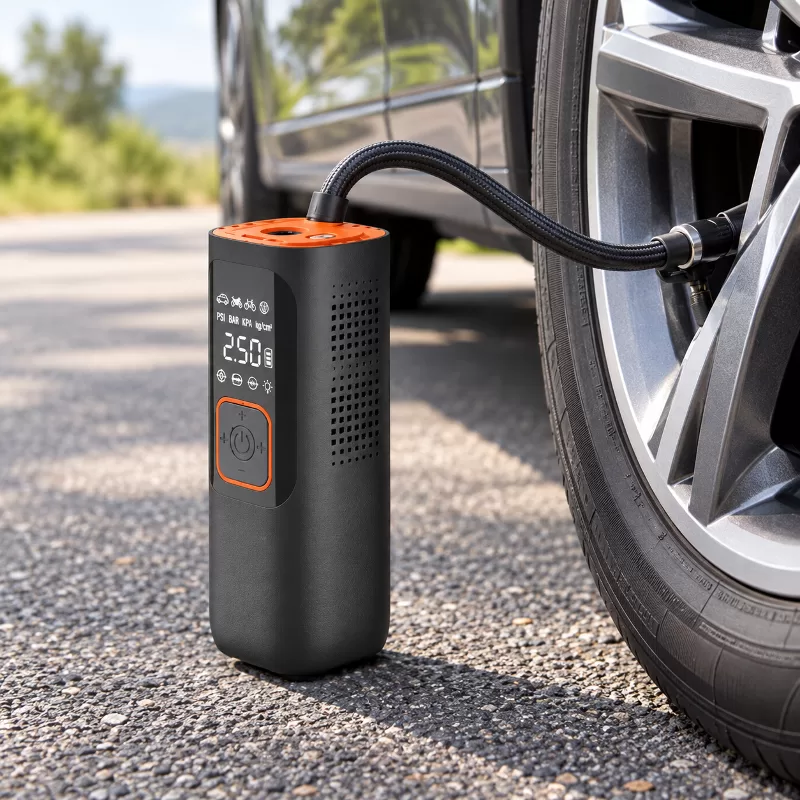
Maintaining correct pneumatic pressure inside automotive tires directly governs tread longevity, braking friction, and fuel economy. Motorists often discover that ambient cold fronts drop internal pressure overnight, triggering dashboard alerts far from a service garage. Investing in a dependable car tyre pump portable solution eliminates dependency on faulty forecourt air towers while facilitating proper cold pressure adjustments whenever required.
Modern lithium-ion cells combined with miniature reciprocating pistons have transformed bulky garage hardware into handheld appliances. Understanding the thermodynamics of air compression, internal cylinder sizing, and digital sensor operation allows drivers to choose tools that preserve tire integrity rather than risk premature roadside failure.
Understanding Modern Portable Inflation Mechanisms
Portable Inflators vs. Workshop Compressors: Key Mechanical Differences
Traditional garage air compressors rely on large induction motors coupled to heavy cast-iron reserve tanks. These stationary setups compress air ahead of time, cooling it inside the reservoir before discharging dry air through high-volume pneumatic lines. Their continuous duty cycles suit commercial tire balancing and high-volume bead seating.
A handheld portable tire inflator compresses atmospheric air directly on demand without a storage reservoir. The internal electric motor drives an eccentric counterweight and connecting rod, reciprocating a small piston inside a metal sleeve. Because ambient air is forced directly through the delivery hose into the tire chamber, miniature units generate localized heat rapidly.
Primary Roadside and Daily Pressure Scenarios
Seasonal temperature swings represent the most frequent cause of under-inflation across passenger vehicles. For every drop of 10°F (5.5°C) in ambient temperature, internal tire pressure contracts by roughly 1 PSI. Drivers parking outdoors during winter mornings face significant contact-patch distortion without suffering actual punctures.
Slow leaks along corroded wheel rims or through aged Schrader valve stems present another persistent maintenance challenge. A compact inflator stored under a cargo floorboard allows commuters to safely top up pressure before departing. This proactive step prevents unseating the bead or ruining a rim during a drive toward an automotive service technician.
Crucial Safety Boundaries: What a Portable Inflator Cannot Fix
Tire inflators restore missing air volume, but they cannot mend mechanical failures or structural damage. Driving over heavy road debris often causes internal carcass delamination, severing steel belts and creating noticeable sidewall blisters. Forcing pressurized air into a tire with compromised sidewall integrity risks sudden, violent decompression.
A puncture larger than 6 mm (1/4 inch), or one located in or extending into the shoulder area, generally falls outside standard passenger-tire repair limits. Have a tire professional inspect the casing thoroughly; never assume that roadside reinflation makes a structurally compromised tire safe to drive on.
Core Technical Criteria for Selecting a Portable Tyre Inflator
Decoding Pressure Ratings: Max PSI vs. Recommended Vehicle Figures
Consumer packaging frequently highlights extreme pressure capabilities, with ratings reaching up to 150 or 160 PSI. Standard passenger cars, crossover utility vehicles, and family sedans rarely require inflation beyond normal commuter ranges under typical payload conditions. These elevated maximum ratings merely reflect the structural pressure tolerance of internal fittings and miniature pump heads.
Commercial light trucks or high-pressure road bicycles may demand higher working pressures, which validates having wider operating pressure envelopes. However, when evaluating a unit for standard vehicles, motor torque and thermal stability matter far more than theoretical three-digit ceiling pressures. An inflator must maintain steady compression against existing back-pressure without stalling its drive circuit.
| Vehicle / Inflation Category | Illustrative Tire Types | Example Pressure Regimes | Primary Operational Considerations |
|---|---|---|---|
| Passenger Vehicles | Compact cars, sedans, crossovers | Check door B-pillar placard | Prioritize auto shut-off precision and steady flow |
| Light Commercial | Loaded cargo vans, light utility | Follow vehicle certification label | Verify duty-cycle limits and motor thermal tolerances |
| High-Pressure Cycles | Road bikes, performance trainers | Follow the tire and rim manufacturers’ permitted pressure ranges | Check adapter compatibility (e.g., Presta fittings) |
| Recreational Items | Balance carts, inflatable balls | Consult item pressure ratings | Utilize lower-pressure preset modes where applicable |
Power Delivery Architectures: Cordless Lithium vs. 12V DC Vehicle Power
Battery-powered inflators offer complete mechanical independence from the car’s electrical harness, eliminating tangled cords around dirty wheel arches. Modern high-discharge 18650 lithium-ion cylindrical cells deliver instantaneous peak amperage to crank the internal piston smoothly. However, chemical cells experience capacity loss if left uncharged inside freezing vehicle trunks over long periods.
Dedicated 12V direct-current systems draw current straight from the vehicle cigarette lighter or battery terminal posts. These tethered units run continuously as long as the automobile electrical circuit provides power, yet their cords introduce tripping hazards and limit servicing reach. Dual-power models that integrate both lithium battery packs and auxiliary vehicle inputs deliver versatile roadside contingency.
Air Delivery Volume and Cylinder Architecture
The real speed of tire inflation depends on air throughput, measured in liters per minute (L/min), rather than top pressure limits alone. Single-cylinder micro-pumps with narrow bores often yield modest flow rates, requiring extended runtimes to raise a deflated tire. During prolonged cycles, mechanical friction warms internal components.
Dual-cylinder mechanisms utilize two reciprocating piston assemblies within the drive housing. In the case of dual 19-cylinder designs, manufacturer specifications indicate free air flow rates of 30 to 35 L/min. Real-world inflation speed and duty cycles always depend on the individual tool’s build quality, ambient heat, and the specific tire volume.
Digital Pressure Control, Sensor Precision, and Automatic Shut-Off
Analog dial gauges rely on mechanical Bourdon tubes, which lose calibration easily if dropped onto asphalt. Digital displays, by contrast, show static pressure readings with clear numerical values on illuminated screens. Clear readouts ensure drivers do not misinterpret fine graduation lines during low-light roadside checks.
Automatic shut-off functionality protects both tire plies and pump mechanics from accidental over-pressurization. The user presets the desired target on a digital display and starts the motor. The pump is specified to stop automatically when it reaches the selected pressure, preventing excessive pneumatic buildup.
Physical Architecture: Hoses, Heat Ports, and Chassis Form Factor
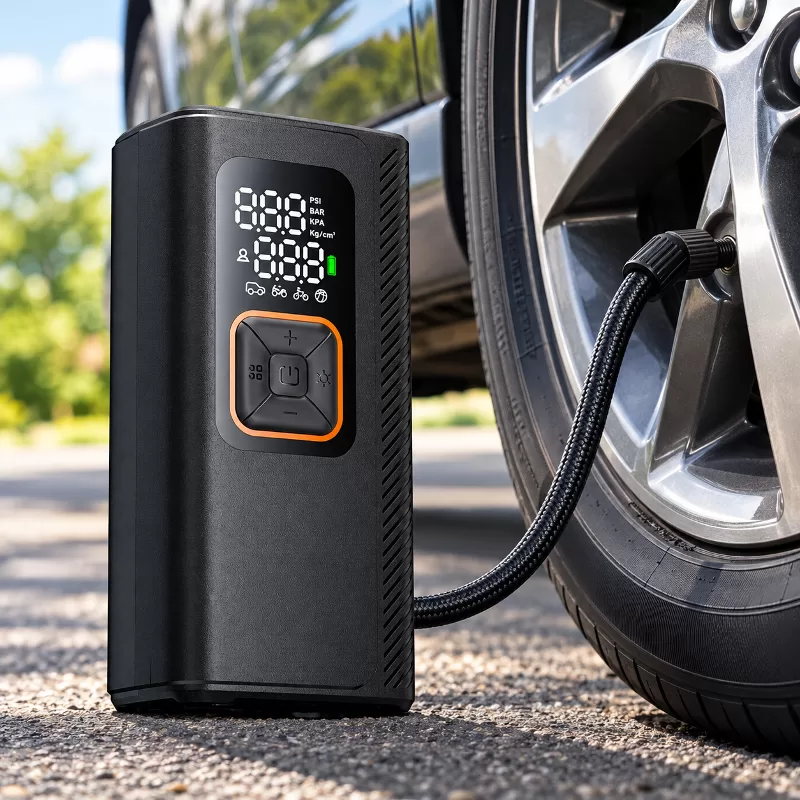
Air compression obeys fundamental thermodynamic principles, converting mechanical work into noticeable heat at the discharge port. Standard unreinforced hoses can soften, bulge, or degrade under heavy continuous thermal loads. Well-constructed systems employ braided multi-layer hoses, often incorporating threaded metal couplers that resist high-heat conditions.
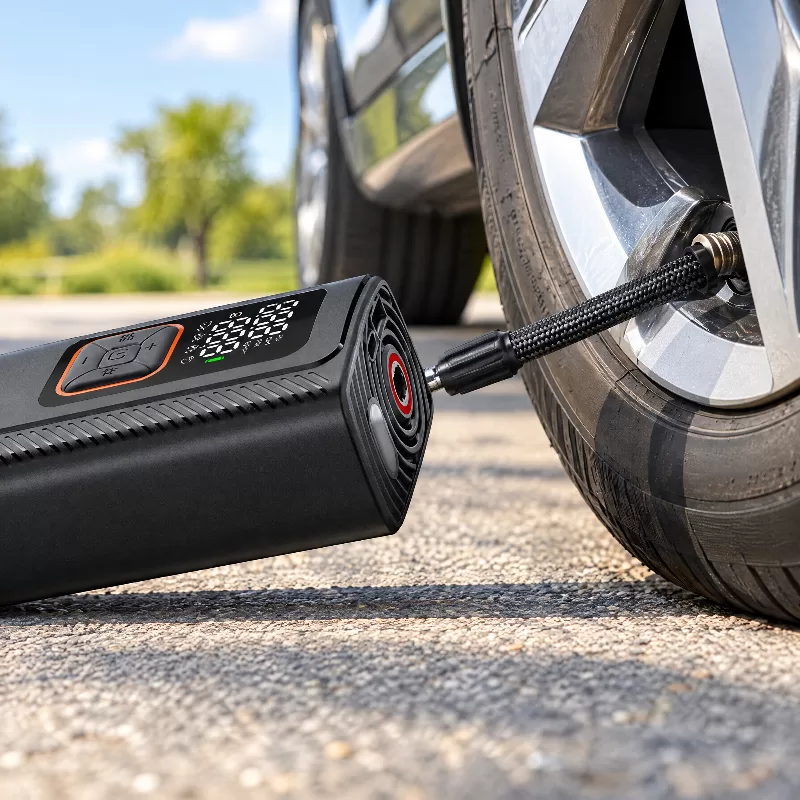
Perforated ventilation ports along the side of the chassis allow natural convection cooling across internal pump heads. Without adequate chassis vents, internal operating temperatures can accumulate rapidly and risk degrading the internal electronics or lithium pack. An upright rectangular footprint provides stability on pavement, preventing the inflator from tipping over during piston vibration.
Step-by-Step Field Guide: Operating a Portable Inflator Safely
Locating Manufacturer Pressure on the B-Pillar Placard
Never inflate an automobile tire to the maximum cold inflation pressure stamped directly onto its outer rubber sidewall. That sidewall figure specifies the structural pressure limit under maximum load rating, not the vehicle manufacturer’s tuned operational setting. Driving on over-inflated tires narrows the tread contact patch, creating a stiff ride, longer braking distances, and accelerated center-tread wear.
- Open the front driver-side door and inspect the metal chassis frame near the latch mechanism (the B-pillar).
- Read the permanent certification placard, which lists factory tire dimensions alongside recommended front and rear cold pressures.
- Note any differences between front and rear axle ratings, particularly when carrying heavy trunk cargo or towing trailers.
- Verify whether temporary spare wheels require dedicated higher pressures, often specified at 60 PSI on compact donuts.
The Cold Pressure Standard: Why Timing Matters
Pneumatic pressure must always be measured when vehicle tires are truly cold. Automotive tires naturally warm up as internal belts flex and scrub against road pavement during transit, raising internal air temperatures and pressures. Consequently, readings taken immediately after a drive will show an elevated pressure level.
To establish an accurate benchmark, park the vehicle for at least three full hours away from direct sunlight before measuring. If a tire is visibly underinflated after driving, add air to the placard’s recommended cold pressure and recheck the reading once the tire has cooled thoroughly; never deflate a warm tire based on its elevated reading.
Systematic Connection, Inflation, and Automatic Cut-Off
- Unscrew the plastic dust cap from the tire’s Schrader valve stem and store it safely in your pocket.
- Thread or clamp the inflator’s braided hose chuck firmly onto the brass stem threads without cross-threading the fitting.
- Observe the initial ambient pressure reading shown on the digital screen to confirm the current tire deficit.
- Select the correct pressure unit (such as PSI or Bar) and adjust the target value using the device’s directional buttons.
- Press the power trigger to start the motor, keeping the main unit standing upright on level pavement.
- Allow the automatic shut-off to disengage the motor, disconnect the chuck briskly to minimize air escape, and replace the dust cap.
Post-Inflation Inspection and Valve Stem Maintenance
After removing the air chuck, inspect the valve opening and listen closely for any faint hissing sounds that indicate continued leakage. If pressure drops persistently after inflation, have an automotive or tire professional inspect the valve core and tire carcass for hidden defects.
Always reinstall high-density plastic or metal valve caps fitted with internal rubber seals. Bare valve stems ingest wet road grime, corrosive salt spray, and moisture during rainy or wintry driving conditions. That grit can migrate directly into the pneumatic core during subsequent top-ups, causing chronic slow leaks and valve failures.
Technical Profile: Newo A01 Multi-Functional Inflator
Pneumatic Architecture: Dual 19-Cylinder Block and 85W Output
Newo is a professional manufacturer specializing in the research, development, and production of smart electric air pumps and portable inflation solutions. Engineered for demanding inflation tasks, the A01 model features a dual 19-cylinder structure powered by an 85W motor. This dual-cylinder configuration supports an airflow rate of 30 to 35 L/min across an operating pressure range of 2 to 160 PSI.
The inflator operates with a specified noise level of 85 dB or below at 1.5 meters. The chassis measures 152 × 53 × 76 mm and weighs approximately 610g in its 3-cell battery version, or 655g in its 4-cell build. This compact form factor offers balanced portability while housing a dual-cylinder pump assembly.
Battery Architecture and Operational Ratings
The internal power system uses high-discharge 18650 lithium-ion cylindrical cells. The base build contains 3 × 18650 cells rated at 2500 mAh (11.1V, 27.75 Wh), while the optional extended build uses 4 × 18650 cells (14.8V, 37 Wh). According to manufacturer data, approximate runtimes are about 20 minutes for the 3-cell version and about 30 minutes for the 4-cell version, with approximate factory inflation capacity listed as about 1.5 of 285 tires for the 3-cell build and about 2 of 285 tires for the 4-cell build (test pressures and specific tire aspect ratios are not detailed in the specifications).
Internal battery protection cutoffs are rated at 12.6V / 9V for the 3-cell build and 16.8V / 12V for the 4-cell build. Across repeated recharging via its Type-C interface, the battery retains 80% or more of its original capacity after 300 cycles. The device is specified to operate within ambient temperatures ranging from -10°C to 45°C.
| Technical Parameter | Specification Standard (A01 – 3-Cell) | Specification Standard (A01 – 4-Cell) |
|---|---|---|
| Cylinder Architecture | Dual 19-cylinder | Dual 19-cylinder |
| Motor Working Power | 85 Watts | 85 Watts |
| Pressure Working Range | 2 – 160 PSI | 2 – 160 PSI |
| Stated Free Air Flow | 30 – 35 L/min | 30 – 35 L/min |
| Internal Pack Capacity | 3 × 18650 (2500mAh, 11.1V, 27.75Wh) | 4 × 18650 (2500mAh, 14.8V, 37Wh) |
| Approximate Runtime | About 20 minutes | About 30 minutes |
| Supported Input / Output | Type-C (up to 20V/2.25A), 12V–14V Car DC | Type-C (up to 20V/2.25A), 12V–14V Car DC |
| Chassis Dimensions & Weight | 152 × 53 × 76 mm; ~610g | 152 × 53 × 76 mm; ~655g |
Bi-Directional Charging and Auxiliary Emergency Power
The A01 functions as a portable power source during outdoor travel or roadside delays. Its Type-C interface supports input and output profiles of 5V/3A, 9V/2A, 12V/2A, 15V/2A, and 20V/2.25A, delivering up to 45W of external fast output. This allows operators to recharge mobile electronics, navigation gear, or communication handsets directly from the inflator.
A secondary USB port provides 5V/2A and 9V/2A output for standard accessories. The technical specifications also list 12V–14V car-power support; consult the product manual for specific connection requirements and operating guidelines when running from a vehicle auxiliary socket.
Multi-Vehicle Adaptability and Hardware Accessories
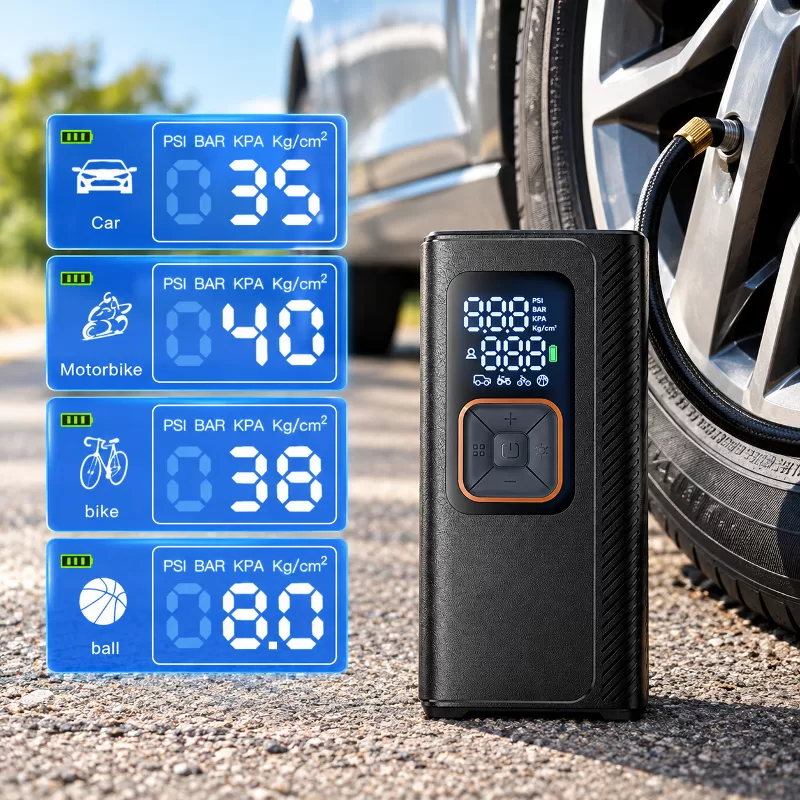
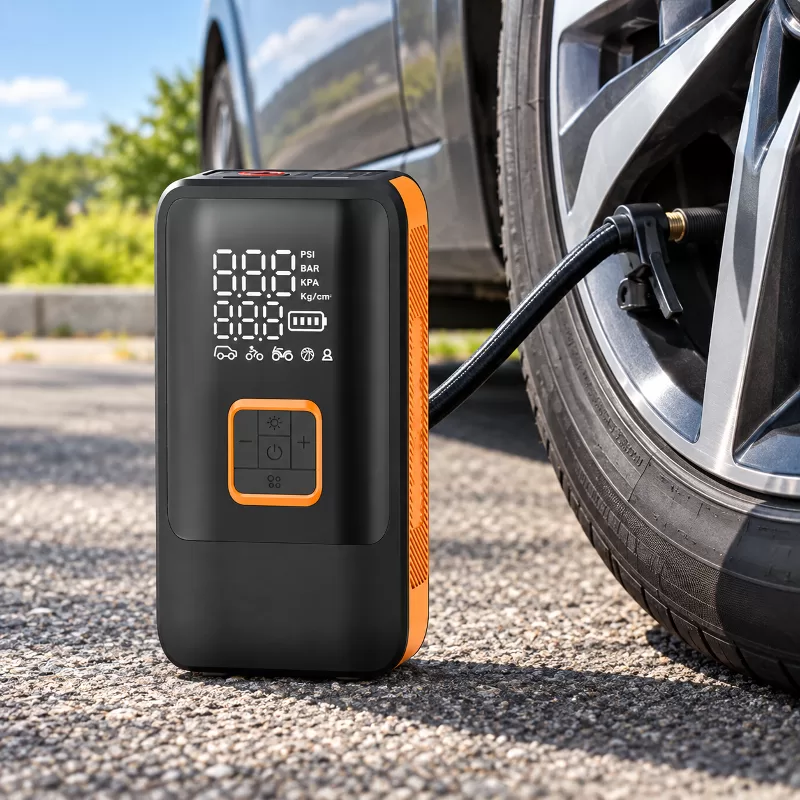
A dual LED display presents real-time pressure, preset targets, pressure units, and remaining battery levels. The firmware includes five preset modes alongside custom pressure setting capabilities, allowing users to adapt the device to various inflation tasks. Once the selected target is reached, the automatic shut-off feature stops operation.
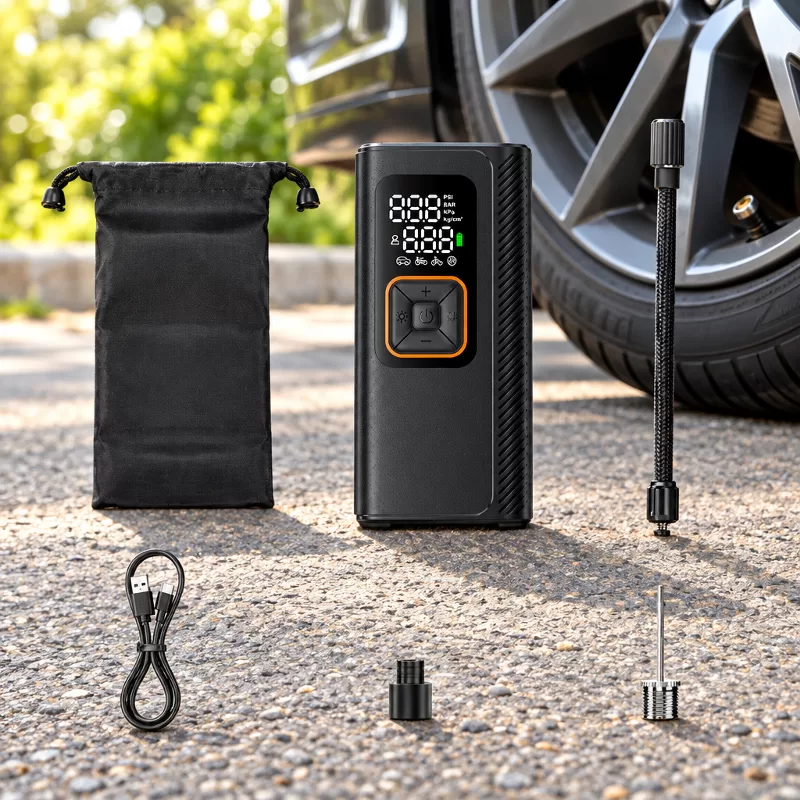
The hardware package includes a 320 mm braided air hose, a Type-C charging cable, a Presta valve adapter, and a ball needle, all stored in a protective drawstring bag. These accessories ensure compatibility with automotive Schrader stems, cycling Presta valves, sports equipment, and mobility devices without requiring third-party adapters.
Operational Lifespan, Thermal Management, and Storage Discipline
Thermal Duty Cycles and Heat Dissipation Practices
Reciprocating air pumps generate mechanical and compression heat between the piston seal and cylinder wall. Operating a compact inflator continuously under heavy resistance causes heat accumulation within the cylinder block and motor windings. Observing careful duty practices preserves internal seals and ensures reliable long-term operation.
- Follow Stated Runtime Boundaries: Refer to the manufacturer’s approximate runtimes (about 20 minutes for 3-cell, about 30 minutes for 4-cell) and avoid continuous running beyond recommended manual limits.
- Observe Intermittent Rest Periods: If the pump body or hose fitting feels excessively hot, power down the device and allow the housing to cool before continuing.
- Direct Port Handling Caution: Avoid touching the metal hose connection immediately after a high-pressure cycle, as thermal energy concentrates at the discharge outlet.
- Unobstructed Ventilation: Keep dust, road grit, and moisture away from the intake vents while placing the pump on road shoulders.
Battery Maintenance Across Extreme Vehicle Climates
Automotive interiors and luggage compartments experience wide temperature fluctuations throughout the year. Parked vehicles exposed to direct summer sunlight can reach interior temperatures above 60°C (140°F), accelerating chemical degradation inside lithium-ion cells. In freezing winter weather, cold slows internal electrochemical reactions, temporarily lowering effective discharge efficiency.
Store the inflator inside a glove box, console, or insulated utility tote to buffer against extreme temperature spikes. Check the battery charge level every few months, maintaining a moderate state of charge during extended storage. Avoid leaving the battery pack completely depleted for prolonged intervals, which helps preserve its 300-cycle design life.
Valve Seals and Storage Care
Tire inflator hoses rely on small elastomeric O-rings inside the brass connector to maintain an airtight seal against the tire stem. Regularly inspect these rubber seals for hardening, cracking, or grit contamination that could induce air leaks during inflation. Storing the hose coiled loosely prevents internal kink damage to its reinforced lining.
Always wipe down the braided hose and control panel before stowing the tool in its drawstring bag. Winter road salts can corrode metal fittings, while loose grit can damage internal valve threads. Clean, organized storage ensures the pump is immediately ready for routine maintenance or roadside emergencies.
Frequently Asked Questions (FAQs)
What cold pressure should I maintain in standard passenger car tyres?
Recommended cold tire pressure for modern passenger vehicles is vehicle-specific and should always be confirmed on the official vehicle placard located on the driver-side door B-pillar or in the owner’s manual. Never rely on the maximum pressure molded onto the tire sidewall, as that marking represents the tire’s structural safety ceiling, not the vehicle manufacturer’s engineered baseline for handling, braking, and tread wear.
Can a 160 PSI portable inflator damage standard car tyres?
A 160 PSI maximum rating does not mean the pump will force 160 PSI into a tire. Set the target to the vehicle placard’s recommended pressure, use automatic shut-off as a convenience rather than a substitute for checking, and verify the final pressure with a reliable gauge.
Can a portable inflator accurately double as a tyre pressure gauge?
Modern digital tire inflators feature pressure sensors that read static pressure when connected to a valve stem with the motor disengaged. When you screw the hose chuck securely onto the tire valve, the digital screen shows the current resting pressure. Drivers can use this display for quick checks, while consulting calibrated gauges whenever high-precision verification is necessary.
Is a portable pump capable of servicing high-pressure bicycle tyres and car tyres equally well?
Dual-cylinder portable pumps can handle both high-volume vehicle tires and high-pressure bicycle tires. While car tires require substantial air volume at moderate pressures, road bicycles demand smaller air volumes compressed to higher pressure thresholds. Utilizing the supplied Presta adapter allows the pump to service cycling tires without air leakage.
When is it dangerous to reinflate a flat tyre on the roadside?
Never attempt to reinflate a tire displaying sidewall bulges, structural plies tearing through rubber, deep cuts into the belt, or run-flat casing damage from rolling on a flat tire. Pumping air into a tire with compromised internal structural integrity can cause a violent rupture. In such instances, mount the spare wheel or summon professional roadside assistance.
Summary
Carrying a capable car tyre pump portable unit provides dependable daily maintenance while serving as vital equipment during unexpected roadside tire emergencies. By choosing an inflator engineered with a balanced dual-cylinder structure, auto shut-off precision, and versatile power inputs, motorists protect tire longevity, fuel economy, and driving safety across every season.
-

Meet NEWO at the 140th Canton Fair: Visit Booth 10.3 M03–04
Meet NEWO at the 140th Canton Fair in Guangzhou, October 15–19, 2026. Visit Booth 10.3 M03–04 to explore portable air pumps and discuss OEM, ODM and distribution opportunities.... -

As Shenzhen Welcomes the World for APEC 2026, NEWO Welcomes You to Our Factory
As Shenzhen prepares for APEC 2026, NEWO welcomes international buyers and partners to visit our factory, meet our team and explore future cooperation.... -

Leading the Way in Product Innovation and Excellence
Smartnewo exemplifies professionalism in product innovation and manufacturing. Their collaboration with Xiaomi Youpin on the G01 crowdfunding project highlights their expertise in creating compact, powerful inflatable pumps. Rigorous engineering, meticulous production processes, and advanced quality assurance underscore their commitment to excellence. The success of the G01 project, with significant market... -

Essential Qualities of an Excellent Supplier
In today's competitive market, finding a reliable supplier is crucial for business success. Based on insights from Smartnewo and broader internet research, here are key qualities an excellent supplier must possess:... -

NW06 Tire Inflator: Compact Power for Quick Inflation
Summary The NW06 Tire Inflator delivers quick and efficient tire inflation with a powerful 35L/min airflow. It features a user-friendly LCD screen for real-time pressure monitoring, dual power options with a built-in 6000mAh battery, and multiple nozzle attachments for versatile use. Its compact design and integrated LED light ensure convenience and... -

Unleash the Power of Portability: The SmartNewo Jump Starter with Air Compressor KF03
This guide will walk you through the steps to effectively use a portable tire inflator, helping you stay prepared and safe on the road.... -

Newo Attends The 2024 Consumer Electronics Show (CES)
Smartnewo booth is located at 53672, Halls A-D, Level 2, Venetian Expo, Las Vegas Convention Center (LVCC). ... -

Smartnewo’s Dual-Cylinder Air Pump Rocks the Hong Kong Autumn Electronics Fair!
Smartnewo’s Dual-Cylinder Air Pump Rocks the Hong Kong Autumn Electronics Fair!... -

Meet at the Canton Fair! Smartnewo brings dual-cylinder air pumps, making your inflation experience faster and more stable!
NEWO has went deep communication and negotiation with customers from all over the world on booth.... -

“Hong Kong Autumn Electronics Fair – 1CA18 (October 13th to 16th): Smartnewo invites you to visit our booth!
Hong Kong Autumn Electronics Fair...
-
What to Check Before Ordering Custom Electric Bike Pumps
Plan custom electric bike pumps with a clear requirements freeze for valves, TPU tubes, portability, repeated top-ups, charging, and model-specific documents.... -

OEM vs ODM Air Pumps: Which Manufacturing Model Fits Your Brand?
Compare OEM and ODM air pump projects by design responsibility, change approval, development scope, and written ownership terms before choosing your route.... -

How to Choose a Reliable Tire Inflator Manufacturer in China
Choose a tire inflator manufacturer in China with a focused RFQ, supplier evidence, configuration checks, and clear sample-to-pilot decisions for your brand.... -

Rechargeable Electric SUP Pump for Paddle Boards: Faster Inflation for SUPs, Kayaks and Inflatable Tents
The BL10-C Portable Electric Bike Tire Inflator is a compact and lightweight mini electric bike pump designed for modern cyclists. With up to 120 PSI pressure, a digital LED display, preset pressure control, automatic shut-off, USB-C charging, and multiple valve adapters, BL10-C offers a convenient inflation solution for road bikes,... -

Are Electric Bike Pumps Worth It in 2026? Electric Pump vs CO₂ vs Mini Hand Pump
Discover whether electric bike pumps are worth it in 2026. This guide compares electric bike pumps, CO₂ inflators, and mini hand pumps for road cycling, gravel riding, commuting, and long-distance rides. Learn the pros, limitations, best use cases, and key features to look for before choosing the right portable tire... -
BL10-C Portable Electric Bike Tire Inflator: Small Size, Reliable Power for Every Ride
The BL10-C Portable Electric Bike Tire Inflator is a compact and lightweight mini electric bike pump designed for modern cyclists. With up to 120 PSI pressure, a digital LED display, preset pressure control, automatic shut-off, USB-C charging, and multiple valve adapters, BL10-C offers a convenient inflation solution for road bikes,... -

Why Mini Electric Bike Pumps Are Becoming Essential for Modern Cycling
Discover why mini electric bike pumps are becoming essential for modern cyclists. Learn how portable electric bike pumps improve tire pressure management, riding safety, and convenience.... -

The Ultimate Smart Solution for Easy Outdoor Adventures in 2026
Discover how a spring travel air pump simplifies outdoor trips with fast inflation, smart features, and powerful performance—perfect for every adventure.... -

Powerful 5-in-1 Portable Car Tire Inflator and Jump Starter: The Ultimate Emergency Tool for Every Driver
Why Every Driver Needs a Portable Car Tire Inflator and Jump Starter Modern drivers face many unexpected situations on the road. A flat tire, low tire pressure, or a dead car battery can happen at the worst possible time. That’s why having a portable car tire inflator and jump starter is... -

7 Real Cycling Scenarios That Show Why Every Rider Should Carry a Mini Bike Pump
Cycling is one of the most freeing activities you can enjoy. Whether you’re commuting to work, riding through city streets, or exploring quiet countryside roads, a bike ride can instantly improve your day. But there’s one small problem that almost every cyclist eventually faces: Low tire pressure. It might happen...
-

How Is a Football Properly Inflated?
The correct inflation of a football - with not too much and not too little air - is a hotly debated topic among footballers.... -

Application Scenarios of Car Inflator Pump
Often long-distance business trips or play car owners because the road may be more remote areas, in this case if you encounter a tire leak....