

 Portable Tire Inflators
 Electric Air Pumps
 Electric Car Tyre Pumps
 Electric Ball Pumps
 Electric Bike Pump
 SUP Air Pump

Car Portable Tire Inflator Guide: Pressure Science, Selection, and Safe Roadside Operation
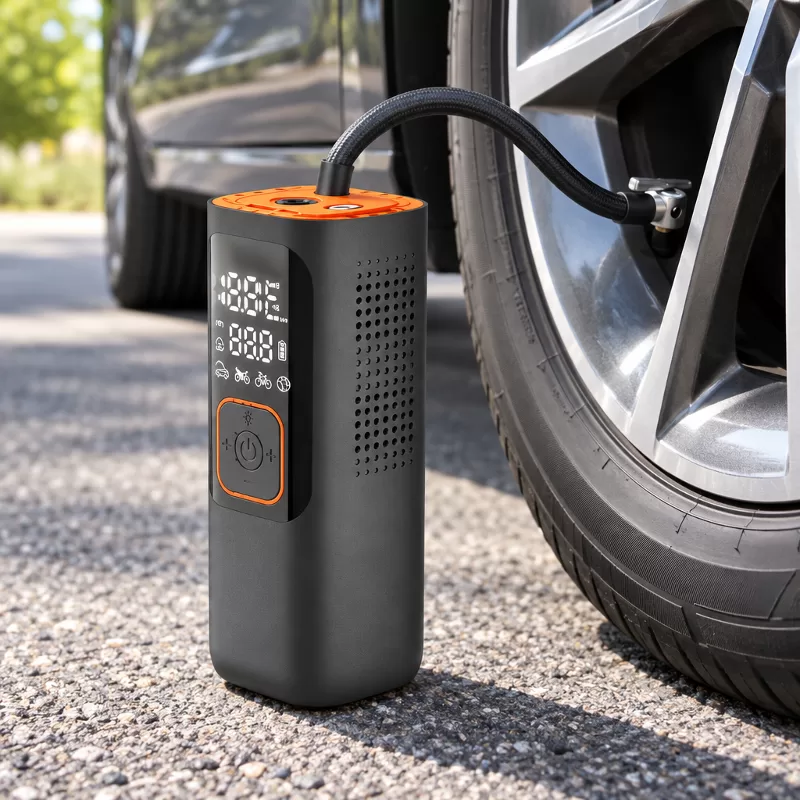
Every driver eventually confronts an unexpected low-pressure warning light on the dashboard. When seasonal temperatures drop or an errant screw pierces the tread on an isolated backroad, having an electric car portable tire inflator in the trunk can make some low-pressure situations easier to manage without immediately seeking a service station or roadside-assistance provider. A compact car portable tire inflator delivers pneumatic pressure on demand, providing a practical tool for drivers who need to maintain target pressure.
Understanding how these compact motorized pumps operate, what their internal mechanisms can achieve, and how their pressure ratings interact with vehicle safety recommendations helps motorists make sensible purchasing and maintenance choices.
Search Intent and Driver Requirements
Primary Intent: Restoring Vehicle Drivability
When people search for a car portable tire inflator, their primary objective is regaining pneumatic pressure quickly and cleanly without mechanical complexity. Most consumers do not need commercial pneumatic shop gear. Instead, many consumers look for a portable unit that is easy to store in the vehicle. Confirm the product’s dimensions and power requirements before assuming it fits a particular compartment.
Motorists want reassurance that if their tire loses pressure overnight or during a highway commute, they can attach a nozzle, enter a target setting, and safely inflate the tire back to factory specifications. Compact dimensions and straightforward controls dominate their criteria.
Supporting Intent: Evaluating Speed, Capacity, and Power Delivery
Beyond basic functionality, vehicle owners compare internal pump architecture, flow rates, and operating mechanisms. Drivers wonder whether a miniature compressor can handle repeated top-ups on large vehicle tires or withstand continuous duty without thermal throttling.
They investigate whether internal batteries provide enough energy for multiple tires, or if a dedicated 12V direct-current vehicle port connection offers greater consistency. Prospective buyers also seek verification regarding adapter compatibility across bicycles, commuter e-bikes, light utility vehicles, and household sports equipment.
Product-Specific Intent: Evaluating Dedicated Compact Options
Users reviewing designated products like the WG01 assess how structured mechanical assemblies translate into daily practical inflation tasks. They look for verifiable motor ratings, cylinder volume, display legibility in bright sunlight, and built-in cord storage.
Shoppers compare published airflow parameters against typical car tire volumes to understand realistic operating expectations. Clear documentation prevents unexpected performance gaps when working in freezing weather or dark roadside conditions.
What a Car Portable Tire Inflator Can and Cannot Do
Everyday Pressure Top-Ups and Seasonal Adjustments
Tire pressure changes with temperature. As a practical rule, pressure may change by about 1 PSI for every 10–12°F change, although the exact change varies. Check pressure when the tires are cold.
A personal car portable tire inflator allows motorists to balance pressure in their own driveways before driving, which represents the only true method for taking a cold tire pressure reading. Adjusting tires while cold ensures tread patterns make optimal road contact and prevents premature shoulder wear.
Slow Leak Management During Roadside Emergencies
A tread puncture may cause a slow leak, but it can also lose pressure rapidly. Treat any unexplained pressure loss as a potential tire-safety problem and inspect the tire before driving.
If the tire has no visible structural damage and a qualified tire professional or the vehicle manufacturer’s instructions permit limited travel, adding air may help you reach a nearby service location. Do not assume restored pressure makes a damaged or repeatedly leaking tire safe.
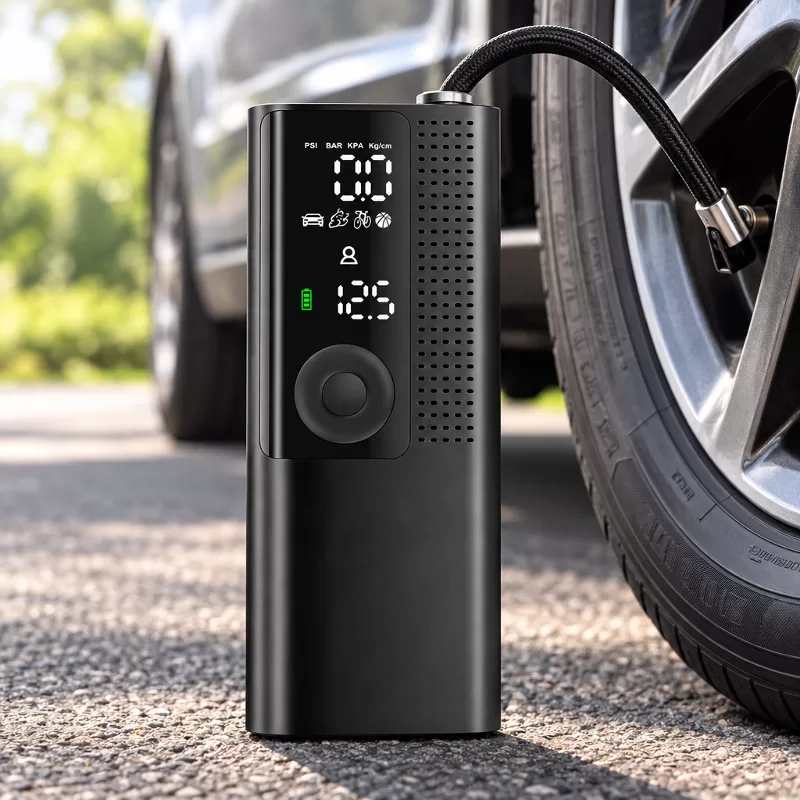
Structural Limitations: Catastrophic Ruptures and Bead Separation
Drivers must understand that no pneumatic inflator repairs mechanical structural failure. If a tire suffers sidewall tearing, bead unseating, or large blowout holes, running an electric air pump is pointless and hazardous.
Do not inflate or drive on a tire with a sidewall cut, bulge, bead separation, exposed cords, or other structural damage. Move to a safe location and use the spare tire or call roadside assistance.
Key Technical Features to Evaluate Before Purchase
Maximum Rated Pressure versus Practical Vehicle Requirements
Many compact inflators advertise maximum output ratings reaching 120 or 150 PSI. However, standard passenger sedans, crossover utility vehicles, and family minivans often specify operating pressures between 30 and 36 PSI. Always use the exact cold pressure on the vehicle placard or in the owner’s manual.
A maximum pressure specification is a pressure-capacity rating. It does not, by itself, establish airflow or inflation speed across practical everyday vehicle tasks. Understanding this distinction prevents buyers from conflating maximum static pressure with volumetric airflow delivery.
| Equipment / Inflatable Category | Illustrative Pressure Range | Volume Demand | Recommended Inflator Focus |
|---|---|---|---|
| Passenger Cars & Crossovers | 30 – 36 PSI (Check Placard) | High Air Volume | Steady airflow (20+ L/min), thermal dissipation |
| Compact City Bicycles | Example: 40 – 65 PSI (Check Tire) | Moderate Air Volume | Standard nozzle compatibility, flexible hose |
| High-Pressure Road Bikes | Example: 80 – 110 PSI (Check Tire) | Low Air Volume | High PSI tolerance, fine-increment gauge |
| Motorcycles & E-Bikes | Example: 28 – 42 PSI (Check Manual) | Moderate Air Volume | Guided mode settings, compact storage |
| Sports Balls | Example: 4 – 12 PSI (Check Ball) | Low Air Volume | Low-pressure support, adapter needle |
Note: Use the pressure printed on the tire, ball, or equipment specification; application compatibility does not establish one universal pressure.
Volumetric Airflow and Thermal Dissipation
Airflow is one factor affecting inflation time. Actual results also depend on tire volume, starting pressure, operating conditions, and the manufacturer’s limits. The manufacturer lists 20–22 L/min airflow for the WG01, but real-world inflation performance varies with load.
Compressing atmospheric gas generates thermal energy within the cylinder head due to rapid mechanical friction and pneumatic compression. Look for clear manufacturer guidance on ventilation, operating limits, and cool-down periods to exhaust heat safely and avoid premature motor cutoff.
Display Interface, Presets, and Automatic Shut-Off
Analog dial gauges rely on internal mechanical Bourdon springs that can drift out of calibration when dropped onto hard pavement. Digital inflators use electronic pressure measurement and display a numeric reading, but accuracy depends on the specific sensor and calibration. Check the manufacturer’s accuracy information when available.
The WG01 is specified to stop automatically when the selected pressure is reached. Follow the vehicle or tire manufacturer’s pressure guidance and verify the final pressure; automatic shut-off does not guarantee protection against every inflation error or tire failure.
Power Architecture: Dedicated Battery versus Direct Vehicle Power
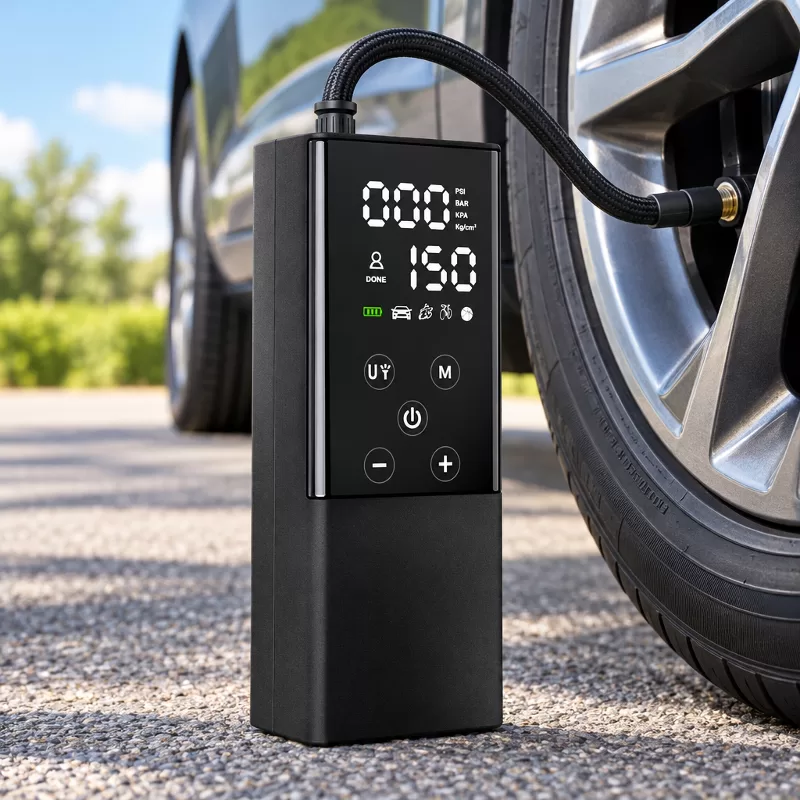
Choosing between an internal rechargeable lithium battery and a 12V automotive cigarette lighter cable involves balancing physical convenience against limitless operating time. Internal batteries eliminate loose cords running across dirty vehicle bodywork.
Cold conditions can reduce the available performance of rechargeable batteries. If a product uses an internal battery, follow its storage and temperature guidance and keep it charged; do not assume reliable operation below the manufacturer’s stated limits.
Practical Decision Matrix for Inflator Selection
[Identify Primary Vehicle Requirement]
       │
       ├─ Passenger Cars / Light Commuting ───► Compare Airflow Rates & Auto Shut-off Features
       │
       ├─ Multi-Modal (Cars, Bicycles, Balls) ──► Check Guided Multi-Mode Interface & Required Adapters
       │
       └─ Heavy Commercial / Oversized 4x4 ────► Review Equipment Specifically Rated for Heavy Tires
Step 1: Confirm Vehicle Placard Specifications
Never guess your operating parameters based on general internet forums. Check the vehicle’s Tire and Loading Information label, usually on the driver’s door edge or door pillar, or consult the owner’s manual.
The placard provides the vehicle manufacturer’s recommended cold inflation pressure for the listed tire sizes and loading conditions. Keep this target number in mind when checking compressor preset ranges.
Step 2: Establish Your Primary Application Scope
For mixed use, look for a guided interface and a pressure range suitable for the intended tires. The WG01 is specified for 2–150 PSI and includes guided mode and wheel-position operation.
For remote backcountry travel or heavy off-road vehicles with oversized light-truck tires, small pocket units will struggle with massive air displacement. Select equipment explicitly rated by its manufacturer for heavy tires or repeated operation.
Step 3: Examine Form Factor and Hose Management
Roadside stress multiplies when you must untangle stiff air hoses or look for misplaced screw adapters in the dark. Pumps designed with integrated internal hose bays prevent connector contamination from grit, dirt, and road salt.
Compact dimensions allow the inflator to fit within spare tire recesses, motorcycle panniers, or underseat storage trays. Clutter-free packaging makes routine seasonal checks far more likely to occur.
Product Spotlight: Portable Tire Inflator 150PSI WG01
Verified Mechanical Specifications and Output Architecture
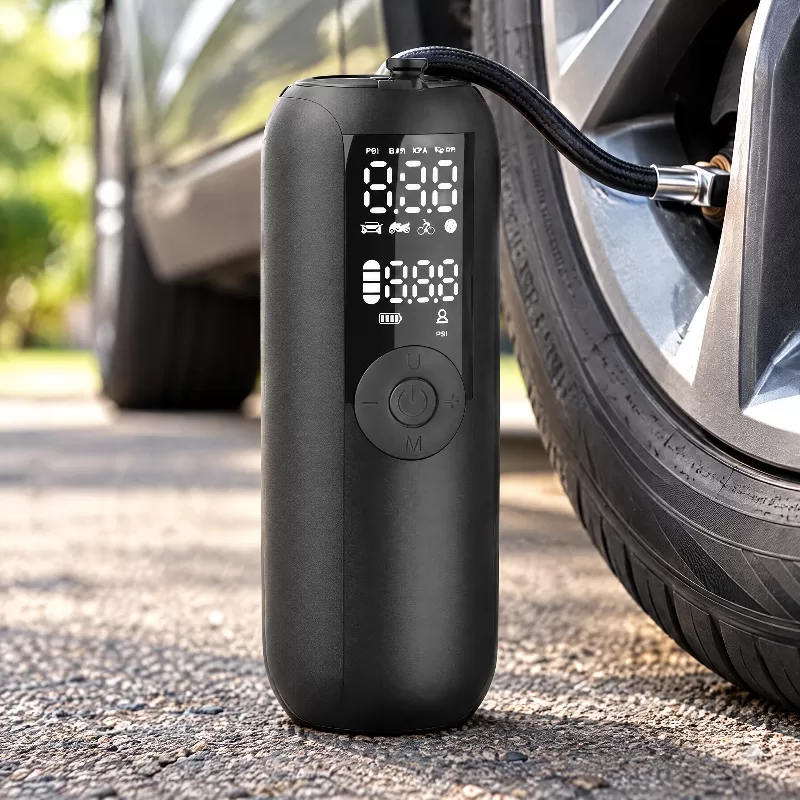
The Portable Tire Inflator 150PSI WG01 is engineered for everyday pneumatic top-ups across passenger cars, commuter bikes, and utility applications. Built around a 17-cylinder air-pump structure, the drive mechanism operates on 35W of power to maintain practical airflow balance.
According to manufacturer technical data, the WG01 supplies between 20 and 22 L/min of airflow. Its pressure range spans from 2 up to 150 PSI, accommodating delicate low-pressure athletic equipment as well as high-resistance bicycle tires.
| Technical Attribute | Manufacturer Specification | Operational Significance |
|---|---|---|
| Maximum pressure | 150 PSI | Accommodates passenger cars, motorcycles, and high-pressure bicycles |
| Pressure range | 2 – 150 PSI | Covers manufacturer-listed range; use ball maker’s specified pressure and adapter |
| Airflow | 20 – 22 L/min | Manufacturer-listed airflow figure for practical top-ups |
| Cylinder structure | 17-cylinder | Manufacturer-listed pump structure |
| Power | 35W | Manufacturer-listed power specification |
| Display and control | Special LED interface | Guided mode and wheel-position operation for clear selection |
| Shut-off function | Automatic shut-off | Automatically cuts motor when selected target pressure is reached |
| Hose storage | Built-in hose storage | Keeps the hose integrated with the pump body for organized storage |
Multi-Application Compatibility
Versatility remains central to the WG01 architecture. The WG01 is listed for sports balls and wheelchair tires, but users must follow the pressure marked by the ball or tire manufacturer and use the correct adapter. The 2–150 PSI range does not guarantee safe inflation of every item.
Transitioning from household recreation to urban transport is handled smoothly. The listed pressure range covers many bicycle, e-bike, wheelchair, and scooter applications, subject to the tire’s specified pressure and the connector or adapter supplied with the unit. Use the connector and adapters supplied with the specific package, and confirm compatibility before purchase.
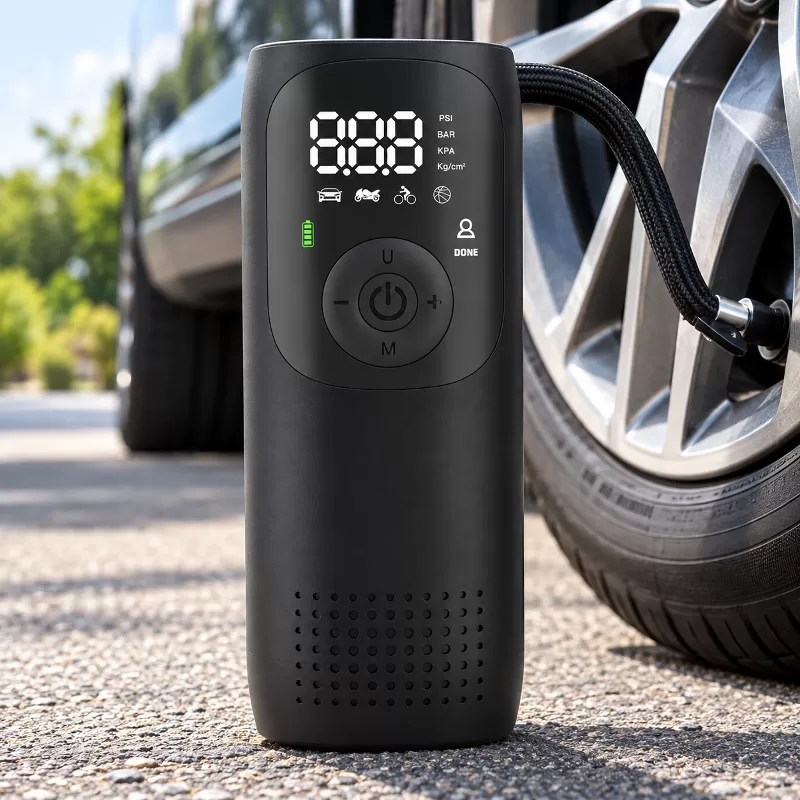
Guided LED Interface and Integrated Storage
The WG01 has a guided LED interface for mode and wheel-position operation. The supplied product information does not specify preset pressure values or display accuracy.
The WG01 is specified to stop automatically when the selected target pressure is reached. The available product information does not specify the sensor or switching components used. The internal hose storage bay encloses the air conduit directly within the housing, keeping threads free of road debris.
As a professional manufacturer specializing in the research, development, and production of smart electric air pumps and portable inflation solutions, Newo pairs pneumatic engineering with strict quality management across products ranging from electric bike pumps to car air pumps and outdoor equipment, and for us, creating dependable gear remains essential for drivers worldwide.
Step-by-Step Guide: Safe Roadside Tire Inflation
Step 1: Ensure Vehicle Safety and Access the Valve
Park your vehicle on solid, level ground well away from moving traffic. Engage the emergency parking brake, switch on hazard flashers, and place roadside safety reflectors behind the vehicle if stopped along a highway shoulder.
Locate the tire valve stem on the under-inflated wheel and remove the protective dust cap. Store the cap safely in your pocket or vehicle console so it is not lost in roadside gravel.
[Park Safely & Apply Brake] ──► [Unscrew Stem Dust Cap] ──► [Firmly Seat Inflator Chuck]
                                                                       │
[Inspect Tire for Cuts/Damage] ◄── [Auto Shut-Off Completes] ◄── [Select Target Placard PSI]
Step 2: Establish an Airtight Mechanical Coupling
Pull the inflation hose from the storage bay. Connect the supplied chuck or fitting squarely to the valve stem and confirm that the unit displays a pressure reading, if supported by the specific model and package.
If you hear persistent hissing, the chuck is improperly seated or angled. Unscrew the fitting slightly, align the connector parallel to the stem, and tighten until the connection is completely sealed.
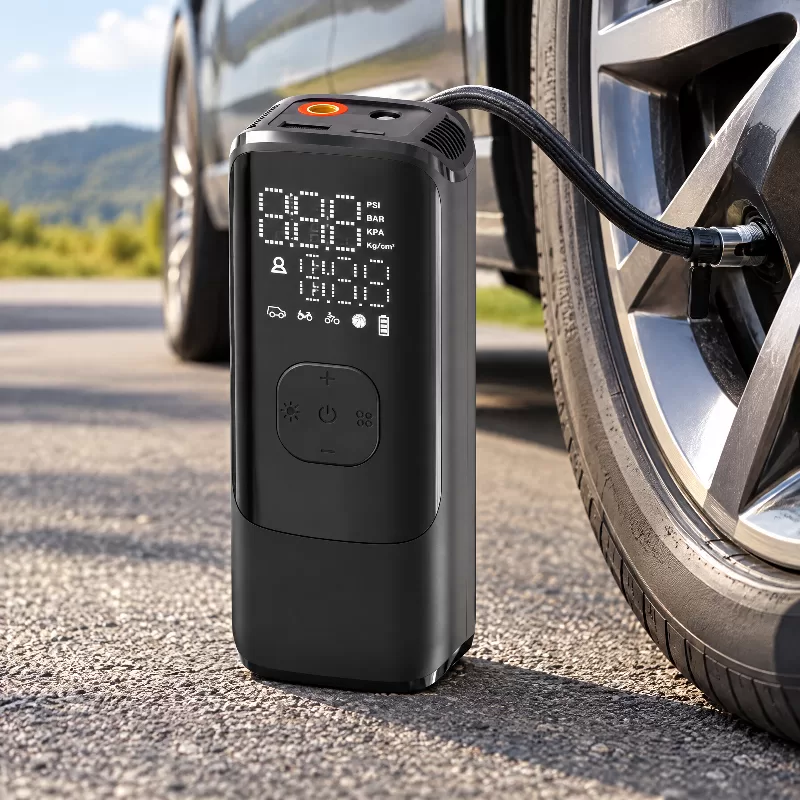
Step 3: Program the Placard Value and Monitor Inflation
Power on the digital display. Check the Tire and Loading Information label on the driver’s door edge or pillar, or consult the owner’s manual. Use the mode selectors or plus/minus interface buttons to enter the exact manufacturer-recommended pressure.
Initiate the compressor motor. Step back slightly while keeping an eye on the digital pressure readout as internal pistons force air into the tire cavity. Avoid resting the unit on wet snow, thick mud, or loose sand where debris could enter internal motor ventilation ports.
Step 4: Verify Final Pressure and Reinstall Dust Cap
When the inflator reaches the programmed threshold, the automatic shut-off logic stops the motor. After shut-off, allow the reading to stabilize, then verify the pressure with a suitable gauge when practical.
Carefully unscrew the hose fitting from the tire stem. A brief puff may occur when the chuck is removed. If air continues to hiss or the pressure drops noticeably, inspect the chuck, valve core, and tire before driving. Immediately reinstall the plastic or metal dust cap tightly to help keep dirt and moisture away from the valve.
Common Tire Inflation Mistakes to Avoid
Following the Sidewall Maximum Instead of the Vehicle Placard
A common inflation mistake is using the maximum pressure marked on the tire sidewall instead of the vehicle’s recommended pressure. The sidewall maximum is the tire’s maximum permissible inflation pressure, not the vehicle manufacturer’s recommended cold pressure. Use the vehicle placard or owner’s manual for the vehicle setting.
Inflating an ordinary passenger tire to its maximum sidewall pressure creates a harsh, jarring ride, prolongs braking distances, and bows the center tread outward. Always follow the vehicle door pillar placard to preserve engineered handling dynamics and even tread wear.
Checking Tires When Hot After Highway Travel
Friction between highway asphalt and rolling tire tread generates significant internal heat, raising internal air pressure by three to five PSI during normal travel. If you check hot tires at a rest stop, the gauge will display an artificially elevated number.
If you vent air from a hot tire to match the door sticker, that tire will become dangerously under-inflated once rubber cools down to ambient temperatures. Always evaluate tire pressure when the vehicle has been stationary for at least three hours.
Over-Torquing Valve Stems and Neglecting Dust Caps
Modern vehicles utilize Tire Pressure Monitoring System (TPMS) sensors incorporated directly into the base of valve stems. Avoid bending or applying excessive force to the valve stem, and consult the vehicle or sensor manufacturer’s guidance during maintenance.
Screw inflator chucks down hand-tight until the seal seats securely without yanking or bending the stem sideways. Replace the valve cap to help keep dirt and moisture away from the valve.
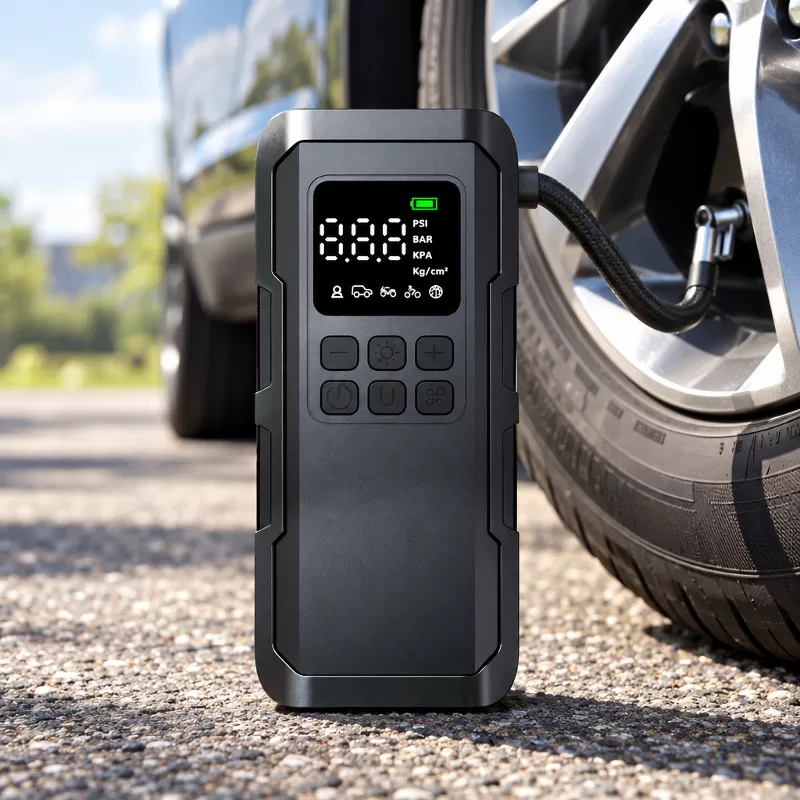
Essential Emergency Roadside Preparedness Kit
Combining Air Delivery with Mechanical Seal Solutions
A car portable tire inflator works best when paired with complementary roadside repair tools. A puncture kit may be an emergency-only measure where permitted by the tire and vehicle manufacturer, but it is not a substitute for professional repair. Proper repair requires removing the tire for internal inspection; a plug alone is not an acceptable permanent repair.
Carrying a dependable dual-head pencil gauge or standalone digital gauge lets you cross-check compressor readouts. Work gloves and an LED headlamp ensure you can work safely around hot brakes and dark roadways.
- Pneumatic Equipment: Portable 12V or rechargeable digital tire inflator with adapter nozzles.
- Puncture Repair: Butyl rubber tire plug kit with insertion T-handles and vulcanizing cement for temporary use.
- Secondary Gauge: High-accuracy standalone tire pressure gauge for measurement cross-checks.
- Personal Safety Gear: High-visibility reflective vest, insulated mechanics work gloves, and an adjustable LED headlamp.
- Valve Hardware: Spare brass Schrader valve cores, a four-way core removal tool, and replacement dust caps.
FAQs
What cold tire pressure should I use for my car tires?
Always check the Tire and Loading Information label on the driver’s door edge or pillar, or consult the owner’s manual. Most standard passenger sedans require between 30 and 35 PSI cold inflation pressure. Never inflate to the maximum pressure stamped on the tire sidewall rubber, as that number represents the tire’s maximum permissible pressure rather than the vehicle manufacturer’s engineered operational target.
Can a 150 PSI inflator safely inflate standard passenger car tires?
A 150 PSI rating states the manufacturer-listed maximum pressure for the inflator; it does not mean the vehicle tire should be inflated to 150 PSI. Because inflators like the WG01 feature integrated digital controls and automatic shut-off mechanisms, you simply program your vehicle’s specific 32 or 35 PSI target. The pump stops once reaching that threshold, helping operators avoid overshooting the target.
Can a portable tire inflator fix a completely flat tire on the roadside?
A portable inflator can re-inflate a tire suffering from a slow leak caused by a nail or screw, providing enough pressure to drive safely to a nearby tire service shop if allowed by manufacturer guidelines. However, if the tire has unseated from the wheel bead, suffered a sidewall blowout, or sustained a large gash, an inflator cannot help. In those instances, install a mechanical spare wheel or call roadside towing services.
How does the automatic shut-off feature on a portable inflator work?
The automatic shut-off feature monitors real-time pneumatic pressure within the air conduit and automatically cuts power to the motor once the preset pressure value is met. The WG01 is specified to stop automatically when the selected target pressure is reached. The automatic shut-off is intended to stop the unit at the selected target, but users should still use the correct vehicle or tire pressure and verify the final reading.
Is the WG01 tire inflator suitable for sports balls and bicycles?
Yes, the WG01 features a broad working pressure range starting at 2 PSI up to 150 PSI. The WG01 is listed for sports balls and wheelchair tires, but users must follow the pressure marked by the ball or tire manufacturer and use the correct adapter. The listed pressure range covers many bicycle, e-bike, wheelchair, and scooter applications, subject to the tire’s specified pressure and the connector or adapter supplied with the unit.
What is the advantage of built-in hose storage on a portable compressor?
Integrated hose storage houses the flexible high-pressure air hose directly within the pump casing. This layout protects sensitive brass screw threads from collecting road grit, prevents hose crimping during trunk transit, and ensures all essential components remain organized together when you need to handle an unexpected roadside emergency.
Final Recommendations for Motorists
Maintaining correct tire pressure remains one of the simplest, most effective habits for ensuring vehicle safety, optimizing braking distances, and maximizing fuel economy. Under-inflated tires increase rolling resistance, causing excessive heat accumulation within internal tire belts that can lead to catastrophic tread failure at highway speeds.
Investing in a reliable car portable tire inflator gives drivers independence from out-of-order gas station air pumps and unpredictable roadside waits. The WG01 is specified with 20–22 L/min airflow, a 2–150 PSI pressure range, guided LED operation, and automatic shut-off. Actual performance depends on the tire and operating conditions. Keeping a dedicated car portable tire inflator in your vehicle transforms routine maintenance into a fast, manageable task while keeping every journey safe and dependable.
-

Meet NEWO at the 140th Canton Fair: Visit Booth 10.3 M03–04
Meet NEWO at the 140th Canton Fair in Guangzhou, October 15–19, 2026. Visit Booth 10.3 M03–04 to explore portable air pumps and discuss OEM, ODM and distribution opportunities.... -

As Shenzhen Welcomes the World for APEC 2026, NEWO Welcomes You to Our Factory
As Shenzhen prepares for APEC 2026, NEWO welcomes international buyers and partners to visit our factory, meet our team and explore future cooperation.... -

Leading the Way in Product Innovation and Excellence
Smartnewo exemplifies professionalism in product innovation and manufacturing. Their collaboration with Xiaomi Youpin on the G01 crowdfunding project highlights their expertise in creating compact, powerful inflatable pumps. Rigorous engineering, meticulous production processes, and advanced quality assurance underscore their commitment to excellence. The success of the G01 project, with significant market... -

Essential Qualities of an Excellent Supplier
In today's competitive market, finding a reliable supplier is crucial for business success. Based on insights from Smartnewo and broader internet research, here are key qualities an excellent supplier must possess:... -

NW06 Tire Inflator: Compact Power for Quick Inflation
Summary The NW06 Tire Inflator delivers quick and efficient tire inflation with a powerful 35L/min airflow. It features a user-friendly LCD screen for real-time pressure monitoring, dual power options with a built-in 6000mAh battery, and multiple nozzle attachments for versatile use. Its compact design and integrated LED light ensure convenience and... -

Unleash the Power of Portability: The SmartNewo Jump Starter with Air Compressor KF03
This guide will walk you through the steps to effectively use a portable tire inflator, helping you stay prepared and safe on the road.... -

Newo Attends The 2024 Consumer Electronics Show (CES)
Smartnewo booth is located at 53672, Halls A-D, Level 2, Venetian Expo, Las Vegas Convention Center (LVCC). ... -

Smartnewo’s Dual-Cylinder Air Pump Rocks the Hong Kong Autumn Electronics Fair!
Smartnewo’s Dual-Cylinder Air Pump Rocks the Hong Kong Autumn Electronics Fair!... -

Meet at the Canton Fair! Smartnewo brings dual-cylinder air pumps, making your inflation experience faster and more stable!
NEWO has went deep communication and negotiation with customers from all over the world on booth.... -

“Hong Kong Autumn Electronics Fair – 1CA18 (October 13th to 16th): Smartnewo invites you to visit our booth!
Hong Kong Autumn Electronics Fair...
-

What to Check Before Ordering Custom Electric Bike Pumps
Plan custom electric bike pumps with a clear requirements freeze for valves, TPU tubes, portability, repeated top-ups, charging, and model-specific documents.... -

OEM vs ODM Air Pumps: Which Manufacturing Model Fits Your Brand?
Compare OEM and ODM air pump projects by design responsibility, change approval, development scope, and written ownership terms before choosing your route.... -

How to Choose a Reliable Tire Inflator Manufacturer in China
Choose a tire inflator manufacturer in China with a focused RFQ, supplier evidence, configuration checks, and clear sample-to-pilot decisions for your brand.... -

Rechargeable Electric SUP Pump for Paddle Boards: Faster Inflation for SUPs, Kayaks and Inflatable Tents
The BL10-C Portable Electric Bike Tire Inflator is a compact and lightweight mini electric bike pump designed for modern cyclists. With up to 120 PSI pressure, a digital LED display, preset pressure control, automatic shut-off, USB-C charging, and multiple valve adapters, BL10-C offers a convenient inflation solution for road bikes,... -

Are Electric Bike Pumps Worth It in 2026? Electric Pump vs CO₂ vs Mini Hand Pump
Discover whether electric bike pumps are worth it in 2026. This guide compares electric bike pumps, CO₂ inflators, and mini hand pumps for road cycling, gravel riding, commuting, and long-distance rides. Learn the pros, limitations, best use cases, and key features to look for before choosing the right portable tire... -
BL10-C Portable Electric Bike Tire Inflator: Small Size, Reliable Power for Every Ride
The BL10-C Portable Electric Bike Tire Inflator is a compact and lightweight mini electric bike pump designed for modern cyclists. With up to 120 PSI pressure, a digital LED display, preset pressure control, automatic shut-off, USB-C charging, and multiple valve adapters, BL10-C offers a convenient inflation solution for road bikes,... -

Why Mini Electric Bike Pumps Are Becoming Essential for Modern Cycling
Discover why mini electric bike pumps are becoming essential for modern cyclists. Learn how portable electric bike pumps improve tire pressure management, riding safety, and convenience.... -

The Ultimate Smart Solution for Easy Outdoor Adventures in 2026
Discover how a spring travel air pump simplifies outdoor trips with fast inflation, smart features, and powerful performance—perfect for every adventure.... -

Powerful 5-in-1 Portable Car Tire Inflator and Jump Starter: The Ultimate Emergency Tool for Every Driver
Why Every Driver Needs a Portable Car Tire Inflator and Jump Starter Modern drivers face many unexpected situations on the road. A flat tire, low tire pressure, or a dead car battery can happen at the worst possible time. That’s why having a portable car tire inflator and jump starter is... -

7 Real Cycling Scenarios That Show Why Every Rider Should Carry a Mini Bike Pump
Cycling is one of the most freeing activities you can enjoy. Whether you’re commuting to work, riding through city streets, or exploring quiet countryside roads, a bike ride can instantly improve your day. But there’s one small problem that almost every cyclist eventually faces: Low tire pressure. It might happen...
-

How Is a Football Properly Inflated?
The correct inflation of a football - with not too much and not too little air - is a hotly debated topic among footballers.... -

Application Scenarios of Car Inflator Pump
Often long-distance business trips or play car owners because the road may be more remote areas, in this case if you encounter a tire leak....