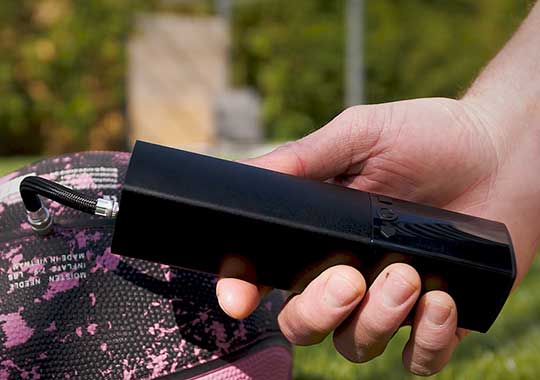

 Portable Tire Inflators
 Electric Air Pumps
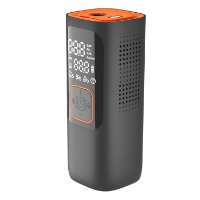 Electric Car Tyre Pumps
 Electric Ball Pumps
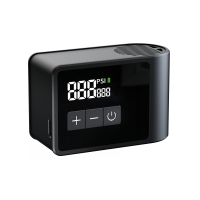 Electric Bike Pump
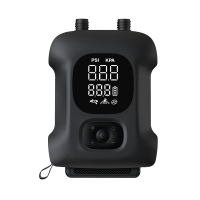 SUP Air Pump

Complete Engineering Guide to the Portable Digital Air Pump
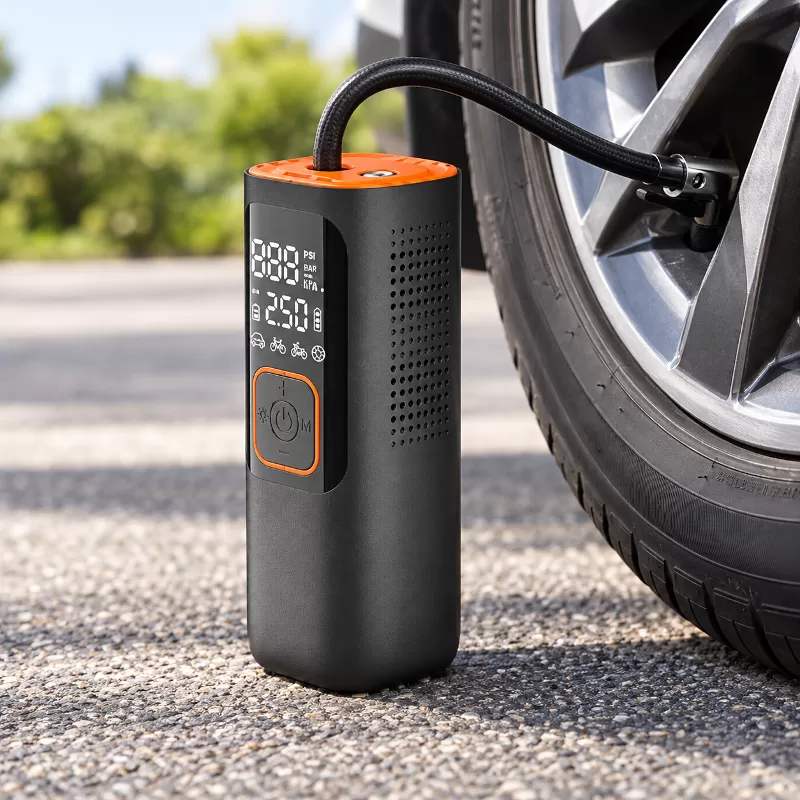
Maintaining correct pneumatic pressure across passenger vehicles, bicycles, and personal mobility gear is essential for overall road safety, optimal energy efficiency, and extended tire tread longevity. When tires drop below their specified pressure thresholds, drivers and cyclists frequently search for a dependable portable digital air pump to handle routine pressure adjustments without relying on broken gas station air hoses or exhausting manual floor pumps. Modern handheld inflators solve this problem by integrating digital pressure displays, rechargeable battery packs, and electric motor assemblies into compact housings that travel anywhere with ease.
Selecting the right cordless inflator requires an understanding of pneumatic performance, realistic airflow rates, and appropriate operational duty cycles. Rather than relying on guesswork or visual tire deformation, digital systems offer automated pressure cut-offs and real-time readouts that help prevent under-inflation and over-inflation. By understanding the mechanical reality of these compact tools, users can select appropriate equipment for their daily maintenance routines and keep their vehicles operating within recommended manufacturer parameters.
Understanding Search Intent and Inflation Realities
What Drives the Need for a Portable Inflator
Tire pressure drops steadily over time through natural rubber permeation, ambient temperature shifts, and minor imperfections around valve stems. Tire pressure changes with ambient temperature; a commonly used estimate across the industry is roughly 1 PSI for every 10 to 12 degrees Fahrenheit of temperature shift, although exact changes vary based on tire volume and environmental conditions. Drivers often discover low pressure warnings at inconvenient times, far from workshop compressors or functional service station lines.
A handheld cordless inflator bridges this gap by providing self-contained, pressure-regulated inflation at any location. Instead of hunting for roadside air towers that frequently suffer from damaged chucks or inaccurate mechanical gauges, users can address pressure warnings immediately from their driveway or trunk. This self-reliance provides practical convenience during daily commutes and long highway trips, ensuring that tires can be inspected and inflated whenever weather conditions cause unexpected pressure losses.
Core Problems Solved by Cordless Compressors
Traditional inflation options force users to choose between cumbersome manual floor pumps and fixed electrical compressors. Hand pumps demand considerable physical effort and struggle to deliver the steady volume required for passenger car tires. Heavy-duty workshop compressors require alternating-current wall outlets or tangle-prone 12-volt automotive cords that may not easily reach rear wheels or trailing equipment on larger vehicles or loaded trailers.
The cordless design reduces manual effort and combines inflation with digital pressure measurement, although a separate reliable gauge may still be useful for verification. Eliminating trailing cords provides untethered freedom around the vehicle perimeter, while integrated pressure displays simplify routine checks. Users can perform regular inflation maintenance without wrestling with long cables or searching for specialized tools across different garage corners or roadside emergency stops.
Distinguishing Real Capability from Marketing Claims
Consumers often encounter miniature compressors advertising peak pressure ratings up to 150 PSI, mistakenly assuming this equates to rapid inflation speeds on large vehicle tires. Pressure capability and free-air displacement represent entirely different pneumatic metrics that must not be confused during purchasing decisions. High maximum pressure does not necessarily mean high flow rate across varying pneumatic containers.
A 150 PSI specification indicates the manufacturer’s stated maximum pressure capability; it does not by itself indicate inflation speed, internal construction, or suitability for every high-pressure application. Filling large-volume automotive tires at moderate pressures requires volumetric flow, measured in liters per minute. Buyers must evaluate motor power and airflow delivery alongside maximum pressure ratings to avoid unrealistic operational expectations regarding tire fill times.
Mechanics of a Portable Digital Air Pump
Cylinder Architecture and Heat Dissipation
In typical small electric inflators, an electric motor drives a mechanical transmission that translates rotational force into the reciprocating stroke of a piston inside a compression cylinder. As ambient air compresses inside the chamber, mechanical work converts directly into heat. This thermal rise affects both the internal mechanical components and the air exiting into the connected hose assembly during routine operation.
Because compression generates thermal energy, structural ventilation is an essential design priority in compact housings. Many handheld units incorporate ventilation cutouts and internal air passages designed to dissipate operating heat during standard inflation routines. Following proper duty-cycle intervals prevents excessive heat buildup around the internal motor and helps keep the inflator within its recommended operating temperature parameters over extended use.
How Digital Sensing and Display Systems Function
Analog pressure gauges rely on mechanical Bourdon tubes or internal springs that expand under pneumatic force to move an indicator needle across a printed dial. Over time, physical shock, road vibration, and mechanical fatigue can degrade analog calibration, leading to misleading pressure readings that risk improper tire maintenance and uneven tread wear across vehicle axles.
Digital inflators replace mechanical needles with internal pressure sensors that measure pressure and display readings digitally on an electronic screen. This electronic setup provides clear numeric readouts without parallax errors or needle vibration during motor operation. Drivers can assess initial tire pressure before starting the pump, establishing a clear baseline reading for regular vehicle maintenance and tire safety monitoring.
Understanding the Role of Automatic Shut-Off
Manual tire inflation requires continuous user monitoring, requiring operators to interrupt the motor, decouple the air chuck, verify pressure with an external gauge, and repeat the cycle to avoid over-inflation. Over-inflating a tire reduces the contact patch, stiffens ride quality, and accelerates center-tread wear over extended driving distances on highway surfaces.
Automatic shut-off creates an internal control loop between the pressure sensor and the motor circuitry. Users enter their target pressure using console controls, and the system monitors the rising pressure during operation. When the selected target is reached, the preset pressure function stops inflation, helping provide consistent and safe inflation without requiring manual shut-off timing from the operator.
Unit Selection: PSI, bar, kPa, and kg/cm²
Global vehicle manufacturers and sporting equipment brands specify inflation targets using different regional measurement units. Cycling gear and North American automobiles typically mandate pounds per square inch (PSI), while European passenger vehicles frequently specify metric bar. Other maintenance manuals or specialized equipment charts may reference kilopascals (kPa) or kilograms per square centimeter, with the product interface listing Kg/cm².
Digital controllers eliminate manual conversion calculations that frequently lead to user error during tire inflation. The interface supports PSI, bar, kPa, and kg/cm² display options, allowing users to select the unit that matches the vehicle or equipment specification. This flexibility simplifies setting target thresholds correctly regardless of whether the vehicle uses imperial or metric maintenance documentation.
Critical Selection Criteria for Buyers
Evaluating Airflow Rate Versus Maximum Pressure
Selecting an inflator requires balancing pressure thresholds against volume requirements across different pneumatic applications. Small-volume bicycle tires often require an inflator capable of reaching higher pressures without motor stall. Conversely, passenger car tires operate at moderate pressures between 30 and 36 PSI, but demand significant air volume to achieve proper pressure corrections.
- Airflow Delivery Rate: The manufacturer lists an airflow of 15–18 L/min; actual top-up time will vary with tire size, starting pressure, connection, and battery condition.
- Maximum Pressure Capability: Indicates the mechanical operating limit of the pump cylinder. A stated capability of 150 PSI allows users to inflate high-pressure bicycle tires and sporting equipment.
- Runtime and Duty Cycle: The duration an inflator can operate before requiring rest. The manufacturer-listed runtime of 20 to 30 minutes provides an operating margin for routine inflation tasks under standard conditions.
Battery Configuration and Power Management
Cordless inflators rely on rechargeable battery packs to power electric motors under continuous pneumatic resistance. Pack capacity is typically rated in milliampere-hours (mAh) alongside nominal voltage and total watt-hours (Wh), which together define total energy storage. The listed 2000 mAh and 7.4 V ratings correspond to approximately 14.8 Wh of nominal battery energy; usable output varies with operating conditions.
Because electric pump motors draw steady electrical current during compression cycles, internal protection circuitry is essential. According to product specifications, the LP1 incorporates motor overcurrent protection along with battery protection voltage thresholds rated at 8.4 V and 6 V. These protective features help safeguard the rechargeable power system across its rated cycle life during regular consumer inflation tasks.
Connector Compatibility and Accessories
Different pneumatic systems rely on distinct stem geometries across automotive and recreational gear. Automotive tires, electric scooters, wheelchairs, and mountain bikes commonly use standard spring-loaded Schrader valves. High-performance road bicycles and select gravel tubes frequently utilize narrow Presta valves with external locknuts that require specialized threading or adaptors.
- Included 2-in-1 Flexible Hose: Connects the pump output to compatible valve stems and attaches to included accessories.
- Presta Valve Adapter: An included Presta adapter attaches to compatible bicycle valve stems, permitting inflation without air leakage.
- Sports Ball Needles: Narrow steel needles insert into basketball, soccer, and volleyball bladders for precise athletic pressure control.
- Swimming Ring Nozzles: Tapered push-fit nozzles adapt the air output for swimming rings, recreational pool floats, and lightweight inflatables.
Practical Application: The Newo LP1 Electric Inflator
Compact Water-Cup Architecture
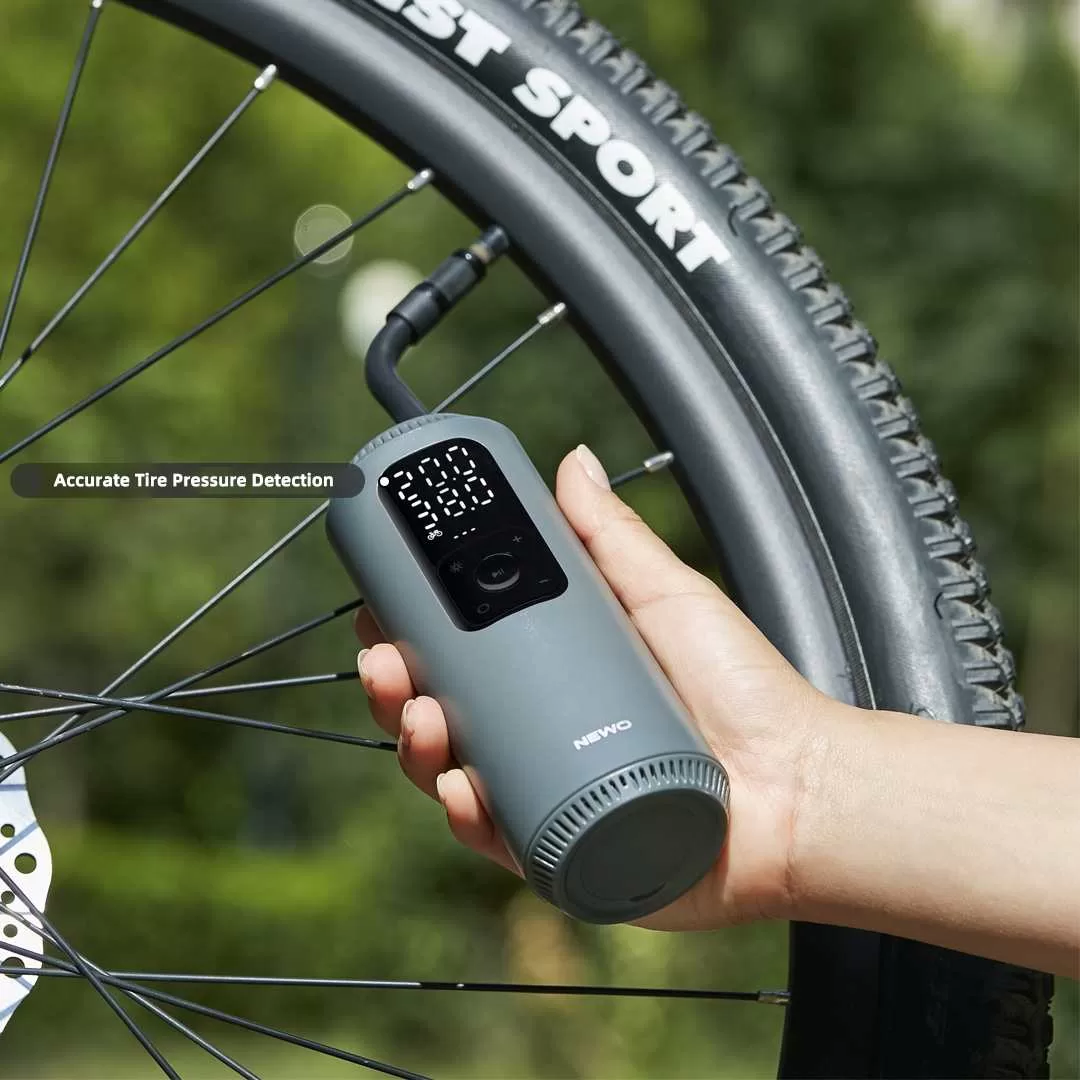
For us, packaging pneumatic efficiency into an ergonomic everyday footprint was a central engineering priority during the design of the Newo LP1. Built in a water-cup-shaped profile measuring 157 × 61 × 61 mm, the inflator weighs 438 g according to manufacturer specifications, allowing it to sit neatly in vehicle door pockets, backpack bottle sleeves, or cycling panniers.
The LP1 incorporates an integrated internal hose storage compartment directly into its housing. Storing the flexible 2-in-1 hose inside the pump body prevents misplaced air lines, protects connector threads from dirt or damage during transit, and maintains an uncluttered, self-contained profile during travel. The compact cylinder shape ensures the entire tool remains manageable for one-handed operation.
Dual Digital Screen and Operating Interface
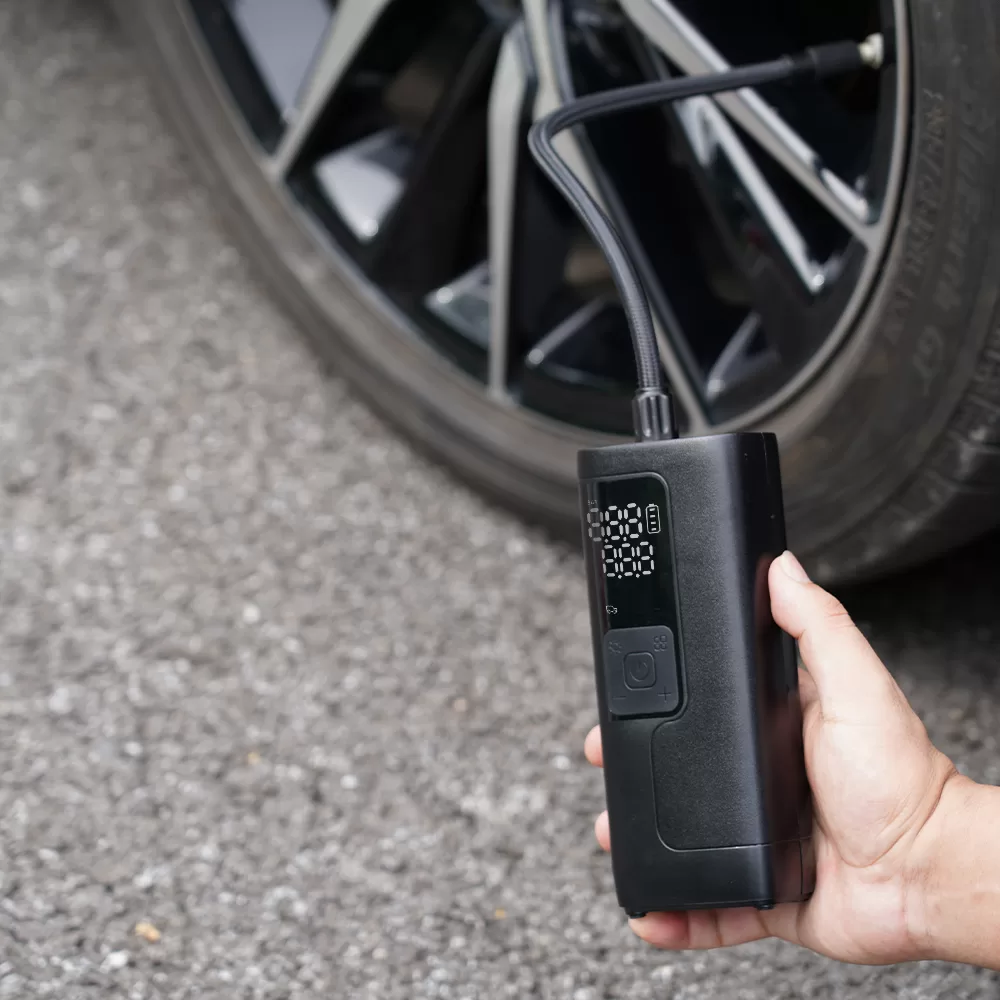
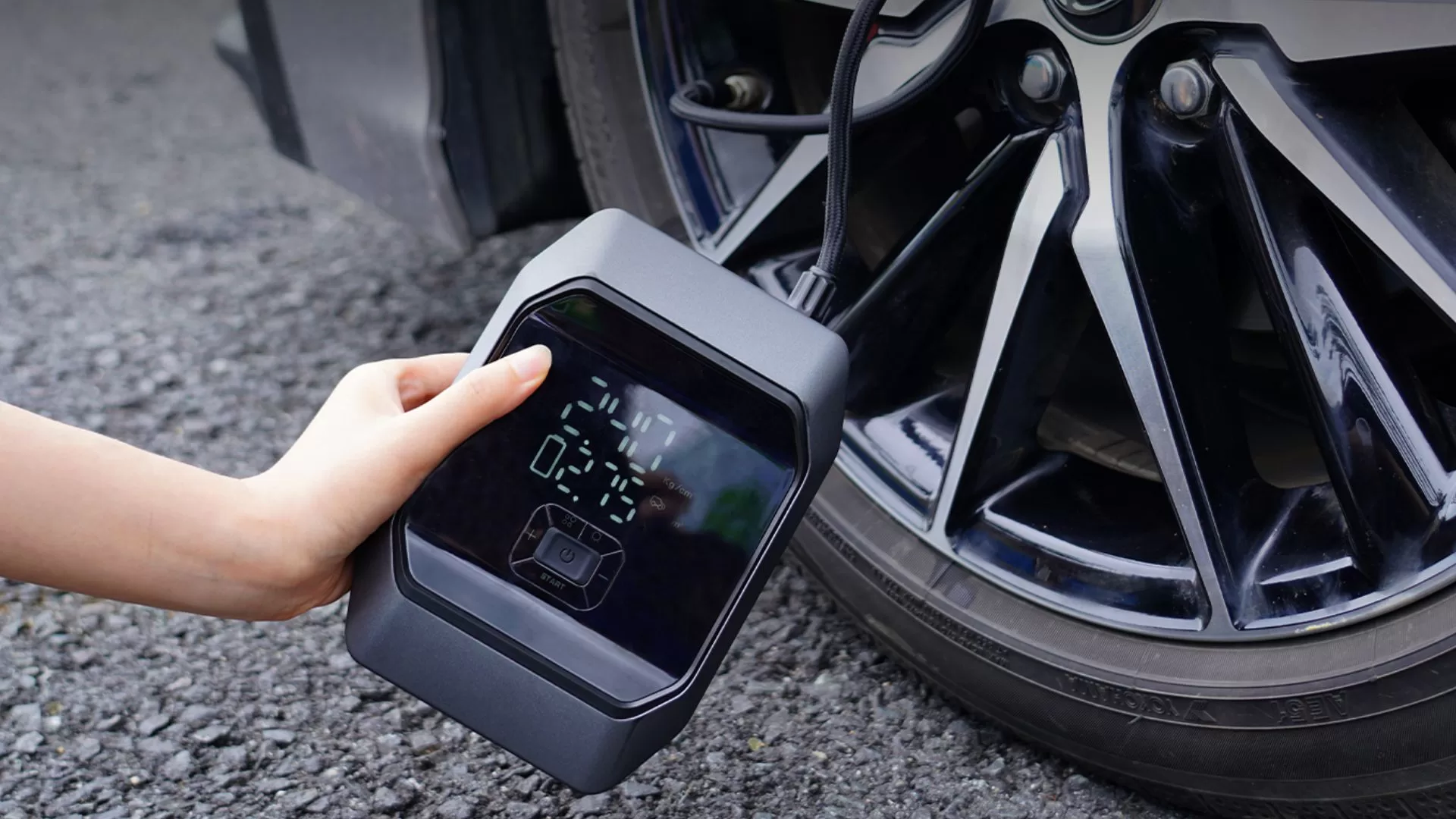
The front interface features a segmented LED screen that simultaneously displays measured tire pressure alongside the selected preset target. This dual-reading configuration allows users to monitor real-time pressure progression directly without toggling between separate display menus or estimating remaining cycle times during inflation.
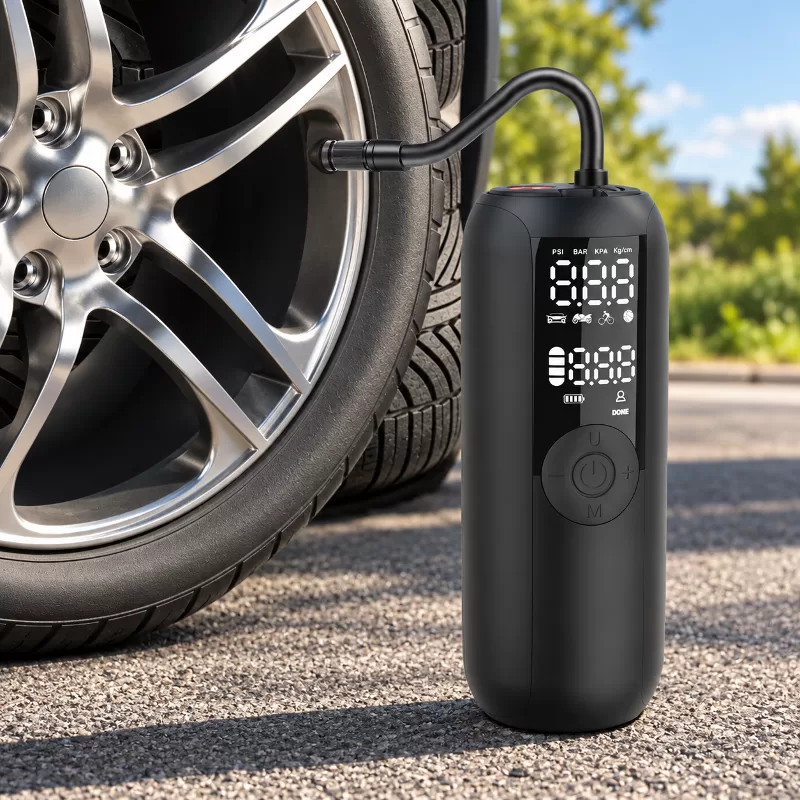
The LP1 includes five preset inflation modes; consult the product interface or manual for the exact mode labels. Operators can toggle between PSI, BAR, KPA, and Kg/cm² units with immediate digital conversion, making it straightforward to match vehicle placard specifications across domestic and imported transport without external mathematical reference charts.
Real-World Utility Features
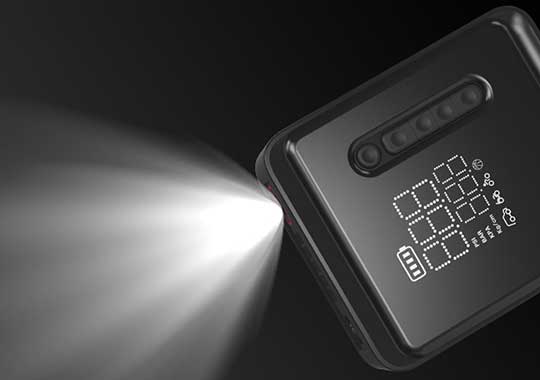
Emergency tire maintenance frequently occurs in low-light environments, such as unlit roadsides or dark parking garages. The LP1 includes a built-in LED light positioned adjacent to the hose port, illuminating the valve stem directly to simplify night connections and roadside inspections under adverse visibility conditions.
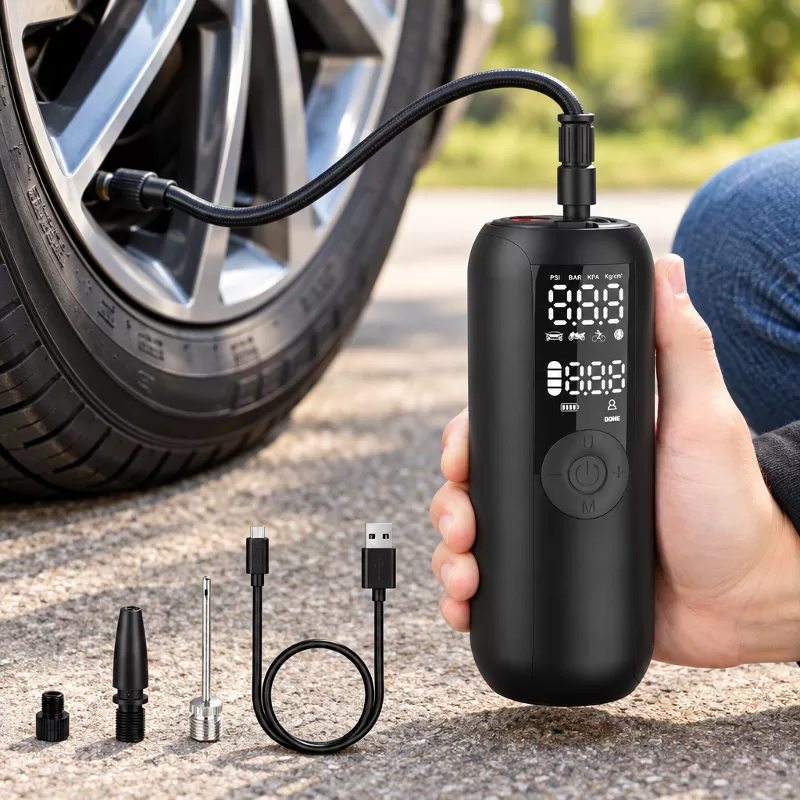
The internal 2000 mAh (7.4 V, 14.8 Wh) rechargeable battery charges through a Type-C port with a 10 W input rating, reaching a full charge in approximately 2 to 3 hours. It charges through a Type-C cable; use a compatible power source that meets the manufacturer’s charging requirements to replenish the battery properly before long trips.
LP1 Technical Specifications
| Engineering Specification | Manufacturer Parameter | Operational Implication |
|---|---|---|
| Model Identifier | LP1 | Handheld smart electric air pump series |
| Pressure Range | 0 to 150 PSI | Stated pressure capability across tires and sports gear |
| Airflow Delivery | 15 to 18 L/min | Manufacturer-listed airflow for regular vehicle top-ups |
| Battery Capacity | 2000 mAh, 7.4 V, 14.8 Wh | Nominal energy storage for portable field use |
| Charging Input | Type-C, 10 W input | Standard cable connectivity for modern charging setups |
| Charging Time | 2 to 3 hours | Listed recharge turnaround between inflation tasks |
| Motor Specifications | 35 W brushed motor | 35 W motor specification for the compact inflator |
| Rated Runtime | 20 to 30 minutes | Manufacturer-listed runtime for inflation maintenance routines |
| Stated Inflation Capacity | 2 car tires, 8 motorcycle tires, 12 bike tires, or 50 balls | Factory capacity benchmark per full battery charge |
| Physical Dimensions | 157 × 61 × 61 mm | Compact water-cup profile fitting vehicle door pockets |
| Product Weight | 438 g | Stated handheld weight for outdoor commuters |
| Operating Temperature | -10°C to 45°C | Multi-season operating range for variable weather |
| Acoustic Noise Level | 85 dB or below at 1 meter | Standard acoustic output for compact electric inflators |
Best Practices for Pressure Safety
Determining Cold Tire Inflation Targets
Tire pressure increases as internal air expands from friction and heat generated while driving on the highway. Measuring pressure on hot tires produces artificially elevated readings, which can lead to inadvertent under-inflation if air is vented to match door-jamb specifications.
- Check When Cold: Measure tire pressure when the vehicle has been parked for at least three hours, or driven less than one mile at moderate speed, to ensure baseline stability.
- Use Vehicle Placards: Always refer to the tire information placard located on the driver-side door jamb or owner manual. Do not use the maximum pressure molded on the tire sidewall as the vehicle’s normal target; use the pressure on the vehicle placard or in the owner’s manual.
- Account for Temperature Changes: Check pressures regularly across seasonal transitions, as cold ambient weather naturally reduces internal air pressure.
Step-by-Step Inflation Workflow
Operating a portable digital air pump correctly ensures consistent pressure readings, airtight connections, and prolonged seal life across both the inflator hose and tire valve stems.
- Clean Valve Stems: Remove the valve dust cap and wipe the stem threads clear of loose road grit, dirt, and moisture before attaching accessories.
- Connect the Hose: Screw the flexible hose securely onto the valve stem threads. A brief hiss confirms the core pin has engaged; continue turning until the seal is completely airtight.
- Power On the Unit: Turn on the inflator to read the live baseline pressure on the LED screen, confirming the current level before initiating the motor.
- Set Target Pressure: Select your desired preset mode or adjust the target value manually to match your vehicle placard specification in the appropriate measurement unit.
- Initiate Inflation: Press the power button to engage the motor, keeping the pump stable on a flat surface or holding it upright during operation.
- Auto Cut-off and Storage: Allow the auto shut-off feature to stop the motor once reaching your preset target. Unscrew the hose briskly to minimize pressure release, replace the valve cap, and store the pump.
Thermal Management During Extended Inflation Cycles
All miniature air compressors produce concentrated heat during continuous operation. While the LP1 includes motor overcurrent protection and a specified 20 to 30 minute runtime, sensible thermal management extends overall tool longevity and ensures user comfort during maintenance sessions.
If the pump becomes hot during extended use, stop operation and allow it to cool before continuing. Follow any duty-cycle or cooling instructions supplied with the product to maintain reliable operation across repeated top-up routines and protect internal electrical components from excessive temperatures.
Avoiding Common Purchasing and Operational Mistakes
Misinterpreting 150 PSI Maximum Pressure Ratings
A common misunderstanding is assuming a 150 PSI rating means an inflator will fill large truck or commercial vehicle tires in seconds. The 150 PSI figure is the manufacturer’s stated maximum pressure capability, not a guarantee of fast inflation or a burst-pressure rating.
Compact inflators can push air to high pressures without stalling the motor, making them suitable for narrow bicycle tires that require elevated pressures with minimal volume. Conversely, an automotive tire holds substantial air volume at moderate pressures; filling it requires volumetric flow (L/min) rather than extreme pressure capabilities alone.
Relying on Visual Tire Inspection
A tire can appear normally inflated even when its pressure is below the recommended value, so visual inspection cannot establish correct pressure. Inspectors should still look for visible damage, bulges, or severe deflation, but rely on measurement tools for actual pressure confirmation.
Significant underinflation can increase rolling resistance and heat buildup and may impair handling and braking under demanding driving conditions. Connecting a digital pressure sensor provides an objective measurement in seconds, removing guesswork and ensuring tires operate within the vehicle manufacturer’s recommended parameters.
Understanding Factory Capacity Benchmarks
The manufacturer claims a capacity of two car tires, eight motorcycle tires, twelve bicycle tires, or fifty basketballs per charge; actual results will vary with tire size, starting pressure, target pressure, temperature, and battery condition.
Inflating a completely flat tire from zero pressure requires moving significantly more air mass against progressive resistance, which consumes more battery runtime than routine top-ups. Keeping the inflator recharged ensures sufficient reserve power for unexpected roadside needs and emergency inflation demands.
Frequently Asked Questions
What is a portable digital air pump used for?
A portable digital air pump is a cordless electric tool designed to inflate passenger vehicle tires, motorcycles, bicycles, electric scooters, wheelchairs, and sports equipment. Its integrated digital display shows real-time pressure and automates inflation shut-off when reaching a user-defined target. The compact form factor allows drivers and cyclists to keep pressure maintenance equipment readily accessible in vehicle consoles, travel bags, or toolkits without relying on manual floor pumps.
Is a 150 PSI pump safe for standard car tires?
The LP1 is designed for car-tire top-ups, but users should set the vehicle manufacturer’s recommended cold pressure, inspect the tire, and verify the result with a reliable gauge when safety is critical. Setting the target according to your door-jamb placard ensures the motor shuts off when reaching your chosen setting. Automatic shut-off minimizes the risk of over-pressurization during routine maintenance routines when the device is operated correctly.
Can a cordless digital air pump inflate completely flat vehicle tires?
The LP1 is intended primarily for pressure top-ups and emergency inflation support. Inflation time for a completely flat car tire varies substantially depending on tire dimensions, ambient temperature, and initial pressure, so it is best viewed as a top-up and stabilization tool rather than a high-volume shop compressor. Users should plan for longer operational cycles when raising large passenger tires from zero pressure.
How does automatic shut-off prevent over-inflation?
The LP1 displays measured pressure digitally and uses its preset-pressure function to stop inflation when the selected target is reached. Users choose their desired operating target in PSI, bar, kPa, or kg/cm², and the internal control circuitry disengages the motor once manifold pressure aligns with that preset value. This mechanism eliminates the continuous manual monitoring required when using conventional mechanical shop inflators.
How long does the Newo LP1 battery hold a charge?
The supplied specifications list a 2000 mAh, 7.4 V battery and a 20 to 30 minute runtime across approximately 300 charge cycles at 80% capacity or above. To maintain standby readiness for roadside emergencies, users should recharge the unit periodically according to the manufacturer’s storage and charging guidance. Periodic top-ups ensure that the battery pack retains ample reserve energy for unexpected pressure alerts.
Can the pump handle high-pressure Presta bicycle tires?
The included Presta adapter is intended for compatible Presta valves, and the 150 PSI stated maximum covers many bicycle-pressure requirements. Always follow the tire, rim, and bicycle manufacturer’s pressure limits when setting your target. Using the appropriate adapter prevents thread damage and ensures a proper connection when inflating bicycle tubes or tubeless wheel assemblies.
Why does the air hose area become warm during use?
Air compression naturally generates heat inside mechanical cylinders, which conducts outward into the surrounding housing and hose connections during extended operation. The pump and hose area may become hot during operation; allow the unit to cool and avoid touching hot metal fittings directly. Following standard cool-down periods between consecutive inflation cycles protects internal components and ensures comfortable handling.
What basic maintenance is required for a cordless electric air pump?
Cordless pumps require simple preventative care to maintain regular operational readiness over extended ownership periods. Keep the hose threads clean from grit, store the device within its rated temperature range of -10°C to 45°C, avoid moisture exposure, and recharge the battery using a compatible Type-C power source that meets input specifications. Storing the unit in a dry environment preserves the internal electronics and battery pack integrity.
Summary: Selecting the Ideal Inflation Solution
Selecting an effective portable digital air pump requires understanding the relationship between pressure thresholds, volumetric flow rates, and thermal duty cycles. While the manufacturer’s 150 PSI figure indicates the stated maximum pressure capability, daily usefulness also depends on airflow, automatic shut-off, display readability, and compatible adapters across household vehicles.
The manufacturer positions the LP1 for portable pressure maintenance across passenger tires, commuter bicycles, and everyday inflatables. Following the operating guidance and allowing adequate cooling intervals during heavy use may help support consistent use and battery life from your portable digital air pump over time.
-

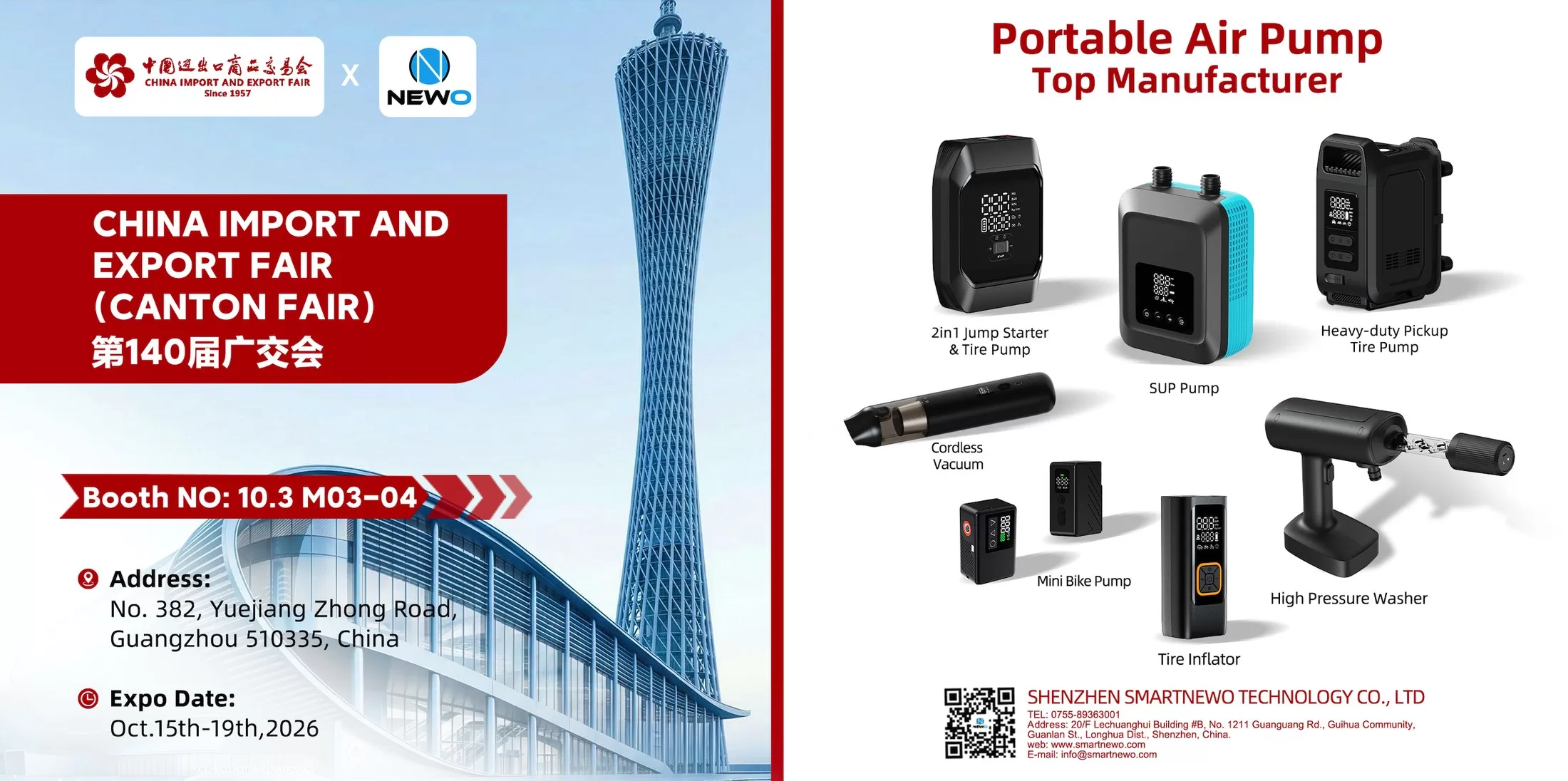
Meet NEWO at the 140th Canton Fair: Visit Booth 10.3 M03–04
Meet NEWO at the 140th Canton Fair in Guangzhou, October 15–19, 2026. Visit Booth 10.3 M03–04 to explore portable air pumps and discuss OEM, ODM and distribution opportunities.... -

As Shenzhen Welcomes the World for APEC 2026, NEWO Welcomes You to Our Factory
As Shenzhen prepares for APEC 2026, NEWO welcomes international buyers and partners to visit our factory, meet our team and explore future cooperation.... -

Leading the Way in Product Innovation and Excellence
Smartnewo exemplifies professionalism in product innovation and manufacturing. Their collaboration with Xiaomi Youpin on the G01 crowdfunding project highlights their expertise in creating compact, powerful inflatable pumps. Rigorous engineering, meticulous production processes, and advanced quality assurance underscore their commitment to excellence. The success of the G01 project, with significant market... -

Essential Qualities of an Excellent Supplier
In today's competitive market, finding a reliable supplier is crucial for business success. Based on insights from Smartnewo and broader internet research, here are key qualities an excellent supplier must possess:... -

NW06 Tire Inflator: Compact Power for Quick Inflation
Summary The NW06 Tire Inflator delivers quick and efficient tire inflation with a powerful 35L/min airflow. It features a user-friendly LCD screen for real-time pressure monitoring, dual power options with a built-in 6000mAh battery, and multiple nozzle attachments for versatile use. Its compact design and integrated LED light ensure convenience and... -

Unleash the Power of Portability: The SmartNewo Jump Starter with Air Compressor KF03
This guide will walk you through the steps to effectively use a portable tire inflator, helping you stay prepared and safe on the road.... -

Newo Attends The 2024 Consumer Electronics Show (CES)
Smartnewo booth is located at 53672, Halls A-D, Level 2, Venetian Expo, Las Vegas Convention Center (LVCC). ... -

Smartnewo’s Dual-Cylinder Air Pump Rocks the Hong Kong Autumn Electronics Fair!
Smartnewo’s Dual-Cylinder Air Pump Rocks the Hong Kong Autumn Electronics Fair!... -

Meet at the Canton Fair! Smartnewo brings dual-cylinder air pumps, making your inflation experience faster and more stable!
NEWO has went deep communication and negotiation with customers from all over the world on booth.... -

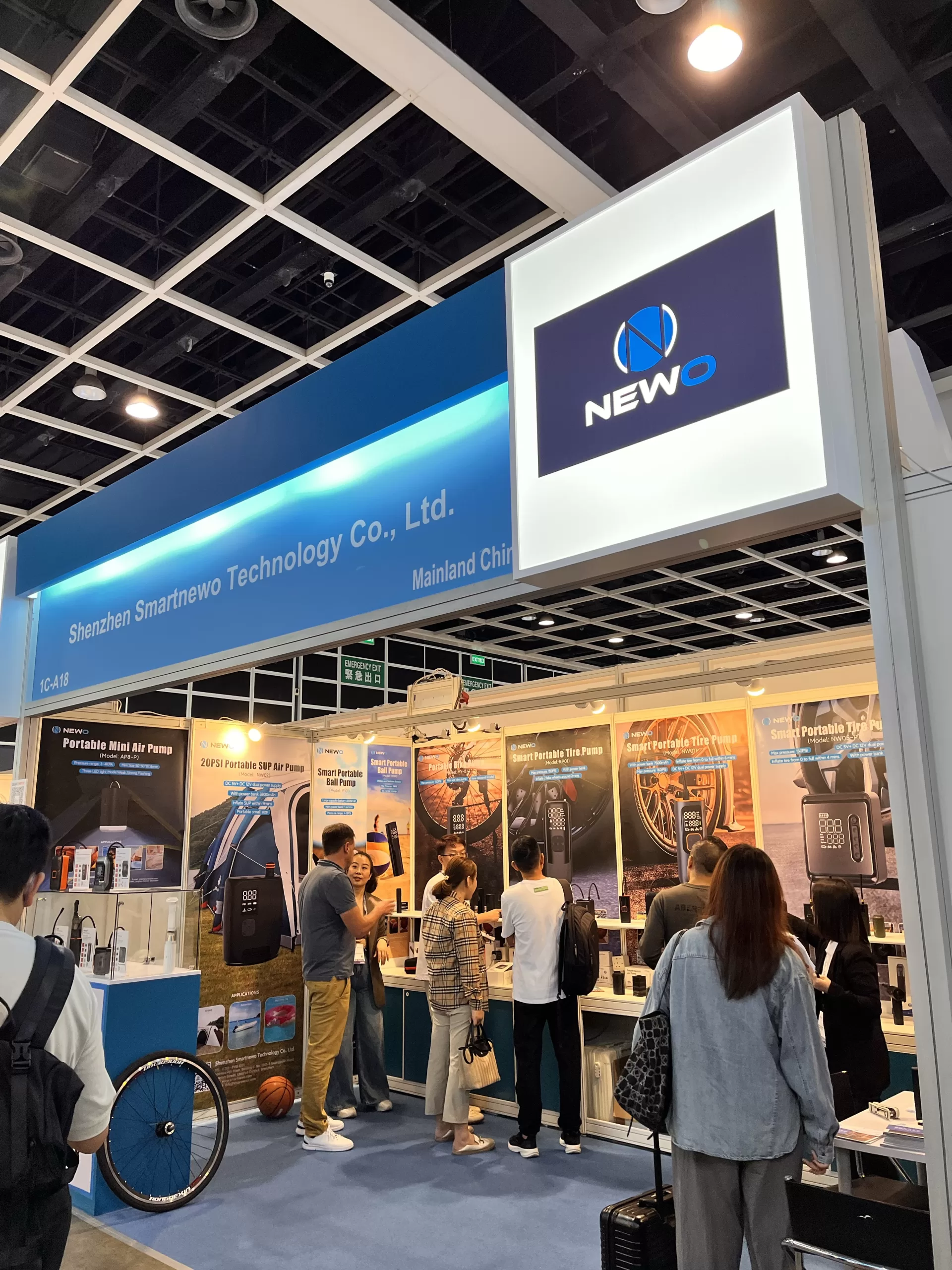
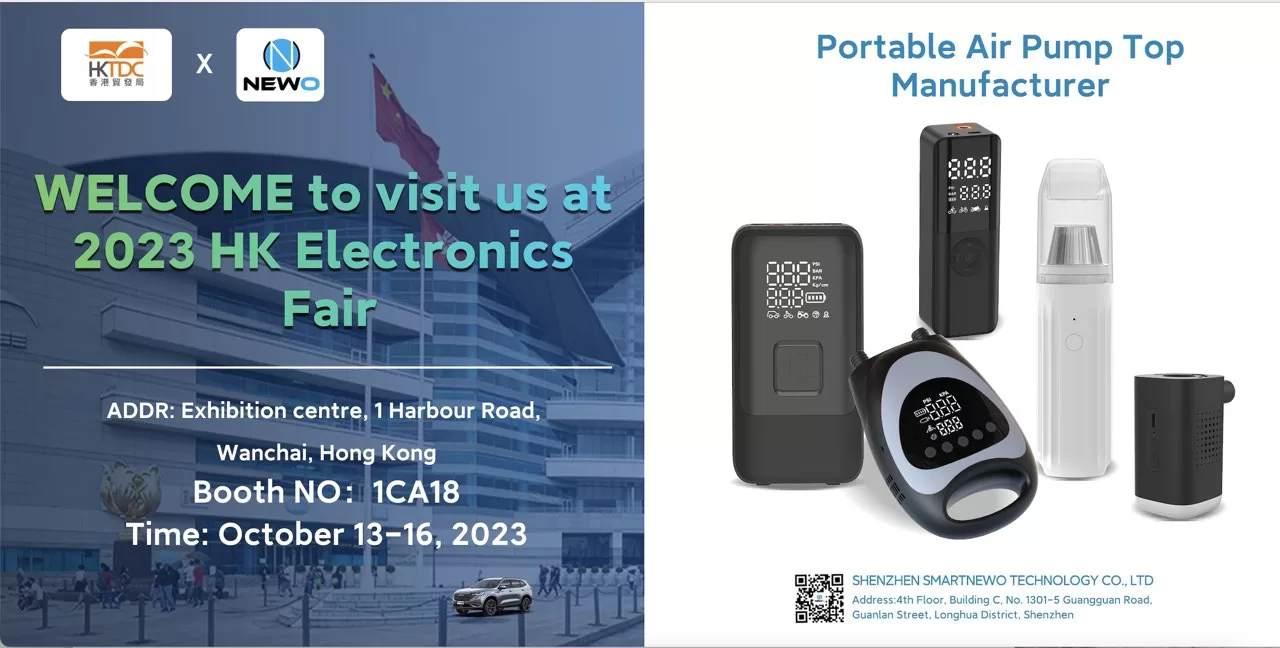
“Hong Kong Autumn Electronics Fair – 1CA18 (October 13th to 16th): Smartnewo invites you to visit our booth!
Hong Kong Autumn Electronics Fair...



-

What to Check Before Ordering Custom Electric Bike Pumps
Plan custom electric bike pumps with a clear requirements freeze for valves, TPU tubes, portability, repeated top-ups, charging, and model-specific documents.... -

OEM vs ODM Air Pumps: Which Manufacturing Model Fits Your Brand?
Compare OEM and ODM air pump projects by design responsibility, change approval, development scope, and written ownership terms before choosing your route.... -
How to Choose a Reliable Tire Inflator Manufacturer in China
Choose a tire inflator manufacturer in China with a focused RFQ, supplier evidence, configuration checks, and clear sample-to-pilot decisions for your brand.... -

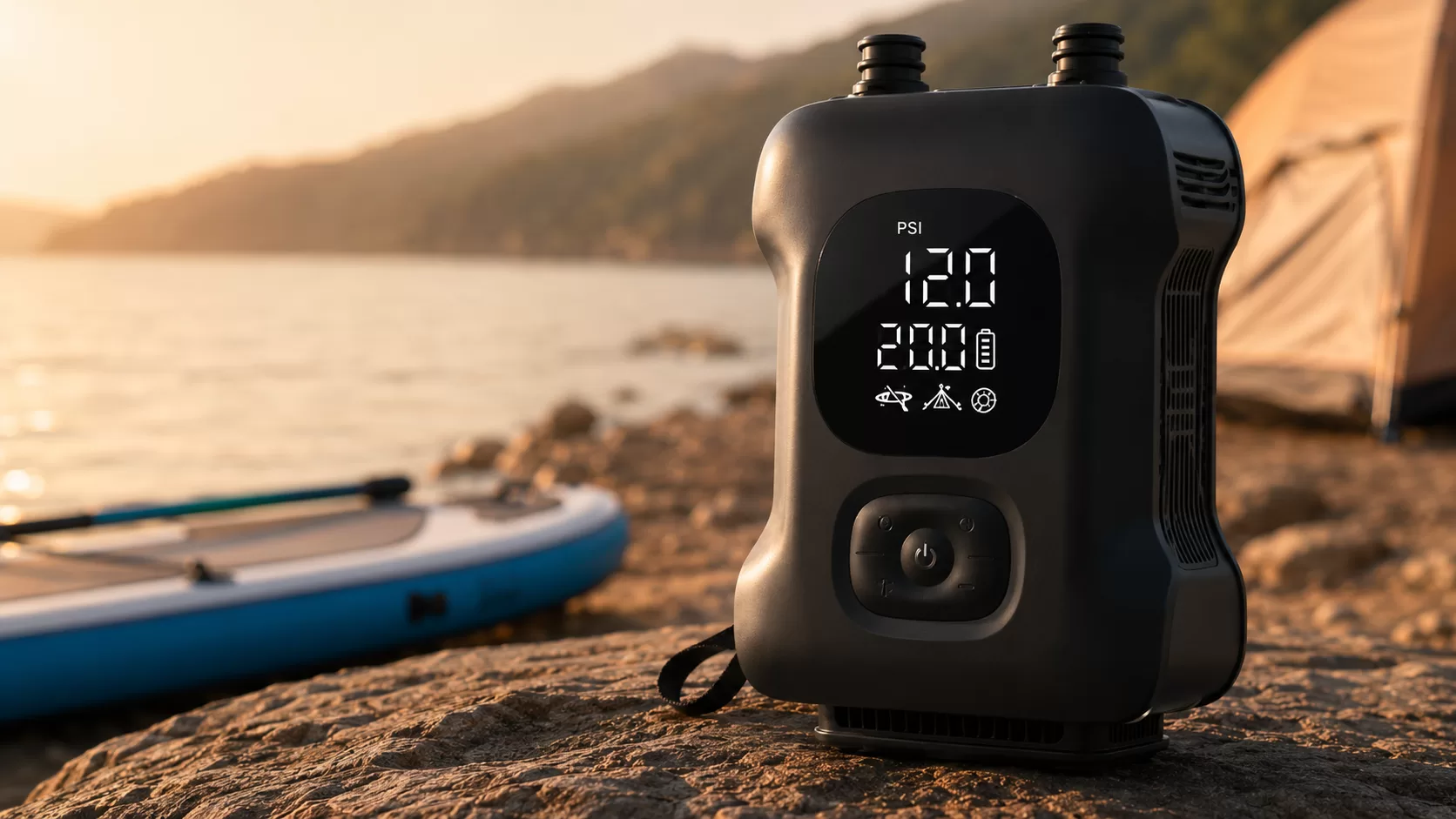
Rechargeable Electric SUP Pump for Paddle Boards: Faster Inflation for SUPs, Kayaks and Inflatable Tents
The BL10-C Portable Electric Bike Tire Inflator is a compact and lightweight mini electric bike pump designed for modern cyclists. With up to 120 PSI pressure, a digital LED display, preset pressure control, automatic shut-off, USB-C charging, and multiple valve adapters, BL10-C offers a convenient inflation solution for road bikes,... -

Are Electric Bike Pumps Worth It in 2026? Electric Pump vs CO₂ vs Mini Hand Pump
Discover whether electric bike pumps are worth it in 2026. This guide compares electric bike pumps, CO₂ inflators, and mini hand pumps for road cycling, gravel riding, commuting, and long-distance rides. Learn the pros, limitations, best use cases, and key features to look for before choosing the right portable tire... -
BL10-C Portable Electric Bike Tire Inflator: Small Size, Reliable Power for Every Ride
The BL10-C Portable Electric Bike Tire Inflator is a compact and lightweight mini electric bike pump designed for modern cyclists. With up to 120 PSI pressure, a digital LED display, preset pressure control, automatic shut-off, USB-C charging, and multiple valve adapters, BL10-C offers a convenient inflation solution for road bikes,... -

Why Mini Electric Bike Pumps Are Becoming Essential for Modern Cycling
Discover why mini electric bike pumps are becoming essential for modern cyclists. Learn how portable electric bike pumps improve tire pressure management, riding safety, and convenience.... -

The Ultimate Smart Solution for Easy Outdoor Adventures in 2026
Discover how a spring travel air pump simplifies outdoor trips with fast inflation, smart features, and powerful performance—perfect for every adventure.... -

Powerful 5-in-1 Portable Car Tire Inflator and Jump Starter: The Ultimate Emergency Tool for Every Driver
Why Every Driver Needs a Portable Car Tire Inflator and Jump Starter Modern drivers face many unexpected situations on the road. A flat tire, low tire pressure, or a dead car battery can happen at the worst possible time. That’s why having a portable car tire inflator and jump starter is... -

7 Real Cycling Scenarios That Show Why Every Rider Should Carry a Mini Bike Pump
Cycling is one of the most freeing activities you can enjoy. Whether you’re commuting to work, riding through city streets, or exploring quiet countryside roads, a bike ride can instantly improve your day. But there’s one small problem that almost every cyclist eventually faces: Low tire pressure. It might happen...


-
How Is a Football Properly Inflated?
The correct inflation of a football - with not too much and not too little air - is a hotly debated topic among footballers.... -
Application Scenarios of Car Inflator Pump
Often long-distance business trips or play car owners because the road may be more remote areas, in this case if you encounter a tire leak....