

 Portable Tire Inflators
 Electric Air Pumps
 Electric Car Tyre Pumps
 Electric Ball Pumps
 Electric Bike Pump
 SUP Air Pump

Portable Rechargeable Tire Inflator: Engineering Insights, Safety, and Practical Field Operation
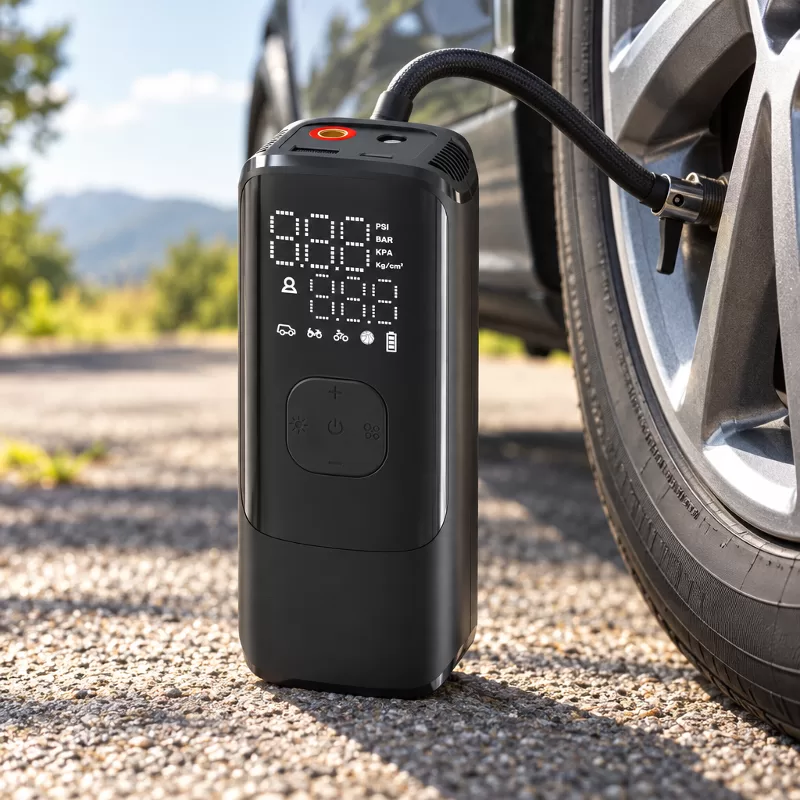
Maintaining appropriate pneumatic pressure inside automobile, motorcycle, bicycle, and mobility equipment casings supports predictable steering response, predictable tire wear, and efficient energy consumption. Using a portable rechargeable tire inflator has simplified routine tire maintenance by reducing reliance on commercial gas station air hoses or manual pumps. With a battery-powered design, drivers and commuters can address pressure adjustments wherever their vehicle or bike is parked.
Incorrect tire pressure can affect handling, tire wear, and fuel economy; underinflation can also increase stopping distance in some conditions, especially on wet roads. Understanding basic pneumatic physics, realistic equipment capabilities, and safe inflation practices ensures tires remain within their recommended parameters across changing weather conditions and daily driving demands. Portable rechargeable tire inflator devices offer an accessible, reliable method for monitoring and adjusting pressure at regular intervals.
Understanding the Portable Rechargeable Tire Inflator
What Is a Cordless Electric Air Pump?
A portable rechargeable tire inflator is a self-contained electro-mechanical tool designed to draw in ambient air, compress it, and deliver it into pneumatic tires without an external power cord. Inside the housing, an electric DC motor drives a piston mechanism, powered by an internal rechargeable battery pack. Built-in electronic monitoring controls pressure tracking and displays settings to the operator.
Unlike traditional compressors that draw power from a vehicle’s 12V electrical port, a battery-powered inflator works independently. This cordless operation allows the user to walk around the entire vehicle, service multiple tires, or inflate equipment far away from any power source.
Digital models let users view current tire pressure, pick preset operating modes, and set target shut-off limits. When the internal sensor detects that the preset pressure target is met, the system cuts off motor operation to prevent unintended overpressurization.
Cordless Inflators vs. 12V Tethered Compressors vs. Floor Pumps
Drivers and riders choose between manual hand pumps, corded 12V compressors, and cordless rechargeable models based on their convenience, storage needs, and inflation duties. Each option presents distinct operating characteristics and practical limits.
| Tool Category | Primary Energy Source | Physical Mobility | Setup and Deployment | Primary Functional Use |
|---|---|---|---|---|
| Cordless Battery Inflator | Internal rechargeable lithium battery | Completely untethered during inflation | Rapid; attach hose and power on | Routine pressure top-ups, bicycles, emergency vehicle inflation |
| 12V Corded Compressor | Vehicle 12V auxiliary outlet / electrical system | Limited by power cord and air hose length | Requires routing cable through vehicle doors or windows | Roadside vehicle tire inflation |
| Manual Floor Pump | Human physical effort | Independent of electrical charging | Instant mechanical connection | Workshop bicycle maintenance, sports balls |
Manual floor pumps require continuous physical exertion, which can prove exhausting when attempting to inflate large passenger tires or high-volume recreational tubes. Conversely, a 12V unit draws electrical current directly from the vehicle’s electrical system, eliminating reliance on internal battery capacity but requiring operators to manage long power cables around vehicle panels, wheels, and wet road surfaces.
A cordless battery inflator balances rapid deployment with compact dimensions. It stores neatly in a glove compartment, door pocket, or backpack, making it well-suited for everyday pressure corrections without the hassle of vehicle power cords.
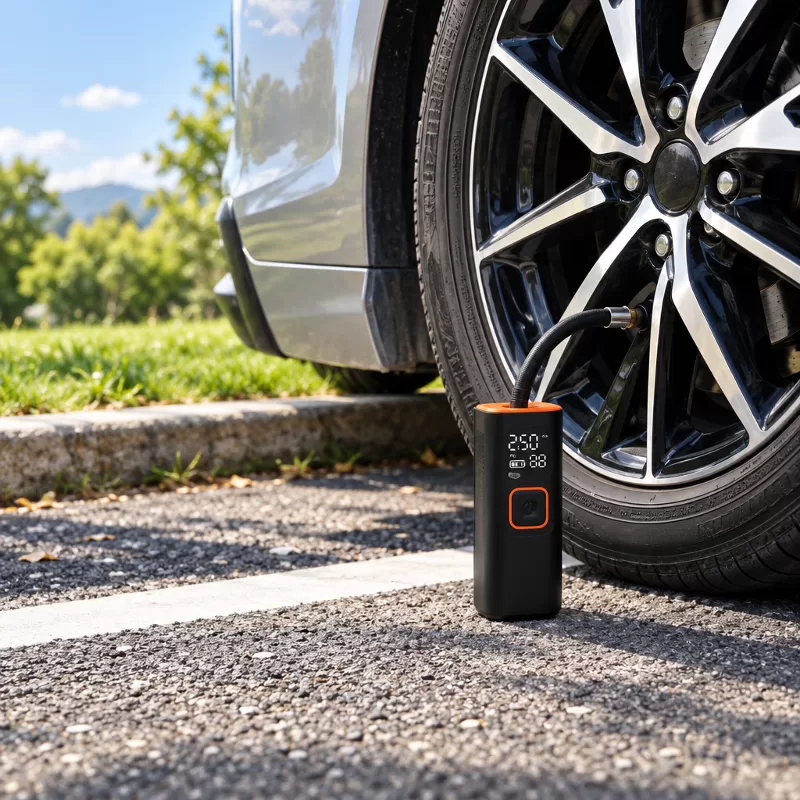
Critical Pneumatic Principles and Vehicle Tire Safety
Vehicle Door Jamb Placards vs. Sidewall Maximum PSI
A frequent misconception among vehicle owners is relying on the PSI figure stamped into the tire’s outer sidewall rubber. The sidewall marking gives the tire’s maximum permissible inflation pressure, not the vehicle’s recommended pressure. Using this maximum pressure for everyday driving can lead to harsh ride characteristics, rapid center-tread wear, and compromised vehicle handling.
To find the correct cold inflation target, always consult the vehicle’s tire information placard, usually located on the driver’s side door jamb, or check the vehicle owner’s manual. Automotive manufacturers calculate these cold inflation values based on vehicle weight, suspension setup, and axle load distribution to ensure balanced traction and braking.
Replacing stock tires with alternative aftermarket sizes requires referencing the vehicle manufacturer’s baseline guidance or consulting a certified tire technician. Never exceed the maximum permissible cold pressure stamped onto the tire casing itself.
The Thermal Factor: Cold vs. Warm Pressure Calibration
Air pressure inside an enclosed tire casing changes naturally with surrounding temperature. Authoritative tire-industry guidance indicates that internal pressure generally changes by roughly 1 to 2 PSI for every 10°F of ambient temperature shift, although the exact relationship varies based on atmospheric factors and tire casing dimensions.
In addition to seasonal weather shifts, driving generates internal heat as the rubber flexes against road surfaces. This friction warms the trapped air, causing pressure to rise noticeably while driving. The exact pressure increase varies depending on vehicle speed, road surface conditions, ambient heat, and vehicle load.
Automotive safety authorities define a cold tire as one that has been parked for three hours or more, or driven less than one mile at moderate speed. If you check your tires when they are warm, never bleed out air to hit the cold placard target; doing so will leave the tire underinflated once it cools down.
Evaluating Inflator Engineering: Specifications That Matter
Maximum Pressure vs. Working Airflow (PSI vs. L/min)
Inflator marketing often emphasizes high maximum pressure limits, such as 120 or 150 PSI. While a high maximum PSI shows that the internal pump can push against stiff backpressure, it does not tell you how quickly air will fill a large tire casing.
Airflow, typically expressed in liters per minute (L/min), measures the volume of compressed air delivered over time. For example, some narrow road bicycle tires may require higher working pressures, whereas wide passenger vehicle tires need a higher volume of air at lower pressures to register an increase.
Always verify that your inflator’s rated pressure matches your specific equipment, consulting manufacturer guidance for bicycles, tires, and rims. Volume delivery determines real inflation speed, so higher L/min ratings generally reduce waiting times during top-ups.
Internal Battery Architecture and Duty Cycles
The internal battery pack provides the current needed to drive the small electric motor under varying pneumatic loads. Handheld inflators commonly rely on rechargeable lithium-ion battery cells, such as multi-cell arrangements, to maintain steady operating voltage.
Operating limits, runtime capacity, and duty-cycle recommendations vary considerably by product model and internal architecture. For example, the LP6 specification lists a continuous runtime of 20 to 22 minutes on a full charge.
Operators should always consult the specific product user manual for recommended operating intervals and rest periods. Following manufacturer-directed runtimes ensures optimal operation across the tool’s usable lifespan.
Digital Pressure Sensing and Automatic Shut-Off
Older mechanical gauges use analog dial faces and internal springs that can lose accuracy over time from road vibration and accidental drops. Modern portable electric inflators use digital pressure sensors that display current manifold pressure directly on an illuminated screen.
Users should check which specific pressure units their inflator supports before setting targets, referencing vehicle placards or equipment documentation to confirm corresponding units. Inspecting the screen readout ensures target values align precisely with manufacturer recommendations.
When using an inflator equipped with automatic shut-off, the tool continuously monitors pressure until it matches the selected target, then automatically cuts motor power. Users may periodically check the resulting pressure with an independent, dedicated tire pressure gauge to verify the reading.
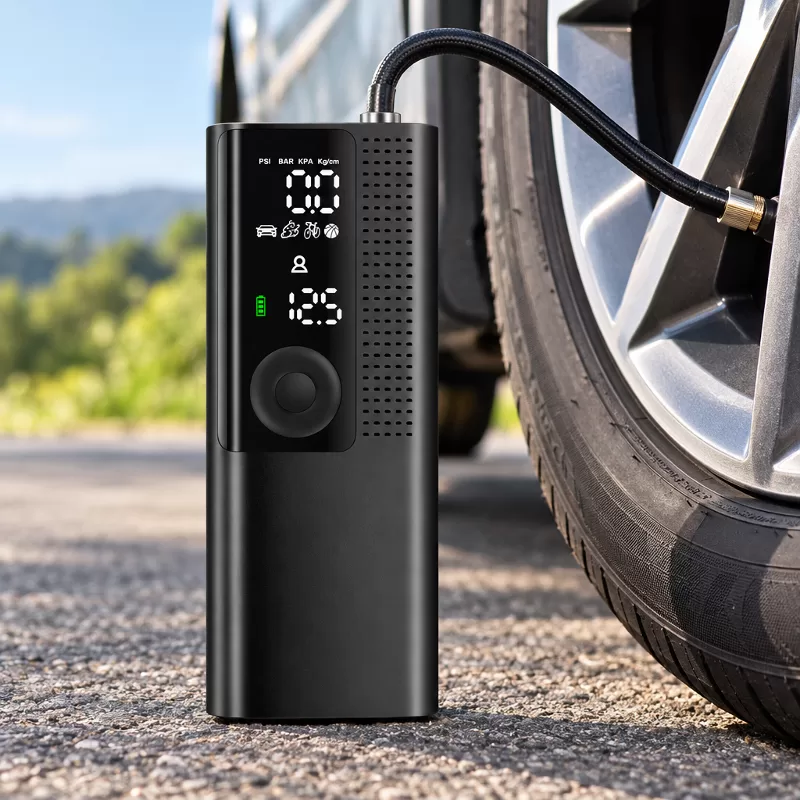
Technical Product Analysis: The LP6 Platform
As a professional manufacturer specializing in smart electric air pumps and portable inflation solutions, Newo designs products such as the LP6 to deliver practical pneumatic performance in a compact handheld form factor.
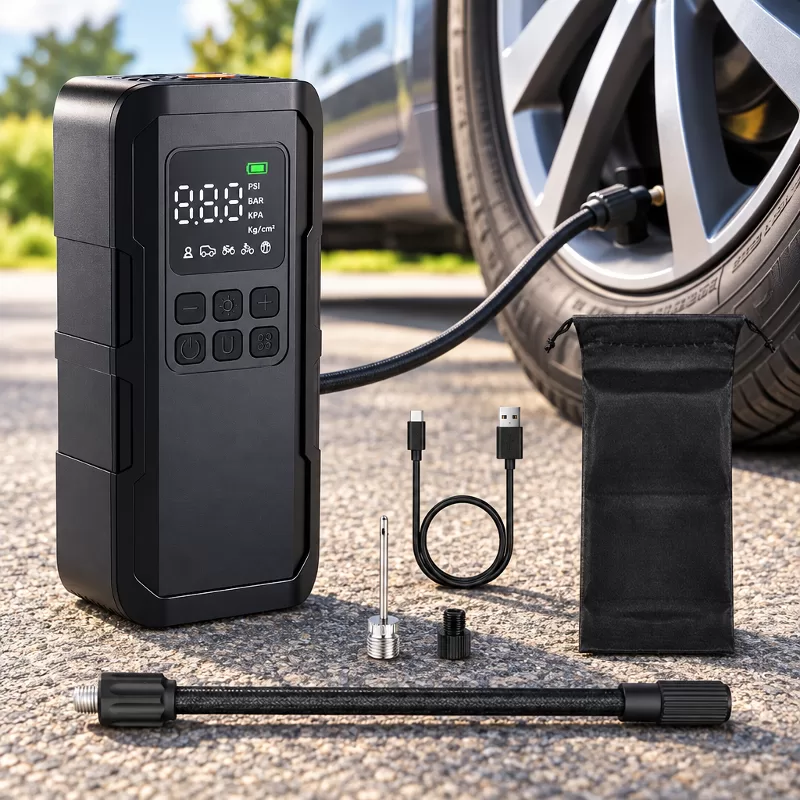
Mechanical Architecture and Performance Benchmarks
The LP6 features a manufacturer-listed 17-cylinder configuration driven by a 30W motor, delivering a stated airflow of 20–22 L/min. This system supports a stated operating pressure range of 2 to 150 PSI, accommodating everything from sports balls to everyday commuter tires.
Power comes from two internal 18650 lithium cells, providing a combined battery capacity of 2000mAh at 7.4V (14.8Wh of total stored energy). The manufacturer states that this battery pack delivers an overall continuous runtime of 20–22 minutes per full charge.
According to product specifications, the LP6 provides an inflation capacity of about 2.5 tires marked "205/R55" per full charge, though specific test conditions are not detailed. Its acoustic output is rated at 85 dB or below at a distance of one meter.
| Technical Parameter | Manufacturer Specification (LP6) |
|---|---|
| Model Designation | LP6 Portable Tire Inflator |
| Mechanism Profile | 17-cylinder configuration |
| Rated Working Power | 30W |
| Supported Pressure Range | 2–150 PSI |
| Air Delivery Rate | 20–22 L/min |
| Battery Cell Setup | 2 × 18650 cells (2000mAh, 7.4V, 14.8Wh) |
| Battery Cycle Durability | 100 cycles at ≥80% original capacity |
| Charging Port Interface | Type-C port, rated input 5V / 2A |
| Full Charge Duration | 2–3 hours |
| Auxiliary Power Output | USB 5V / 2A (Power Bank Function) |
| Maximum Acoustic Level | 85 dB or below at 1 meter |
| Working Temperature Range | -10°C to 45°C |
| Physical Enclosure Dimensions | 46 × 68 × 152 mm |
| Net Hardware Weight | 442 grams |
Physical Ergonomics and Multi-Role Usability
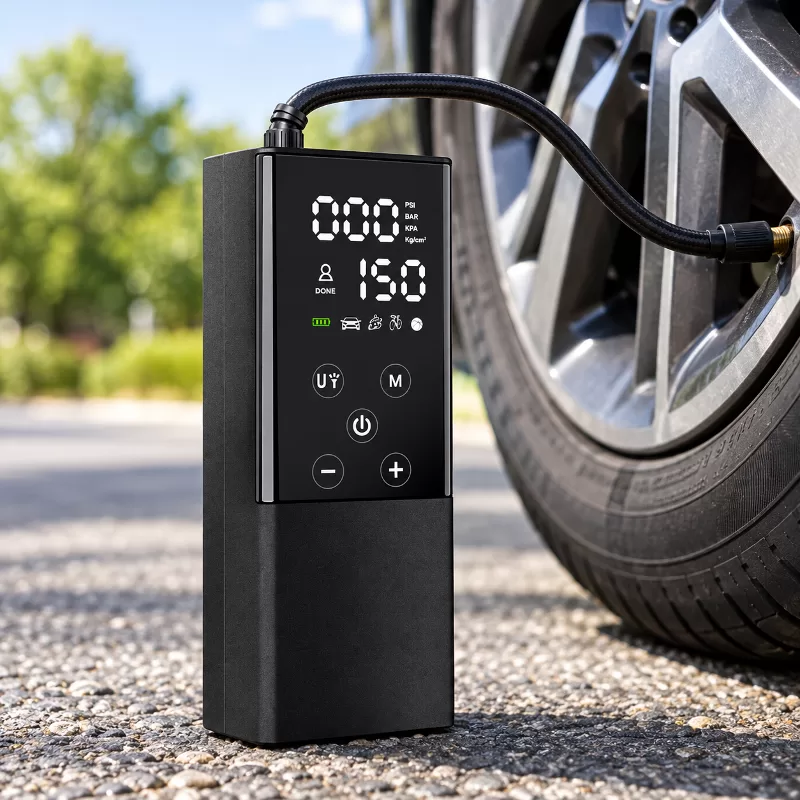
Weighing 442 grams and measuring 46 × 68 × 152 mm, the LP6 is built for compact storage in vehicle center consoles, saddlebags, or toolkits. Its modest footprint makes it easy to carry along for daily commutes or road trips.
The device features a single LED screen with battery status indicators, pressure readouts, five preset modes, and custom pressure adjustments. These settings let users tailor the target pressure to different vehicles and equipment.
For charging, the manufacturer lists a Type-C input of 5V/2A with a charging time of 2–3 hours. The unit also includes a 5V/2A USB output, allowing it to serve as a backup power source for mobile phones or small devices during travel.
Practical Field Operating Guide: Step-by-Step Execution
Preparation and Pre-Inflation Inspection
Safe tire inflation begins with a quick check of your equipment and the target tire before attaching the inflator hose.
- Locate the vehicle placard on the driver’s door jamb to verify the correct cold pressure specification.
- Inspect the tire tread and sidewalls for deep cuts, bulges, embedded debris, or severe rim damage.
- Power on the inflator to confirm that the battery indicator shows sufficient charge for the task.
- Check the pressure display to confirm the active measurement unit before setting your target value.
Active Inflation Sequence
Follow these sequential steps during inflation to protect the valve stem and achieve an accurate reading.
- Remove the tire valve cap and thread the inflator’s air hose securely onto the valve stem.
- Read the current tire pressure shown on the display to see how much air is needed.
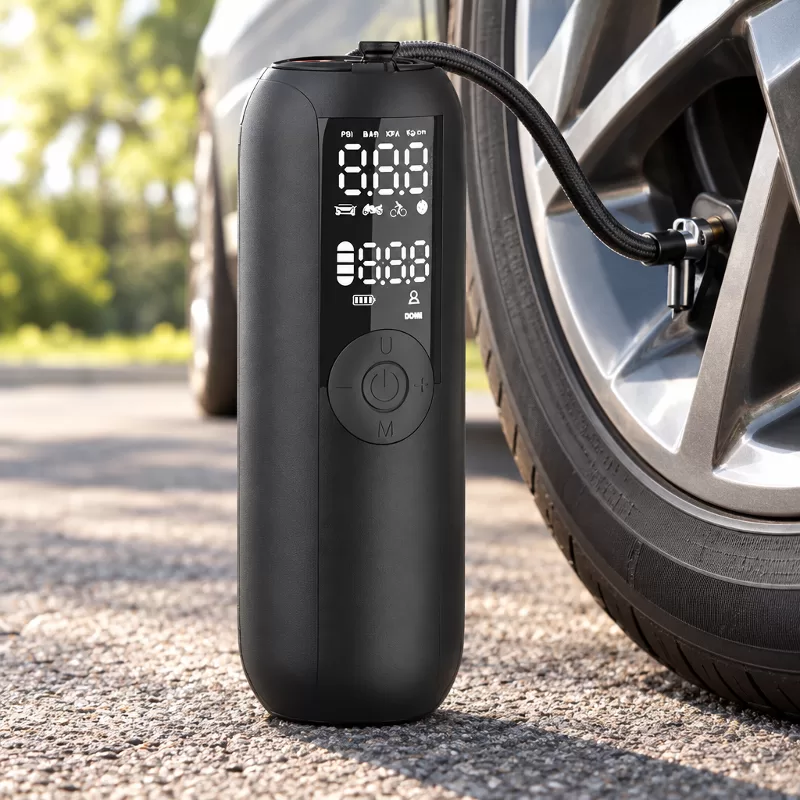
- Use the control buttons to set your target pressure or choose an appropriate preset mode.
- Start the inflator and let it run, placing the device on stable ground or holding it securely.
- Allow the pump to run until the automatic shut-off stops motor operation at your selected target.
Post-Inflation Protocol and Proper Storage
Once the pump stops running, disconnect the unit safely and prepare it for storage.
- Unscrew the air chuck from the valve stem quickly to minimize air loss.
- Take care when handling the hose fitting, as the metal connector may feel warm after inflation.
- Replace the valve dust cap to protect the inner valve core from road grit and moisture.
- Store the inflator following the manufacturer’s storage instructions, noting its rated working temperature range of -10°C to 45°C during active use.
Operational Mistakes to Avoid
Relying on Visual Sidewall Deflection
Radial tires naturally display a slight sidewall bulge under normal vehicle load, which makes visual checks unreliable. A tire can lose significant air pressure before showing any noticeable change in its profile.
Operating a vehicle with low tire pressure increases rolling resistance and generates excess heat within the casing. Always use an accurate digital gauge or inflator readout rather than guessing by eye.
Misunderstanding the Scope of Portable Inflators
A portable rechargeable tire inflator is built for routine top-ups and pressure adjustments, not for repairing structural tire failures. If a tire has suffered a major blowout, a sidewall cut, or a broken rim seal, an inflator cannot resolve the issue.
If the pump runs for several minutes without any noticeable rise in pressure, stop inflation immediately. Continuing to run the pump can deplete the battery and overheat the motor while air leaks out of the tire.
Neglecting Seasonal Battery Self-Discharge
Like all lithium-ion devices, portable inflators gradually lose their charge over time due to natural internal self-discharge. Leaving the tool stored for extended periods without inspection can affect available battery capacity when an emergency arises.
Check your inflator’s battery level before long road trips and follow the manufacturer’s storage and maintenance instructions. Keeping the battery charged ensures the device will be ready to perform when unexpected pressure drops occur.
Frequently Asked Questions
What is a portable rechargeable tire inflator?
A portable rechargeable tire inflator is a handheld, battery-powered compressor that lets you inflate vehicle tires, bicycle tubes, and sports equipment without connecting to a wall outlet or 12V vehicle socket.
Can a compact inflator fully inflate a flat car tire?
A portable inflator can add air to a low tire, but whether it can fill a completely flat tire depends on tire size, initial pressure, and battery charge. For the LP6, the manufacturer lists an inflation capacity of about 2.5 tires marked "205/R55" per charge, though specific test conditions are not detailed. If a tire has been driven flat or shows structural damage, it should be inspected by a professional rather than simply refilled.
How does the automatic shut-off feature work?
The inflator tracks internal pressure as air enters the tire. Once that pressure matches the target value set by the user, the internal control system turns off the motor to prevent overinflation.
Why is cold tire pressure measurement recommended over warm readings?
Driving warms the air inside a tire, which naturally raises its internal pressure. Setting tire pressure when cold ensures you match the vehicle manufacturer’s door-jamb placard accurately, without underinflating the tire once it cools down.
Can a portable inflator run while plugged into its Type-C charging cable?
The LP6 specifications list a Type-C charging input of 5V/2A and a charging time of 2–3 hours, but they do not state whether the unit can inflate while charging. Operators should check the product user manual or consult the supplier regarding simultaneous charging and operation.
What valve types and adapters work with portable inflators?
Supported valve connections vary depending on the model and the adapters supplied in the packaging. Some inflators connect directly to standard automotive Schrader valves, while others include separate adapters for bicycle Presta valves, sports balls, or small inflatables. Refer to the product manual or package contents to verify included accessories.
How loud is a portable rechargeable tire inflator during operation?
Because the internal piston moves quickly to compress air, all portable inflators generate mechanical noise during operation. For the LP6, the manufacturer rates the noise level at 85 dB or below at a distance of one meter.
How should I store and maintain the inflator’s internal battery?
To preserve battery performance over time, follow the manufacturer’s specific guidelines regarding storage conditions and periodic charging. Check the battery level indicator before traveling to ensure the tool has adequate power ready for use.
What should I do if the inflator runs but tire pressure does not increase?
If the motor runs but the measured pressure does not climb, shut off the inflator right away. Verify that the air chuck is threaded tightly onto the valve stem, and inspect the tire surface for visible punctures, cuts, or air leaks.
Final Perspective on Cordless Inflation Technology
Adding a portable rechargeable tire inflator to your vehicle maintenance kit provides a dependable way to keep tires properly inflated year-round. Consistent pressure checks reduce irregular tread wear, help maintain designed fuel economy, and support stable vehicle handling across varied road conditions. By relying on clear specifications, practicing cold pressure calibration, and using tools with automatic shut-off at a selected target pressure, drivers can maintain their tires safely and efficiently wherever they travel.
-

Meet NEWO at the 140th Canton Fair: Visit Booth 10.3 M03–04
Meet NEWO at the 140th Canton Fair in Guangzhou, October 15–19, 2026. Visit Booth 10.3 M03–04 to explore portable air pumps and discuss OEM, ODM and distribution opportunities.... -

As Shenzhen Welcomes the World for APEC 2026, NEWO Welcomes You to Our Factory
As Shenzhen prepares for APEC 2026, NEWO welcomes international buyers and partners to visit our factory, meet our team and explore future cooperation.... -

Leading the Way in Product Innovation and Excellence
Smartnewo exemplifies professionalism in product innovation and manufacturing. Their collaboration with Xiaomi Youpin on the G01 crowdfunding project highlights their expertise in creating compact, powerful inflatable pumps. Rigorous engineering, meticulous production processes, and advanced quality assurance underscore their commitment to excellence. The success of the G01 project, with significant market... -

Essential Qualities of an Excellent Supplier
In today's competitive market, finding a reliable supplier is crucial for business success. Based on insights from Smartnewo and broader internet research, here are key qualities an excellent supplier must possess:... -

NW06 Tire Inflator: Compact Power for Quick Inflation
Summary The NW06 Tire Inflator delivers quick and efficient tire inflation with a powerful 35L/min airflow. It features a user-friendly LCD screen for real-time pressure monitoring, dual power options with a built-in 6000mAh battery, and multiple nozzle attachments for versatile use. Its compact design and integrated LED light ensure convenience and... -

Unleash the Power of Portability: The SmartNewo Jump Starter with Air Compressor KF03
This guide will walk you through the steps to effectively use a portable tire inflator, helping you stay prepared and safe on the road.... -

Newo Attends The 2024 Consumer Electronics Show (CES)
Smartnewo booth is located at 53672, Halls A-D, Level 2, Venetian Expo, Las Vegas Convention Center (LVCC). ... -

Smartnewo’s Dual-Cylinder Air Pump Rocks the Hong Kong Autumn Electronics Fair!
Smartnewo’s Dual-Cylinder Air Pump Rocks the Hong Kong Autumn Electronics Fair!... -

Meet at the Canton Fair! Smartnewo brings dual-cylinder air pumps, making your inflation experience faster and more stable!
NEWO has went deep communication and negotiation with customers from all over the world on booth.... -

“Hong Kong Autumn Electronics Fair – 1CA18 (October 13th to 16th): Smartnewo invites you to visit our booth!
Hong Kong Autumn Electronics Fair...










-

What to Check Before Ordering Custom Electric Bike Pumps
Plan custom electric bike pumps with a clear requirements freeze for valves, TPU tubes, portability, repeated top-ups, charging, and model-specific documents.... -

OEM vs ODM Air Pumps: Which Manufacturing Model Fits Your Brand?
Compare OEM and ODM air pump projects by design responsibility, change approval, development scope, and written ownership terms before choosing your route.... -
How to Choose a Reliable Tire Inflator Manufacturer in China
Choose a tire inflator manufacturer in China with a focused RFQ, supplier evidence, configuration checks, and clear sample-to-pilot decisions for your brand.... -

Rechargeable Electric SUP Pump for Paddle Boards: Faster Inflation for SUPs, Kayaks and Inflatable Tents
The BL10-C Portable Electric Bike Tire Inflator is a compact and lightweight mini electric bike pump designed for modern cyclists. With up to 120 PSI pressure, a digital LED display, preset pressure control, automatic shut-off, USB-C charging, and multiple valve adapters, BL10-C offers a convenient inflation solution for road bikes,... -

Are Electric Bike Pumps Worth It in 2026? Electric Pump vs CO₂ vs Mini Hand Pump
Discover whether electric bike pumps are worth it in 2026. This guide compares electric bike pumps, CO₂ inflators, and mini hand pumps for road cycling, gravel riding, commuting, and long-distance rides. Learn the pros, limitations, best use cases, and key features to look for before choosing the right portable tire... -
BL10-C Portable Electric Bike Tire Inflator: Small Size, Reliable Power for Every Ride
The BL10-C Portable Electric Bike Tire Inflator is a compact and lightweight mini electric bike pump designed for modern cyclists. With up to 120 PSI pressure, a digital LED display, preset pressure control, automatic shut-off, USB-C charging, and multiple valve adapters, BL10-C offers a convenient inflation solution for road bikes,... -

Why Mini Electric Bike Pumps Are Becoming Essential for Modern Cycling
Discover why mini electric bike pumps are becoming essential for modern cyclists. Learn how portable electric bike pumps improve tire pressure management, riding safety, and convenience.... -

The Ultimate Smart Solution for Easy Outdoor Adventures in 2026
Discover how a spring travel air pump simplifies outdoor trips with fast inflation, smart features, and powerful performance—perfect for every adventure.... -

Powerful 5-in-1 Portable Car Tire Inflator and Jump Starter: The Ultimate Emergency Tool for Every Driver
Why Every Driver Needs a Portable Car Tire Inflator and Jump Starter Modern drivers face many unexpected situations on the road. A flat tire, low tire pressure, or a dead car battery can happen at the worst possible time. That’s why having a portable car tire inflator and jump starter is... -

7 Real Cycling Scenarios That Show Why Every Rider Should Carry a Mini Bike Pump
Cycling is one of the most freeing activities you can enjoy. Whether you’re commuting to work, riding through city streets, or exploring quiet countryside roads, a bike ride can instantly improve your day. But there’s one small problem that almost every cyclist eventually faces: Low tire pressure. It might happen...








-
How Is a Football Properly Inflated?
The correct inflation of a football - with not too much and not too little air - is a hotly debated topic among footballers.... -
Application Scenarios of Car Inflator Pump
Often long-distance business trips or play car owners because the road may be more remote areas, in this case if you encounter a tire leak....

