

 Portable Tire Inflators
 Electric Air Pumps
 Electric Car Tyre Pumps
 Electric Ball Pumps
 Electric Bike Pump
 SUP Air Pump

Portable Air Car Pump: How to Choose, Evaluate, and Use a Cordless Tire Inflator
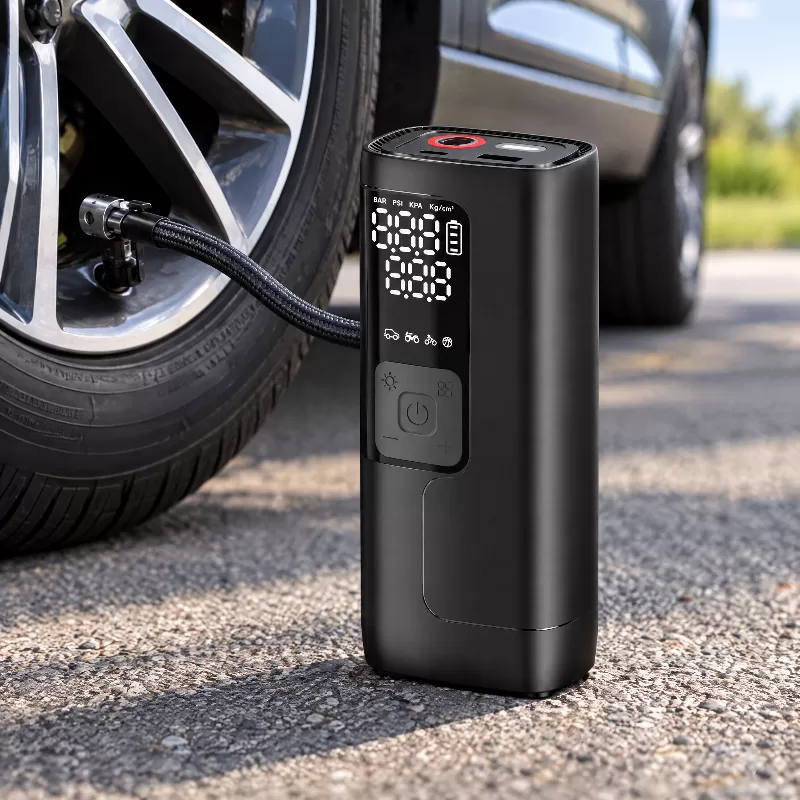
Maintaining correct tire pressure remains a foundational pillar of roadway safety and automotive efficiency, yet it is frequently neglected until a dashboard indicator signals an alert. A dedicated portable air car pump gives motorists direct independence from unreliable service station infrastructure, letting them address pressure deviations wherever they park. Selecting an appropriate tool requires examining physical pump mechanisms, electrical discharge parameters, thermal realities, and sensor accuracy.
Tire pressure monitoring systems alert drivers only after significant inflation loss has already occurred. By integrating a dedicated portable car tire inflator into regular maintenance routines, vehicle owners protect tread longevity, optimize rolling resistance, and prevent emergency roadside stranding.
Understanding the Portable Air Car Pump
What It Is and How Modern Electric Pumps Operate
A modern portable air car pump is a compact, self-contained electro-mechanical assembly built to supply pressurized air directly into pneumatic tires. In general terms, an electric compressor pairs an electric motor with internal cylinders, guided by integrated pressure sensing and automatic shut-off controls inside a portable enclosure.
When attached to a tire valve stem, the internal transducer samples static backpressure inside the tire chamber. As the electric motor cycles the internal pistons within their cylinders, ambient air drawn through intake vents is compressed and directed through the air hose into the tire. Unlike stationary workshop compressors that store vast quantities of compressed air in large pressure tanks, a portable inflator relies on rapid cyclic strokes to deliver air directly and continuously into the tire carcass.
The Practical Urgency: Why Modern Drivers Keep One in the Trunk
Relying on commercial petrol station air pumps presents several practical difficulties. Drivers routinely discover severed air hoses, uncalibrated mechanical dial gauges that yield conflicting readings, or payment terminals that demand exact change during late-night travels. These public units are exposed to continuous weather wear and rough handling, which often degrades their internal calibration.
Tire pressure generally falls as ambient temperature drops, and seasonal swings can cause noticeable pressure changes. As a rule of thumb, pressure can decrease approximately 1 psi for every 10°F drop, so drivers should regularly check readings against the vehicle’s cold-pressure placard. If the TPMS warning illuminates, check the tire pressure as soon as it is safe to stop and inflate to the vehicle placard’s recommended cold pressure; avoid unnecessary driving on an underinflated tire, which can cause overheating and tire damage. Keeping a compact, battery-powered tire pump in the vehicle trunk eliminates logistical delays by allowing operators to inspect and correct pressure discrepancies immediately in their own driveway or a safe parking area.
Key Criteria When Choosing a Portable Tire Inflator
Piston Displacement and Airflow vs. Theoretical PSI
Promotional descriptions of compact inflators frequently highlight maximum achievable pressure figures, such as 120 or 150 PSI. While high pressure is technically relevant for narrow road bicycle tires or certain specialty trailer tires, passenger cars operate within a much lower range, generally between 30 and 36 PSI. Volumetric displacement, expressed in liters per minute (L/min), provides a far more meaningful measure of real-world capability.
A large passenger car or sport utility vehicle tire contains an expansive physical air volume. Total inflation time depends heavily on tire volume, initial starting pressure, and the compressor’s true airflow under load. A pump operating with lower displacement rates must run significantly longer to achieve the same pressure gain, which can accumulate internal heat and risk engaging thermal cutoff switches before inflation is complete.
Product architectures address this volumetric requirement by altering internal cylinder sizing. In the case of the NW08, the manufacturer specifies a dual 24-cylinder structure paired with 100W working power, delivering an airflow rating of 32 L/min and an operating range from 2 to 150 PSI. Reviewing airflow specifications under real working pressures gives buyers a much clearer picture of performance than evaluating peak pressure ratings in isolation.
Battery Architecture, Thermal Management, and Duty Cycles
The development of standalone lithium-ion power sources has significantly expanded inflator utility, removing the need for a tethered connection to an auxiliary 12V vehicle socket. However, compressing ambient gas generates substantial thermodynamic heat alongside continuous electrical current draw, making battery specifications an essential consideration.
Compressor motors operating under heavy backpressure draw significant continuous amperage. The NW08, for instance, incorporates a battery configuration of 3 × 4000mAh cells rated at 11.1V and 44.4Wh, supplying the sustained current necessary for its 100W motor. A stable voltage platform helps prevent premature low-voltage cutoffs when working against higher tire pressures.
Because pneumatic compression concentrates thermal energy near the cylinder head and discharge manifold, every compact pump operates within defined duty cycles. The NW08 product data specifies a continuous runtime of 12 to 15 minutes within an ambient operating window of -10°C to 45°C. Perforated heat-dissipation vents on the outer housing support passive cooling, while respecting operational run-time limits protects internal motor windings and seals from excessive thermal degradation.
Pressure Measurement Accuracy and Auto Shut-Off Logic
Analog pressure gauges rely on mechanical Bourdon tubes or internal springs that can suffer mechanical calibration drift when exposed to the vibrations of regular trunk storage. Modern portable inflators replace mechanical springs with digital pressure transducers connected directly to an onboard microcontroller.
This digital architecture enables automatic shut-off functionality. The user selects the exact target pressure through the physical control interface, attaches the chuck to the valve, and activates the pump. The internal microprocessor monitors incoming pressure pulses in real time, cutting power to the motor the moment the measured pressure matches the preset target. This automated shut-off eliminates manual guesswork, minimizes over-inflation risks, and prevents excessive structural stress on tire casings.
Charging Versatility and Multi-Functional Power
Standardized charging interfaces have made maintaining a portable inflator much simpler. Instead of relying on proprietary wall adapters that are easily misplaced, modern inflators adopt universal Type-C charging ports. The NW08 is specified with Type-C charging input up to 20V/3A, and the stated charging time is two to three hours when used with a compatible power source.
Furthermore, portable inflator batteries can serve secondary duties during travel or emergencies. The NW08 provides Type-C power-bank output up to 20V/2A through a C-to-C connection. This provides practical supplemental power for external devices during road trips or unexpected delays without requiring a separate backup battery pack.
Technical Profile: Compact Air Pump for Car 150PSI NW08
Engineering Data and Operating Benchmarks
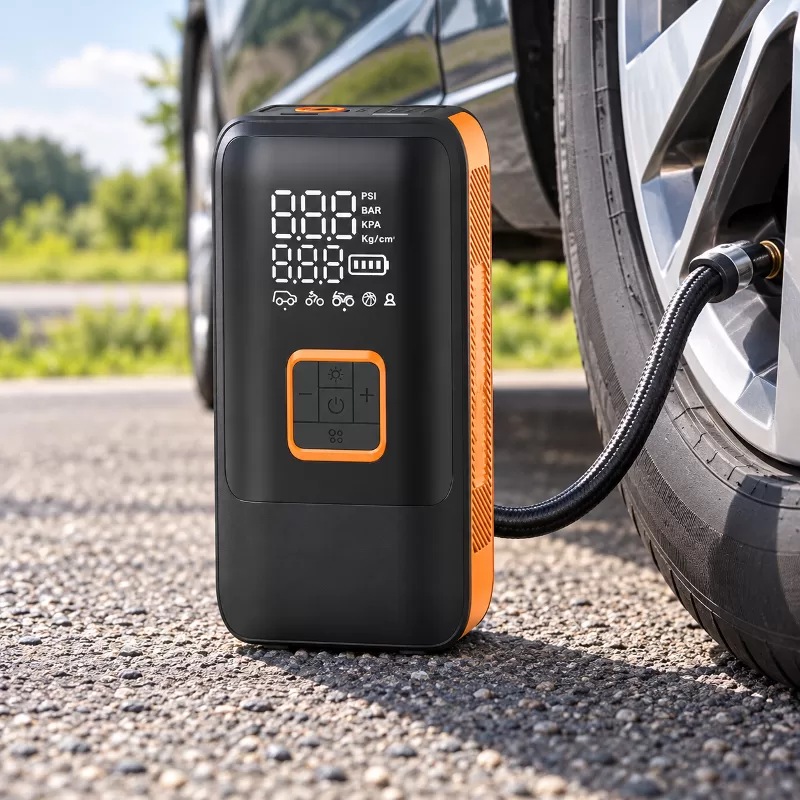
The NW08 portable electric air pump illustrates how these design parameters converge in a consumer-ready automotive device. For us at Newo, as a specialized manufacturer in pneumatic technology and smart inflation products, balancing displacement volume, thermal performance, and practical portability is central to product design. The manufacturer’s documented technical specifications for the NW08 include:
| Specification Parameter | Factory Specification Data |
|---|---|
| Model Designation | NW08 Portable Electric Air Pump |
| Cylinder Configuration | Dual 24-cylinder structure |
| Working Power | 100W |
| Operating Pressure Range | 2 to 150 PSI |
| Displacement Airflow | 32 L/min |
| Battery Capacity & Energy | 3 × 4000mAh, 11.1V, 44.4Wh |
| Battery Service Life | 300 cycles, retaining ≥ 80% original capacity |
| Recharge Duration | 2 to 3 hours |
| Input Charging Protocol | Type-C (Up to 20V / 3A) |
| Power Bank Output | Up to 20V / 2A (via Type-C to Type-C connection) |
| Continuous Operating Runtime | 12 to 15 minutes |
| Working Temperature Range | -10°C to 45°C |
| Acoustic Noise Rating | ≤ 85dB at 1 meter distance |
| Dimensions & Net Weight | 185 × 96 × 63.6 mm; Net Weight: 1035g |
| Display & Controls | Digital LED screen with 5 preset operational modes |
Vehicle and Equipment Suitability
With an airflow rating of 32 L/min, custom pressure adjustments, and five built-in preset modes, the NW08 addresses a range of inflation requirements across private transportation, recreation, and commercial distribution channels:
- SUVs and Off-Road Vehicles: The NW08 is specified for SUVs, off-road vehicles, and larger car tires; actual inflation time and whether a cooling break is needed depend on tire size, starting pressure, ambient temperature, and duty-cycle limits.
- Daily Commuter Vehicles: Enables routine pressure maintenance before morning departures to preserve fuel efficiency and balanced handling.
- Motorcycles and E-Bikes: Its adjustable pressure setting can help users match the motorcycle or e-bike manufacturer’s recommended cold pressure.
- Bicycles and Road Bikes: Supports bicycle inflation up to its stated 150 PSI limit; confirm the included valve adapters before specifying Schrader or Presta compatibility.
- Sports Equipment and Inflatables: The sports-ball mode is intended to simplify inflation, but users should select the pressure recommended for the specific ball and avoid relying on the 150-PSI maximum as a target.
- Emergency Roadside Backup: Functions as a self-powered inflation tool during travel or roadside stops without drawing current from the vehicle starter battery.
Comparing Tire Inflation Solutions
Cordless Battery Inflator vs. 12V Wired Inflator
Choosing between a battery-powered inflator and a traditional 12V plug-in model involves evaluating daily convenience against continuous power access. A 12V wired unit draws power directly from the vehicle, which eliminates concerns about internal battery discharge during prolonged storage. However, running a cord from the cabin socket out to all four tires can be cumbersome, especially in rain, snow, or mud.
A long cable may be less convenient to route from the power socket to distant wheels, particularly on longer wheelbases or multi-row passenger vehicles. Furthermore, older or high-draw 12V pumps can blow the accessory socket fuse if the electrical circuit is not rated for continuous heavy loads. A cordless design avoids using the vehicle’s 12V socket and allows setup without routing a cable from the cabin, simplifying work around all four corners of the car.
Portable Pumps vs. Gas-Station Air Pumps vs. Workshop Air Compressors
Different inflation methods offer distinct advantages and trade-offs depending on location, required precision, and available equipment:
| Inflation Category | Storage & Portability | Sensor & Gauge Reliability | Airflow & Speed | Availability & Access |
|---|---|---|---|---|
| Cordless Portable Pump | High; stores easily in trunk, underfloor tray, or bag | Digital display and preset-pressure auto shut-off; specific sensor tolerance not stated | Moderate (e.g., 32 L/min on NW08) | Portable and available where the battery is charged, subject to safe stopping conditions and tire compatibility |
| 12V Wired Inflator | Moderate; compact pump requiring cable management | Moderate; uses mechanical needle dial or digital display | Low to Moderate (typically 15 to 25 L/min) | Requires vehicle power, typically through a 12V socket or direct battery connection |
| Gas-Station Air Station | Fixed location; zero vehicle storage required | Variable; mechanical gauges may exhibit calibration variance, so using a personal gauge is advised | High; commercial shop pneumatic line | Restricted; dependent on operational machines and payment |
| Workshop Air Compressor | Non-portable; requires garage or dedicated bay | High; relies on external commercial pressure gauges | Very High; massive reservoir displacement | Restricted; accessible only at home garages or commercial shops |
Step-by-Step Safe Operating Guide
1. Locating True Cold Inflation Specifications
Before attaching any pump, drivers must verify the vehicle manufacturer’s engineered cold inflation pressure. This information is displayed on the tire and loading information placard affixed to the driver-side door jamb (B-pillar), or detailed in the owner’s manual.
A frequent mistake is inflating tires to the pressure figure stamped onto the rubber sidewall. That embossed marking indicates the maximum cold inflation pressure the tire structure is rated to hold under maximum gross load, rather than the vehicle chassis’s intended operating pressure. Inflating to the sidewall maximum instead of the vehicle placard can overinflate the tire; overinflated tires can wear unevenly and ride more harshly.
2. Checking Cold Tire Conditions
Tire pressure must always be measured when tires are cold. A tire is considered cold after the vehicle has been parked for at least three hours, or after it has been driven less than one mile following that period. Adhering to this definition ensures the measurement reflects base structural conditions.
Driving naturally warms the tire through internal friction, flexing sidewalls, and road contact, which raises the internal air pressure. Drivers should never vent air from a warm tire to match the door placard figure. Releasing air from a warm tire causes it to become dangerously underinflated once the tire cools back down to ambient temperature.
3. Pre-Inflation Visual Inspection
A visual and physical inspection of the tire should always precede inflation. Examine the entire tread circumference and both inner and outer sidewalls for signs of structural compromise, foreign objects, or physical damage.
Check for nails, screws, stone cuts, and rim flange impacts. Look closely for sidewall bulges, bubbles, cord exposure, or rubber cracking from weathering. If a tire displays a localized bubble or casing separation, introducing compressed air can provoke catastrophic tire failure. In those instances, the tire must not be inflated; mount the spare wheel or summon professional roadside recovery.
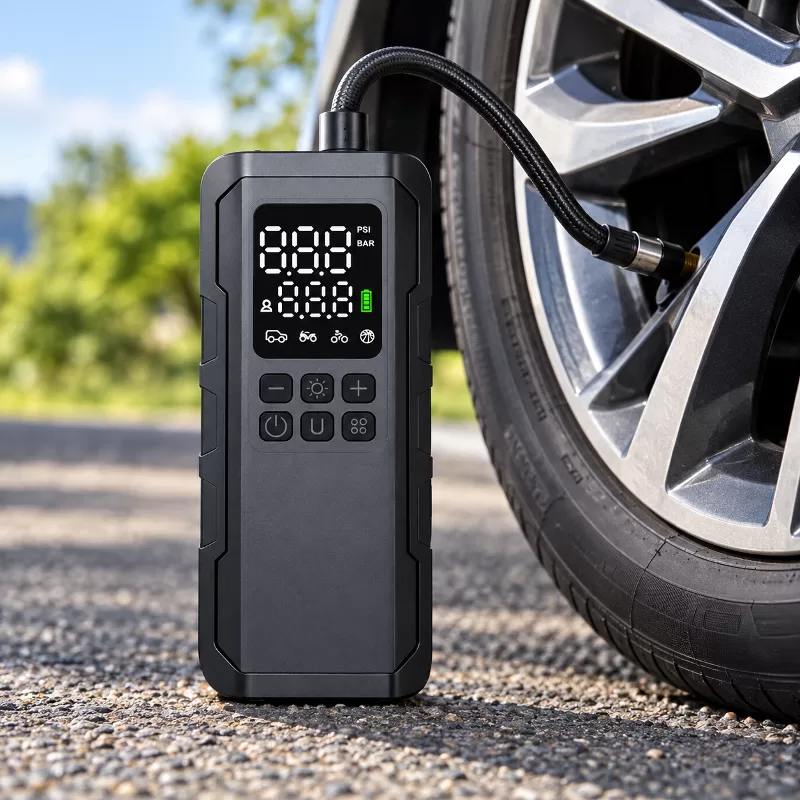
4. Connecting, Setting, and Running the Device
Following a systematic operating sequence protects the pump’s components and ensures precise inflation:
- Remove the valve cap and check that the valve and chuck connection are free of visible dirt before attaching the hose.
- Align the inflator chuck squarely with the Schrader valve and secure it firmly until a stable seal forms without audible hissing.
- Power on the digital inflator to read and confirm the current resting cold tire pressure shown on the LED screen.
- Select the correct engineering unit (PSI, BAR, or kPa) and choose the appropriate vehicle operational mode preset.
- Adjust the target pressure setting using the plus or minus controls to match the vehicle’s door placard specification.
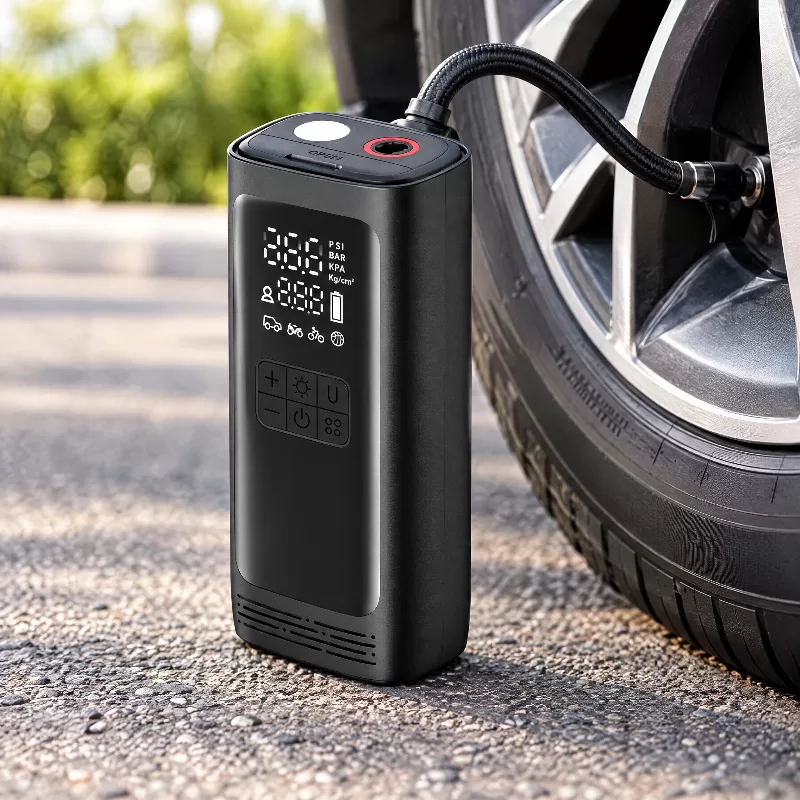
- Press the power button to start compression; allow the motor to cycle until the auto shut-off mechanism stops automatically at the set target.
- Disconnect the air chuck promptly to minimize pressure loss, replace the protective dust cap, and let the pump fitting cool before packing the tool away.
5. Diagnosing Recurring Pressure Loss
A repeated or unexplained pressure loss warrants inspection for a leak; compare readings under similar cold conditions rather than relying only on routine top-ups. Continually pumping air into a tire that repeatedly loses pressure risks sudden failure on the road.
Pressure loss typically stems from three mechanical causes: an embedded puncture in the tread belt, corrosion along the wheel bead rim preventing an airtight seal, or a damaged or loose internal Schrader valve core. Applying a mild soapy water solution to the valve stem and bead rim helps isolate the problem: expanding foam bubbles reveal escaping air, indicating whether the valve core needs tightening or the wheel requires shop dismounting and professional repair.
Practical Selection Checklist
When evaluating a portable air car pump for personal use or commercial stocking, consider these essential physical and operational criteria:
- [ ] Displacement Airflow (L/min): Confirm that output airflow (e.g., 32 L/min) matches the tire volume of your primary vehicles.
- [ ] Cylinder Structure: Look for documented cylinder designs, such as dual 24-cylinder layouts, that support reliable inflation across demanding tires.
- [ ] Operating Pressure Range: Select equipment that covers low sport-ball pressures (e.g., 2 PSI) up to high-pressure demands (e.g., 150 PSI).
- [ ] Digital Pressure Display and Auto Shut-Off: Confirm the unit provides clear digital readouts and automatically cuts motor power at the set pressure target.
- [ ] Sub-Zero Operating Envelope: Ensure the device operates across realistic seasonal temperatures, such as -10°C to 45°C.
- [ ] Acoustic Rating: Check that noise suppression keeps sound output at or below 85dB at one meter to reduce operational strain.
- [ ] Modern Type-C Port: Verify the unit recharges via modern Type-C connections rather than outdated, proprietary plugs.
- [ ] Power-Bank Output: Verify the supported Type-C output rating and device compatibility; the NW08 is specified at up to 20V/2A through a C-to-C connection.
- [ ] Physical Dimensions and Weight: Ensure the unit remains under 1.5 kg and fits comfortably into interior glove boxes, trunk side nets, or storage bins.
- [ ] Direct Manufacturing Background: Select hardware manufactured under strict quality controls by experienced pneumatic producers rather than unbranded re-sellers.
Frequently Asked Questions (FAQs)
Is a 150 PSI maximum rating necessary for everyday passenger cars?
A 150 PSI maximum rating is the pump’s maximum rated pressure, not the target for passenger-car tires. Passenger vehicles typically operate between 30 and 36 PSI; always refer to the vehicle placard for the correct pressure. The higher rating simply allows the device to service high-pressure bicycle tires or specialized applications when required.
Can a compact air pump handle high-volume SUV and off-road tires?
Compact inflators can handle larger SUV and off-road tires provided their internal displacement rate is sufficiently high. Units configured with a dual 24-cylinder structure and a 100W motor, such as the NW08, deliver an airflow rating of 32 L/min. This volumetric output supports larger tire air volumes within reasonable run times, subject to duty-cycle limits.
How does ambient temperature affect cordless pump battery performance?
Low ambient temperatures slow the internal chemical kinetics of lithium-ion cells, which can temporarily reduce effective discharge capacity and shorten total running time. An operating rating down to -10°C indicates the manufacturer’s stated usable temperature range, but cold conditions can still reduce available battery performance. Keeping the device inside a climate-controlled vehicle cabin during winter road trips helps preserve maximum battery runtime.
Can I use a portable tire pump to fix a completely flat tire on the highway?
Do not assume a pump makes a punctured tire safe to drive. If the tire is damaged or will not hold pressure, use the spare or contact roadside assistance; follow professional guidance before moving the vehicle. A portable pump is designed for inflation maintenance and cannot repair structural casing damage or unseated tire beads.
Why does the inflator hose get hot near the pump base during operation?
The air hose connection gets warm due to basic thermodynamic laws: compressing ambient air concentrates thermal energy, which is transferred directly to the cylinder head and hose connection. This temperature rise is a normal byproduct of pneumatic compression. Avoid touching hot metal fittings immediately after operation and allow the pump and hose connection to cool before storage.
What should I do if the tire pressure continues to drop after inflation?
Persistent or unexplained pressure loss may indicate a leak; compare readings under similar cold conditions and have the tire inspected if the loss continues. Inspect the tread carefully for embedded screws, check the valve stem for escaping air, and have a certified tire technician inspect the wheel rim bead for hidden corrosion or micro-cracks.
Reliable Tire Maintenance on the Go
Carrying an efficient portable air car pump transforms routine tire pressure management into a more convenient routine. Regular monitoring prevents premature tire wear, enhances fuel economy, and reduces the likelihood of emergency roadside delays caused by unnoticed under-inflation.
Selecting a unit built with balanced motor power, verified airflow displacement, and automated digital cut-offs gives drivers dependable support across everyday commutes and remote journeys alike. By pairing reliable inflation hardware with the correct vehicle cold-pressure specifications, motorists maintain total control over their driving safety wherever the road leads.
-

Meet NEWO at the 140th Canton Fair: Visit Booth 10.3 M03–04
Meet NEWO at the 140th Canton Fair in Guangzhou, October 15–19, 2026. Visit Booth 10.3 M03–04 to explore portable air pumps and discuss OEM, ODM and distribution opportunities.... -

As Shenzhen Welcomes the World for APEC 2026, NEWO Welcomes You to Our Factory
As Shenzhen prepares for APEC 2026, NEWO welcomes international buyers and partners to visit our factory, meet our team and explore future cooperation.... -

Leading the Way in Product Innovation and Excellence
Smartnewo exemplifies professionalism in product innovation and manufacturing. Their collaboration with Xiaomi Youpin on the G01 crowdfunding project highlights their expertise in creating compact, powerful inflatable pumps. Rigorous engineering, meticulous production processes, and advanced quality assurance underscore their commitment to excellence. The success of the G01 project, with significant market... -

Essential Qualities of an Excellent Supplier
In today's competitive market, finding a reliable supplier is crucial for business success. Based on insights from Smartnewo and broader internet research, here are key qualities an excellent supplier must possess:... -

NW06 Tire Inflator: Compact Power for Quick Inflation
Summary The NW06 Tire Inflator delivers quick and efficient tire inflation with a powerful 35L/min airflow. It features a user-friendly LCD screen for real-time pressure monitoring, dual power options with a built-in 6000mAh battery, and multiple nozzle attachments for versatile use. Its compact design and integrated LED light ensure convenience and... -

Unleash the Power of Portability: The SmartNewo Jump Starter with Air Compressor KF03
This guide will walk you through the steps to effectively use a portable tire inflator, helping you stay prepared and safe on the road.... -

Newo Attends The 2024 Consumer Electronics Show (CES)
Smartnewo booth is located at 53672, Halls A-D, Level 2, Venetian Expo, Las Vegas Convention Center (LVCC). ... -

Smartnewo’s Dual-Cylinder Air Pump Rocks the Hong Kong Autumn Electronics Fair!
Smartnewo’s Dual-Cylinder Air Pump Rocks the Hong Kong Autumn Electronics Fair!... -

Meet at the Canton Fair! Smartnewo brings dual-cylinder air pumps, making your inflation experience faster and more stable!
NEWO has went deep communication and negotiation with customers from all over the world on booth.... -

“Hong Kong Autumn Electronics Fair – 1CA18 (October 13th to 16th): Smartnewo invites you to visit our booth!
Hong Kong Autumn Electronics Fair...
-

What to Check Before Ordering Custom Electric Bike Pumps
Plan custom electric bike pumps with a clear requirements freeze for valves, TPU tubes, portability, repeated top-ups, charging, and model-specific documents.... -

OEM vs ODM Air Pumps: Which Manufacturing Model Fits Your Brand?
Compare OEM and ODM air pump projects by design responsibility, change approval, development scope, and written ownership terms before choosing your route.... -

How to Choose a Reliable Tire Inflator Manufacturer in China
Choose a tire inflator manufacturer in China with a focused RFQ, supplier evidence, configuration checks, and clear sample-to-pilot decisions for your brand.... -

Rechargeable Electric SUP Pump for Paddle Boards: Faster Inflation for SUPs, Kayaks and Inflatable Tents
The BL10-C Portable Electric Bike Tire Inflator is a compact and lightweight mini electric bike pump designed for modern cyclists. With up to 120 PSI pressure, a digital LED display, preset pressure control, automatic shut-off, USB-C charging, and multiple valve adapters, BL10-C offers a convenient inflation solution for road bikes,... -

Are Electric Bike Pumps Worth It in 2026? Electric Pump vs CO₂ vs Mini Hand Pump
Discover whether electric bike pumps are worth it in 2026. This guide compares electric bike pumps, CO₂ inflators, and mini hand pumps for road cycling, gravel riding, commuting, and long-distance rides. Learn the pros, limitations, best use cases, and key features to look for before choosing the right portable tire... -
BL10-C Portable Electric Bike Tire Inflator: Small Size, Reliable Power for Every Ride
The BL10-C Portable Electric Bike Tire Inflator is a compact and lightweight mini electric bike pump designed for modern cyclists. With up to 120 PSI pressure, a digital LED display, preset pressure control, automatic shut-off, USB-C charging, and multiple valve adapters, BL10-C offers a convenient inflation solution for road bikes,... -

Why Mini Electric Bike Pumps Are Becoming Essential for Modern Cycling
Discover why mini electric bike pumps are becoming essential for modern cyclists. Learn how portable electric bike pumps improve tire pressure management, riding safety, and convenience.... -

The Ultimate Smart Solution for Easy Outdoor Adventures in 2026
Discover how a spring travel air pump simplifies outdoor trips with fast inflation, smart features, and powerful performance—perfect for every adventure.... -

Powerful 5-in-1 Portable Car Tire Inflator and Jump Starter: The Ultimate Emergency Tool for Every Driver
Why Every Driver Needs a Portable Car Tire Inflator and Jump Starter Modern drivers face many unexpected situations on the road. A flat tire, low tire pressure, or a dead car battery can happen at the worst possible time. That’s why having a portable car tire inflator and jump starter is... -

7 Real Cycling Scenarios That Show Why Every Rider Should Carry a Mini Bike Pump
Cycling is one of the most freeing activities you can enjoy. Whether you’re commuting to work, riding through city streets, or exploring quiet countryside roads, a bike ride can instantly improve your day. But there’s one small problem that almost every cyclist eventually faces: Low tire pressure. It might happen...
-

How Is a Football Properly Inflated?
The correct inflation of a football - with not too much and not too little air - is a hotly debated topic among footballers.... -

Application Scenarios of Car Inflator Pump
Often long-distance business trips or play car owners because the road may be more remote areas, in this case if you encounter a tire leak....