

 Portable Tire Inflators
 Electric Air Pumps
 Electric Car Tyre Pumps
 Electric Ball Pumps
 Electric Bike Pump
 SUP Air Pump

Portable Air Inflator Pump: Selection Criteria, Operating Physics, and Application Guide
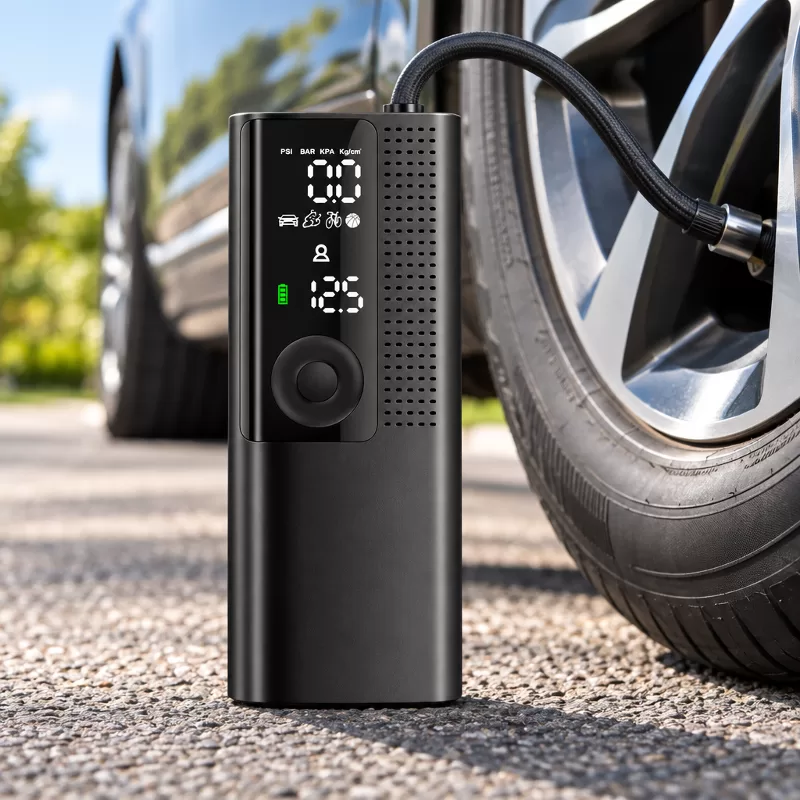
When a driver encounters a sudden drop in tire pressure miles away from a service station, having an autonomous portable air inflator pump provides a practical way to manage routine pressure adjustments and roadside top-offs. Modern pneumatic technology has progressed beyond cumbersome workshop equipment, packaging motor assemblies and lithium cells into compact, glove-box-friendly enclosures. Selecting an effective portable air inflator pump requires understanding how compact reciprocating compressors operate, how runtime guidance manages continuous use, and why vehicle manufacturers dictate cold inflation thresholds. This engineering guide examines mechanical principles, practical workflows, and real-world performance metrics across everyday automotive and utility applications.
Fundamentals of Portable Pneumatic Compression
Mechanics of Compact Reciprocating Compressors
In consumer pneumatic tools, small reciprocating compressors typically use an electric motor to cycle an internal piston through an intake and exhaust sequence. During the intake stroke, ambient air enters through an inlet valve into the cylinder space. When the stroke reverses, internal air volume decreases, forcing pressurized air past an outlet check valve and into the delivery hose.
Because the internal displacement within compact handheld enclosures is limited, the motor must complete multiple strokes rapidly to generate steady pneumatic delivery. This mechanical setup packages pneumatic force into a lightweight profile that is easy to store and transport. At the same time, compressing air creates heat as a natural thermodynamic outcome, which requires adequate casing ventilation during regular operation.
Pneumatic Terminology: Demystifying PSI, BAR, and Airflow
Many operators mistakenly equate maximum rated pressure with rapid inflation speed, creating unrealistic expectations during roadside top-offs. Static pressure ratings, typically expressed in pounds per square inch (PSI) or bar (1 bar equals approximately 14.5038 PSI), represent the maximum operating pressure boundary stated by the manufacturer for the tool.
Volumetric throughput, measured in liters per minute (L/min) or cubic feet per minute (CFM), dictates actual inflation duration across various tire volumes. A compact unit may list a rated airflow of 17 to 18 L/min in its product specifications, but actual delivery rates naturally taper as pneumatic backpressure mounts inside a pressurized tire cavity. Understanding this distinction prevents users from confusing static high-pressure capability with volumetric filling speed.
Core Selection Criteria for Portable Inflator Pumps
Power Delivery Architectures: Battery Cells vs. DC Vehicle Feeds
Choosing an inflator requires evaluating how electrical power is routed to the compression motor during transit or off-grid field use. Cordless battery units provide untethered mobility around trailers, mountain bikes, and roadside tire positions without trailing power cables through car door seals.
Conversely, dedicated 12V direct-current auxiliary plugs draw power directly from the vehicle auxiliary electrical circuit, eliminating battery self-discharge concerns during seasonal glove-box storage. Hybrid architectures that accept both internal lithium cells and 12V to 14V automotive power sockets offer practical operational resilience when internal cells have low charge.
| Power Architecture | Primary Advantages | Operational Limitations | Ideal Use Case |
|---|---|---|---|
| Internal Lithium Pack (e.g., 7.4V) | Complete cordless freedom; compact storage; dual utility as mobile power reserve | Cell self-discharge over time; finite runtime per full charge | Commuting, cycling, quick pressure adjustments, urban parking |
| 12V–14V DC Vehicle Socket | Continuous power feed from vehicle auxiliary socket; no reliance on internal cells | Restricted cable reach; requires access to vehicle auxiliary port; cord management | Road trips, commercial fleet backup, vehicular emergency kits |
| Hybrid Dual-Power | Flexible operation; allows use when internal battery is uncharged | Additional power input ports and internal switching circuitry | Mixed-vehicle fleets, roadside backup kits, long-distance touring |
Thermal Duty Cycles and Continuous Runtime Limits
Every portable air inflator pump operates under thermal and mechanical parameters determined by its internal motor and cylinder assembly. In compact inflator housings, internal mechanical movement and air compression generate heat during operation, requiring operators to observe recommended runtime boundaries.
Rather than assuming an inflator can run indefinitely, users must adhere to the specific operating limits outlined in the product manual. For instance, the LP17A-P product specifications list a continuous runtime of about 20 minutes, indicating that operators should pause the unit to let it cool after prolonged pumping tasks.
Digital Pressure Gauging and Auto-Shutoff Mechanisms
Analog dial gauges rely on mechanical Bourdon tubes, which can lose calibration when dropped into trunk footwells or subjected to regular vehicular vibrations. Modern electronic units replace these older dial assemblies with digital displays that show numerical readings clearly during low-light conditions.
Integrated preset controls and automatic shut-off functions allow operators to select a target pressure before initiating inflation. When the unit detects that internal pressure has reached the selected target threshold, it automatically stops motor operation to help prevent accidental over-inflation, although users should confirm final tire pressure with a dedicated tire gauge when high precision is necessary.
Form Factor, Mass, and Vehicle Staging
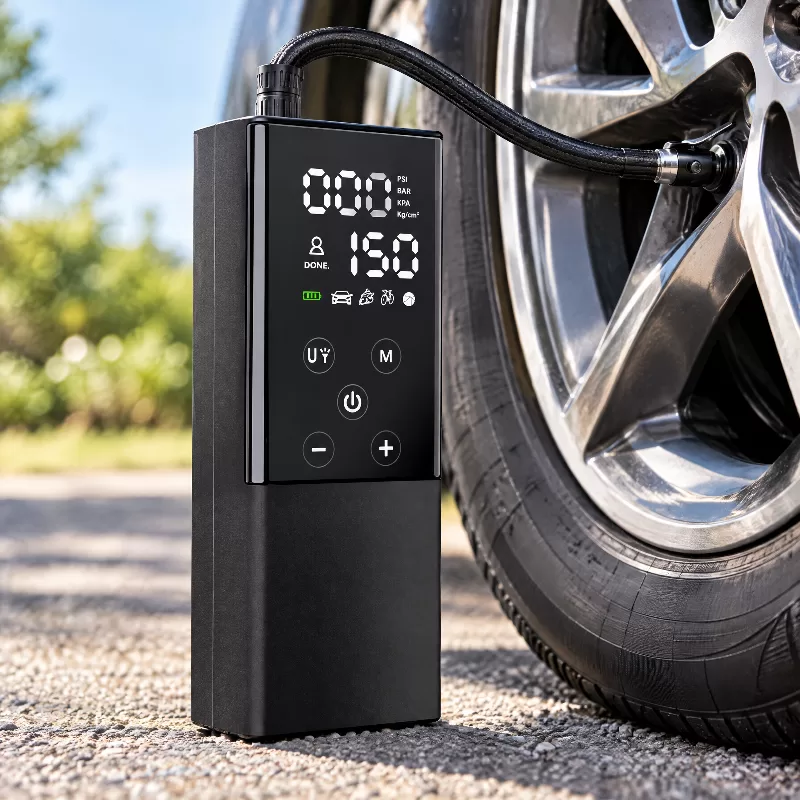
Roadside gear must balance physical sturdiness against compact dimensions that fit inside motorcycle luggage, under-seat storage trays, or glove compartments. A device weighing roughly 450 to 500 grams with a footprint resembling a water bottle ensures users can conveniently carry the hardware on daily commutes.
Unanchored inflators may shift slightly across rough ground during motor operation due to natural piston reciprocation. When evaluating different hardware choices, looking for stable flat bases or non-marring rubberized contact points can help keep the unit properly positioned during roadside inflation beside highway traffic.
Safe Operating Protocol: Cold Inflation and Tire Dynamics
Placard Pressure vs. Sidewall Markings
A frequent error among motorists involves reading the maximum inflation pressure embossed directly onto the rubber tire sidewall. Sidewall markings represent the maximum cold inflation pressure the tire structure is rated to hold under maximum load capacity, established by tire industry engineering standards.
In contrast, the vehicle manufacturer prints the recommended cold inflation pressure on the driver-side B-pillar door placard or in the vehicle owner manual. This vehicle-specific specification balances suspension engineering, chassis dynamics, load distribution, and tread contact footprint, and drivers should always follow this placard guidance rather than targeting the maximum sidewall figure.
- Door Placard Guidance: Dictates the engineered cold tire pressure intended by the vehicle manufacturer for balanced vehicle handling, braking performance, and even tread wear across the tire profile.
- Sidewall Maximum Marking: Designates the structural upper limit for the tire carcass, serving as an absolute safety threshold rather than an operational target for daily driving.
- Over-Inflation Consequences: Stiffens ride compliance, promotes accelerated center-tread wear, and increases vulnerability to structural impact damage from potholes and road debris.
- Under-Inflation Consequences: Induces heavy shoulder-tread abrasion, reduces vehicle fuel economy, compromises directional stability, and significantly elevates internal tire operating heat.
Cold Measurement Rules and Ambient Thermal Shifts
Pneumatic pressure inside an automotive tire fluctuates dynamically based on friction generated during travel and changing seasonal air temperatures. Authoritative safety guidance defines cold tire pressure as a measurement taken after the vehicle has been parked for at least three hours, or driven less than one mile after that rest period.
Ambient weather changes directly influence internal pressure through gas expansion and contraction. Vehicle manufacturers often note that changing outdoor temperatures cause noticeable pressure shifts, making it prudent to consult the vehicle manual and measure cold pressure regularly. Motorists checking tires during sudden seasonal cold snaps frequently discover low pressure alerts caused primarily by atmospheric cooling rather than physical tire punctures.
Step-by-Step Roadside Top-Off Execution
- Position the vehicle on a stable, level surface away from active traffic lanes, engage the emergency parking brake, and activate hazard indicator lights.
- Locate the vehicle placard on the driver door frame or consult the owner manual to confirm exact recommended cold pressure targets for front and rear axles.
- Unscrew the valve stem dust cap, clearing away loose surface dust from the threaded stem before attaching the inflator air chuck.
- Thread the inflator chuck firmly onto the valve stem to achieve a tight seal without audible air leakage, consulting the device manual for display feedback.
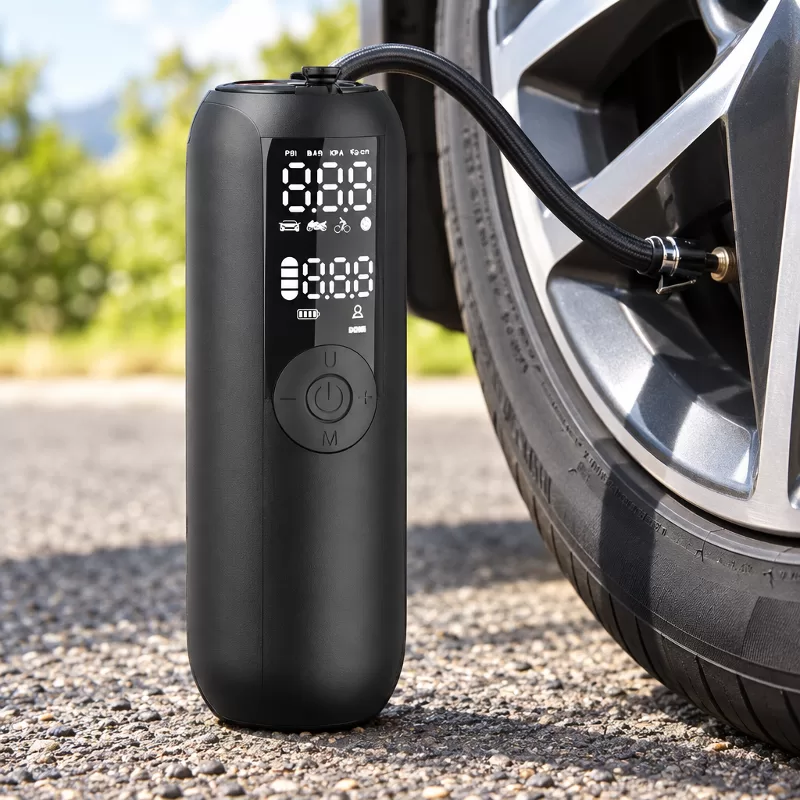
- Select the relevant target preset mode or manually set the required pressure limit using the interface controls.
- Initiate the compression cycle and monitor progress from a safe standing position, allowing the automatic shut-off function to stop the airflow upon reaching the target.
- Disconnect the air chuck smoothly to minimize air loss, reinstall the protective dust cap, and inspect the hose fitting before storing the inflator.
Technical Profile: LP17A-P Dual-Power Inflator
Engineering Specifications and Architecture
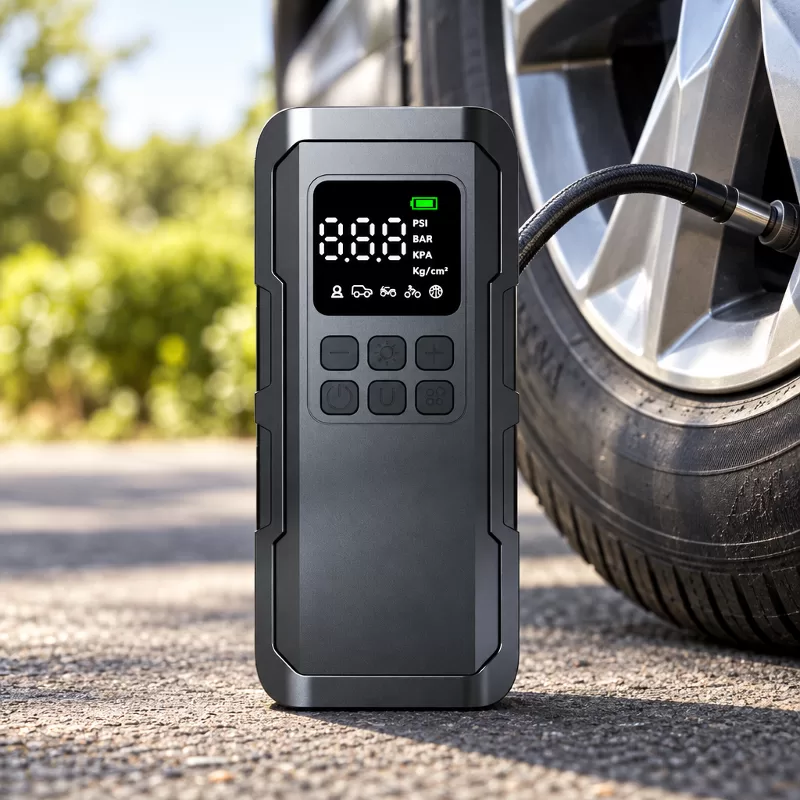
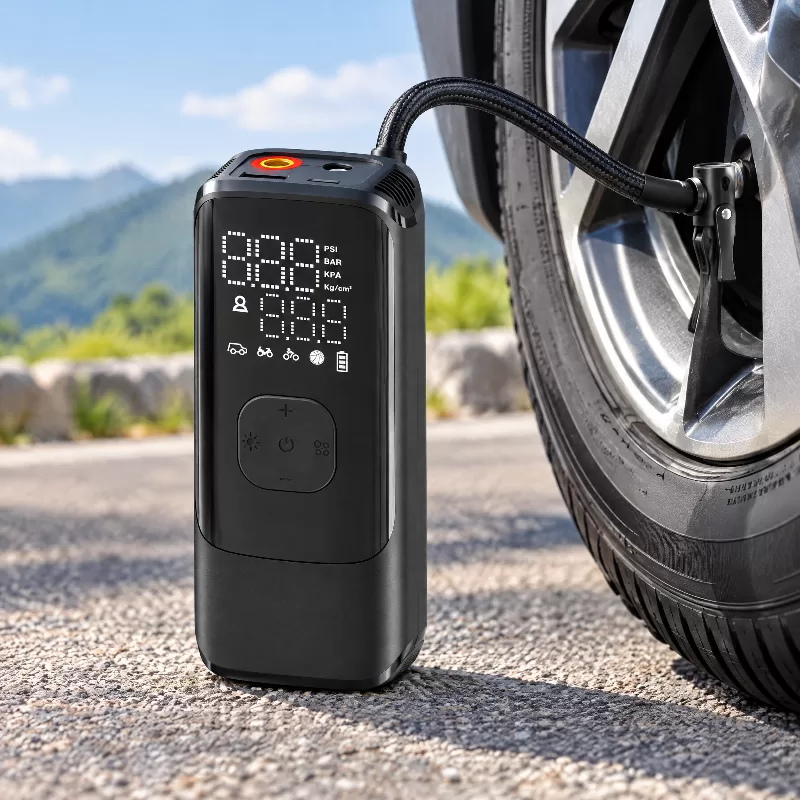
Modern dual-power equipment bridges the gap between everyday convenience and emergency roadside capability. Engineered for versatile pneumatic tasks, the LP17A-P features an internal 17-cylinder structure and a 50-watt maximum working power motor drive, delivering a rated airflow rate of 17 to 18 L/min.
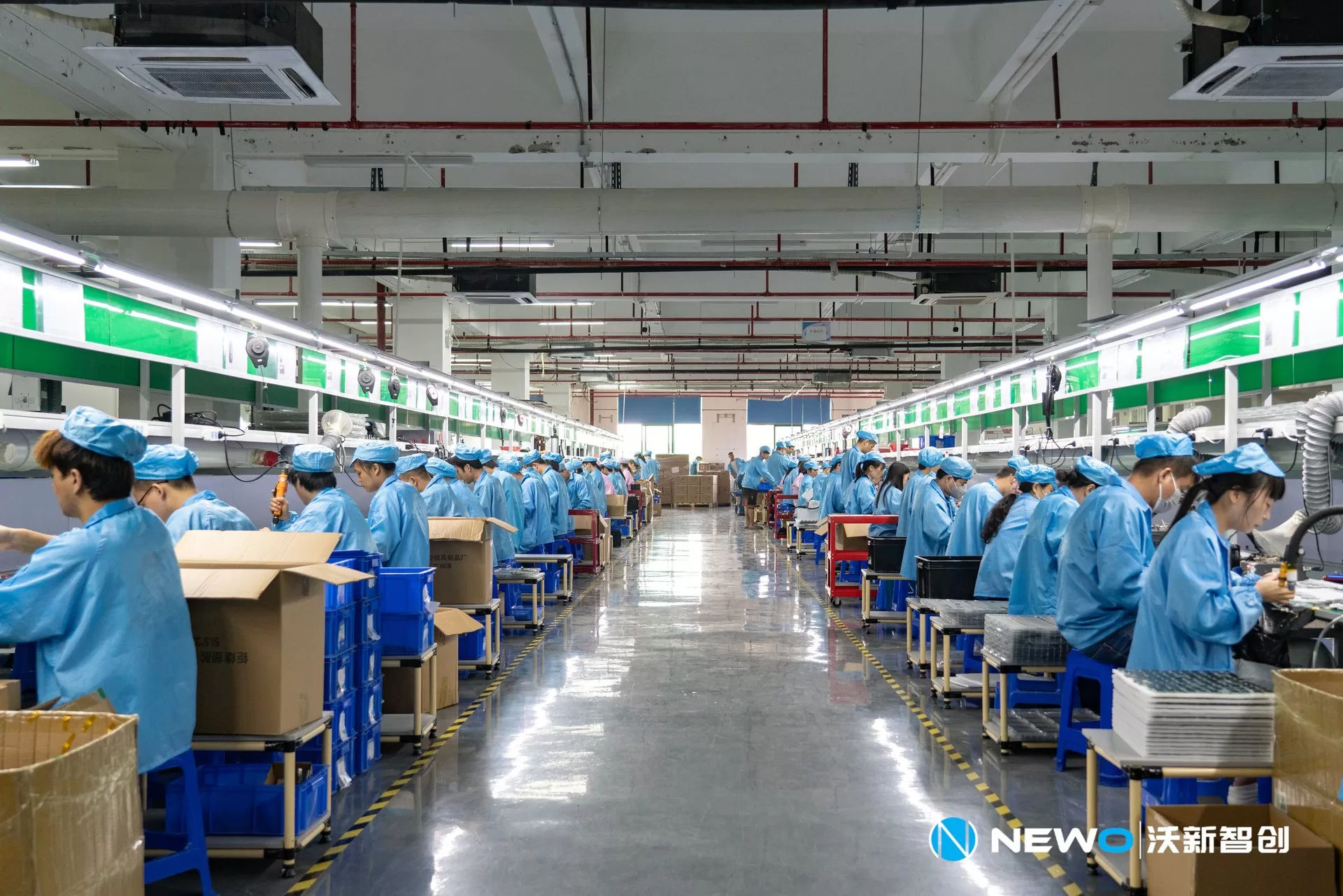
Its power topology combines an onboard 7.4V lithium pack (two 18650 cells totaling 14.8Wh) with direct support for 12V to 14V automotive auxiliary vehicle power sockets. This allows operators to power the compressor directly from their car even if the internal battery cells have depleted over time. Supported by advanced production capabilities, experienced engineers, and strict quality management, Newo manufactures smart electric air pumps and portable inflation solutions designed to deliver convenience, efficiency, and reliability for customers worldwide.
Benchmark Specification Matrix
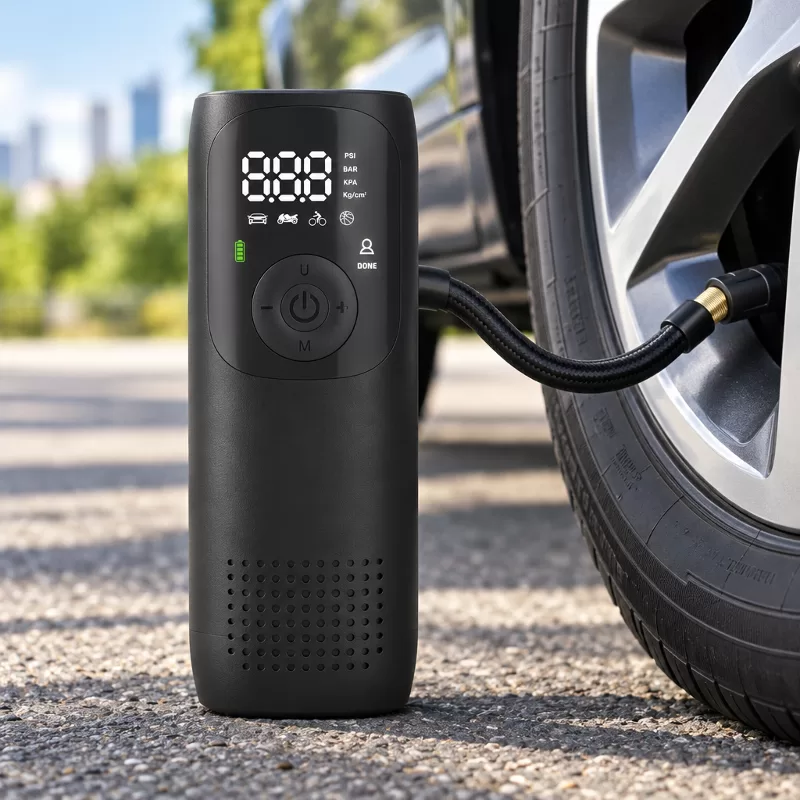
Evaluating an inflator requires clear, transparent data covering electrical inputs, working envelopes, sound emission, and physical dimensions. The following technical specifications outline verified engineering metrics for the LP17A-P portable tire inflator air pump:
| Technical Parameter | Engineering Specification | Practical Operational Context |
|---|---|---|
| Pressure Range | 2 to 150 PSI | Accommodates athletic balls up to high-pressure bicycle tires |
| Delivery Airflow | 17 to 18 L/min | Listed airflow rate for tire top-offs and inflation tasks |
| Cylinder Specification | 17 cylinder | Manufacturer-specified mechanical cylinder configuration |
| Battery Configuration | 2 × 18650 cells (2000mAh, 7.4V, 14.8Wh) | Enables cordless operation without requiring external vehicle wiring |
| External Power Input | 12V to 14V vehicle power | Connects to standard automotive auxiliary DC sockets |
| Operating Temperature | -10°C to 45°C | Manufacturer-stated operating temperature range |
| Manufacturer Inflation Claim | Stated capacity of about 2 tire inflations per full charge | Documented manufacturer specification for internal battery run |
| Continuous Runtime | About 20 minutes | Operational runtime ceiling cited in product specifications |
| Noise Level | 85 dB or below at 1 meter | Acoustic sound emission level listed for the device |
| Product Dimensions & Mass | 68 × 46 × 160 mm; ~453.1 g | Compact hand-held footprint suitable for door pockets or packs |
| Interface & Utility Ports | Type-C input (5V/2A); 5V/2A output | Facilitates internal pack charging and secondary power-bank style utility |
Operational Boundaries across Vehicles and Equipment
The LP17A-P serves a wide operational spectrum spanning passenger car tires, motorcycles, e-bikes, wheelchairs, balance vehicles, and sports equipment via five preset modes. Selecting custom pressure settings allows precise adjustments for specialized low-pressure sports balls or equipment requiring single-digit PSI targets.
Nevertheless, small-bore reciprocating pumps have distinct mechanical limits. While the 150 PSI upper ceiling easily handles high-pressure bicycle inner tubes, commercial semi-truck tires containing vast air volumes require heavy-duty high-CFM commercial compressors. The LP17A-P is specifically engineered for passenger car pressure maintenance, emergency tire top-offs, and two-wheeled transport.
Preventative Maintenance, Battery Health, and Long-Term Storage
Lithium Cell Preservation in Extreme Vehicle Cabins
Automotive interiors expose electronic accessories to notable seasonal temperature swings, with cabin temperatures rising sharply during midsummer parking and dropping below freezing during winter nights. Sustained high heat accelerates internal battery aging, while sub-freezing temperatures temporarily restrict chemical activity inside lithium-ion cells.
To preserve battery performance over time, users should follow the manufacturer’s battery storage instructions and consider keeping the inflator inside cooler, shaded storage areas like a trunk compartment rather than on exposed dashboards. Periodically checking and recharging the battery pack according to product guidelines helps avoid deep self-discharge states.
Connector Thread Care and Pneumatic Seal Integrity
Field reliability relies heavily on the physical condition of the air delivery hose and its terminal connectors. Road grit, sand, and fine debris can contaminate valve threads, leading to micro-leaks that disrupt pressure readings during inflation.
- Connector Seal Inspection: Regularly inspect the flexible sealing ring inside the brass air chuck for signs of cracking, wear, or trapped grit.
- Debris Management: Wipe valve stems clean of dirt and road grime before attaching the inflator chuck to prevent abrasive particles from entering the pneumatic path.
- Ventilation Clearance: Keep body ventilation ports clean and free of dust, lint, or trunk debris to maintain unobstructed motor cooling.
- Hose Handling: Coil the flexible air hose naturally without sharp pinches or extreme bends that could crease internal layers.
Frequently Asked Questions (FAQs)
Can a compact 150 PSI pump inflate heavy truck or commercial tires?
A 150 PSI rating represents the maximum pressure boundary specified for the unit, but it does not mean the inflator is practical for commercial heavy-duty tires. Large truck tires contain substantial volumes of air. A portable pump delivering 17 to 18 L/min would require extended runtimes that exceed its designated continuous operating duration, making the device best suited for passenger cars, motorcycles, bicycle tires, and light utility equipment.
Why does the pump barrel and air hose get hot during extended operation?
Heat generation is a direct physical result of mechanical air compression rather than an electrical defect. As ambient air molecules are compressed into a smaller volume, thermodynamic conversion generates heat across the cylinder head and air hose. Operators should handle brass fittings and adjacent hose collars with care following long operating cycles.
What is the difference between cold tire pressure and driving tire pressure?
Cold tire pressure represents the resting equilibrium pressure before driving generates frictional heat between tire rubber and the roadway. Driving regularly causes internal air to warm, resulting in higher pressure readings. Drivers should never bleed air from a warm tire to match cold door placard ratings; doing so leaves the tire under-inflated once cooled. Always calibrate pressure when tires meet cold criteria, or recheck when cold if an emergency top-off was performed.
Will using a 12V auxiliary vehicle socket drain my car’s starter battery?
A 50W compact inflator powered by a 12V automotive socket draws approximately 4.2 amperes under peak 50W power draw at that voltage, with actual current varying depending on supply voltage and operating load. Operators should consult both their vehicle and inflator user manuals regarding auxiliary socket usage to prevent draining vehicle starting batteries during accessory operation.
How does an automatic shut-off feature prevent over-inflation?
An automatic shut-off feature relies on preset target pressure controls. The operator selects a desired inflation value, and the inflator automatically halts air compression once it registers that the target pressure has been reached. This feature helps prevent unintended over-inflation during routine top-offs, though operators should periodically verify resting pressure with an accurate tire gauge.
Practical Conclusion: Integrating Reliable Inflation into Routine Maintenance
Maintaining correct tire pressure represents one of the most effective measures for vehicle safety, even tread wear, and fuel efficiency. Depending entirely on commercial gas station air hoses can lead to neglected maintenance schedules and misleading readings taken on hot, driven tires. Keeping an autonomous portable air inflator pump on hand ensures you can adjust cold pressures at home or handle unexpected pressure drops on the road, with final checks confirmed by a dependable tire gauge. Selecting a dependable portable air inflator pump equipped with clear digital controls, balanced airflow throughput, and versatile dual-power support turns essential tire upkeep into a simple, reliable routine.
-

Meet NEWO at the 140th Canton Fair: Visit Booth 10.3 M03–04
Meet NEWO at the 140th Canton Fair in Guangzhou, October 15–19, 2026. Visit Booth 10.3 M03–04 to explore portable air pumps and discuss OEM, ODM and distribution opportunities.... -

As Shenzhen Welcomes the World for APEC 2026, NEWO Welcomes You to Our Factory
As Shenzhen prepares for APEC 2026, NEWO welcomes international buyers and partners to visit our factory, meet our team and explore future cooperation.... -

Leading the Way in Product Innovation and Excellence
Smartnewo exemplifies professionalism in product innovation and manufacturing. Their collaboration with Xiaomi Youpin on the G01 crowdfunding project highlights their expertise in creating compact, powerful inflatable pumps. Rigorous engineering, meticulous production processes, and advanced quality assurance underscore their commitment to excellence. The success of the G01 project, with significant market... -

Essential Qualities of an Excellent Supplier
In today's competitive market, finding a reliable supplier is crucial for business success. Based on insights from Smartnewo and broader internet research, here are key qualities an excellent supplier must possess:... -

NW06 Tire Inflator: Compact Power for Quick Inflation
Summary The NW06 Tire Inflator delivers quick and efficient tire inflation with a powerful 35L/min airflow. It features a user-friendly LCD screen for real-time pressure monitoring, dual power options with a built-in 6000mAh battery, and multiple nozzle attachments for versatile use. Its compact design and integrated LED light ensure convenience and... -

Unleash the Power of Portability: The SmartNewo Jump Starter with Air Compressor KF03
This guide will walk you through the steps to effectively use a portable tire inflator, helping you stay prepared and safe on the road.... -

Newo Attends The 2024 Consumer Electronics Show (CES)
Smartnewo booth is located at 53672, Halls A-D, Level 2, Venetian Expo, Las Vegas Convention Center (LVCC). ... -

Smartnewo’s Dual-Cylinder Air Pump Rocks the Hong Kong Autumn Electronics Fair!
Smartnewo’s Dual-Cylinder Air Pump Rocks the Hong Kong Autumn Electronics Fair!... -

Meet at the Canton Fair! Smartnewo brings dual-cylinder air pumps, making your inflation experience faster and more stable!
NEWO has went deep communication and negotiation with customers from all over the world on booth.... -

“Hong Kong Autumn Electronics Fair – 1CA18 (October 13th to 16th): Smartnewo invites you to visit our booth!
Hong Kong Autumn Electronics Fair...










-

What to Check Before Ordering Custom Electric Bike Pumps
Plan custom electric bike pumps with a clear requirements freeze for valves, TPU tubes, portability, repeated top-ups, charging, and model-specific documents.... -

OEM vs ODM Air Pumps: Which Manufacturing Model Fits Your Brand?
Compare OEM and ODM air pump projects by design responsibility, change approval, development scope, and written ownership terms before choosing your route.... -
How to Choose a Reliable Tire Inflator Manufacturer in China
Choose a tire inflator manufacturer in China with a focused RFQ, supplier evidence, configuration checks, and clear sample-to-pilot decisions for your brand.... -

Rechargeable Electric SUP Pump for Paddle Boards: Faster Inflation for SUPs, Kayaks and Inflatable Tents
The BL10-C Portable Electric Bike Tire Inflator is a compact and lightweight mini electric bike pump designed for modern cyclists. With up to 120 PSI pressure, a digital LED display, preset pressure control, automatic shut-off, USB-C charging, and multiple valve adapters, BL10-C offers a convenient inflation solution for road bikes,... -

Are Electric Bike Pumps Worth It in 2026? Electric Pump vs CO₂ vs Mini Hand Pump
Discover whether electric bike pumps are worth it in 2026. This guide compares electric bike pumps, CO₂ inflators, and mini hand pumps for road cycling, gravel riding, commuting, and long-distance rides. Learn the pros, limitations, best use cases, and key features to look for before choosing the right portable tire... -
BL10-C Portable Electric Bike Tire Inflator: Small Size, Reliable Power for Every Ride
The BL10-C Portable Electric Bike Tire Inflator is a compact and lightweight mini electric bike pump designed for modern cyclists. With up to 120 PSI pressure, a digital LED display, preset pressure control, automatic shut-off, USB-C charging, and multiple valve adapters, BL10-C offers a convenient inflation solution for road bikes,... -

Why Mini Electric Bike Pumps Are Becoming Essential for Modern Cycling
Discover why mini electric bike pumps are becoming essential for modern cyclists. Learn how portable electric bike pumps improve tire pressure management, riding safety, and convenience.... -

The Ultimate Smart Solution for Easy Outdoor Adventures in 2026
Discover how a spring travel air pump simplifies outdoor trips with fast inflation, smart features, and powerful performance—perfect for every adventure.... -

Powerful 5-in-1 Portable Car Tire Inflator and Jump Starter: The Ultimate Emergency Tool for Every Driver
Why Every Driver Needs a Portable Car Tire Inflator and Jump Starter Modern drivers face many unexpected situations on the road. A flat tire, low tire pressure, or a dead car battery can happen at the worst possible time. That’s why having a portable car tire inflator and jump starter is... -

7 Real Cycling Scenarios That Show Why Every Rider Should Carry a Mini Bike Pump
Cycling is one of the most freeing activities you can enjoy. Whether you’re commuting to work, riding through city streets, or exploring quiet countryside roads, a bike ride can instantly improve your day. But there’s one small problem that almost every cyclist eventually faces: Low tire pressure. It might happen...







-
How Is a Football Properly Inflated?
The correct inflation of a football - with not too much and not too little air - is a hotly debated topic among footballers.... -
Application Scenarios of Car Inflator Pump
Often long-distance business trips or play car owners because the road may be more remote areas, in this case if you encounter a tire leak....

