

 Portable Tire Inflators
 Electric Air Pumps
 Electric Car Tyre Pumps
 Electric Ball Pumps
 Electric Bike Pump
 SUP Air Pump

Portable Tire Inflator for Motorcycle: How to Choose and Use One
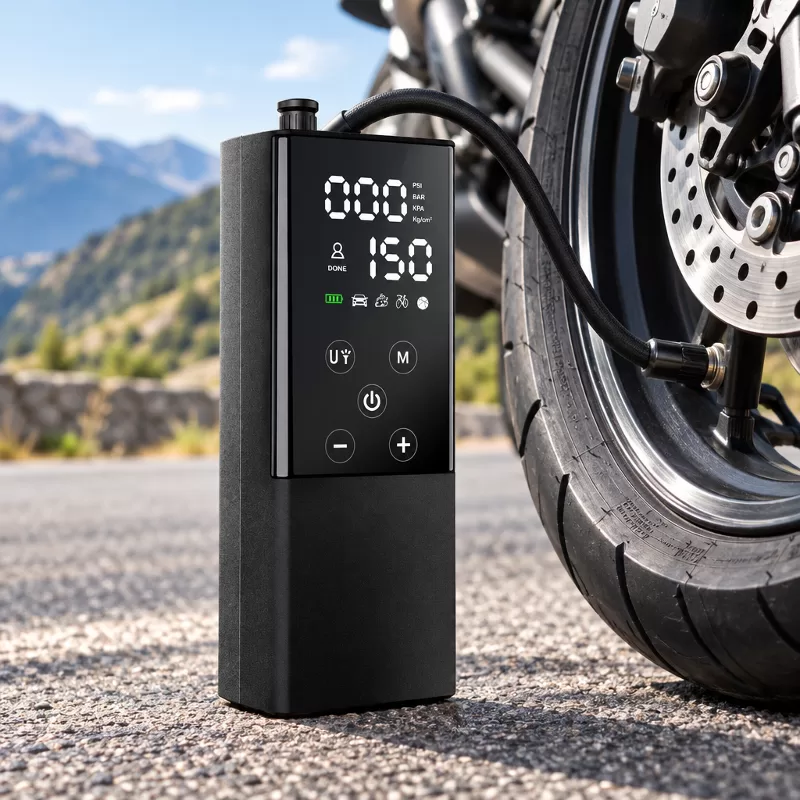
Carrying a reliable portable tire inflator for motorcycle trips changes roadside maintenance from an intimidating ordeal into a manageable routine. Motorcycles rely on two contact patches, each roughly the size of a credit card, meaning even small pressure fluctuations alter steering response, lean angles, and braking performance. Finding an unexpected pressure drop at a remote mountain pass leaves a rider stranded if they rely only on commercial gas station air hoses.
A dedicated portable tire inflator for motorcycle tires provides autonomous control over air management wherever the road leads. Compact inflation hardware has evolved, shifting from cumbersome hand pumps and single-use gas canisters to motorized units with integrated digital sensors. Selecting the right setup requires balancing physical dimensions, airflow capacity, motor thermal limits, and gauge accuracy against the unique demands of motorcycle wheels.
1. What Motorcycle Riders Need from a Portable Tire Inflator
Motorcycle tire maintenance differs fundamentally from passenger car service due to wheel design, limited chassis clearance, and extreme sensitivity to pneumatic balance. Riders operating dual-sport, cruiser, or sport-touring machinery encounter diverse operational stresses that demand consistent air pressure verification.
Common Pressure Loss Scenarios: Commutes, Touring, and Cold Snaps
Motorcycle tires experience gradual pressure loss over time through natural permeation across the rubber carcass, valve stem micro-seals, and temperature variations. Because the rate of pressure loss varies according to tire construction, ambient conditions, and wheel condition, regular pre-ride pressure checks remain essential before daily commutes and touring journeys.
Cooler ambient temperatures generally reduce internal tire pressure according to basic gas expansion principles. A sharp cold front can leave a tire visibly softer in the morning, making it critical to recheck cold pressure after major weather shifts. In addition, road touring introduces hazards like slow punctures from road debris, where having an immediate roadside inflation tool allows a rider to stabilize pressure and reach safe service facilities.
Motorcycle-Specific Pressure Sensitivity
Unlike a four-wheeled vehicle that tolerates modest tire pressure imbalances with minimal driver feedback, a two-wheeled chassis communicates pressure deficits directly through altered handling dynamics. An under-inflated front tire can generate heavy steering resistance and sluggish turn-in characteristics, depending on the specific geometry and weight distribution of the motorcycle.
Rear tire pressure loss compromises carcass stability under acceleration, which may cause wallowing sensations through sweeping corners or degrade general braking predictability. Because the tire carcass flexes continuously during operation, running at incorrect pressures accelerates heat buildup, alters contact patch geometry, and can lead to uneven, premature tread wear patterns over time.
Capabilities and Boundaries of Compact Compressors
A compact electric inflator is engineered to deliver controlled volumes against moderate backpressures, excel at routine pressure top-offs, and reinflate repaired tires after a puncture. It eliminates the physical fatigue of operating a manual hand pump while wearing riding gear under intense sun or rainfall.
Riders must recognize the mechanical boundaries of portable air systems. A compact inflator such as the WG01 should not be assumed to have the high-volume output needed to reseat a fully unseated bead; use suitable shop equipment or professional assistance unless the manufacturer specifically confirms bead-seating capability. Understanding what the hardware can achieve prevents dangerous roadside assumptions and preserves mechanical equipment during backcountry tours.
2. Key Criteria for Choosing a Motorcycle Tire Pump
Selecting an inflator suited for motorcycle duty requires looking past generic advertising claims to examine the engineering parameters that dictate field survival and user safety.
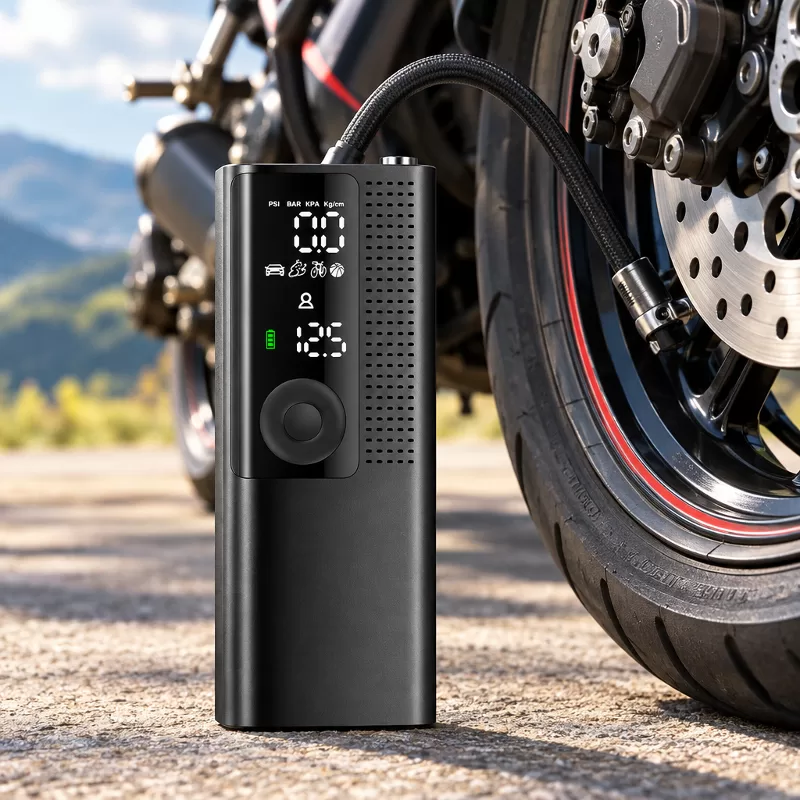
Pressure Range vs. Real Motorcycle Targets
Recommended cold tire pressure varies by motorcycle model, tire specification, and loading, so the owner’s manual or vehicle placard must always control actual target pressures. Dual-sport and adventure motorcycles may intentionally air down for loose off-pavement sections, requiring subsequent reinflation before returning to high-speed tarmac.
The WG01’s stated 2–150 PSI range covers common motorcycle pressure targets, but the maximum rating should not be interpreted as a runtime or durability guarantee. Compressors pushed near their absolute pressure boundaries experience heavier mechanical load, so choosing hardware with an operating envelope well above typical motorcycle requirements provides practical reassurance during regular maintenance.
Airflow Rate, Power Output, and Thermal Duty Cycle
Airflow rate, commonly expressed in liters per minute (L/min), dictates how long the motor must run to raise tire pressure to specification. The stated 20 to 22 L/min airflow at 35W power supports routine pressure top-offs and moderate reinflation tasks, helping keep roadside maintenance pauses practical and manageable.
All miniature air compressors generate frictional and compression heat within the cylinder assembly during continuous running. Because the product documentation does not state a continuous-duty rating, follow the manufacturer’s instructions and allow the unit to cool if it becomes hot during extended use. Respecting realistic cooling windows between multiple tires preserves mechanical integrity over time.
Form Factor, Packing Volume, and On-Bike Storage
Storage space on a motorcycle is notoriously limited, requiring tools to fit within under-seat compartments, tank bags, or side panniers alongside safety gear. An awkward, bulky shape discourages daily carry, leaving the rider unprotected during spontaneous weekend jaunts or urban daily commutes.
Built-in hose storage keeps the hose organized and reduces loose components in motorcycle luggage. Housing the flexible connector neatly inside the compact body protects fittings against accidental crushing or thread damage while riding across rough terrain.
Display Readability, Auto-Shutoff, and Pressure Gauge Accuracy
Direct sunlight often washes out inferior liquid crystal screens, making an illuminated, high-contrast segmented LED interface vital for roadside usability. When kneeling beside a hot brake rotor on an unlit shoulder, clear numeric feedback prevents costly reading errors.
The automatic shut-off is designed to stop inflation when the selected target is reached; users should still monitor the process and verify pressure with a trusted gauge if accuracy matters. If accuracy is in doubt, compare the pump reading with a trusted separate gauge; the product information does not state an accuracy tolerance.
Valve Access and Chuck Compatibility
Motorcycle wheels present challenging clearance obstacles, including large dual front brake discs, bulky cast-aluminum hub spokes, and chain guards. Standard straight screw-on air chucks often require sharp hose bending that strains the valve stem, creating unnecessary mechanical stress.
- Threaded Brass Connectors: Provide airtight retention under pressure, preventing accidental blow-offs while the compressor runs hands-free.
- Quick-Release Thumb Latches: Allow rapid attachment and detachment, though they require adequate radial clearance between the valve stem and adjacent brake components.
- Right-Angle Adapters: Act as essential secondary accessories for bikes with straight valve stems, routing the air connection parallel to the rim to bypass spoke interference.
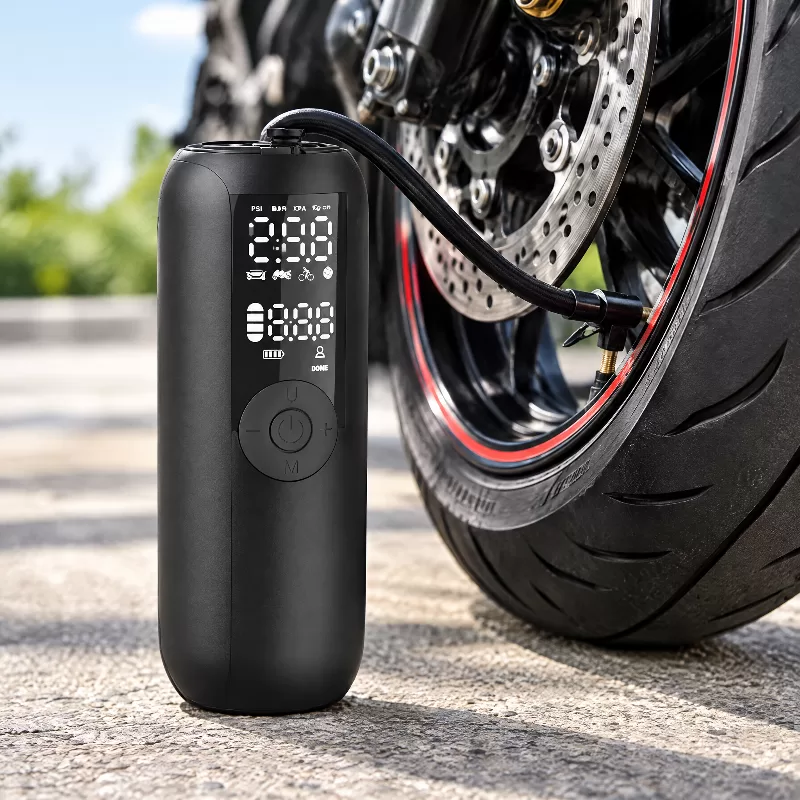
3. Step-by-Step Guide: How to Inflate a Motorcycle Tire Safely
Inflating a motorcycle tire involves critical safety procedures to ensure personal safety, structural integrity of the wheel, and reliable pressure retention under high-speed operation.
Step 1: Identify Manufacturer Cold-Pressure Specifications
Find the recommended cold pressure in the owner’s manual or on the motorcycle’s tire-information placard, which may be located on the frame, swingarm, chain guard, under the seat, or another manufacturer-specified location. Always verify any specified adjustments for carrying a passenger or heavy luggage loads.
The tire sidewall lists its maximum load and maximum cold inflation pressure; these are not necessarily the motorcycle’s recommended operating pressure. Follow the owner’s manual or vehicle placard, and do not exceed the tire’s stated limits.
Step 2: Ensure the Tire Is Cold
A tire is technically defined as "cold" only when the motorcycle has sat parked for at least three consecutive hours or has been ridden for less than one mile at moderate city speeds. As a motorcycle rolls down the highway, internal air friction and sidewall flexing generate heat, expanding the trapped air and increasing internal pressure by several PSI above cold baseline.
Never release air from a warm or hot motorcycle tire that indicates a pressure higher than your cold placard target. Bleeding hot air results in a severely under-inflated tire once internal air temperatures normalize back down to ambient levels, causing excessive casing flex and heat buildup on subsequent rides.
Step 3: Connect, Preset Target, and Monitor Inflation
Position the motorcycle securely on its side stand or center stand, rotating the wheel only as needed to achieve comfortable, unobstructed valve stem access. Ensure the motorcycle remains completely stable on level ground, and keep the air hose routing clear of hot exhaust pipes and moving linkages.
- Attach the chuck securely and check for leakage; if air continues escaping, reseat the connector before inflating.
- Power on the digital interface and inspect the initial static pressure reading to understand the baseline deficit.
- Toggle the guided mode to the appropriate vehicle profile or manually set your target cold PSI using the adjustment keys.
- Initiate the motor and maintain visual contact with the pump assembly, ensuring the hose remains free of severe kinks and away from hot exhaust pipes.
- Allow the automated cut-off system to stop air delivery once the target threshold is met.
Step 4: Final Verification and Valve Stem Sealing
Once the electric compressor completes its cycle and powers down, decouple the air chuck with a swift, straight motion to minimize pressure bleed. Disconnecting the chuck can release a modest amount of air from the tire, so checking the final resting pressure with a trusted separate gauge remains a sensible verification step.
Inspect the valve stem tip by applying a drop of moisture across the opening to verify that the internal spring-loaded valve core has seated cleanly without micro-leaks. Once verified, thread and securely tighten the protective valve dust cap to prevent fine road debris from entering the valve mechanism.
Step 5: Roadside Triage Protocols
If you are using a portable tire inflator for motorcycle recovery following a roadside puncture repair, perform a structured safety evaluation before riding away. Check that the tire plug or patch holds firmly without audible hissing or bubbling when tested with moisture.
Do not ride if the tire exhibits visible bulges, exposed or damaged cords, significant cuts, persistent air leakage, or uncertain repair integrity, and seek qualified tire service instead. Roadside plugs serve primarily as temporary emergency measures to reach a repair facility, not permanent structural rebuilds.
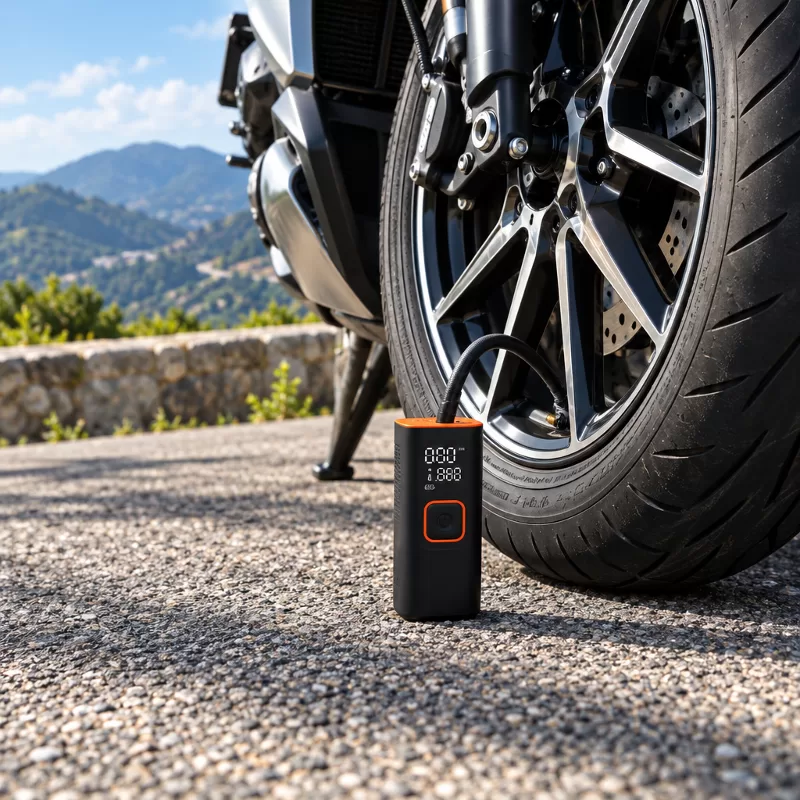
4. Technical Snapshot: WG01 Compact Tire Inflator Specifications
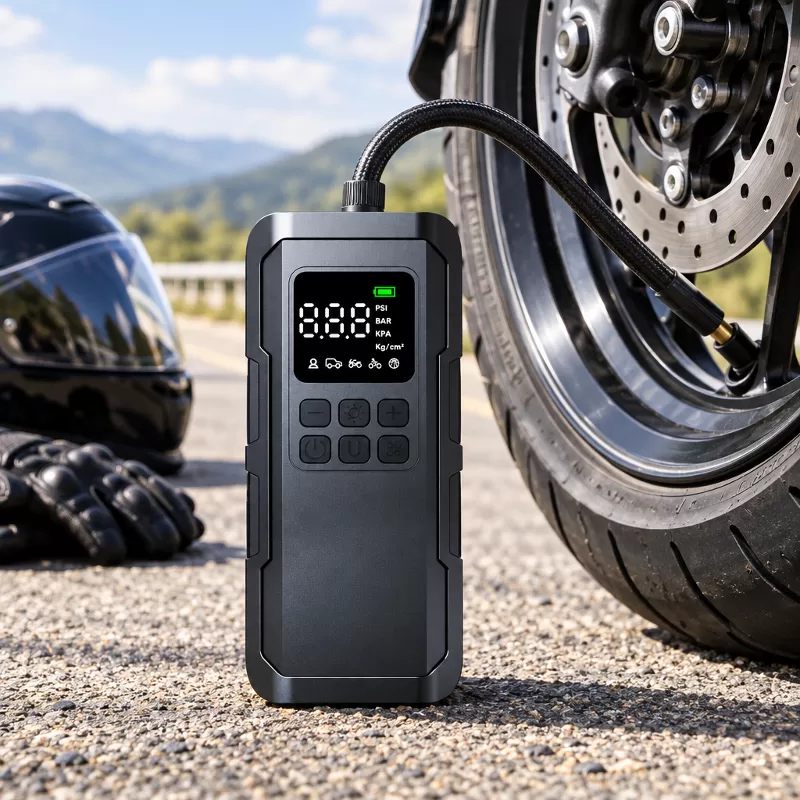
To understand how hardware specifications translate into field capability, examine the stated technical parameters of the Portable Tire Inflator 150PSI WG01. Developed with a compact form factor suited for multi-vehicle utility, its architecture provides a practical balance of pressure output and portability.
Specification Profile
The following technical table highlights the core physical and pneumatic parameters of the WG01 unit as outlined in product documentation:
| Specification Parameter | Technical Rating / Feature Characteristic |
|---|---|
| Maximum Working Pressure | 150 PSI |
| Functional Pressure Range | 2 – 150 PSI |
| Volumetric Airflow Delivery | 20 – 22 L/min |
| Internal Cylinder Structure | 17-cylinder |
| Motor Power Consumption | 35W |
| Operational Interface | Guided LED display with mode and wheel-position operation |
| Pressure Regulation | Integrated automatic shut-off |
| Hose Management | Built-in integrated hose storage body |
| Multi-Vehicle Compatibility | Motorcycles, e-bikes, cars, bicycles, wheelchairs, sports balls |
Functional Role in Motorcycle Maintenance
The 20 to 22 L/min airflow rating delivers practical utility for two-wheel operators, supporting routine pressure top-offs and post-repair reinflation without cumbersome delays. Operating at a moderate 35W power rating allows the pump to deliver practical everyday inflation performance while remaining within a compact hardware design.
Built-in hose storage keeps the hose organized and reduces loose components in motorcycle luggage. Storing the flexible line directly within the main chassis prevents loose cords from tangling with tools or sustaining puncture damage inside tight travel bags.
Transparent Boundaries of Stated Data
While first-party technical data confirms a 150 PSI ceiling and 20–22 L/min delivery, factory specifications do not document continuous runtime limits, decibel levels, or wet-weather water resistance ratings. Users must exercise operational prudence by allowing the casing to cool after demanding inflation cycles, avoiding use during heavy rainstorms, and respecting the limits of miniature motorized equipment.
5. Comparing Inflation Methods: Electric Inflators vs. Traditional Alternatives
Motorcycle riders choose between several distinct roadside inflation technologies, each presenting clear mechanical trade-offs regarding physical exertion, packing volume, speed, and continuous reliability.
Rechargeable / Battery-Powered Smart Pumps
Rechargeable electric inflators have become favored solutions for modern road travelers. These standalone units operate without physical cords, using internal lithium cells to drive a miniature motor and piston. The automated pressure shut-off eliminates constant manual gauge checking, allowing hands-free operation along busy road shoulders.
The trade-off centers on battery discipline. An uncharged battery leaves the rider without air, and cold mountain weather can reduce available battery capacity. High-load cycles generate internal heat, requiring periodic cooling pauses between multiple vehicle tires.
12-Volt Wired Motorcycle Compressors
Wired compressors draw power through the motorcycle’s electrical system, so users must follow the compressor and motorcycle manufacturer’s fuse, connector, and engine-operation requirements. Never assume a particular fuse rating or safe runtime without checking your vehicle’s specific manual.
The disadvantages involve cabling complexity and electrical demands. Routed cords can snag on hot exhaust headers or engine cases during setup. Running a high-draw compressor from an accessory socket without appropriate electrical sizing risks blown fuses or unexpected battery drain.
Manual Mini-Pumps and CO₂ Cartridge Kits
Manual bicycle-style hand pumps and compressed CO₂ canisters represent purely mechanical, analog options. Mini-pumps offer unlimited inflation cycles without electrical dependencies, while threaded 16g or 25g CO₂ canisters provide rapid gas discharge that packs neatly into a jacket pocket.
Both approaches present clear practical limitations on motorcycle tires. A manual hand pump requires repeated physical effort and extended pumping time to deliver meaningful pressure gains into high-volume motorcycle tires. Meanwhile, CO₂ cartridges represent a finite, single-use resource that provides limited pressure regulation, often requiring multiple canisters per tire and leaving no backup capacity if a roadside repair leaks.
Comparative Decision Matrix
| Inflation Method | Packing Efficiency | User Physical Effort | Repetitive Roadside Use | Pressure Precision | Electrical Dependency |
|---|---|---|---|---|---|
| Cordless Smart Pump | High (self-contained) | Minimal (automated) | Moderate (battery limited) | High (digital auto-stop) | Internal battery charge |
| 12V Wired Compressor | Moderate (cables/plugs) | Minimal (automated) | High (runs off vehicle) | Moderate to High | Vehicle electrical system |
| Manual Hand Pump | Moderate (long body) | Significant (manual pumping) | Unlimited | Low (requires separate gauge) | None |
| CO₂ Canister Kit | Maximum (pocket-sized) | Minimal (instant discharge) | Very Low (single-use bulbs) | Low (unmetered burst) | None |
For us at Newo, matching precise pneumatic technology to rider demands remains the foundation of our engineering approach across all portable inflation solutions.
6. Common Motorcycle Inflation Pitfalls to Avoid
Proper tire maintenance requires avoiding common operational errors that compromise motorcycle stability, tire lifespan, and rider safety.
Confusing Sidewall Maximum with Cold Running Pressure
The tire sidewall lists its maximum load and maximum cold inflation pressure; these are not necessarily the motorcycle’s recommended operating pressure. Follow the owner’s manual or vehicle placard, and do not exceed the tire’s stated limits.
Inflating a motorcycle tire significantly beyond the vehicle manufacturer’s recommendation stiffens the carcass excessively and may alter cornering feel and contact-patch behavior. As a result, the motorcycle may exhibit harsh ride qualities over rough pavement alongside accelerated center-tread wear patterns.
Air Pressure Adjustments on Hot Tires
Halting mid-ride at a filling station and bleeding air because your tire reads higher than normal represents an equally dangerous mistake. Internal air naturally expands under operating friction, and releasing air while the casing is hot leaves the tire under-inflated once it cools down.
- Thermal Equilibrium: Tire temperatures stabilize only after hours of complete rest away from radiant sunlight.
- Under-Inflation Hazards: Running an under-inflated tire creates excessive casing flex, which causes unnecessary heat buildup and accelerates structural tire wear.
- Inspection Routine: Measure and correct tire pressures exclusively before starting your journey when tires are cold.
Assuming Max PSI Equals Flow Speed
Riders frequently assume that an inflator rated at 150 PSI inflates a motorcycle tire twice as fast as one rated at 75 PSI. Maximum pressure rating indicates internal cylinder structural strength and motor stall resistance, not volumetric displacement.
Volumetric airflow, measured in liters per minute, determines how quickly an inflator fills a tire. A high-pressure miniature pump with a tiny piston might produce high stall pressures while delivering only limited volumetric flow, requiring extended periods to top off a motorcycle tire compared to a balanced 20–22 L/min system.
Skipping Visual Inspection of the Casing
Pressurizing a motorcycle tire without inspecting the tread and sidewall surface invites sudden failures. Road debris often beds into tread grooves without causing immediate pressure drops until internal pressure is restored or the tire carcass flexes during cornering.
Before attaching the air chuck, roll the motorcycle forward slowly to inspect the accessible tread rubber. Check for embedded glass fragments, metal wires, radial cracks, and structural deformation near the rim edge. Identifying casing damage on the side of the road prevents serious handling issues miles later.
7. Frequently Asked Questions (FAQ)
What PSI should I use for my motorcycle tires?
Riders should always reference the tire specification placard located on their motorcycle’s frame, swingarm, or within the official owner’s manual. These specifications represent the cold inflation pressures engineered specifically for that motorcycle model, including any recommended adjustments for carrying a passenger or heavy touring luggage.
Can an inflator rated up to 150 PSI damage a motorcycle tire?
The 150 PSI figure describes the pump’s stated maximum pressure, not the motorcycle tire’s target. Use the motorcycle manufacturer’s cold-pressure specification, monitor inflation carefully throughout the cycle, and verify the final reading with a trusted gauge to avoid accidental over-inflation.
Is built-in automatic shut-off accurate enough on its own?
The WG01 includes automatic shut-off, but its accuracy tolerance is not stated in the available product information. Treat the feature as a convenience and verify pressure with a trusted separate gauge when accuracy is important.
Can a portable inflator re-seat a tubeless tire bead after a blowout?
A compact inflator such as the WG01 should not be assumed to have the high-volume output needed to reseat a fully unseated bead; use suitable shop equipment or professional assistance unless the manufacturer specifically confirms bead-seating capability.
What additional tire tools should be packed alongside an inflator?
To create a complete roadside tire kit, pack a quality tubeless plug set with insertion needles and reaming tools, replacement Schrader valve cores, a compact valve core removal wrench, and a flexible right-angle brass valve adapter to ensure easy access around tight brake discs.
8. Summary: Selecting the Right Motorcycle Tire Solution
Maintaining correct tire pressure is the simplest, most vital safety practice for any motorcycle rider. A quality portable tire inflator for motorcycle trips combines controlled airflow, automatic pressure cutoff, clear digital monitoring, and compact packaging into a self-reliant safety tool. Equipping your travel kit with a dependable portable motorcycle tire air pump ensures that daily adjustments remain effortless, preventing handling instability and keeping your two-wheeled journeys safe and enjoyable across every mile.
-

Meet NEWO at the 140th Canton Fair: Visit Booth 10.3 M03–04
Meet NEWO at the 140th Canton Fair in Guangzhou, October 15–19, 2026. Visit Booth 10.3 M03–04 to explore portable air pumps and discuss OEM, ODM and distribution opportunities.... -

As Shenzhen Welcomes the World for APEC 2026, NEWO Welcomes You to Our Factory
As Shenzhen prepares for APEC 2026, NEWO welcomes international buyers and partners to visit our factory, meet our team and explore future cooperation.... -

Leading the Way in Product Innovation and Excellence
Smartnewo exemplifies professionalism in product innovation and manufacturing. Their collaboration with Xiaomi Youpin on the G01 crowdfunding project highlights their expertise in creating compact, powerful inflatable pumps. Rigorous engineering, meticulous production processes, and advanced quality assurance underscore their commitment to excellence. The success of the G01 project, with significant market... -

Essential Qualities of an Excellent Supplier
In today's competitive market, finding a reliable supplier is crucial for business success. Based on insights from Smartnewo and broader internet research, here are key qualities an excellent supplier must possess:... -

NW06 Tire Inflator: Compact Power for Quick Inflation
Summary The NW06 Tire Inflator delivers quick and efficient tire inflation with a powerful 35L/min airflow. It features a user-friendly LCD screen for real-time pressure monitoring, dual power options with a built-in 6000mAh battery, and multiple nozzle attachments for versatile use. Its compact design and integrated LED light ensure convenience and... -

Unleash the Power of Portability: The SmartNewo Jump Starter with Air Compressor KF03
This guide will walk you through the steps to effectively use a portable tire inflator, helping you stay prepared and safe on the road.... -

Newo Attends The 2024 Consumer Electronics Show (CES)
Smartnewo booth is located at 53672, Halls A-D, Level 2, Venetian Expo, Las Vegas Convention Center (LVCC). ... -

Smartnewo’s Dual-Cylinder Air Pump Rocks the Hong Kong Autumn Electronics Fair!
Smartnewo’s Dual-Cylinder Air Pump Rocks the Hong Kong Autumn Electronics Fair!... -

Meet at the Canton Fair! Smartnewo brings dual-cylinder air pumps, making your inflation experience faster and more stable!
NEWO has went deep communication and negotiation with customers from all over the world on booth.... -

“Hong Kong Autumn Electronics Fair – 1CA18 (October 13th to 16th): Smartnewo invites you to visit our booth!
Hong Kong Autumn Electronics Fair...










-

What to Check Before Ordering Custom Electric Bike Pumps
Plan custom electric bike pumps with a clear requirements freeze for valves, TPU tubes, portability, repeated top-ups, charging, and model-specific documents.... -

OEM vs ODM Air Pumps: Which Manufacturing Model Fits Your Brand?
Compare OEM and ODM air pump projects by design responsibility, change approval, development scope, and written ownership terms before choosing your route.... -
How to Choose a Reliable Tire Inflator Manufacturer in China
Choose a tire inflator manufacturer in China with a focused RFQ, supplier evidence, configuration checks, and clear sample-to-pilot decisions for your brand.... -

Rechargeable Electric SUP Pump for Paddle Boards: Faster Inflation for SUPs, Kayaks and Inflatable Tents
The BL10-C Portable Electric Bike Tire Inflator is a compact and lightweight mini electric bike pump designed for modern cyclists. With up to 120 PSI pressure, a digital LED display, preset pressure control, automatic shut-off, USB-C charging, and multiple valve adapters, BL10-C offers a convenient inflation solution for road bikes,... -

Are Electric Bike Pumps Worth It in 2026? Electric Pump vs CO₂ vs Mini Hand Pump
Discover whether electric bike pumps are worth it in 2026. This guide compares electric bike pumps, CO₂ inflators, and mini hand pumps for road cycling, gravel riding, commuting, and long-distance rides. Learn the pros, limitations, best use cases, and key features to look for before choosing the right portable tire... -
BL10-C Portable Electric Bike Tire Inflator: Small Size, Reliable Power for Every Ride
The BL10-C Portable Electric Bike Tire Inflator is a compact and lightweight mini electric bike pump designed for modern cyclists. With up to 120 PSI pressure, a digital LED display, preset pressure control, automatic shut-off, USB-C charging, and multiple valve adapters, BL10-C offers a convenient inflation solution for road bikes,... -

Why Mini Electric Bike Pumps Are Becoming Essential for Modern Cycling
Discover why mini electric bike pumps are becoming essential for modern cyclists. Learn how portable electric bike pumps improve tire pressure management, riding safety, and convenience.... -

The Ultimate Smart Solution for Easy Outdoor Adventures in 2026
Discover how a spring travel air pump simplifies outdoor trips with fast inflation, smart features, and powerful performance—perfect for every adventure.... -

Powerful 5-in-1 Portable Car Tire Inflator and Jump Starter: The Ultimate Emergency Tool for Every Driver
Why Every Driver Needs a Portable Car Tire Inflator and Jump Starter Modern drivers face many unexpected situations on the road. A flat tire, low tire pressure, or a dead car battery can happen at the worst possible time. That’s why having a portable car tire inflator and jump starter is... -

7 Real Cycling Scenarios That Show Why Every Rider Should Carry a Mini Bike Pump
Cycling is one of the most freeing activities you can enjoy. Whether you’re commuting to work, riding through city streets, or exploring quiet countryside roads, a bike ride can instantly improve your day. But there’s one small problem that almost every cyclist eventually faces: Low tire pressure. It might happen...









-
How Is a Football Properly Inflated?
The correct inflation of a football - with not too much and not too little air - is a hotly debated topic among footballers.... -
Application Scenarios of Car Inflator Pump
Often long-distance business trips or play car owners because the road may be more remote areas, in this case if you encounter a tire leak....

