

 Portable Tire Inflators
 Electric Air Pumps
 Electric Car Tyre Pumps
 Electric Ball Pumps
 Electric Bike Pump
 SUP Air Pump

Portable Car Inflator: How to Choose, Safely Use, and Maintain a Compact Tire Air Pump
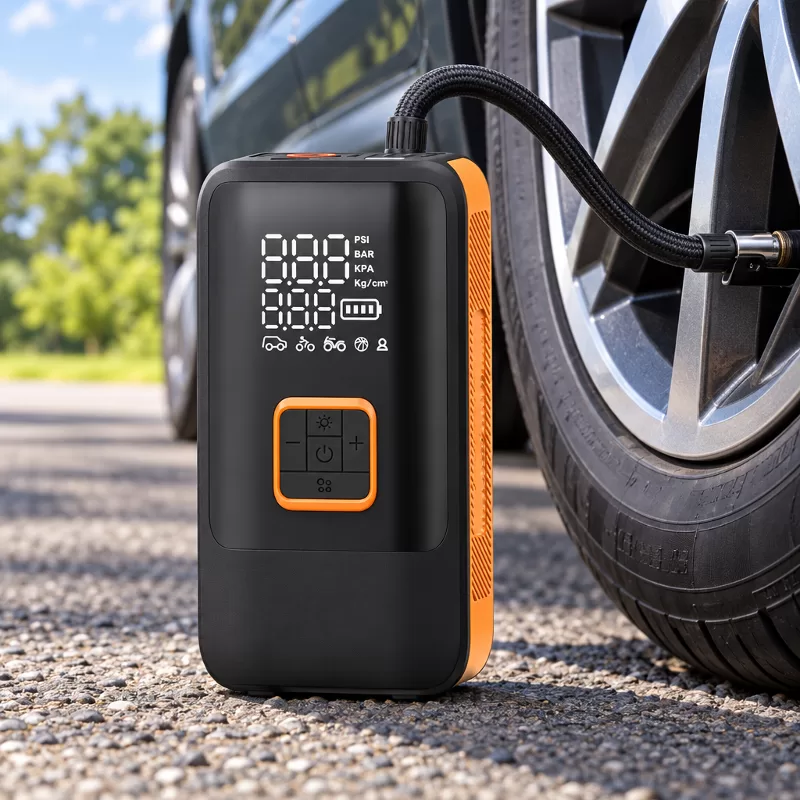
When a tire pressure warning light illuminates on an isolated road, an ordinary commute can quickly turn into a frustrating situation. Driving on an underinflated tire causes irregular tread wear, degrades fuel efficiency, and can generate internal casing heat that compromises vehicle safety. Historically, resolving low tire pressure meant driving to a service station, hoping the air compressor was operational, and fumbling with coins in harsh weather. Today, keeping a reliable portable car inflator in your glove compartment or trunk gives motorists direct control over routine tire maintenance, roadside safety, and journey preparedness.
What a Portable Car Inflator Does
How a Portable Inflator Adds Air to a Tire
A portable car inflator operates as a small electrically powered air compressor designed to transfer ambient air into a sealed tire chamber. The unit’s internal motor drives mechanical motion that compresses intake air through one-way valves. This builds pressure inside the compressor assembly before releasing the air down a delivery hose and past the tire’s spring-loaded Schrader valve core.
Because these compact designs function without heavy industrial oil baths or bulky mechanical sumps, motor power and internal heat must remain closely balanced. The compressor motor must maintain sufficient driving torque to push against rising counter-pressure from the tire. This controlled air delivery allows drivers to top off tires safely without relying on bulky external machinery.
When a Portable Inflator Is Useful—and What It Cannot Fix
Portable tire inflators are practical tools for routine pressure top-offs, seasonal adjustments, and managing minor tire maintenance. Tire pressure can change by roughly 1–2 PSI for every 10°F temperature change; check against the vehicle’s recommended cold pressure to account for these natural fluctuations directly in your driveway.
However, a portable pump cannot fix structural tire failures. It cannot seal sidewall tears, resolve casing damage from severe road impacts, or reseat a bead that has broken away from the wheel rim. Running a compact compressor continuously against an open puncture will merely drain the battery and generate unnecessary heat without rendering the tire safe for driving.
Portable Inflator versus a Service-Station Air Pump
Commercial service-station air pumps rely on high-capacity industrial compressors backed by large pressurized storage vessels. They can discharge significant air volume in a short timeframe, but their practical reliability is often compromised by weathered air chucks, worn hoses, or damaged mechanical gauges. Motorists often pay service fees only to discover the station air line is uncalibrated or entirely out of service.
A personal portable unit trades that rapid discharge rate for consistent availability, digital display monitoring, and roadside self-reliance. It enables drivers to measure and adjust cold tire pressure before driving, avoiding the pressure increases that occur once tires heat up on the highway.
| Feature | Personal Portable Inflator | Service-Station Air Pump |
|---|---|---|
| Equipment Availability | Stowed inside vehicle cabin; accessible anywhere | Dependent on commercial station operating hours and upkeep |
| Cold Pressure Check | Allows direct measurement before vehicle is driven | Driving heats tires, artificially elevating internal pressure |
| Air Delivery Speed | Moderate air delivery suitable for routine top-ups | Fast air discharge from large industrial pressure tanks |
| Gauge Accuracy | Digital pressure display and preset shut-off; accuracy depends on device | Mechanical dial, frequently worn, dropped, or uncalibrated |
| Power Independence | Internal rechargeable battery or 12V auxiliary socket | Requires commercial utility power connection |
| Cost per Inflation | Zero ongoing per-use cost after equipment purchase | Frequently requires coins or card transactions per cycle |
How to Choose a Portable Car Inflator
Match the Pressure Range to Your Intended Uses
Selecting an inflator begins with assessing the pressure specifications of the vehicles and equipment you plan to service. Standard passenger cars, crossovers, and minivans generally run between 30 and 36 PSI. Light-truck pressures vary considerably by vehicle, tire, and load, so drivers should check the vehicle placard or owner’s manual rather than relying on a generic PSI range.
Units rated up to 150 PSI offer the structural headroom to connect with high-pressure items such as performance bicycle tires. Users should confirm the required operating pressure of their equipment and verify that the inflator is rated to deliver practical airflow at that specific pressure level.
Consider Airflow, Runtime, and Battery Capacity
Airflow rate, typically expressed in liters per minute (L/min), determines how steadily the compressor pushes air into a tire chamber. Compact electric compressors frequently deliver between 20 and 30 L/min under baseline testing conditions. A steady airflow rate reduces the time spent attending to a tire alongside busy traffic.
Inflator Selection Decision Path:
1. Vehicle Application Needs?
   ├── Passenger Cars, Bicycles, & Sports Balls ──> Compact Rechargeable Inflator (Balanced Portability)
   └── Heavy Off-Road Vehicles & High-Capacity Work Trucks ──> Heavy-Duty Direct-Battery Compressor System
2. Operational Power Preference?
   ├── Total Cordless Maneuverability ──> Multi-Cell Lithium Battery Pack
   └── Continuous Emergency Power Supply ──> Hardwired 12V Auxiliary Car Socket
Airflow speed must be evaluated alongside operating runtime and thermal management. Battery-operated inflators rely on multi-cell lithium arrangements, such as three series-connected 18650 cells providing an 11.1V platform. Manufacturers often state runtimes between 20 and 25 minutes, though actual operating duration depends on working pressure, ambient temperature, and tire conditions.
Compare Controls, Display, Units, and Automatic Shut-Off
Analog dial gauges are susceptible to mechanical stick and visual reading errors caused by viewing angles. Digital screens improve usability by clearly presenting live pressure readouts alongside the target shut-off figure. This visual feedback helps drivers monitor progress and maintain accurate inflation levels.
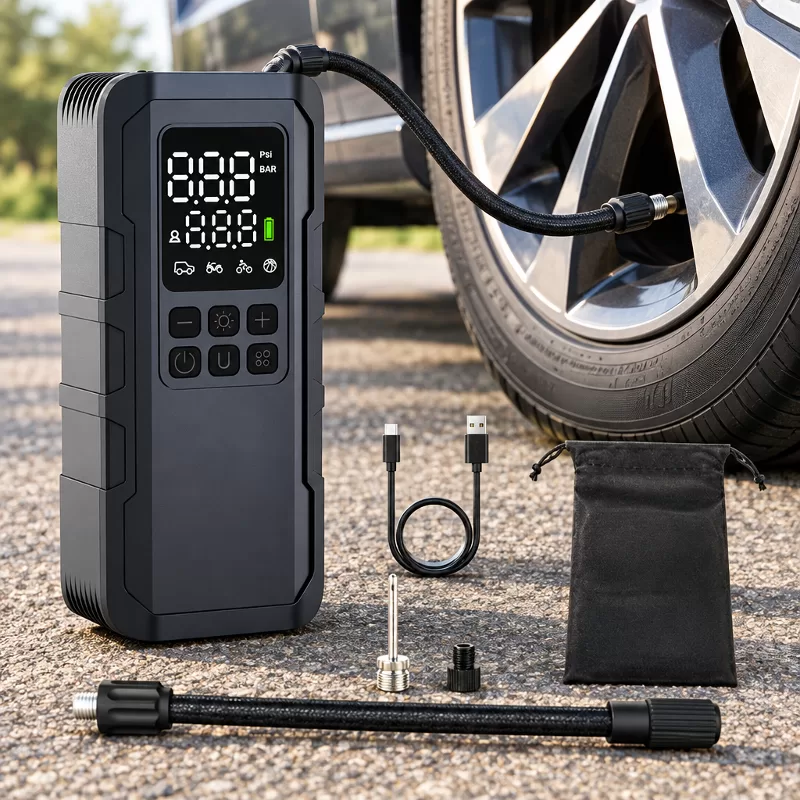
The LP8 is specified to shut off automatically at the selected target pressure. Drivers should confirm the final pressure reading on the display and follow the vehicle manufacturer’s placard. Choosing a model that allows direct toggling between PSI and BAR units makes it simple to cross-reference placard specifications accurately.
Check Charging Options, Size, Weight, and Included Accessories
A practical emergency tool should stow neatly without taking up excessive passenger or cargo space. Contemporary inflators often feature upright handheld designs weighing between 500 and 600 grams, sliding neatly into door pockets, center consoles, or glove compartments. Modern USB Type-C charging ports allow the device to recharge from standard USB adapters, in-car ports, or compatible power sources.
- Reinforced Air Hose: Built to withstand operational pressure while resisting abrasive contact with roadway surfaces.
- Presta Valve Adapter: Attaches securely to French-style bicycle valves to permit airtight inflation without adapter leakage.
- Needle and Nozzle Attachments: Provide proper mechanical fit for inflating sports equipment and low-pressure utility inflatables.
- Protective Storage Case: Keeps the hose assembly, charging cables, and small brass fittings organized in one accessible pouch.
Understand the Difference Between Maximum Pressure and Inflation Speed
A common misunderstanding is assuming an inflator’s maximum pressure rating indicates how fast it will fill a tire. A compressor rated to 150 PSI will not necessarily fill an automotive tire faster than a unit rated for 100 PSI. Maximum pressure refers to the mechanical resistance threshold the motor and piston can push against before stalling.
Inflation speed depends on compressor cylinder displacement and motor working power. A unit engineered with balanced working power moves sufficient air volume per cycle for practical automotive maintenance. Conversely, an ultra-compact pump might reach high nominal pressures using a very small cylinder bore while moving air too slowly for convenient passenger car use.
How to Use a Portable Car Inflator Safely
Find the Vehicle’s Recommended Cold Tire Pressure
The pressure marking molded into the outer tire sidewall is not the vehicle’s recommended operating pressure. That marking indicates the tire’s maximum permissible inflation pressure, not the vehicle’s recommended operating pressure. Operating continuously at sidewall pressure compromises road grip, causes uneven center tread wear, and stiffens ride quality.
Always locate the official tire safety placard mounted on the driver-side door jamb, B-pillar, or inside the fuel filler flap. This placard states the exact cold inflation pressures specified by the vehicle manufacturer to optimize handling stability, braking performance, and passenger safety.
Connect the Hose and Set the Target Pressure
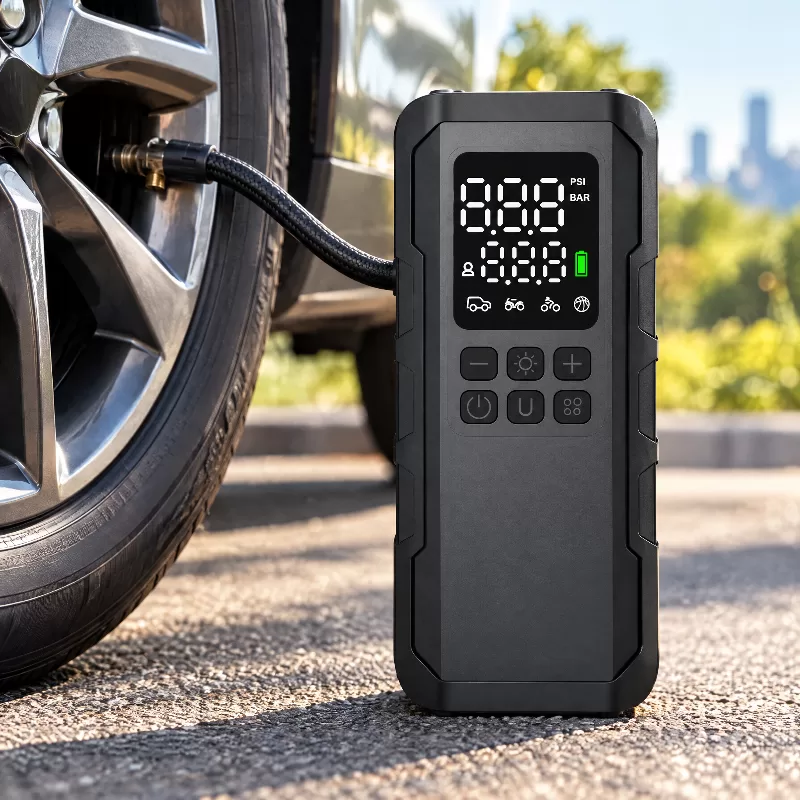
Following a systematic sequence helps protect internal compressor components and ensures dependable pressure readings:
- Inspect the Valve Stem: Unscrew the protective plastic dust cap and check the valve threads for accumulated grit, moisture, or dirt.
- Attach the Air Chuck: Thread or clamp the air hose chuck firmly onto the tire valve stem, ensuring a straight and airtight connection.
- Read Baseline Pressure: Power on the digital unit to observe the current cold tire pressure displayed on the screen.
- Set Target Threshold: Use the interface buttons to select the appropriate preset mode or manually enter the exact placard PSI.
- Start Inflation: Press the power button to initiate the compressor motor, allowing internal sensors to monitor pressure buildup.
Inflate, Check the Reading, and Replace the Valve Cap
While the inflator runs, monitor the digital readout and ensure the hose remains properly aligned with the valve stem. When the unit finishes its cycle, check the final pressure reading on the display. Unthread the chuck cleanly to minimize unnecessary air loss, and screw the dust cap back on tightly to protect the valve core from road dirt and moisture.
Compressing air naturally generates heat inside mechanical assemblies. Avoid touching the metal connector or hose fitting if it feels hot after prolonged continuous use, and follow the manufacturer’s operational instructions. Allowing the equipment a few moments to cool between wheels preserves seal integrity and prevents unnecessary thermal wear.
Recognize When a Tire Needs Repair Rather Than More Air
Adding air to a damaged tire without addressing the underlying fault can create dangerous driving conditions. If a tire repeatedly loses pressure over several days, inspect the tread area carefully with a flashlight for embedded screws, nails, or sharp debris. Check for audible air leaks around the valve stem and wheel rim bead.
Tires exhibiting sidewall bulges, severe rubber cracks, exposed internal cords, or bead distortion must never be reinflated. Adding air to a tire with structural damage can cause a sudden rupture. Under these conditions, install the spare tire or contact a professional towing service rather than attempting roadside inflation.
LP8 Portable Tire Inflator: Supplied Specifications
Pressure Control, Display, and Compressor Details
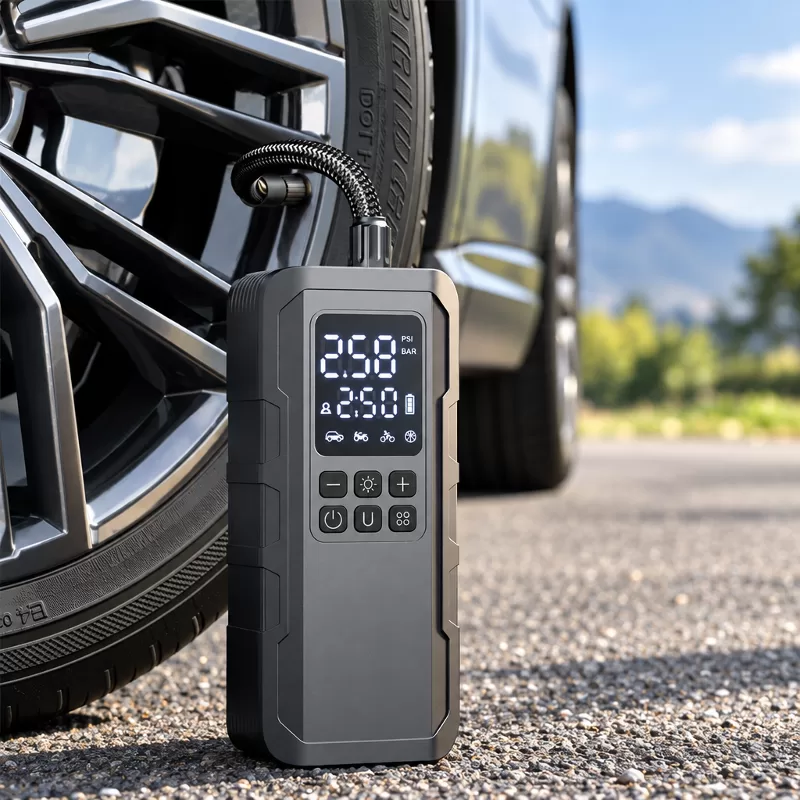
Engineered to deliver capable inflation in a compact form factor, the LP8 Portable Tire Inflator handles diverse domestic and automotive maintenance tasks. The supplied product documentation lists the cylinder size as "19 cylinder" paired with a 60W working power motor, producing a stated open airflow rate of 26 to 28 L/min. This mechanical arrangement balances air delivery with manageable electrical current draw.
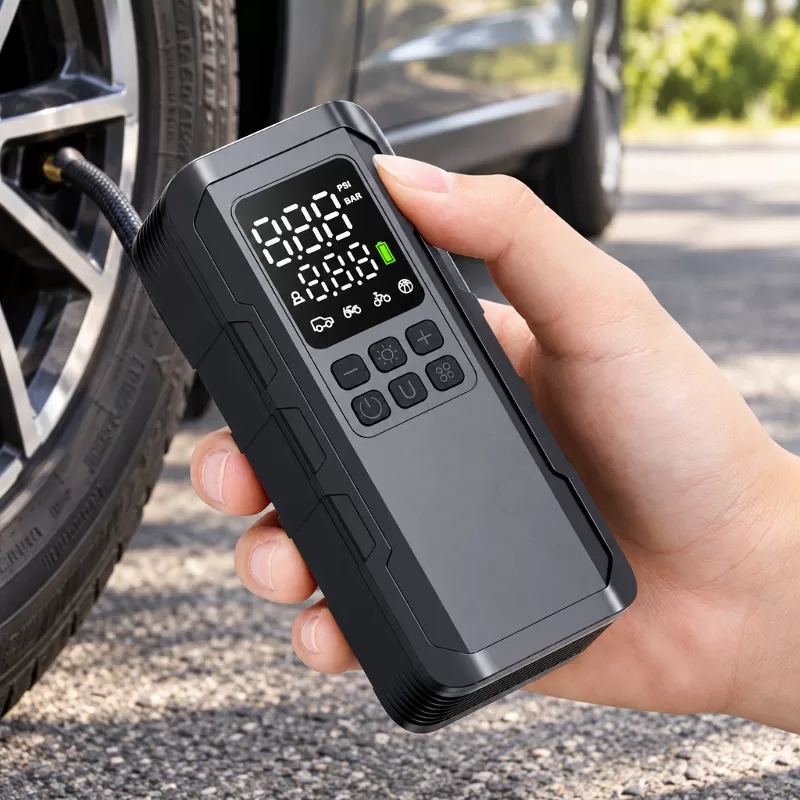
The LP8 operates across a pressure range of 2 to 150 PSI, managed through dual LED screens. This display arrangement shows both real-time tire pressure and target cutoff values simultaneously in PSI or BAR. Five preset inflation modes and manual pressure controls allow users to set target pressures, and the inflator is specified to shut off automatically once that target is reached.
LP8 Control Architecture:
[Power Key] ──> Initializes Microprocessor & Dual LED Displays
[Preset Selector] ──> Toggles Modes: Car / Motorcycle / Bicycle / Ball / Custom
[Unit Toggle] ──> Switches Units: PSI <──> BAR
[+/- Buttons] ──> Adjusts Target Pressure Threshold (2 to 150 PSI Range)
[Pressure Transducer] ──> Signals Automatic Motor Cutoff at Target Pressure
Battery, Charging, Size, and Stated Runtime
Cordless operation relies on an internal three-cell lithium-ion battery pack arranged in an 11.1V configuration (3 × 18650 cells, 2000mAh, 22.2Wh total capacity). Manufacturer documentation states this battery provides 20 to 25 minutes of runtime and retains at least 80% of original capacity after 300 charge cycles, with actual operational duration depending on workload and starting pressure.
Recharging is managed via a Type-C port supporting 5V/2A and 9V/1.5A inputs, replenishing the battery pack in 2 to 3 hours under stated manufacturer conditions. The specifications also list a power output rating of 5V/2A and 9V/1.5A. Measuring 70.5 × 50 × 165 mm and weighing 522 g, the LP8 is built for convenient storage inside vehicle cabins.
Intended Applications and Limits of the Supplied Data
Manufacturer specifications state that the LP8 can inflate approximately 3.5 tires of size 205/55 R16 on a single full charge under specified factory test parameters. Operating acoustic noise is rated at 85 dB or below at a 1-meter distance. An integrated LED light provides constant-on, flashing, and SOS illumination modes for night-time roadside visibility.
These performance metrics reflect manufacturer bench-testing under controlled baseline conditions. Real-world inflation counts, total runtime, and battery longevity will vary based on initial tire pressure, ambient temperature, tire volume, and valve stem conditions.
| Technical Parameter | LP8 Manufacturer Stated Value |
|---|---|
| Stated Cylinder Specification | 19 cylinder (as listed in manufacturer specifications) |
| Working Electrical Power | 60W |
| Pressure Range | 2 to 150 PSI (supports PSI and BAR units) |
| Air Flow Output | 26 to 28 L/min |
| Internal Battery Pack | 3 × 18650, 2000mAh, 11.1V, 22.2Wh |
| Stated Runtime | 20 to 25 minutes |
| Recharge Duration | 2 to 3 hours (Type-C 5V/2A or 9V/1.5A) |
| Specified Power Output | 5V / 2A and 9V / 1.5A |
| Dimensions & Net Weight | 70.5 × 50 × 165 mm; 522 g |
| Working Temperature Range | -10°C to 45°C (14°F to 113°F) |
| Noise Level Rating | ≤ 85 dB at 1-meter distance |
Is the LP8 a Fit for Your Needs?
For Occasional Car-Tire Top-Ups
For daily commuters and passenger car owners, the LP8 provides a practical, self-contained tire maintenance solution. It removes the inconvenience of searching for working commercial air pumps during routine monthly pressure checks. The 26 to 28 L/min airflow rating provides steady delivery for topping off passenger car tires in home driveways.
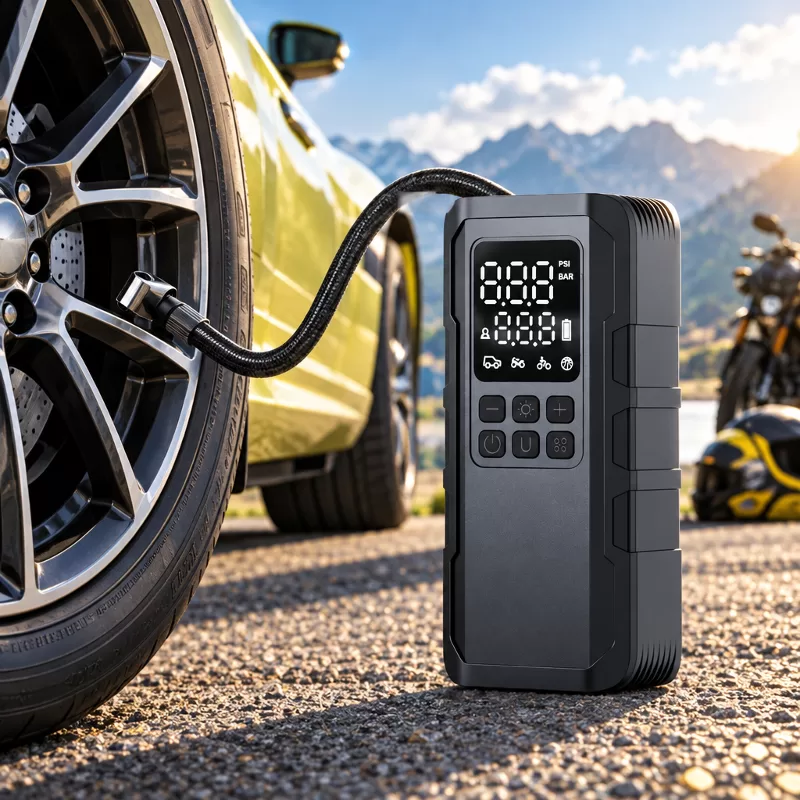
Because the unit measures just 165 mm tall and weighs 522 g, it stows neatly inside door pockets, center consoles, or glove compartments. Keeping the pump in the vehicle ensures minor seasonal pressure warnings can be addressed promptly without disrupting daily travel.
For Bicycles, Motorcycles, and Sports Balls
Bicycle owners, motorcycle riders, and urban e-bike commuters will find the LP8’s compact design and broad pressure range suitable for everyday travel. The 150 PSI rated maximum pressure accommodates diverse tire formats, while the preset cutoff mechanism stops the compressor at the selected pressure setting for that specific tire.
The included adapter package threads directly onto Presta valves and sports equipment needles. Because inflatable balls carry specific manufacturer inflation ratings, users should always check the pressure stamped on the ball’s casing and inflate carefully using the appropriate needle adapter to prevent over-inflation.
For Buyers Who Need Extended or Heavy-Duty Inflation
While the LP8 handles routine passenger tire top-ups effectively, operators of commercial vehicles or dedicated off-road rigs may require heavy-duty equipment. Off-road drivers who regularly air down large 33-inch or 35-inch all-terrain tires require substantial air displacement to refill four oversized tires. The LP8’s compact compressor and 22.2Wh battery pack are designed for portable convenience rather than continuous heavy-duty cycling.
Similarly, commercial fleet operators servicing dual-rear-wheel trucks or heavy trailers should choose industrial-grade compressors wired directly to vehicle battery terminals. Matching compressor capacity to tire volume ensures efficient inflation without placing excessive mechanical demands on the pump.
Care, Charging, and Storage
Keep the Battery Charged and Inspect Accessories
Lithium-ion cells experience gradual self-discharge over time, particularly when kept in vehicle cabins exposed to seasonal temperature shifts. To keep your portable inflator ready for unexpected roadside needs, connect it to a Type-C charger every three to four months. Maintaining a partial charge prevents deep self-discharge and supports overall battery life.
Periodically inspect the braided air hose, brass Schrader chuck, and adapter threads for signs of physical wear. Check that internal rubber sealing washers remain flexible and free of debris, as degraded or missing seals allow air to escape during inflation.
Observe the Stated Operating-Temperature Range
The LP8 is rated for operation across a temperature window of -10°C to 45°C (14°F to 113°F). Sub-zero winter conditions increase mechanical grease viscosity and temporarily suppress lithium battery voltage, which can lower airflow output. If your vehicle has been parked outside in freezing weather, bringing the inflator into the heated passenger cabin before use helps optimize battery performance.
Avoid running the compressor continuously beyond its rated operating duration. Compressing air generates mechanical heat inside the cylinder chamber. Letting the unit rest and cool between tire fills protects internal components and extends the working life of the compressor motor.
Store the Inflator Where It Is Accessible and Protected
In roadside situations, having rapid access to your gear is essential. Avoid burying your portable car inflator under heavy luggage or beneath cargo in deep trunk wells. Instead, keep the device secured inside its protective pouch in a door storage pocket, under the front passenger seat, or within an easily reached storage cubby.
The protective storage pouch shields the dual LED screens, control buttons, and ventilation slots from dirt, road grit, and moisture. Clean the outer casing periodically using a soft, dry cloth to prevent dust accumulation near the intake ports.
- Manufacturing Background: Supported by advanced production capabilities, experienced engineers, and strict quality management, Newo is a professional manufacturer specializing in the research, development, and production of smart electric air pumps and portable inflation solutions. For us, every pneumatic design balances precision engineering with real-world convenience to build lasting reliability for customers worldwide.
FAQs
Can a portable car inflator fill a completely flat tire?
A portable car inflator can add air to a flat tire provided the tire bead remains fully seated against the wheel rim and the casing has sustained no structural tears. However, inflating a tire is not a structural repair and does not establish roadworthiness. Drivers should never operate a vehicle on a tire that has an unresolved leak or has suffered internal damage from rolling flat; use a spare tire or seek professional roadside assistance.
Should I inflate to the PSI printed on the tire sidewall?
No, drivers should not inflate tires to the maximum PSI molded on the tire sidewall. That marking indicates the tire’s maximum permissible inflation pressure, not the vehicle’s recommended operating pressure. For daily driving, always match the cold inflation pressures specified on your vehicle’s safety placard, located on the driver-side door pillar or in the vehicle owner’s manual.
Can one inflator work for cars, bicycles, and balls?
Yes, versatile portable tire inflators feature broad pressure spans—such as the LP8’s 2 to 150 PSI range—and include multiple nozzle adapters. The primary threaded chuck attaches to automotive Schrader valves, while included adapters fit bicycle Presta valves and sports equipment needles. Dedicated preset modes simplify selecting target pressures across different equipment.
How long does a rechargeable tire inflator run?
The LP8 is specified by the manufacturer to deliver 20 to 25 minutes of continuous runtime on a full battery charge. Actual operating duration depends on initial starting pressure, tire volume, and ambient temperature. This runtime is generally sufficient to manage routine tire pressure top-ups across passenger vehicle wheels before requiring a Type-C recharge.
Can I use an inflator while the tire is warm?
Tires heat up through internal friction after being driven just one or two miles, which increases internal pressure above cold baseline readings. For optimal accuracy, check and inflate tires when cold, meaning the vehicle has been parked for at least three hours. If a warm tire appears underinflated during travel, add air to match the vehicle placard’s recommended cold pressure, never release air from a warm tire, and recheck the pressure once the tires have fully cooled.
Conclusion
Keeping a reliable portable car inflator in your vehicle transforms routine pressure management from an inconvenient chore into a straightforward maintenance habit. Instead of searching for operational service-station air pumps or driving on underinflated tires, drivers can maintain manufacturer-recommended tire pressures directly from their own driveways. Compact rechargeable units like the LP8 combine versatile 150 PSI multi-mode capability, dual LED display monitoring, and emergency lighting in a lightweight handheld format. Stowing a dependable portable car inflator onboard gives motorists the independence, safety, and confidence needed to handle seasonal temperature shifts, recreational outings, and unexpected roadside situations with ease.
-

Meet NEWO at the 140th Canton Fair: Visit Booth 10.3 M03–04
Meet NEWO at the 140th Canton Fair in Guangzhou, October 15–19, 2026. Visit Booth 10.3 M03–04 to explore portable air pumps and discuss OEM, ODM and distribution opportunities.... -

As Shenzhen Welcomes the World for APEC 2026, NEWO Welcomes You to Our Factory
As Shenzhen prepares for APEC 2026, NEWO welcomes international buyers and partners to visit our factory, meet our team and explore future cooperation.... -

Leading the Way in Product Innovation and Excellence
Smartnewo exemplifies professionalism in product innovation and manufacturing. Their collaboration with Xiaomi Youpin on the G01 crowdfunding project highlights their expertise in creating compact, powerful inflatable pumps. Rigorous engineering, meticulous production processes, and advanced quality assurance underscore their commitment to excellence. The success of the G01 project, with significant market... -

Essential Qualities of an Excellent Supplier
In today's competitive market, finding a reliable supplier is crucial for business success. Based on insights from Smartnewo and broader internet research, here are key qualities an excellent supplier must possess:... -

NW06 Tire Inflator: Compact Power for Quick Inflation
Summary The NW06 Tire Inflator delivers quick and efficient tire inflation with a powerful 35L/min airflow. It features a user-friendly LCD screen for real-time pressure monitoring, dual power options with a built-in 6000mAh battery, and multiple nozzle attachments for versatile use. Its compact design and integrated LED light ensure convenience and... -

Unleash the Power of Portability: The SmartNewo Jump Starter with Air Compressor KF03
This guide will walk you through the steps to effectively use a portable tire inflator, helping you stay prepared and safe on the road.... -

Newo Attends The 2024 Consumer Electronics Show (CES)
Smartnewo booth is located at 53672, Halls A-D, Level 2, Venetian Expo, Las Vegas Convention Center (LVCC). ... -

Smartnewo’s Dual-Cylinder Air Pump Rocks the Hong Kong Autumn Electronics Fair!
Smartnewo’s Dual-Cylinder Air Pump Rocks the Hong Kong Autumn Electronics Fair!... -

Meet at the Canton Fair! Smartnewo brings dual-cylinder air pumps, making your inflation experience faster and more stable!
NEWO has went deep communication and negotiation with customers from all over the world on booth.... -

“Hong Kong Autumn Electronics Fair – 1CA18 (October 13th to 16th): Smartnewo invites you to visit our booth!
Hong Kong Autumn Electronics Fair...
-

What to Check Before Ordering Custom Electric Bike Pumps
Plan custom electric bike pumps with a clear requirements freeze for valves, TPU tubes, portability, repeated top-ups, charging, and model-specific documents.... -

OEM vs ODM Air Pumps: Which Manufacturing Model Fits Your Brand?
Compare OEM and ODM air pump projects by design responsibility, change approval, development scope, and written ownership terms before choosing your route.... -

How to Choose a Reliable Tire Inflator Manufacturer in China
Choose a tire inflator manufacturer in China with a focused RFQ, supplier evidence, configuration checks, and clear sample-to-pilot decisions for your brand.... -

Rechargeable Electric SUP Pump for Paddle Boards: Faster Inflation for SUPs, Kayaks and Inflatable Tents
The BL10-C Portable Electric Bike Tire Inflator is a compact and lightweight mini electric bike pump designed for modern cyclists. With up to 120 PSI pressure, a digital LED display, preset pressure control, automatic shut-off, USB-C charging, and multiple valve adapters, BL10-C offers a convenient inflation solution for road bikes,... -

Are Electric Bike Pumps Worth It in 2026? Electric Pump vs CO₂ vs Mini Hand Pump
Discover whether electric bike pumps are worth it in 2026. This guide compares electric bike pumps, CO₂ inflators, and mini hand pumps for road cycling, gravel riding, commuting, and long-distance rides. Learn the pros, limitations, best use cases, and key features to look for before choosing the right portable tire... -
BL10-C Portable Electric Bike Tire Inflator: Small Size, Reliable Power for Every Ride
The BL10-C Portable Electric Bike Tire Inflator is a compact and lightweight mini electric bike pump designed for modern cyclists. With up to 120 PSI pressure, a digital LED display, preset pressure control, automatic shut-off, USB-C charging, and multiple valve adapters, BL10-C offers a convenient inflation solution for road bikes,... -

Why Mini Electric Bike Pumps Are Becoming Essential for Modern Cycling
Discover why mini electric bike pumps are becoming essential for modern cyclists. Learn how portable electric bike pumps improve tire pressure management, riding safety, and convenience.... -

The Ultimate Smart Solution for Easy Outdoor Adventures in 2026
Discover how a spring travel air pump simplifies outdoor trips with fast inflation, smart features, and powerful performance—perfect for every adventure.... -

Powerful 5-in-1 Portable Car Tire Inflator and Jump Starter: The Ultimate Emergency Tool for Every Driver
Why Every Driver Needs a Portable Car Tire Inflator and Jump Starter Modern drivers face many unexpected situations on the road. A flat tire, low tire pressure, or a dead car battery can happen at the worst possible time. That’s why having a portable car tire inflator and jump starter is... -

7 Real Cycling Scenarios That Show Why Every Rider Should Carry a Mini Bike Pump
Cycling is one of the most freeing activities you can enjoy. Whether you’re commuting to work, riding through city streets, or exploring quiet countryside roads, a bike ride can instantly improve your day. But there’s one small problem that almost every cyclist eventually faces: Low tire pressure. It might happen...
-

How Is a Football Properly Inflated?
The correct inflation of a football - with not too much and not too little air - is a hotly debated topic among footballers.... -

Application Scenarios of Car Inflator Pump
Often long-distance business trips or play car owners because the road may be more remote areas, in this case if you encounter a tire leak....