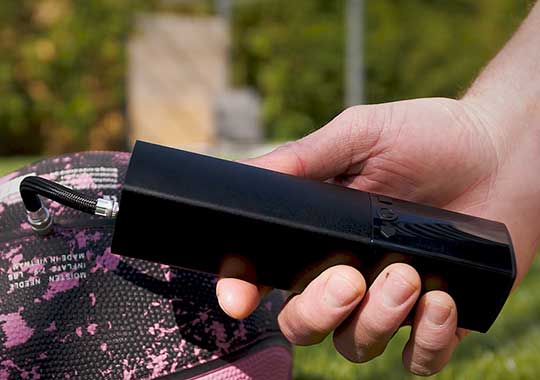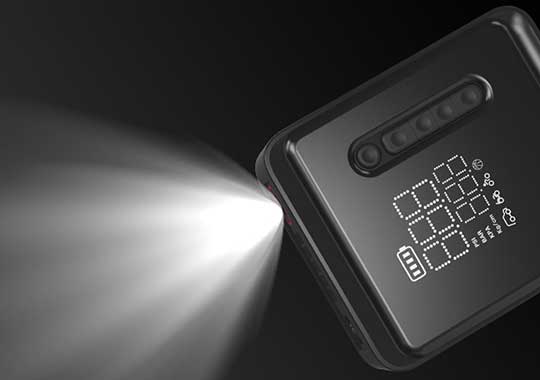

 Portable Tire Inflators
 Electric Air Pumps
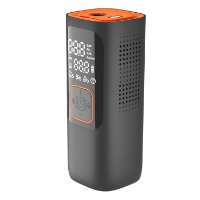 Electric Car Tyre Pumps
 Electric Ball Pumps
 Electric Bike Pump
 SUP Air Pump

Portable Car Tyre Pump: Complete Guide to Selection, Safe Operation, and Performance
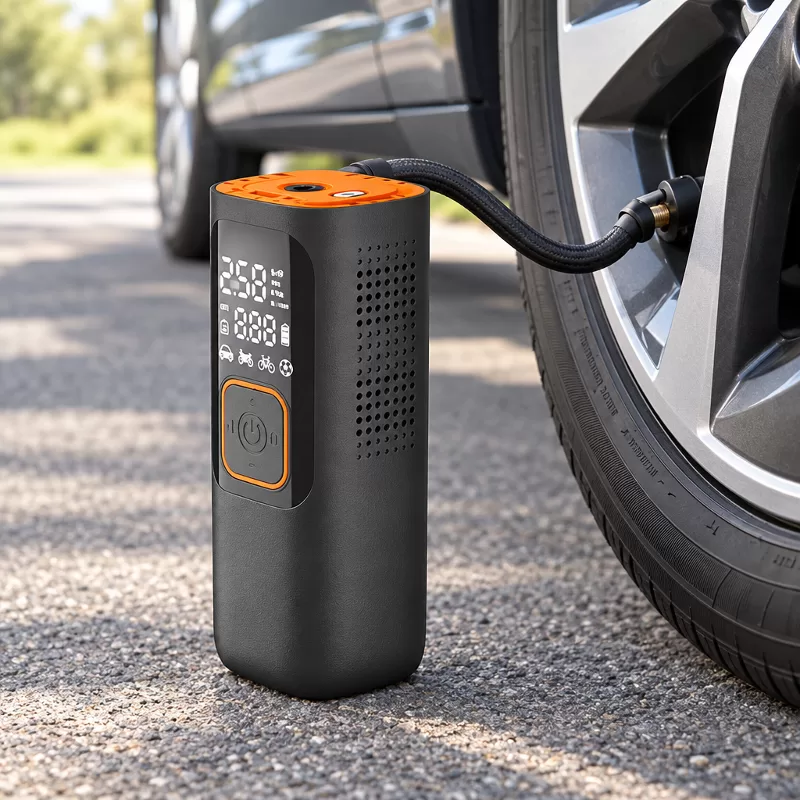
A reliable portable car tyre pump has transitioned from an optional garage accessory into essential automotive safety equipment. Modern drivers frequently encounter low-pressure warnings caused by seasonal temperature drops, road debris, or slow bead leaks. When tyre pressure monitoring systems alert you to an issue miles from a service station, having an onboard inflator prevents unnecessary roadside stops. Understanding how these compact pneumatic tools operate allows vehicle owners to preserve tyre tread life, maintain optimal fuel economy, and handle roadside emergencies safely.
Every tyre loses air over time through microscopic porosity in the butyl rubber liner and minor valve stem seepage. Drivers searching for a portable car tyre pump or cordless electric air pump need clear facts regarding flow rates, battery limits, and mechanical durability. Navigating these variables ensures that when an inflation need arises, your device performs reliably without overheating or leaving you stranded with a depleted battery.
Maintaining correct pneumatic pressure inside vehicle tyres is one of the most effective ways to ensure consistent handling and prolong tread life. Under-inflated tyres increase rolling resistance, which forces the engine or electric drivetrain to consume substantially more energy to maintain standard highway speeds. By deploying a compact compressor for periodic monthly adjustments, motorists avoid premature shoulder wear on expensive tyre sets while preserving optimal braking stability under wet conditions.
Understanding What a Portable Car Tyre Pump Can and Cannot Do
Everyday Maintenance vs. Emergency Roadside Repairs
A compact electric inflator is built specifically to address routine pressure maintenance and gradual pressure loss. As an approximate rule of thumb commonly cited in automotive maintenance, tyre pressure typically drops by roughly one to two pounds per square inch for every ten degrees Fahrenheit drop (approximately 5.6 degrees Celsius) in ambient temperature, though exact figures vary depending on baseline volume and atmospheric conditions. A portable car tyre pump easily rectifies these natural drops on your driveway without requiring a trip to a petrol station.
However, a portable pump cannot fix mechanical tire damage or severe road impacts. If a tire has suffered a severe sidewall puncture, an unseated bead, or a blowout, forcing compressed air into the carcass accomplishes nothing. The inflator supplies pneumatic volume, but it cannot seal structural rubber fissures. In such instances, drivers must install a spare tyre or call roadside assistance.
Understanding the mechanical boundaries of portable air compressors helps prevent dangerous roadside assumptions. While an onboard unit easily handles slow bead leaks or nail penetrations in the center tread to get a car to a nearby repair facility, running an inflator on a tire with torn cords or separated plies presents severe blowout hazards. Drivers must always visually inspect the tyre tread and casing surface before attaching any air delivery hose.
Demystifying PSI and Airflow Delivery
Many consumers examine portable inflator packaging and focus entirely on maximum pressure ratings, often marked at 150 or 160 PSI. For an ordinary passenger vehicle tyre, this figure does not reflect everyday filling speed. Standard car tyres operate between 30 and 36 PSI, while road bicycles and specialized high-pressure equipment require much higher numbers.
Inflation throughput depends on air volume delivery, measured in litres per minute, rather than ultimate pressure thresholds. A unit with a high pressure rating but a microscopic cylinder bore will struggle to fill a wide vehicle tyre within a reasonable timeframe. Selecting a balanced compressor requires looking at both maximum pressure capacity and steady volume output.
In practical driving conditions, total inflation time depends primarily on the pump’s rated airflow delivery alongside the physical volume of the tyre and its initial starting pressure. Compact compressors deliver varying flow rates based on motor wattage and piston bore specifications. Reviewing realistic airflow figures ensures expectations align with the actual time needed to top up large modern passenger tyres.
Avoiding Tyre Sidewall Pressure Misunderstandings
A frequent mistake made by drivers using an inflator is reading the pressure number embossed on the tyre sidewall. The figure molded into the outer tyre casing indicates the maximum cold inflation limit designed into the rubber carcass by the tire maker. Inflating your wheels to that threshold compromises steering response, increases braking distances, and accelerates center-tread wear.
Correct operational pressure is determined by vehicle weight distribution and chassis suspension tuning. You will find the correct cold tyre inflation specifications on the yellow-and-white tyre information placard located on the driver-side door jamb or inside the fuel filler flap. You should always set your portable car tyre pump to match that vehicle manufacturer placard rather than the sidewall limit.
Critical Engineering Criteria When Choosing an Inflator
Power Architecture: Cordless Battery vs. 12V Auxiliary Supply
Portable tire inflators utilize two primary electrical formats: internal rechargeable lithium-ion battery packs and 12-volt direct-current auxiliary plugs. Cordless units provide total freedom of movement around the vehicle, eliminating tangled cords and allowing rapid deployment in tight parking spots or off-road settings.
Purely battery-powered tools require diligent charging habits because chemical batteries self-discharge over months of glovebox storage. Models that incorporate rechargeable cells alongside 12V to 14V automotive auxiliary power support offer an additional connection option when compatible vehicle sockets are available. Having versatile power inputs provides valuable flexibility across different roadside and garage situations.
When evaluating auxiliary power cables, checking the reach of the cord and the compatibility of the plug ensures the tool fits your specific vehicle layout. Some systems allow recharging or supplemental operation from vehicle sockets, which can be useful when away from mains power outlets. Considering how and where you store your compressor will help determine whether a dedicated cordless model or an auxiliary-capable format best serves your routine driving needs.
Pumping Mechanisms and Cylinder Bore Dimensions
The internal mechanical heart of any portable car tyre pump consists of an electric DC motor connected to an eccentric drive and reciprocating piston assembly. Entry-level units frequently employ a small single cylinder with an 11 mm to 15 mm bore diameter. These compact mechanisms spin at high revolutions, producing substantial thermal buildup while delivering modest volume.
More capable portable designs incorporate dual-cylinder structures, such as dual 19-cylinder assemblies matched with higher working power motors. According to manufacturer engineering specifications, paired cylinder systems coupled with an 85W motor can deliver airflow rates between 30 and 35 litres per minute. This elevated throughput speeds up air volume displacement on passenger vehicle tyres compared with smaller single-piston inflators.
Operating efficiency in compact compressors depends on the precise alignment of internal mechanical assemblies and overall motor power. When an electric air pump is engineered with balanced dual-cylinder components, it manages mechanical movement smoothly during air intake and compression. Matching motor output directly to cylinder capacity allows the inflator to maintain steady airflow output throughout regular maintenance tasks.
Pressure Range and Multi-Vehicle Versatility
While passenger sedans and crossovers require moderate pressures, household inflation demands vary widely across outdoor equipment. A versatile inflator must support a broad operational pressure range, starting as low as 2 PSI for sports equipment up to 160 PSI for high-pressure bicycle tires. Precision control across this span prevents over-pressurizing low-volume items while providing the muscle required for vehicle tyres.
Versatility also depends on pneumatic fittings. Standard automotive valves use Schrader connectors, whereas performance road bicycles rely on Presta valves, and recreational gear requires narrow needle adapters. High-grade inflators bundle these accessories directly with a heat-resistant braided inflation hose, enabling seamless transitions from garage utility to outdoor recreation.
Having broad operational versatility means a single compact tool replaces multiple manual pumps. Outdoor enthusiasts can service high-pressure bicycle tyres up to 100 PSI before a trail ride, inflate utility carts or wheelbarrows around the property, and manage standard vehicle tyres without swapping tools. A modular selection of adapters kept securely alongside the compressor ensures immediate readiness for any inflation task.
Display Clarity and Automatic Pressure Shut-Off
Analogue dial gauges bounce during piston cycling, making exact pressure readings difficult to gauge. Digital dual LED screens resolve this operational issue by displaying both the real-time measured tyre pressure and the target shut-off threshold simultaneously. This layout removes guesswork during early morning or nighttime roadside stops.
Modern digital inflators incorporate automated pressure shut-off capabilities that stop the motor once the user-selected target pressure is achieved. This function prevents accidental over-inflation, allowing the operator to attend to vehicle surroundings without constantly staring at a dial. Precise digital readouts also simplify unit conversion, switching smoothly between standard engineering scales according to driver preference.
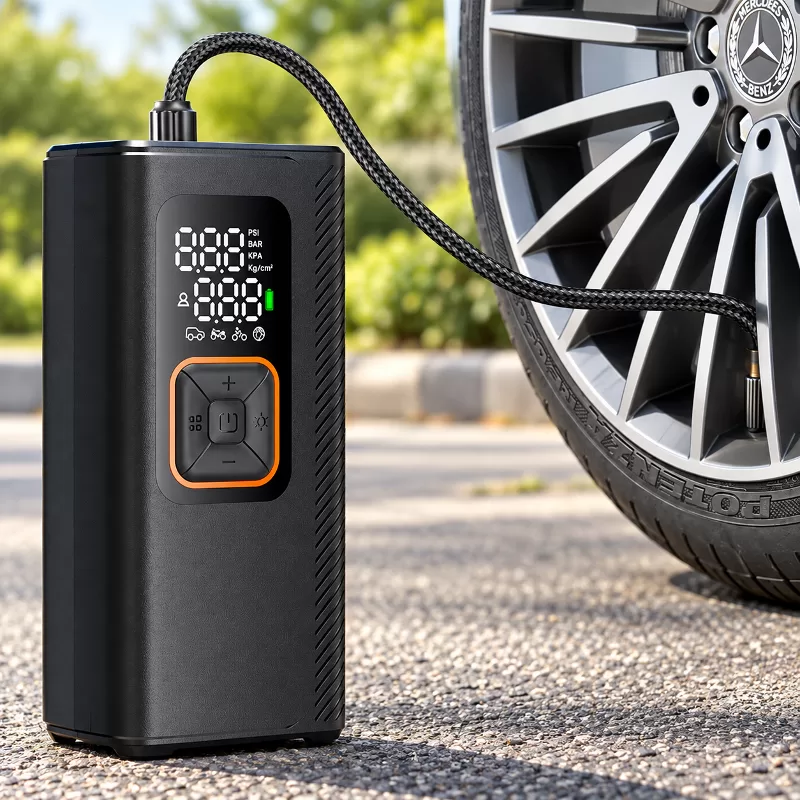
Product Analysis: The Battery Operated Car Tire Pump 160PSI A01
Engineering Architecture and Technical Parameters
Evaluating real-world hardware clarifies how physical specifications translate into everyday roadside utility. The Newo A01 represents an advanced iteration of the modern portable car tyre pump, engineered with a dual 19-cylinder structure and an 85W working power core. As a manufacturer specializing in smart electric air pumps and portable inflation solutions, the engineering behind this unit balances physical dimensions with sustained pneumatic flow.
The A01 inflator provides an operational pressure range of 2 to 160 PSI while delivering a continuous airflow rate between 30 and 35 litres per minute. The following table summarizes verified first-party technical data for this model:
| Technical Parameter | Specification Standard |
|---|---|
| Model Identifier | A01 Portable Electric Air Pump |
| Working Power Output | 85W |
| Cylinder Architecture | Dual 19-Cylinder Structure |
| Operating Pressure Range | 2 to 160 PSI |
| Flow Delivery Rate | 30 to 35 L/min |
| Noise Emission Level | ≤85 dB at 1.5 meters |
| Standard Battery Pack | 3 × 18650 cells (2500mAh, 11.1V, 27.75Wh) |
| Optional Battery Pack | 4 × 18650 cells (2500mAh, 14.8V, 37Wh) |
| Battery Protection Threshold | 3-cell version 12.6V / 9V; 4-cell version 16.8V / 12V |
| Battery Cycle Life Rating | 300 cycles at 80% original capacity or above |
| Full Charge Duration | 3 to 4 hours |
| Vehicle Power Support | 12V to 14V Car Power Supported |
| Operating Temperature | −10°C to 45°C |
| Housing Dimensions | 152 × 53 × 76 mm |
| Bare Unit Weight | Approx. 610g (3-cell) / 655g (4-cell) |
| Total Packaged Weight | Approximately 910g |
Runtime Performance and Battery Capacity Options
Battery endurance determines how many low tires an inflator can manage before needing a power outlet. The A01 platform provides two internal battery architectures: a standard 3-cell configuration yielding 27.75 watt-hours and an optional 4-cell setup delivering 37 watt-hours. In stated manufacturer technical specifications, the 3-cell model delivers approximately 20 minutes of runtime, while the 4-cell unit operates for approximately 30 minutes.
According to manufacturer testing data, these runtimes equate to an inflation capacity of about 1.5 of 285-width tyres on the 3-cell configuration and about 2 of 285 tyres on the 4-cell version. Battery management circuitry protects cells from over-discharge, shutting down operating power at 9V on the 3-cell platform and 12V on the 4-cell model. The product specifications also confirm 12V–14V car-power support, offering an alternate power option for compatible automotive setups.
The battery pack is engineered for longevity, retaining at least 80% of original capacity after 300 charge-discharge cycles. Recharging the internal cells from empty requires approximately 3 to 4 hours via standard Type-C inputs. This versatile charging capability allows users to replenish battery levels using standard home USB adapters, vehicle cabin charging ports, or portable charging stations.
Control Modes and Secondary Power Utilities
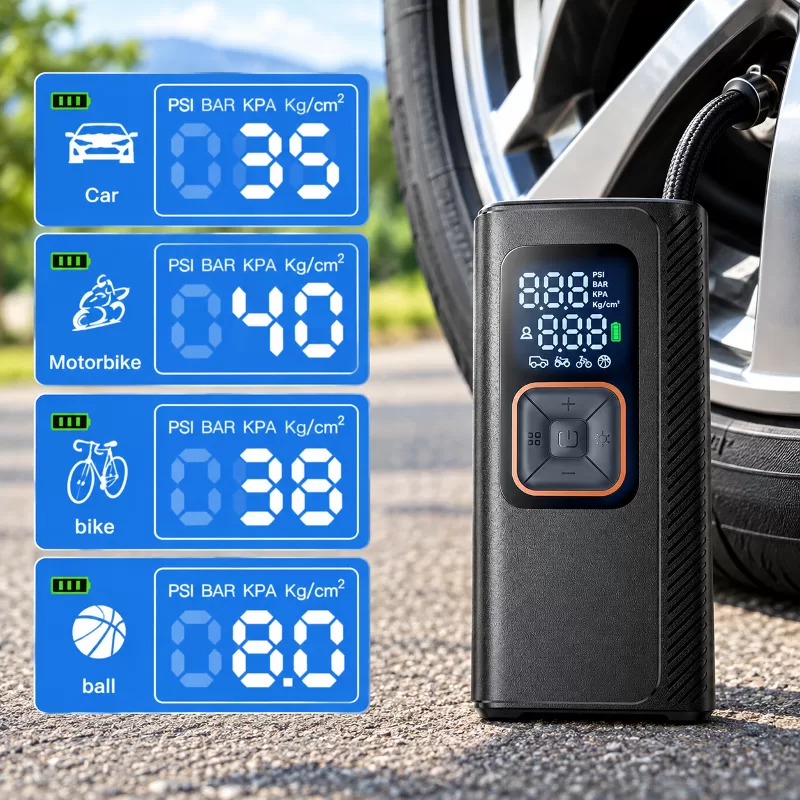
The A01 inflator integrates five preset operating profiles designed for cars, motorcycles, bicycles, sports balls, and custom user targets. Selecting a preset loads safe baseline pressures into memory, streamlining the initial setup. Drivers can override these baselines using dedicated physical push-buttons to match specific vehicle recommendations.
Beyond pneumatic duties, the A01 serves as an emergency electrical power source for roadside electronics. The internal circuitry supports bi-directional Type-C fast charging, handling input and output profiles of 5V/3A, 9V/2A, 12V/2A, 15V/2A, and 20V/2.25A for a maximum external output of 45W. A supplemental USB-A port provides 5V/2A and 9V/2A outputs, allowing stranded drivers to recharge smartphones while monitoring pressure levels.
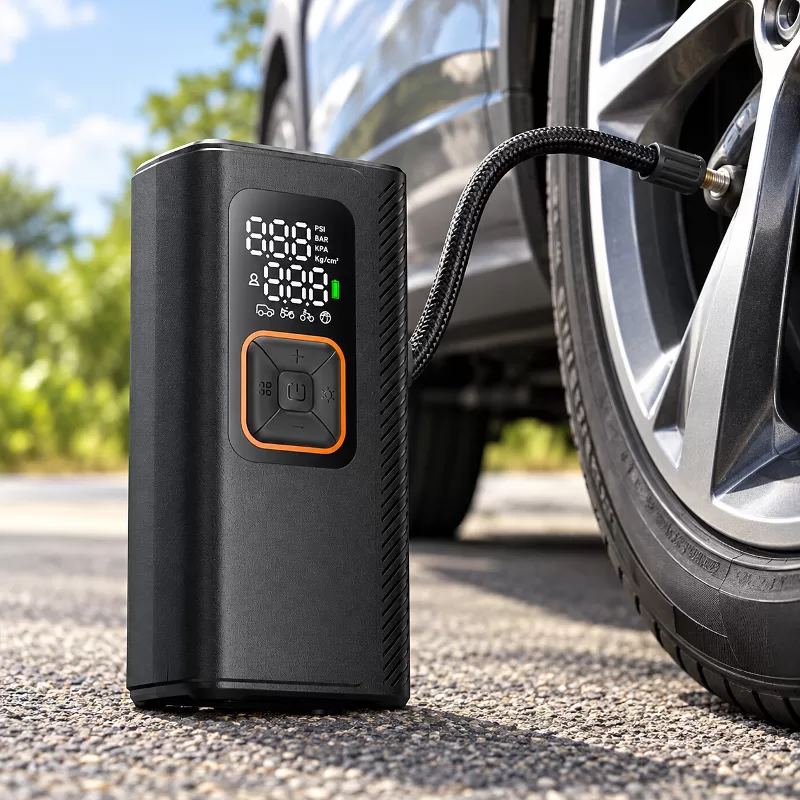
Step-by-Step Guide: How to Safely Inflate a Car Tyre
Safety Precautions and Pre-Operation Preparation
Roadside tire inflation requires strict adherence to practical vehicle safety procedures. Never attempt to service a tire while parked on a narrow shoulder or an unlit highway verge where traffic passes close by. Pull completely off the roadway onto firm, level ground, engage your vehicle parking brake firmly, switch on emergency hazard lights, and turn off the ignition.
Tyre inflation readings should always be taken when the rubber is completely cold. A cold tire is defined as one that has been parked for at least three hours or driven for less than 1.6 kilometers at moderate speeds. Driving heats the compressed air trapped inside the rubber chamber, causing air expansion and artificially raising the measured pressure reading by several PSI.
Personal safety must always take precedence over immediate inflation tasks. If you carry emergency warning triangles or roadside markers, deploy them only when it is entirely safe and legally permitted to do so, and never walk into live traffic lanes to set up equipment. If traffic conditions make servicing the wheel hazardous, remain safely behind crash barriers and call professional breakdown recovery.
Connecting Hardware and Setting Parameters
Follow these sequential mechanical steps to ensure an airtight seal and prevent unnecessary pressure leakage during connection:
- Remove the protective dust cap from the wheel’s valve stem and place it in a secure spot such as a pocket or cup holder.
- Inspect the valve stem for exterior debris, road salt, or moisture that might interfere with an airtight pneumatic seal.
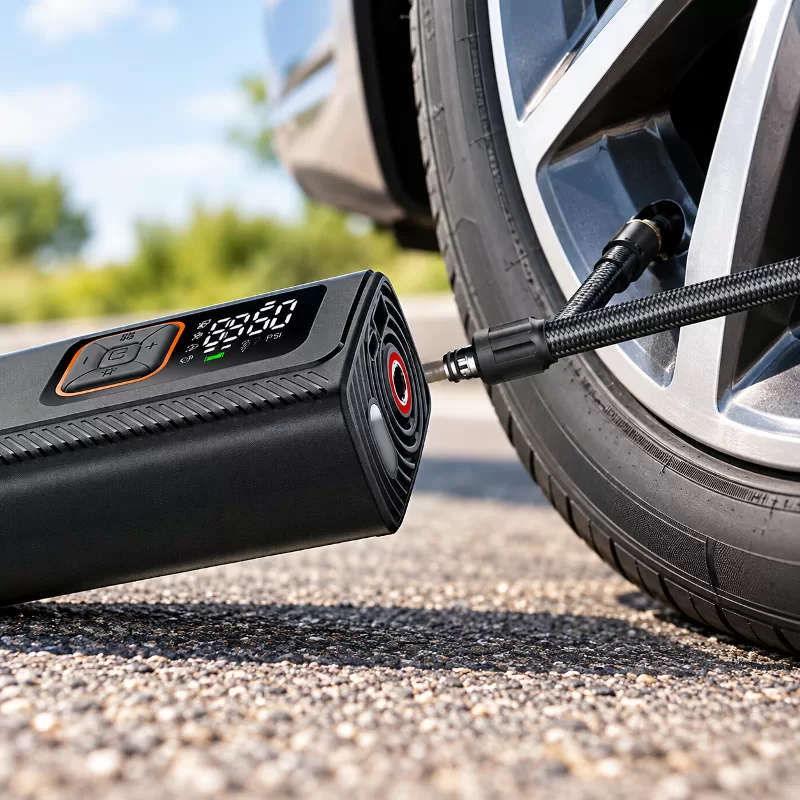
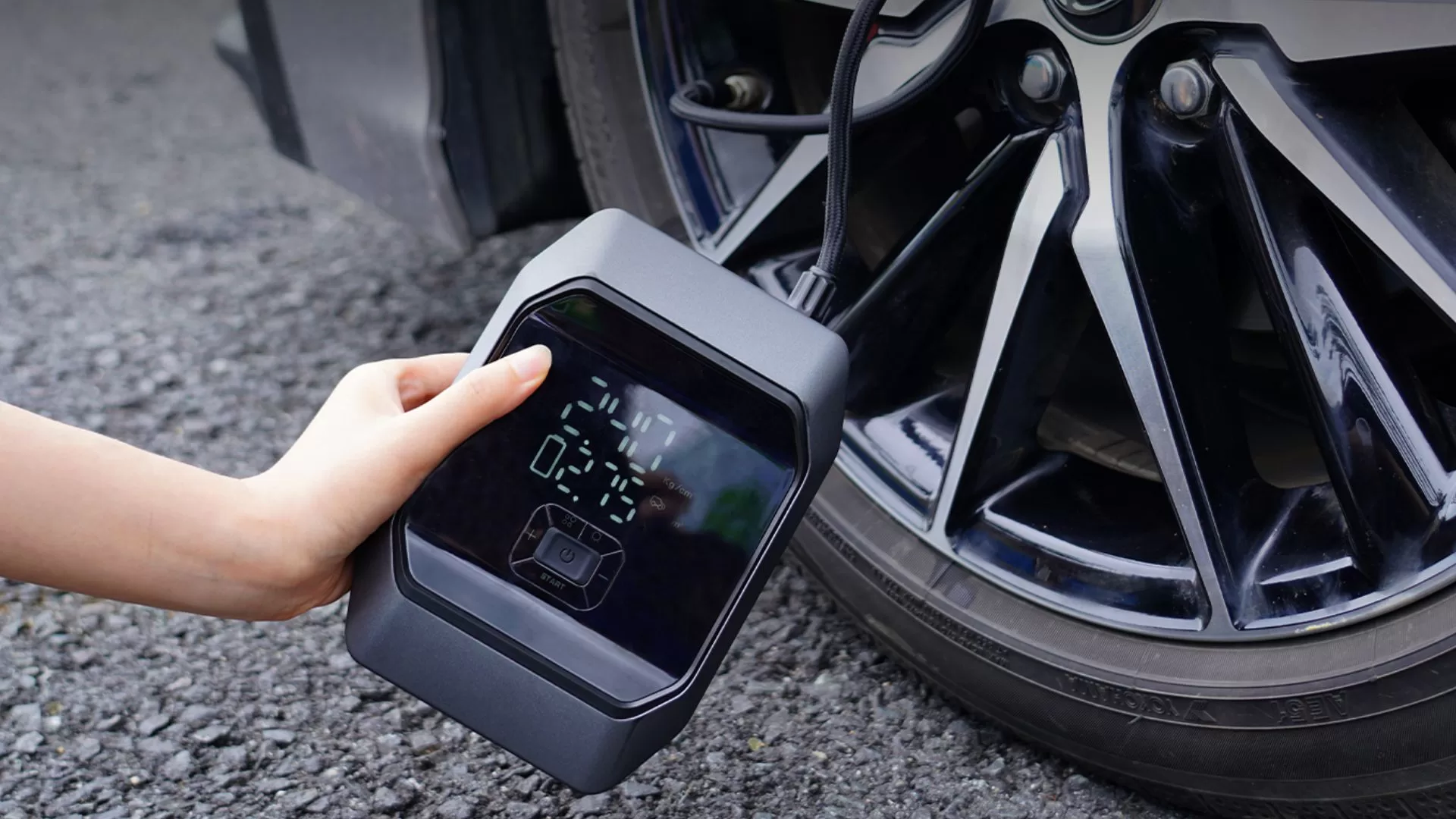
- Secure the inflator hose fitting firmly onto the tire valve stem using the fitting’s attachment mechanism until the digital screen registers an internal pressure reading.
- Power on the inflator and select your desired measurement unit, toggling between PSI, BAR, or KPA depending on your regional preference.
- Adjust the target pressure setting upward or downward using the control buttons until it matches the vehicle manufacturer placard figure.
Operating the Unit and Detaching Safely
Once your target value is set, press the primary power button to engage the internal 85W motor. The compressor will vibrate and emit a mechanical hum, operating at noise levels at or below 85 decibels at a 1.5-meter distance. Keep the unit upright on clean ground or hold it steady by the composite outer casing.
Observe the digital screen as internal pressure approaches your programmed cut-off point. Once the automated shut-off engages and the motor halts, disconnect the hose fitting using its designated release method, following the manufacturer manual instructions. A brief hiss of escaping air is normal during removal, representing residual air venting from the hose line rather than air escaping from the tyre cavity. Replace the valve dust cap securely to seal out grit.
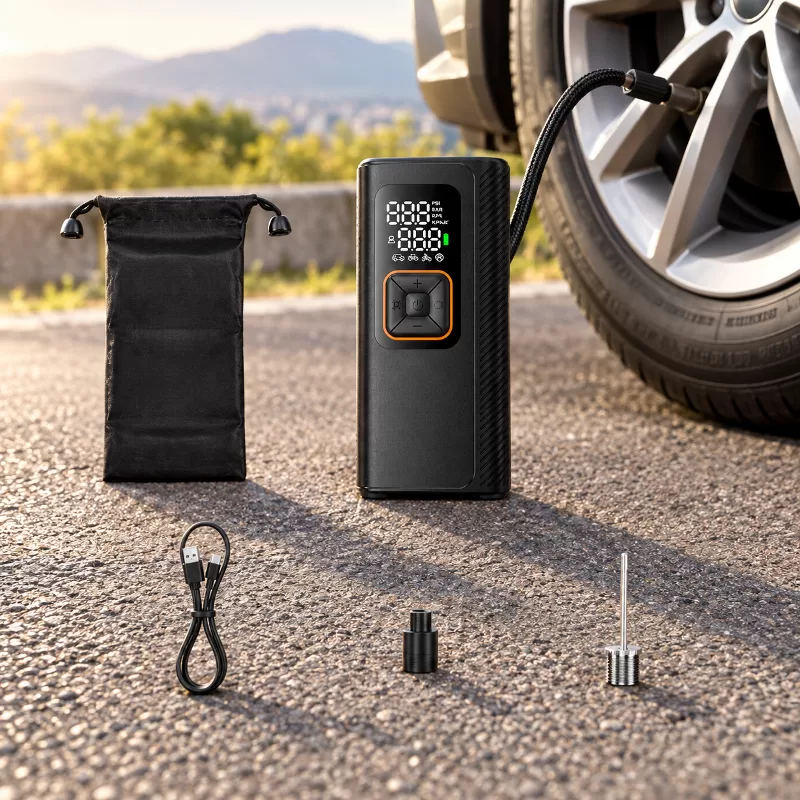
After reattaching the valve cap, store the inflation hose and accessories back inside the protective carry bag. Keeping pneumatic fittings free from road grit protects the internal valve seals from scoring or premature degradation. Double-check that all doors, luggage compartments, and tool bins are secured before disengaging the emergency brake and returning to traffic.
Thermal Limits, Maintenance, and Common Mistakes
Heat Generation and Operational Boundaries
Compressing atmospheric air generates thermal energy naturally through the laws of thermodynamics. As the internal motor and cylinder assembly forces ambient air into a compressed space, kinetic friction and pneumatic compression produce heat within the cylinder housing. The air hose fitting absorbs some of this thermal energy directly during extended pumping cycles.
Users must observe proper operating boundaries to protect motor windings and extend component life. The A01 has a rated operating temperature range of −10°C to 45°C. When operating any compact compressor, consult the product manual for recommended continuous run limits and pause operation if the housing or hose fitting becomes excessively hot to the touch.
Pneumatic heat also affects the immediate pressure reading inside the hose assembly during active compression. Because the compressor forces warm air past the fitting, taking a final static pressure check after the unit stops ensures the tyre cavity matches target specifications. Allowing components to cool between successive vehicle tyres protects internal rubber seals from thermal degradation.
Battery Maintenance in Extreme Weather
Vehicle passenger cabins and trunks experience significant temperature swings throughout the seasons. Leaving a lithium-ion battery tool inside a freezing vehicle during winter reduces available discharge capacity and increases internal battery resistance. Extreme heat during mid-summer produces battery cell degradation if units sit on hot dashboards in direct sunlight.
To keep your portable car tyre pump ready for emergency deployment, observe these storage practices:
- Quarterly top-up charging: Recharge the battery cells every three to four months to prevent internal self-discharge from dropping cells past low-voltage cut-offs.
- Avoid dashboard exposure: Store the unit inside its protective drawstring bag in the trunk floor well, glove compartment, or under-seat storage.
- Thermal conditioning: If the pump has been stored in freezing temperatures, allow it to warm inside the heated vehicle cabin for several minutes before initiating high-load inflation cycles.
- Hose care: Avoid kinking or sharply bending the braided rubber hose during storage, which can compromise the inner tube liner.
Operational Mistakes to Avoid
Drivers often make predictable errors that degrade portable inflation equipment or damage vehicle handling. A frequent error is operating the pump while the air hose is bent sharply against the wheel rim, restricting airflow and forcing the motor to push against artificial head resistance. Always keep the braided inflation hose running freely from the unit to the valve stem.
Another mistake involves driving on tyres that cannot hold set pressures. If an inflator brings a tyre to the recommended setting but the pressure drops noticeably shortly after driving, this may indicate a leak or another tyre or wheel problem. Continuing to drive under these conditions risks tire failure; motorists should stop safely in a secure location and have the wheel inspected professionally.
Buying Checklist: Matching the Inflator to Your Requirements
Daily Commuters vs. Long-Distance Travelers
Selecting the right inflator depends on your driving habits, typical routes, and vehicle size. Daily urban commuters who stay within municipal zones benefit from ultra-compact handheld inflators. These fit neatly inside center consoles or gloveboxes, handling routine top-ups without taking up valuable luggage space.
Long-distance highway drivers, rural commuters, and outdoor travelers need higher pneumatic capacity. When driving far from emergency services, selecting an inflator with an expanded battery capacity and verified auxiliary vehicle power support is practical. High-volume passenger vehicles, including crossovers and light trucks running larger tires, benefit from dual-cylinder designs capable of sustained airflow rates of 30 to 35 L/min.
Vehicle weight and luggage volume also influence which inflator format makes sense. For compact hatchbacks with minimal underfloor boot storage, a handheld unit measuring 152 × 53 × 76 mm occupies virtually no functional cargo area. For overland expeditions or towing applications where multiple tyres require pressure adjustments, having dual power inputs ensures sustained operation regardless of charging access.
Family Utility and Multi-Sport Use
A household car tyre pump often serves multiple recreational purposes on weekends. Families with bicycles, e-bikes, and sports gear gain significant value from an inflator with a broad 2 to 160 PSI range and swappable valve adapters. The ability to switch between low-pressure sports items and higher-pressure tyres makes a versatile cordless compressor a practical household tool.
For us, combining pneumatic efficiency with practical safety features remains central to developing portable inflation technology. Incorporating bidirectional fast charging turns a dedicated tire compressor into an emergency backup power bank, adding peace of mind on outdoor trips and family excursions.
Recreational equipment often requires exact low-pressure parameters where slight over-inflation can damage seams or bladders. An inflator supporting low starting thresholds around 2 PSI enables controlled top-ups for sports balls, mobility equipment, and lightweight pneumatic gear. Having Presta and needle adapters packed in a single travel pouch prevents misplacing vital accessories during family outings.
Frequently Asked Questions (FAQs)
What pressure setting should I use on my portable car tyre pump?
You should always configure your target pressure to match the cold inflation figures printed on the vehicle tyre placard. This sticker is located on the driver-side door jamb, the inner sill, or inside the fuel filler flap. Do not set your pump to the maximum pressure printed on the tyre sidewall, as that number represents the absolute structural casing limit rather than your vehicle’s recommended operating specification.
Can a portable car tyre pump inflate a completely flat tyre?
A dual-cylinder inflator such as the A01 can inflate a flat tyre back to full pressure, provided the tyre bead remains firmly seated against the wheel rim. Inflating a flat passenger tyre from zero requires substantial air volume and takes several minutes of continuous motor work. If the tyre unseated from the rim bead while rolling flat, a compact inflator cannot deliver the sudden burst of high-volume air required to reseat the bead.
Why does the air hose connector become warm during operation?
The hose connector warms up due to the physics of air compression. Compressing atmospheric air from ambient density up to vehicle operating pressures produces significant thermal energy within the cylinder. As hot compressed air passes through the delivery line, heat transfers into the connector fittings. Users should handle connectors by the hose strain relief and avoid touching hot metal sections immediately after prolonged inflation.
How often should I check my vehicle tyre pressures?
Automotive safety organizations recommend checking tyre pressure at least once every month and before departing on long highway journeys. Tyres lose pressure through temperature changes and natural seepage even when vehicles sit parked. Monthly checks help detect slow punctures early and prevent uneven tread wear caused by under-inflation.
Can I use a car tyre pump to inflate bicycles and sports balls?
You can use a versatile inflator across bicycles, e-bikes, motorcycles, and sports gear, provided the tool supports the target pressure range and includes compatible adapters. The A01 inflator features an operational range of 2 to 160 PSI and includes a Presta adapter alongside an inflation needle. Users must check the recommended pressure printed on each specific sporting item or bicycle tire and manually set the target shut-off to match that rating.
What should I do if my tyre inflator stops automatically before the tyre is full?
If an inflator cuts out prematurely, verify that the target pressure setting was not programmed lower than the current tyre pressure. When the measured pressure matches or exceeds the programmed target value, the automatic shut-off feature prevents the motor from running. Additionally, check the battery level indicator to confirm that low-voltage battery protection has not engaged to protect internal cells.
How long does a portable car tyre pump battery maintain its charge during storage?
Lithium-ion cells experience gradual self-discharge over time, particularly when subjected to extreme seasonal vehicle temperatures. Quality battery packs typically retain adequate operational power for three to four months of glovebox storage. However, topping up the battery every quarter ensures that full capacity remains immediately available when an unexpected roadside low-pressure warning occurs.
Summary
Investing in a quality portable car tyre pump gives drivers control over their vehicle’s safety, tire lifespan, and roadside readiness. Having dependable pneumatic power onboard eliminates the stress of hunting down functional petrol station air lines or driving on soft, under-inflated rubber. By understanding mechanical flow rates, maintaining battery packs properly, and adhering strictly to vehicle placard pressure recommendations, drivers ensure their journeys remain efficient, predictable, and safe across every mile.
-

Meet NEWO at the 140th Canton Fair: Visit Booth 10.3 M03–04
Meet NEWO at the 140th Canton Fair in Guangzhou, October 15–19, 2026. Visit Booth 10.3 M03–04 to explore portable air pumps and discuss OEM, ODM and distribution opportunities.... -

As Shenzhen Welcomes the World for APEC 2026, NEWO Welcomes You to Our Factory
As Shenzhen prepares for APEC 2026, NEWO welcomes international buyers and partners to visit our factory, meet our team and explore future cooperation.... -

Leading the Way in Product Innovation and Excellence
Smartnewo exemplifies professionalism in product innovation and manufacturing. Their collaboration with Xiaomi Youpin on the G01 crowdfunding project highlights their expertise in creating compact, powerful inflatable pumps. Rigorous engineering, meticulous production processes, and advanced quality assurance underscore their commitment to excellence. The success of the G01 project, with significant market... -

Essential Qualities of an Excellent Supplier
In today's competitive market, finding a reliable supplier is crucial for business success. Based on insights from Smartnewo and broader internet research, here are key qualities an excellent supplier must possess:... -

NW06 Tire Inflator: Compact Power for Quick Inflation
Summary The NW06 Tire Inflator delivers quick and efficient tire inflation with a powerful 35L/min airflow. It features a user-friendly LCD screen for real-time pressure monitoring, dual power options with a built-in 6000mAh battery, and multiple nozzle attachments for versatile use. Its compact design and integrated LED light ensure convenience and... -

Unleash the Power of Portability: The SmartNewo Jump Starter with Air Compressor KF03
This guide will walk you through the steps to effectively use a portable tire inflator, helping you stay prepared and safe on the road.... -

Newo Attends The 2024 Consumer Electronics Show (CES)
Smartnewo booth is located at 53672, Halls A-D, Level 2, Venetian Expo, Las Vegas Convention Center (LVCC). ... -

Smartnewo’s Dual-Cylinder Air Pump Rocks the Hong Kong Autumn Electronics Fair!
Smartnewo’s Dual-Cylinder Air Pump Rocks the Hong Kong Autumn Electronics Fair!... -

Meet at the Canton Fair! Smartnewo brings dual-cylinder air pumps, making your inflation experience faster and more stable!
NEWO has went deep communication and negotiation with customers from all over the world on booth.... -

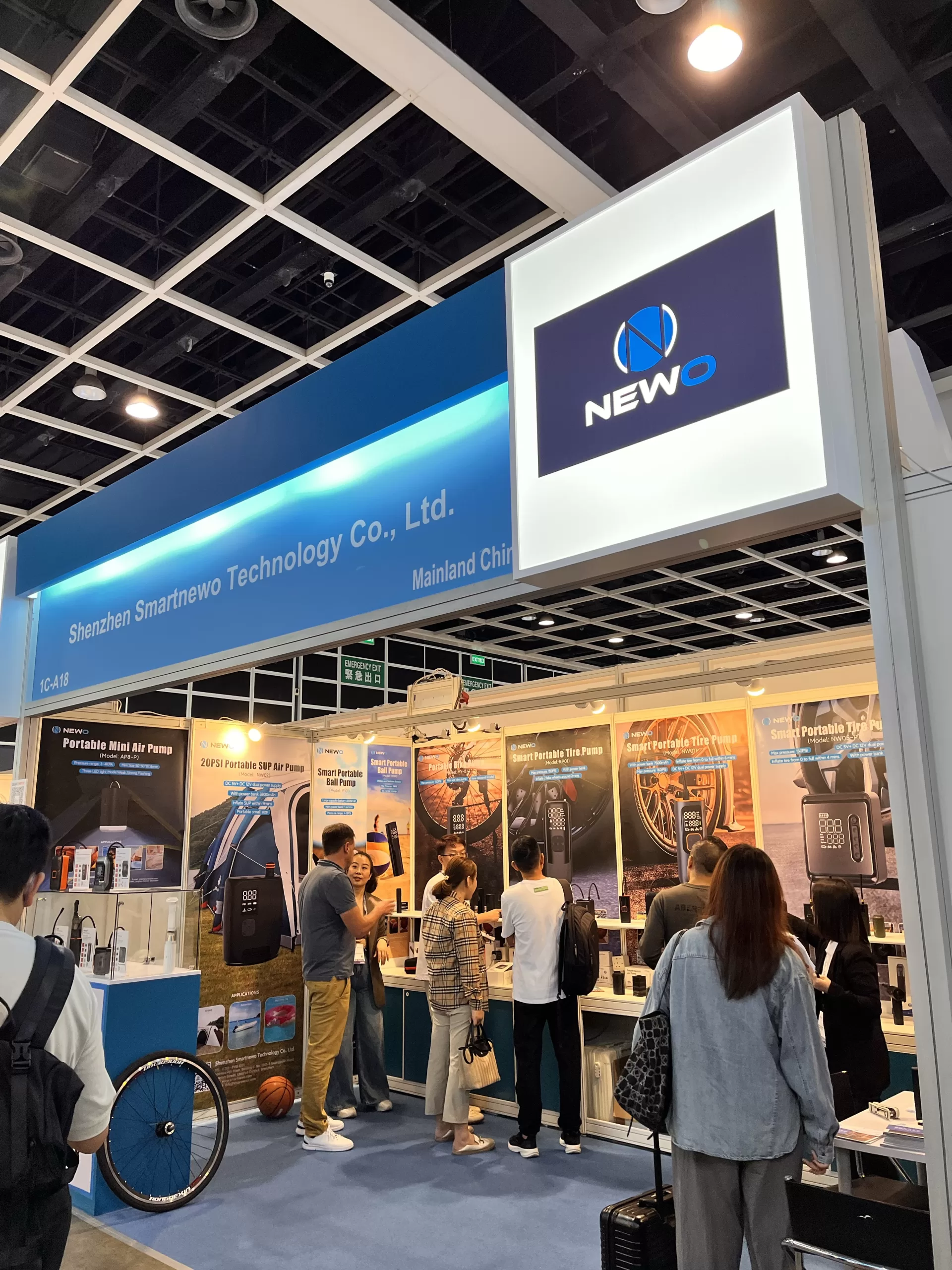
“Hong Kong Autumn Electronics Fair – 1CA18 (October 13th to 16th): Smartnewo invites you to visit our booth!
Hong Kong Autumn Electronics Fair...





-

What to Check Before Ordering Custom Electric Bike Pumps
Plan custom electric bike pumps with a clear requirements freeze for valves, TPU tubes, portability, repeated top-ups, charging, and model-specific documents.... -

OEM vs ODM Air Pumps: Which Manufacturing Model Fits Your Brand?
Compare OEM and ODM air pump projects by design responsibility, change approval, development scope, and written ownership terms before choosing your route.... -
How to Choose a Reliable Tire Inflator Manufacturer in China
Choose a tire inflator manufacturer in China with a focused RFQ, supplier evidence, configuration checks, and clear sample-to-pilot decisions for your brand.... -

Rechargeable Electric SUP Pump for Paddle Boards: Faster Inflation for SUPs, Kayaks and Inflatable Tents
The BL10-C Portable Electric Bike Tire Inflator is a compact and lightweight mini electric bike pump designed for modern cyclists. With up to 120 PSI pressure, a digital LED display, preset pressure control, automatic shut-off, USB-C charging, and multiple valve adapters, BL10-C offers a convenient inflation solution for road bikes,... -

Are Electric Bike Pumps Worth It in 2026? Electric Pump vs CO₂ vs Mini Hand Pump
Discover whether electric bike pumps are worth it in 2026. This guide compares electric bike pumps, CO₂ inflators, and mini hand pumps for road cycling, gravel riding, commuting, and long-distance rides. Learn the pros, limitations, best use cases, and key features to look for before choosing the right portable tire... -
BL10-C Portable Electric Bike Tire Inflator: Small Size, Reliable Power for Every Ride
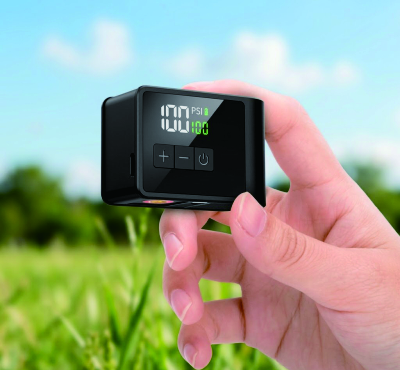
The BL10-C Portable Electric Bike Tire Inflator is a compact and lightweight mini electric bike pump designed for modern cyclists. With up to 120 PSI pressure, a digital LED display, preset pressure control, automatic shut-off, USB-C charging, and multiple valve adapters, BL10-C offers a convenient inflation solution for road bikes,... -

Why Mini Electric Bike Pumps Are Becoming Essential for Modern Cycling
Discover why mini electric bike pumps are becoming essential for modern cyclists. Learn how portable electric bike pumps improve tire pressure management, riding safety, and convenience.... -

The Ultimate Smart Solution for Easy Outdoor Adventures in 2026
Discover how a spring travel air pump simplifies outdoor trips with fast inflation, smart features, and powerful performance—perfect for every adventure.... -

Powerful 5-in-1 Portable Car Tire Inflator and Jump Starter: The Ultimate Emergency Tool for Every Driver
Why Every Driver Needs a Portable Car Tire Inflator and Jump Starter Modern drivers face many unexpected situations on the road. A flat tire, low tire pressure, or a dead car battery can happen at the worst possible time. That’s why having a portable car tire inflator and jump starter is... -

7 Real Cycling Scenarios That Show Why Every Rider Should Carry a Mini Bike Pump
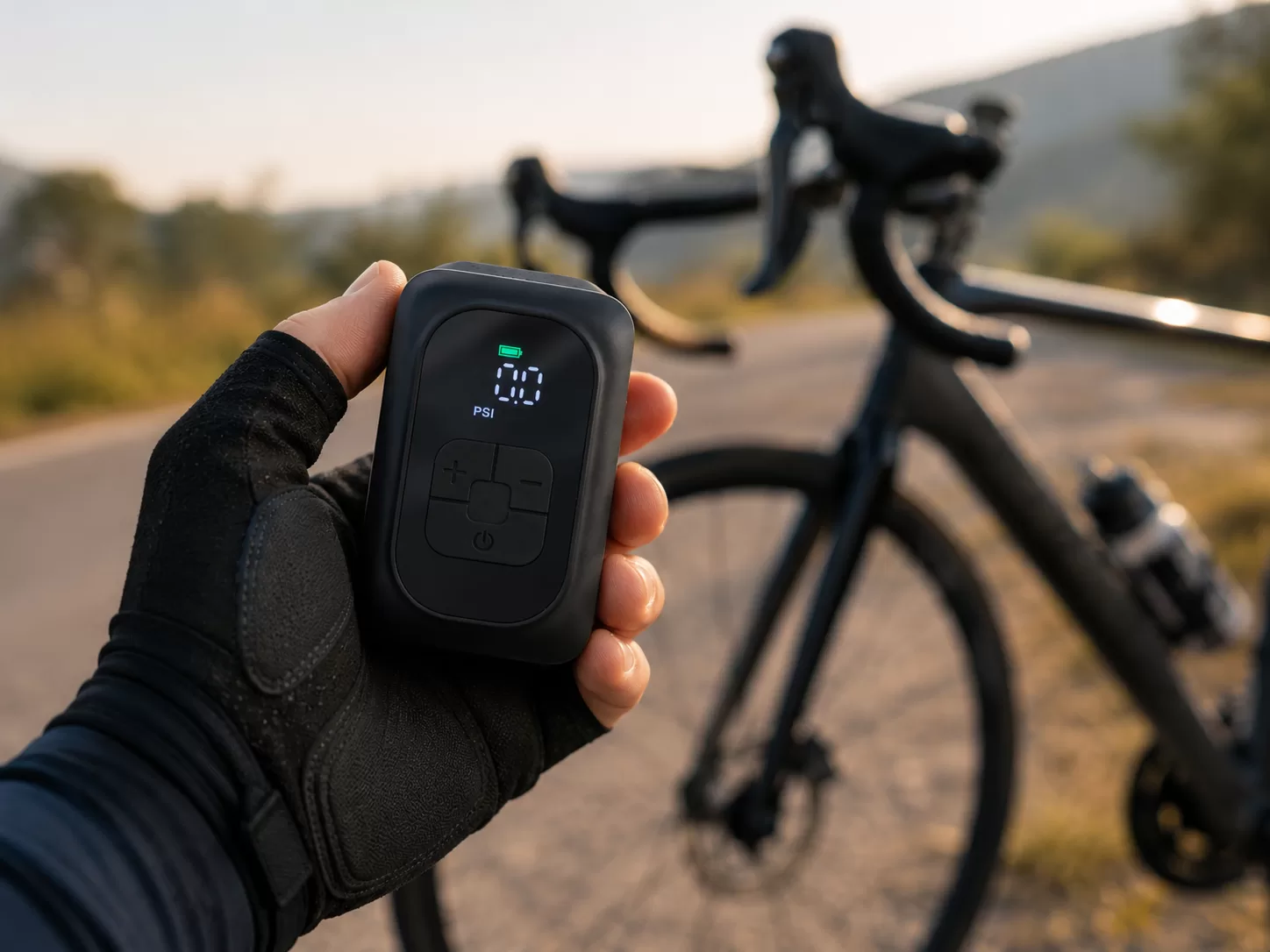
Cycling is one of the most freeing activities you can enjoy. Whether you’re commuting to work, riding through city streets, or exploring quiet countryside roads, a bike ride can instantly improve your day. But there’s one small problem that almost every cyclist eventually faces: Low tire pressure. It might happen...




-
How Is a Football Properly Inflated?
The correct inflation of a football - with not too much and not too little air - is a hotly debated topic among footballers.... -
Application Scenarios of Car Inflator Pump
Often long-distance business trips or play car owners because the road may be more remote areas, in this case if you encounter a tire leak....